18.2Electrostatics
Electric Force and Coulomb’s Law — American System Physics Revision Notes & Topical Questions
10 min read 7 parts Lesson 4 of 5 1 quiz
State Coulomb's law and identify the variables and their units.Coulomb's lawforce = Coulomb constant × charge 1 × charge 2 ÷ distance², F = kq1q2/r2 (N; C; m).What the symbols mean: F = electric force (N) · Q1, Q2 = charges (C) · r = separation (m) · k = 1/4πε0 = 8.99 × 10⁹ N m2 …
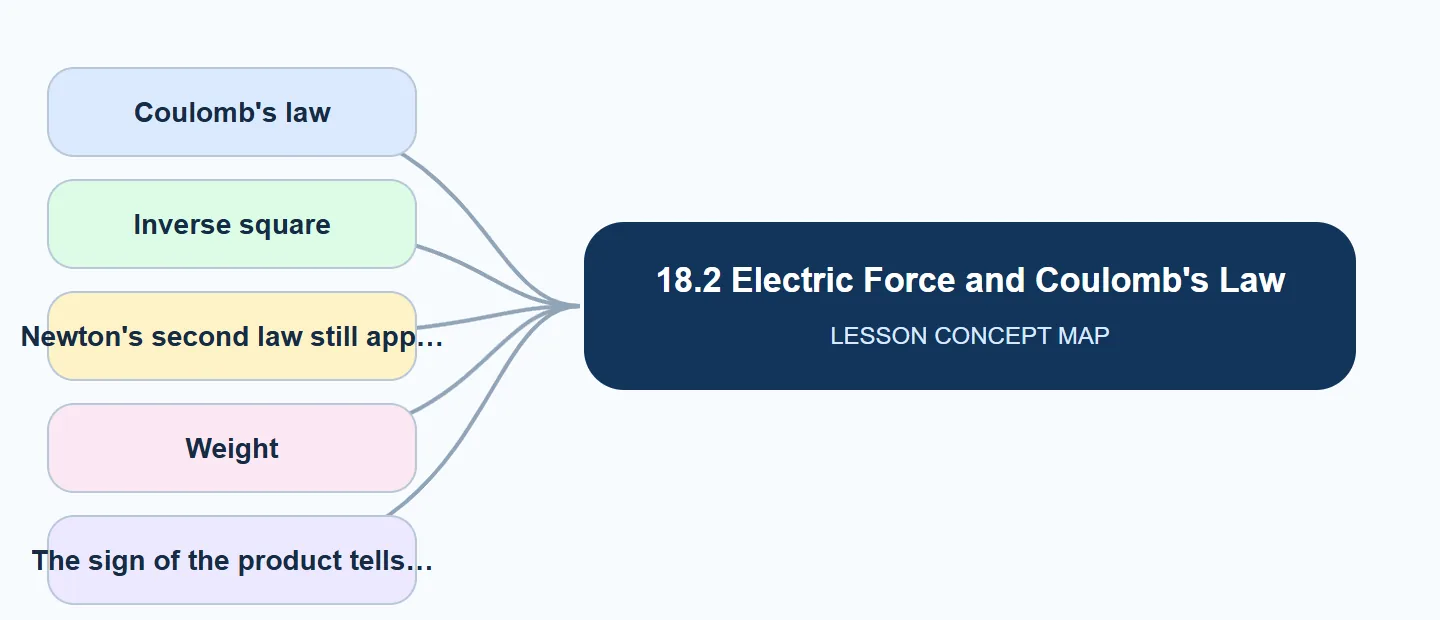
- Inverse square
- Newton's second law still applies
- The sign of the product tells the direction
- Electric (electrostatic) force
- Coulomb constant (k)
- Permittivity of free space (ε0)
Section 1 of 7Electric Force and Coulomb’s Law
Section 2 of 7Process & sequence
Solving a Coulomb's law problemwrite these steps in this order; each step is a marking point.
Section 3 of 7Compare
| Feature | Electric force | Gravitational force |
|---|---|---|
| Depends on | Charge | Mass |
| Law | F = kq1q2/r2 | F = Gm1m2/r2 |
| Constant | k = 8.99 × 10⁹ N m2/C2 | G = 6.67 × 10⁻¹¹ N m2/kg2 |
| Direction | Attract or repel | Attract only |
| Relative strength (two protons) | About 1036 times larger | Tiny |
| Distance dependence | Inverse square | Inverse square |
| Change | New force |
|---|---|
| Double one charge | 2F |
| Double both charges | 4F |
| Double distance | F/4 |
| Halve distance | 4F |
| Triple distance | F/9 |
Section 4 of 7Worked examples
- F = kq1q2/r2 = 8.99 × 109 × 3.0 × 10−6 × 5.0 × 10−6 / (0.20)2 = 0.1349/0.040 = 3.4 N, attractive (unlike charges).
- Fnew = F × 2 / 32 = 12 × 2/9 = 2.7 N (repulsive).
- A on B: F = 8.99 × 109 × (2.0 × 10−6)2/(0.10)2 = 3.6 N, repulsive, so +x direction.
- C on B: F = 8.99 × 109 × 2.0 × 10−6 × 1.0 × 10−6/(0.20)2 = 0.45 N, attractive towards C, also +x.
- Net3.6 + 0.45 = 4.0 N in the +x direction.
Section 5 of 7Key terms
Section 6 of 7Command terms
Section 7 of 7Exam technique
Keywords the mark scheme looks for in this lesson
How to get full marks (examiner guidance)
Words to avoid
Instant feedbackCheck yourself
Q1. If the distance between two charges is doubled, the force becomes
- A. 2F
- B. F/2
- C. F/4
- D. 4F
Show answer
C. Inverse square: (1/2)² = 1/4.
Q2. The SI unit of k in Coulomb's law is
- A. N m²/C²
- B. C²/N m²
- C. N/C
- D. J/C
Show answer
A. k = Fr²/(q₁q₂) has units N m²/C².
Q3. Two charges of 1.0 μC are 1.0 m apart. The force is about
- A. 9.0 × 10⁻³ N
- B. 9.0 N
- C. 9.0 × 10⁻⁶ N
- D. 1.0 N
Show answer
A. F = 9.0×10⁹ × 1.0×10⁻¹² / 1 = 9.0×10⁻³ N.
Q4. A +4 μC charge and a +1 μC charge exert forces on each other. The force on the +1 μC charge is
- A. 4 times larger
- B. equal in size
- C. 4 times smaller
- D. zero
Show answer
B. Newton's third law: equal and opposite.
Q5. Both charges are tripled at the same distance. The force
- A. triples
- B. increases 6 times
- C. increases 9 times
- D. is unchanged
Show answer
C. F ∝ q₁q₂: 3 × 3 = 9.
Q6. A +2 C and −2 C charge placed near each other will
- A. repel
- B. attract
- C. not interact
- D. both become positive
Show answer
B. Unlike charges attract.
Marked practiceQuizzes for this lesson
Last updated: