Skip to content
Dabour HubLEARN · PRACTICE · EXPLORESign inStudent

18.3Electrostatics

Electric Fields and Potential — American System Physics Revision Notes & Topical Questions

10 min read 7 parts Lesson 5 of 5 1 quiz

🩺
100% Curriculum Specification Match Lesson Doctor Verified
The only platform with 100% curriculum specification match and verified interactive question banks.
0%read
Lesson summary

Define electric field and field strength and state the direction of a field.Field strength = force ÷ charge, E = F/q (N/C); so F = qE (N).What the symbols mean: E = electric field strength (N C−1) · F = force on the charge (N) · Q or q = charge (C)Field of a point chargeE = kq/r2…

  • Uniform field between plates
  • Millikan's oil drop
  • Field lines are a model
  • How much work is done moving a 3.0 μC charge through a potential difference of 12 V?
  • Electric field strength (E)
  • Direction of an electric field

Section 1 of 7Electric Fields and Potential
Essential knowledge
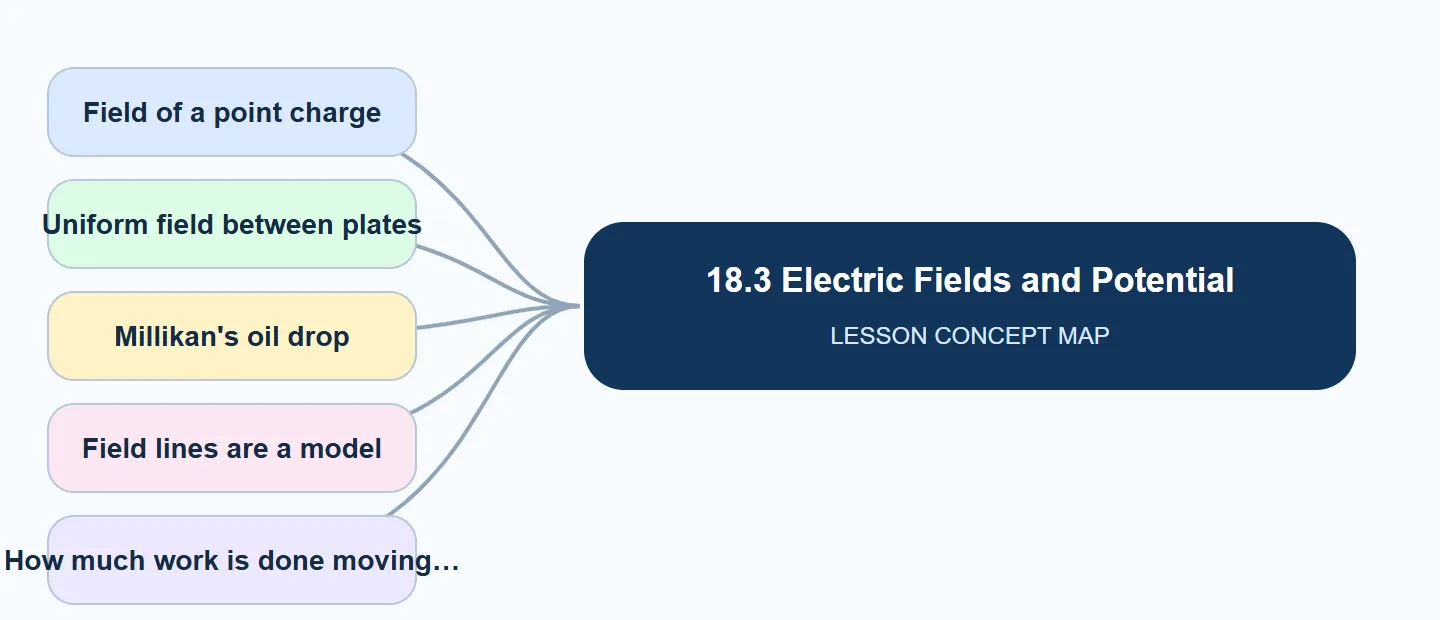
18.3 Electric Fields and Potential concept map: Field of a point charge, Uniform field between plates, Millikan's oil drop, Field lines are a model, How much work is done moving
Visual guide to the key ideas explained in this lesson.
Rather than charges acting directly on each other, we say each charge sets up an electric field around it, and the field exerts a force on other charges placed in it.
The field direction is defined using a positive test charge. A negative charge (such as an electron) experiences a force opposite to the field direction.
Field lines are a model
Field lines are a model arrows show direction, spacing shows strength. They start on positive charges (or at infinity) and end on negative charges (or at infinity), and they meet conductor surfaces at right angles.
Around a single point charge the field is radial; its strength falls with the square of distance, so lines spread out.
Between two oppositely charged parallel plates the field is uniform in the middle, with curved (fringing) lines at the edges. A charged particle there feels a constant force qE, so it accelerates uniformly, like a ball in uniform gravity.
Moving a positive charge against the field does work on it and increases its electric potential energy; the energy change per coulomb is the potential difference.
Equipotential lines are perpendicular to field lines; between parallel plates they are parallel to the plates and equally spaced.
On a charged conductor, charges spread to the outside surface and crowd at sharp points, where the field is strongest. This explains lightning conductors and why a car or metal cage (Faraday cage) shields its contents.
A capacitor stores charge on two plates; the charge stored is proportional to the voltage across it. Capacitors are used in camera flashes, keyboards and timing circuits.
Millikan balanced charged oil drops between plates by adjusting the voltage until the electric force upward equalled the weight, showing that every drop's charge was a multiple of 1.60 × 10⁻¹⁹ C.

Section 2 of 7Process & sequence

1
Pour a thin layer of castor oil into a clear dish and sprinkle semolina grains on it.
2
Place two electrodes in the oil (points,
  • or parallel metal strips) and connect them to a high-voltage supply.
    • (with safety precautions and teacher supervision)
3
Switch on; the grains are polarized and line up along the field lines.
4
Observe radial patterns around a point electrode and parallel lines between flat strips.
5
Sketch the pattern, adding arrows from positive to negative.
6
Note where lines are closest (strongest field) and the curved fringing at the edges of the plates.

Drawing an electric field patternwrite these steps in this order; each step is a marking point.

1
Identify the positive and negative charges or plates.
2
Draw lines leaving positive and entering negative charges, at right angles to conductor surfaces.
3
Add arrows pointing from positive to negative.
4
Space lines closer where the field is stronger and never let lines cross.
5
For parallel plates draw equally spaced parallel lines, with slight curving at the edges.

Section 3 of 7Compare

Field line patterns
ArrangementPattern of linesNotes
Isolated positive point chargeStraight lines radiating outwardField strength falls as 1/r2
Isolated negative point chargeStraight lines pointing inwardSame shape, opposite direction
+ and − charges near each otherCurved lines from + to −Dense between charges
Two like chargesLines curve apart; neutral point midwayZero field at neutral point (equal charges)
Parallel platesParallel, equally spaced from + to − plateUniform field; E = ΔV/d; edges curve

Section 4 of 7Worked examples

Worked examples
A charge of +4.0 × 10⁻⁶ C experiences a force of 0.024 N in an electric field. Find the field strength.
  • E = F/q = 0.024/4.0 × 10−6 = 6.0 × 10³ N/C in the direction of the force.
Two parallel plates 2.5 cm apart have a potential difference of 500 V. Find (a) the field strength, (b) the force on an electron between them.
  • (a) E = ΔV/d = 500/0.025 = 2.0 × 10⁴ V/m (N/C).
    • (b) F = qE = 1.60 × 10−19 × 2.0 × 104 = 3.2 × 10⁻¹⁵ N, directed towards the positive plate.

How much work is done moving a 3.0 μC charge through a potential difference of 12 V?

  • W = qΔV = 3.0 × 10−6 × 12 = 3.6 × 10⁻⁵ J.

Section 5 of 7Key terms

Section 6 of 7Command terms

Command terms
Identify / Describe (FRQ)
A short, specific statement; describing requires relevant characteristics, not a single word.
Explain / Justify (FRQ)
Give the cause-and-effect reasoning or evidence; a restated fact does not score.
Calculate
Show setup, substitution and the answer with units.
Predict
State the expected outcome; add a reason only if asked to justify.
MCQ technique
Read every option; eliminate distractors that are true statements but do not answer the question; watch for NOT/EXCEPT.

Section 7 of 7Exam technique

Keywords the mark scheme looks for in this lesson

Keywords the mark scheme looks for in this lesson
Electric field · Electric field strength (E) · Direction of an electric field · Electric field line · Uniform electric field · Test charge · Electric potential energy (U) · Electric potential difference (voltage, ΔV) · Volt (V) · Equipotential · Capacitor · Electron volt (eV)
Learn each definition in the Key words tab exactly; a missing keyword in a definition usually loses the mark.

How to get full marks (examiner guidance)

1
Answer exactly what is asked; extra correct material does not earn credit, and contradictory statements can cancel credit (AP FRQ).
2
Use precise vocabulary, never “it/stuff/things”.
3
Show units and working in calculations.
4
In MCQs, predict the answer before reading the options, then eliminate.

Words to avoid

1
the field direction is the way an electron movesfield direction is the direction of the force on a positive test charge.
2
electric field lines can crossfield lines never cross because the field has only one direction at each point.
3
a volt is a unit of energya volt is one joule per coulomb, a unit of potential difference.
4
E = F × qE = F/q, the force per unit charge.
5
the field between plates is stronger near the platesthe field between parallel plates is uniform (the same everywhere except at the edges).

Last updated: