Atomic Structure and Properties
Elements & Mixtures — AP CHEMISTRY Revision Notes & Topical Questions
5 min read 11 parts Lesson 1 of 16 Unit quiz
Lesson summary
Elements & Mixtures — AP CHEMISTRY notes: Classify matter as pure substances or mixtures, use the law of definite proportions, determine empirical and molecular formulae, and calculate composition and purity.Pure substance = matter of fixed composition containing particles of a s…
- Ionic compound
- Homogeneous mixture (solution)
- Heterogeneous mixture
- Empirical formula
- Convert to moles using n
- Formula unit
Part 1 of 9Pure substances and formulas
Pure substance
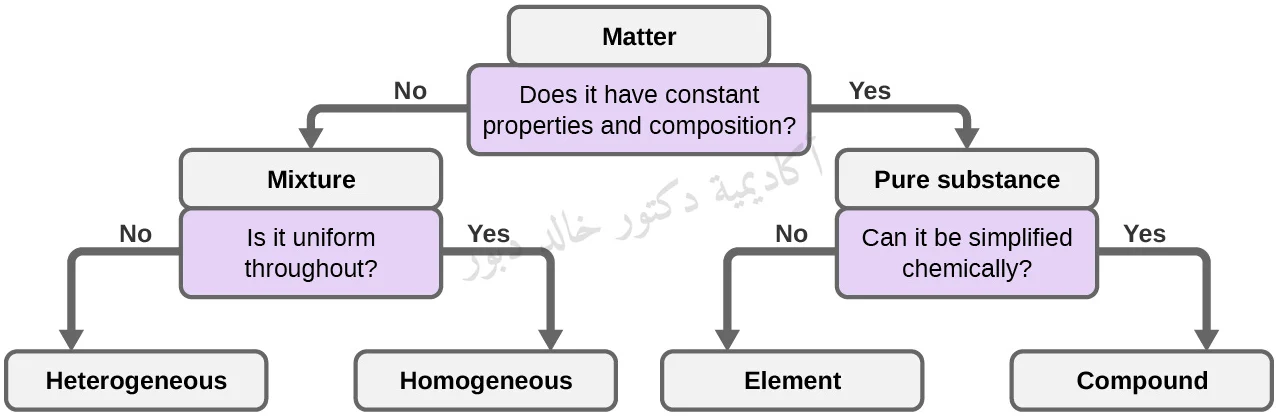
Pure substance matter of fixed composition containing particles of a single type, and it has sharp melting and boiling points.
- Elements contain one kind of atom, such as aluminium (Al) or oxygen (O2).
- Compounds have a unique combination of atoms, shown by a chemical formula with subscripts.
Molecule
Molecule two or more atoms joined by covalent bonds, for example H2O.
Ionic compound
Ionic compound ions held in a fixed repeating arrangement by ionic bonds, described by a formula unit such as NaCl.
Part 2 of 9Mixtures
1Mixture
Mixture matter of non-fixed composition, containing two or more types of particle called components.
- Air is a mixture of oxygen, nitrogen and small amounts of other gases.
2Homogeneous mixture (solution)
Homogeneous mixture (solution) same composition throughout, for example air.
3Heterogeneous mixture
Heterogeneous mixture composition varies between regions, for example oil and water.
4
At the particle level a pure substance shows one type of particle, whereas a mixture shows two or more.
Part 3 of 9Law of definite proportions
1
The law states that the ratio of the masses of elements in a compound is always the same.
2
A pure compound therefore has the same composition and properties wherever it comes from.
3
Two samples of water of different masses have the same mass ratio of hydrogen to oxygen.
4
The law is used to decide whether two compounds are the same by comparing mass ratios.
Part 4 of 9Molecular and empirical formulae
Molecular formula
Molecular formula the actual number of atoms of each element in one molecule, for example C4H8 for butene.
Empirical formula
Empirical formula the simplest whole-number ratio of atoms, for example CH2 for butene.
For an ionic compound the formula is both empirical and molecular.
Part 5 of 9Finding an empirical formula
Write the mass of each element (or take the percentage as grams in a 100 g sample).
Convert to moles using n
Convert to moles using n m/M.
Divide all mole values by the smallest value to get a ratio.
Multiply by a small integer if needed to remove fractions, for example ×2 turns 1.5 into 3.
Use the whole-number ratio as the subscripts.
Part 6 of 9Finding a molecular formula
Finding a molecular formula
Calculate the molar mass of the empirical formula.
Divide the molar mass of the compound by the molar mass of the empirical formula to get a whole number.
Multiply every subscript in the empirical formula by that whole number.
Part 7 of 9Elemental analysis and purity
Elemental analysis determines the relative composition of elements in a substance and its purity.
- Convert the mass of a marker element to moles, use the formula to find moles and then mass of the compound.
- Compare with the whole samplepercent of compound = (mass of compound ÷ mass of sample) × 100.
Purity
(mass of desired compound ÷ total mass of sample) × 100, or the percentage composition of the desired compound.
Part 8 of 9More from the specification
More from the specification
Ionic lattice composition and formula units
- Ionic lattice composition and formula units stoichiometry in giant crystalline arrays reflects the simplest whole-number ratio of constituent ions in formula units.
Chloride
- Salt of hydrochloric acid.
Sodium chloride
- Compound of sodium and chlorine; common salt.
Part 9 of 9More from the specification
- Unknown
- A sample whose identity is to be found out by testing.
Key terms
| Term | Meaning |
|---|---|
| Pure substance | Matter of fixed composition containing one type of particle. |
| Formula unit | Smallest repeating ratio of ions in an ionic compound. |
| Empirical formula | Simplest whole-number ratio of atoms in a compound. |
| Molecular formula | Actual number of atoms of each element in one molecule. |
| Law of definite proportions | A compound always has the same mass ratio of its elements. |
| Homogeneous mixture | Mixture with uniform composition throughout. |
| Purity | Percentage by mass of the desired compound in a sample. |
Avoid these mistakes
1
Treating the empirical formula as the actual molecule — the molecular formula is a whole-number multiple of it
2
Rounding mole ratios such as 1.5 to 2 — multiply by 2 to get whole numbers
3
Describing a mixture as a compound — a compound has fixed composition, a mixture does not
4
Using percentage purity without converting everything to the same units of mass
Topic quiz · 10 questionsQuiz for this lesson
Last updated: