Structures and Functions in Living Organisms
Nutrition — Edexcel Linear - OL Revision Notes & Topical Questions
15 min read 26 parts Lesson 12 of 25 Unit quiz
Plant Nutrition: Minerals and Photosynthesis Practicals — EDEXCEL LINEAR - OL notes: Explain why plants need mineral ions and carry out and evaluate the practicals that show oxygen release and the need for light and carbon dioxide.Photosynthesis provides carbohydrates, but plants…
- Worked example 1
- Worked example 2
- Worked example 3
- Worked example 4
- Worked example 5
- Iodine solution
Part 1 of 5Why plants need more than carbohydrates
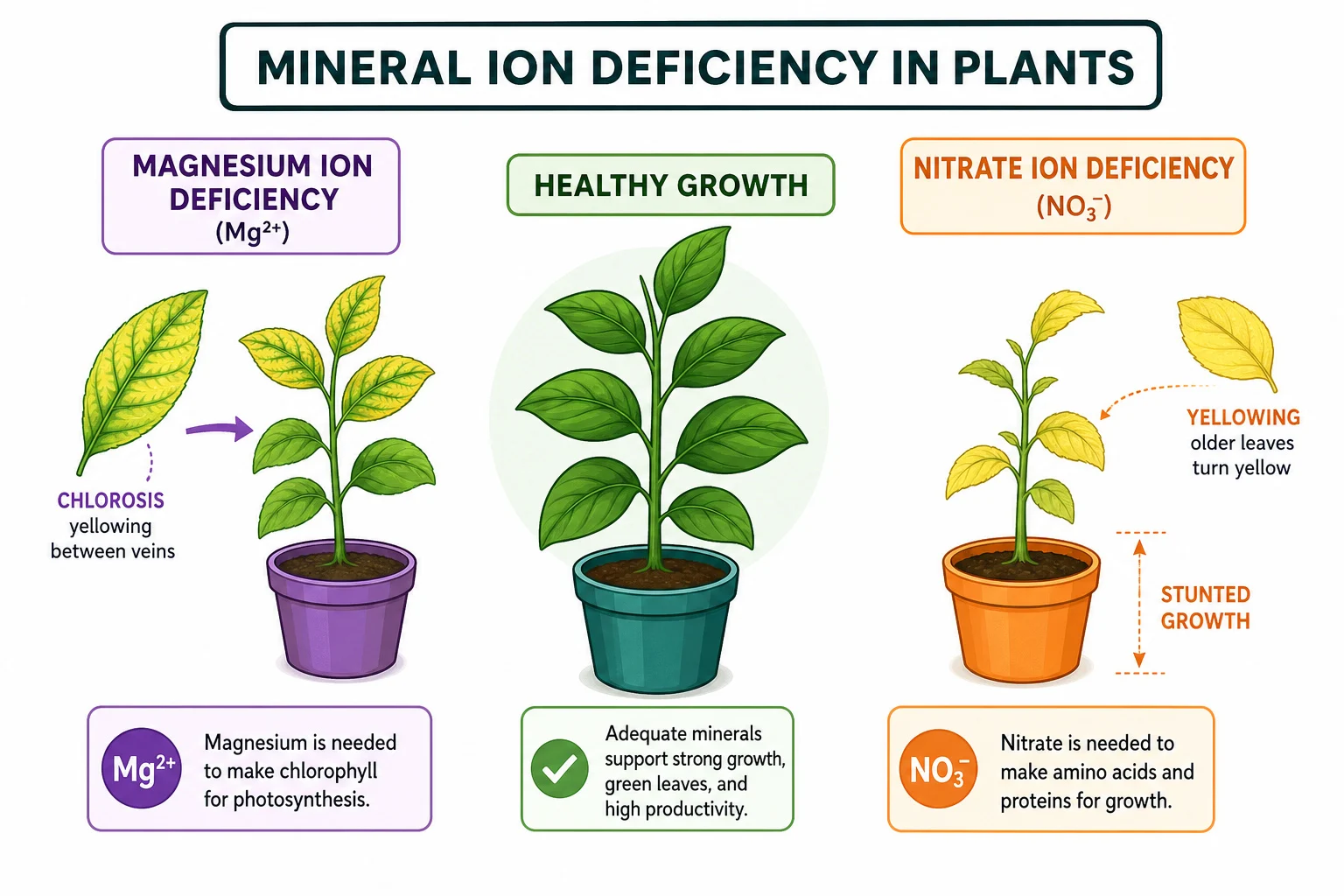
Photosynthesis provides carbohydrates, but plants also contain and need many other biological molecules: proteins, lipids and nucleic acids (DNA).
| Mineral ion | Used to make | Deficiency symptom |
|---|---|---|
| Nitrate | Amino acids and proteins | Stunted growth, yellow older leaves |
| Magnesium | Chlorophyll | Yellow leaves (chlorosis), especially between the veins |
Part 2 of 5Practical: oxygen released by a water plant
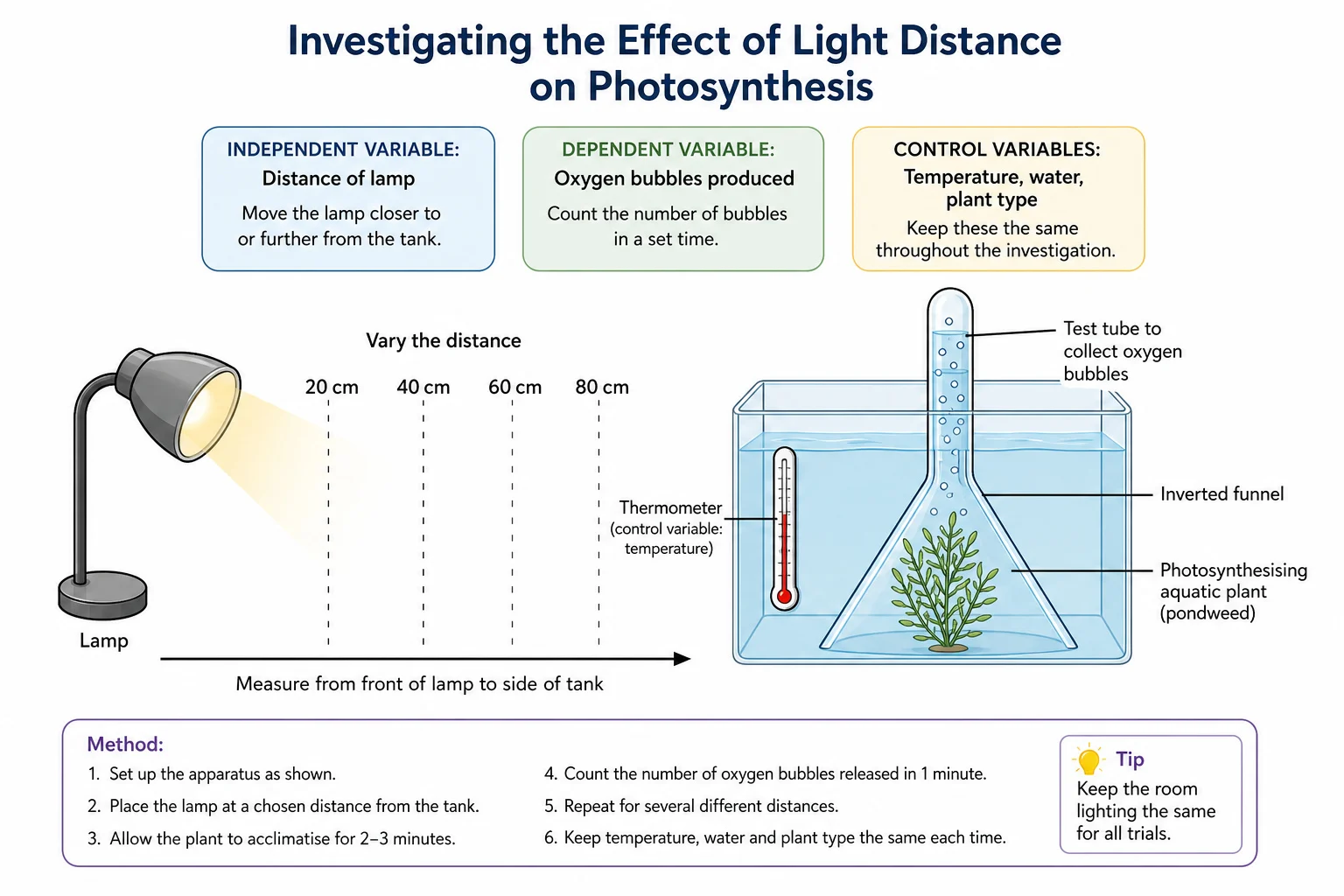
Oxygen produced by photosynthesis can be shown using a water plant such as Elodea (pondweed).
As the plant is in water, the oxygen released can be seen as bubbles; the rate of bubbles shows the rate of photosynthesis.
Part 3 of 5Practical: testing a leaf for starch to show light is needed
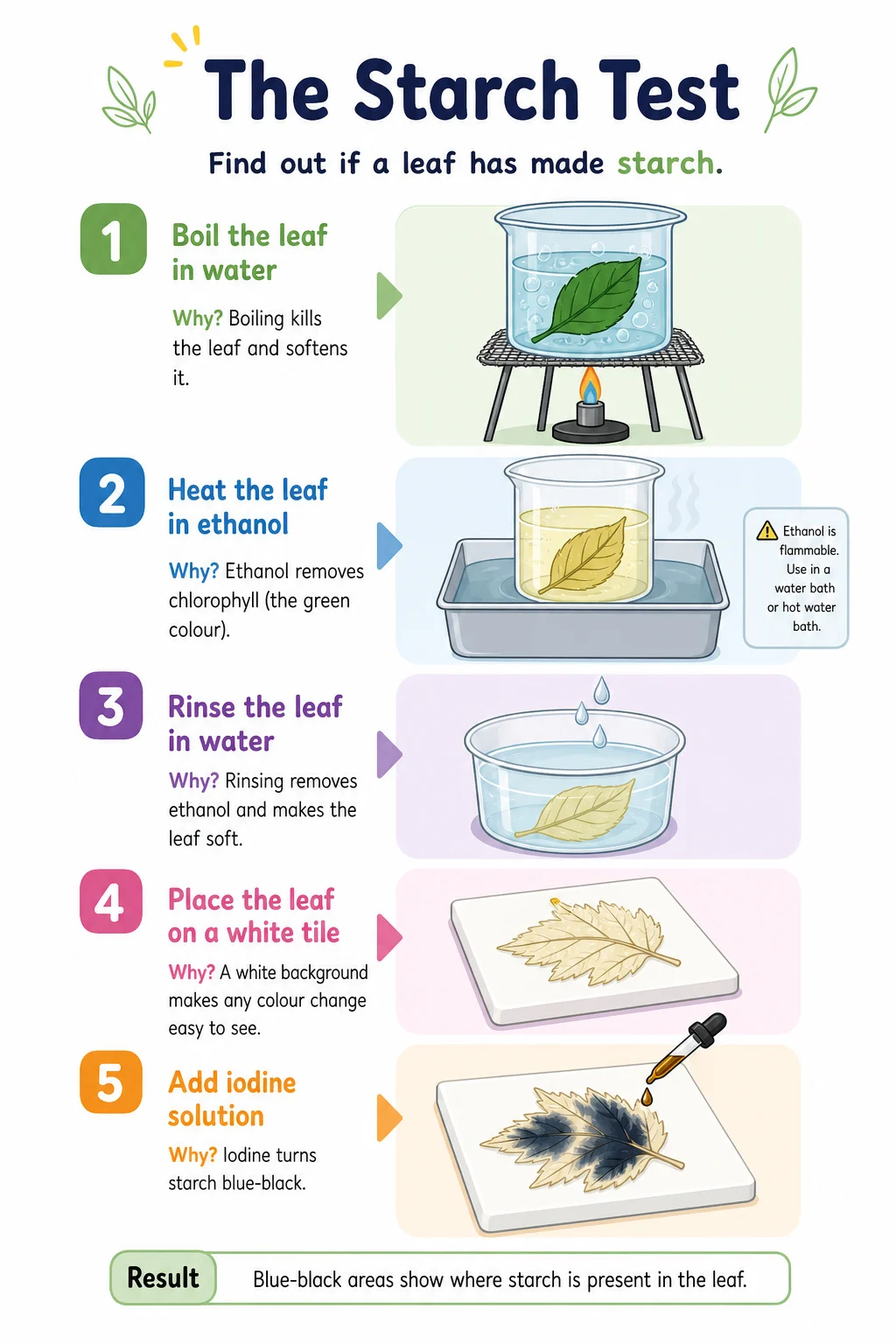
The glucose made is quickly used up, converted into other substances and transported or stored as starch, so a leaf cannot be reliably tested for glucose. Starch is stored in chloroplasts where photosynthesis occurs, so testing a leaf for starch is a reliable indicator of where photosynthesis has happened.
- because it is extremely flammable;
- use an electric water bath or water from a just-boiled kettle) to remove the chlorophyll.
The exposed area turns blue-black (starch present); the covered area stays yellow-brown or orange-brown, because without light it could not photosynthesise and the cells broke down starch to use the glucose in respiration.
- such as a strip or triangle of foil, most of the leaf turns blue-black with an orange-brown strip containing a blue-black triangle in the centre.
Part 4 of 5Practical: carbon dioxide and the CORMS evaluation
To show carbon dioxide is needed, de-starch the plant, then enclose one leaf in a conical flask containing potassium hydroxide (which absorbs carbon dioxide) and another leaf in a control flask without potassium hydroxide.
Evaluate with CORMS: Change one thing (light or no light), Observe/measure, Repeat to make results reliable, Measure the outcome, keep the leaves from the same plant or species and of the same age and size, Same conditions otherwise (controlled variables).
Part 5 of 5Worked examples
Why does a plant need nitrate ions? [2]2 marks
To make amino acids and then proteins; plants cannot make proteins from carbohydrates alone because proteins contain nitrogen.
Describe how to remove chlorophyll from a leaf before the starch test and why this is done. [3]3 marks
Boil the leaf in ethanol in a water bath (heated safely, not over a flame). Chlorophyll would hide the colour change with iodine.
A leaf partly covered with foil is tested with iodine. State and explain the result. [3]3 marks
The uncovered part turns blue-black because light allowed photosynthesis and starch to be made; the covered part stays orange-brown because there was no light.
Why is the plant put in the dark for 24 hours before the experiment? [2]2 marks
To remove existing starch so that any starch found must have been made during the experiment.
What is the purpose of potassium hydroxide in the carbon dioxide experiment? [1]1 mark
It absorbs carbon dioxide from the air inside the flask.
Key terms
| Term | Meaning |
|---|---|
| Nitrate | A mineral ion needed to make amino acids and proteins. |
| Magnesium | A mineral ion needed to make chlorophyll. |
| De-starch | Remove starch from a plant by keeping it in the dark. |
| Iodine solution | Reagent that turns blue-black with starch. |
| Control | A set-up where the factor being tested is kept unchanged for comparison. |
Avoid these mistakes
Last updated:
\n