Structures and Functions in Living Organisms
Gas exchange — Edexcel Linear - OL Revision Notes & Topical Questions
10 min read 13 parts Lesson 13 of 25 Unit quiz
Gas Exchange in Plants and the Human Respiratory System — EDEXCEL LINEAR - OL notes: Interpret hydrogencarbonate-indicator results for leaves in different light conditions and describe the structures of the human respiratory system.This experiment shows how light affects photosyn…
- Hydrogencarbonate indicator
- Worked example 1
- Worked example 2
- Worked example 3
- Worked example 4
- Worked example 5
Part 1 of 5Practical: the effect of light on gas exchange in a leaf
This experiment shows how light affects photosynthesis and respiration by following changes in carbon dioxide levels around a leaf. Plants photosynthesise in the light, using carbon dioxide, but respire all the time, producing it. Hydrogencarbonate indicator is orange at normal atmospheric carbon dioxide levels, turns yellow as carbon dioxide increases and purple as it decreases.
- Tube Ba leaf in bright light.
- Tube Ca leaf wrapped in foil (dark).
- Tube Da leaf wrapped in muslin (cotton cloth), giving dim light.
| Tube | Colour at end | Explanation |
|---|---|---|
| A: no leaf | Orange | No change in carbon dioxide |
| B: leaf in bright light | Purple | Photosynthesis exceeds respiration, so net uptake of CO2; the level decreases |
| C: leaf in dark (foil) | Yellow | Only respiration, so CO2 is released; the level increases |
| D: leaf in muslin | Orange or slightly purple | Photosynthesis and respiration are relatively balanced; the net exchange is small, though photosynthesis may slightly exceed respiration |
Any colour change in tube D is much smaller than in the bright light tube. Apply CORMS: change the light (foil, muslin, none); observe the colour; repeat; measure the colour before and after; keep the same volume of indicator, number of leaves, size of leaf, and temperature.
Part 2 of 5Structures of the human respiratory system
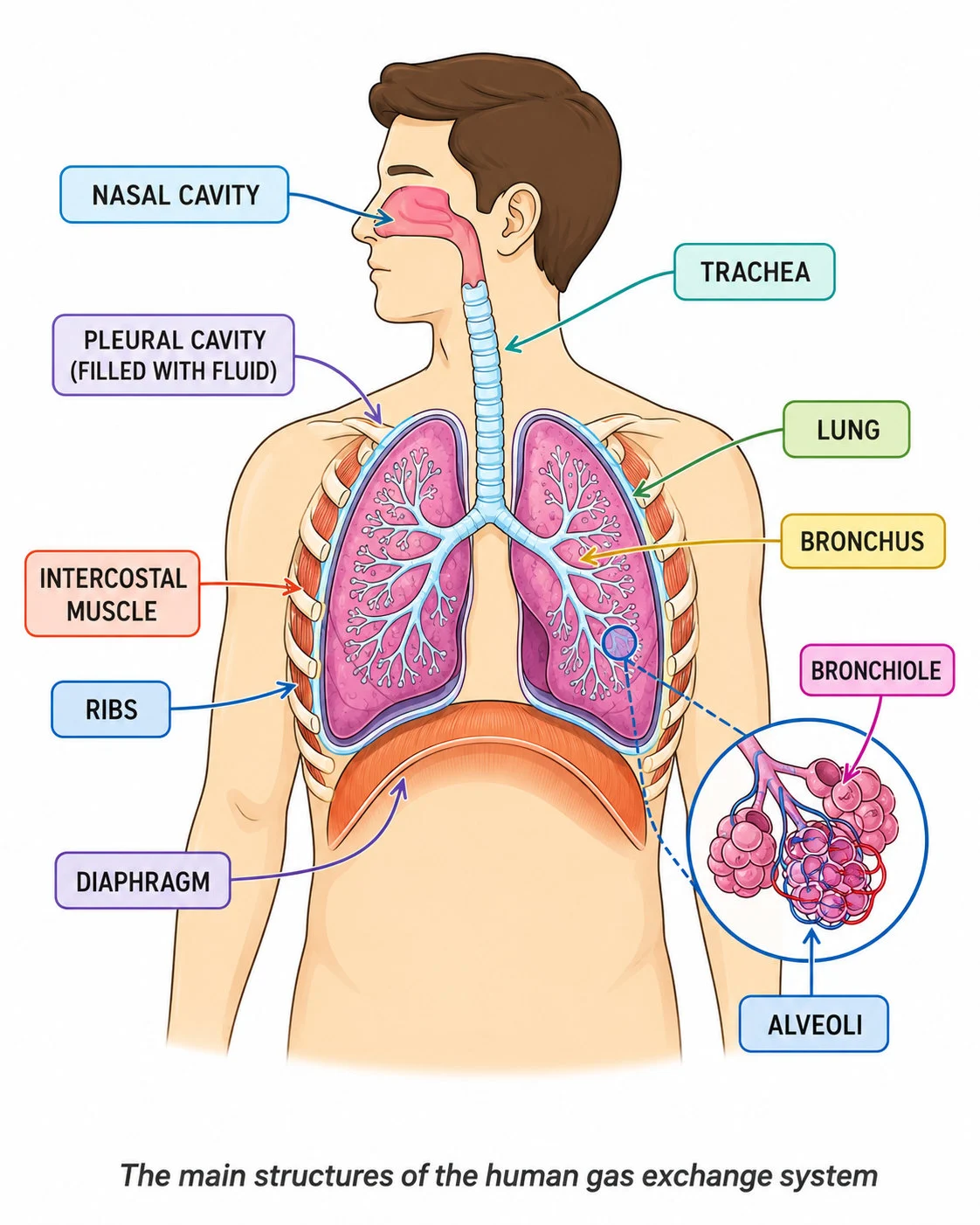
Gas exchange occurs in the respiratory system, located in the thorax (the chest cavity). You must be able to recognise the structures and state the order air passes through them
| Structure | Function |
|---|---|
| Ribs | Bone structure that protects internal organs such as the lungs |
| Intercostal muscles | Muscles between the ribs; control their movement for inhalation and exhalation |
| Trachea | Windpipe; rings of cartilage keep it open; carries air to the bronchi |
| Bronchus (plural bronchi) | One of two tubes leading from the trachea to each lung |
| Bronchioles | Smaller tubes that connect the bronchi to the alveoli |
| Alveoli | Tiny, balloon-like air sacs at the ends of the bronchioles; the gas exchange surfaces, where oxygen diffuses into the blood and carbon dioxide diffuses out |
| Diaphragm | Sheet of muscle below the lungs involved in ventilation |
| Pleural membranes | Thin layers of tissue surrounding the lungs and lining the inside of the thorax |
The alveoli have a good blood supply, which maintains a high concentration gradient by carrying blood with a high concentration of oxygen away from the alveoli (and bringing blood low in oxygen).
Part 3 of 5Why gas exchange in a leaf changes between day and night
In daylight a leaf carries out both photosynthesis and respiration.
- so the leaf takes in carbon dioxide from the air and gives out oxygen as the net exchange.
Gas exchange in a leaf happens by diffusion through the open stomata, controlled by the guard cells, and the thin, flat shape and air spaces in the spongy mesophyll give a short diffusion path and a large surface area. In humans the same principle applies at the alveoli, where gases move by diffusion down their concentration gradients: oxygen into the blood, carbon dioxide out of it.
Part 4 of 5Answering practical questions on the indicator
When you explain a colour change, give three linked statements: which process is dominant (photosynthesis or respiration), what happens to the carbon dioxide level, and the resulting colour.
Part 5 of 5Worked examples
A tube containing a leaf in the dark turns yellow. Explain why. [3]3 marks
No photosynthesis occurs without light, but the leaf still respires and releases carbon dioxide. The carbon dioxide level increases, so the indicator turns yellow.
What is the purpose of the tube with no leaf? [1]1 mark
It is a control to show the indicator does not change colour by itself.
Name the structures air passes through from the mouth to the alveoli. [3]3 marks
Trachea, bronchus, bronchioles, then the alveoli.
State the function of the pleural membranes. [1]1 mark
They surround the lungs and line the thorax, allowing the lungs to move smoothly.
List three variables to control in the hydrogencarbonate experiment. [3]3 marks
Volume of indicator, number and size of leaves, and temperature (and the time left).
Key terms
| Term | Meaning |
|---|---|
| Hydrogencarbonate indicator | Indicator that is orange at normal CO2, yellow with more CO2 and purple with less. |
| Trachea | Windpipe carrying air to the bronchi. |
| Bronchioles | Small tubes connecting the bronchi to the alveoli. |
| Alveoli | Air sacs in the lungs where gas exchange takes place. |
| Intercostal muscles | Muscles between the ribs that move the rib cage. |
| Pleural membranes | Thin layers surrounding the lungs and lining the thorax. |
Avoid these mistakes
Last updated:
\n