Structures and Functions in Living Organisms
Co-ordination and response — Edexcel Linear - OL Revision Notes & Topical Questions
15 min read 18 parts Lesson 15 of 25 Unit quiz
Nervous and Endocrine Systems, Reflex Arc and the Eye — EDEXCEL LINEAR - OL notes: Compare nervous and hormonal control, describe synapses and reflex arcs, and explain how the structures of the eye focus on near and distant objects.FeatureNervous systemEndocrine systemMade up ofN…
- central nervous system
- peripheral nervous system
- neurotransmitters
- accommodation
- Worked example 1
- Worked example 2
Part 1 of 6Nervous and endocrine systems compared
| Feature | Nervous system | Endocrine system |
|---|---|---|
| Made up of | Nerves (bundles of neurones), brain, spinal cord | Glands |
| Signal | Electrical impulses along neurones | Hormones (chemicals) carried in the blood |
| Speed | Very fast | Slower |
| Effect lasts | Short time | Longer |
| Target | Specific muscles or glands | One or more target organs |
Hormones are carried by the blood around the whole body and alter the activity of specific target organs.
Part 2 of 6Synapses and the reflex arc
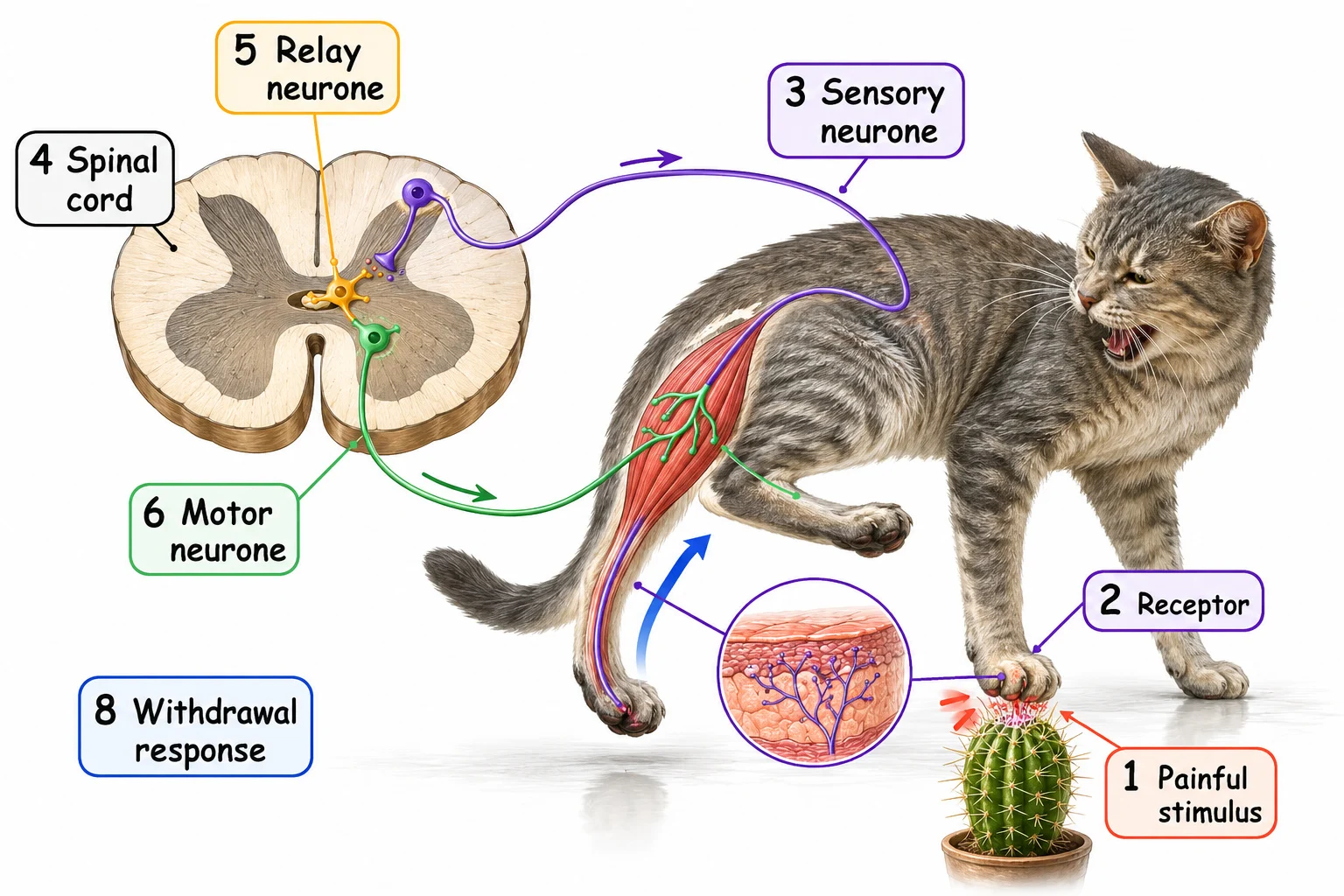
Neurones do not touch. The tiny gap between two neurones is a synapse. When an impulse reaches the end of one neurone, it triggers the release of neurotransmitters (chemical messengers) that diffuse across the gap and bind to receptors on the next neurone, starting a new impulse.
A reflex response is automatic and rapid and does not involve the conscious part of the brain as coordinator; awareness occurs after the response. This minimises damage and aids survival (pain withdrawal, blinking, coughing). The reflex arc pathway:
Part 3 of 6The structure of the eye
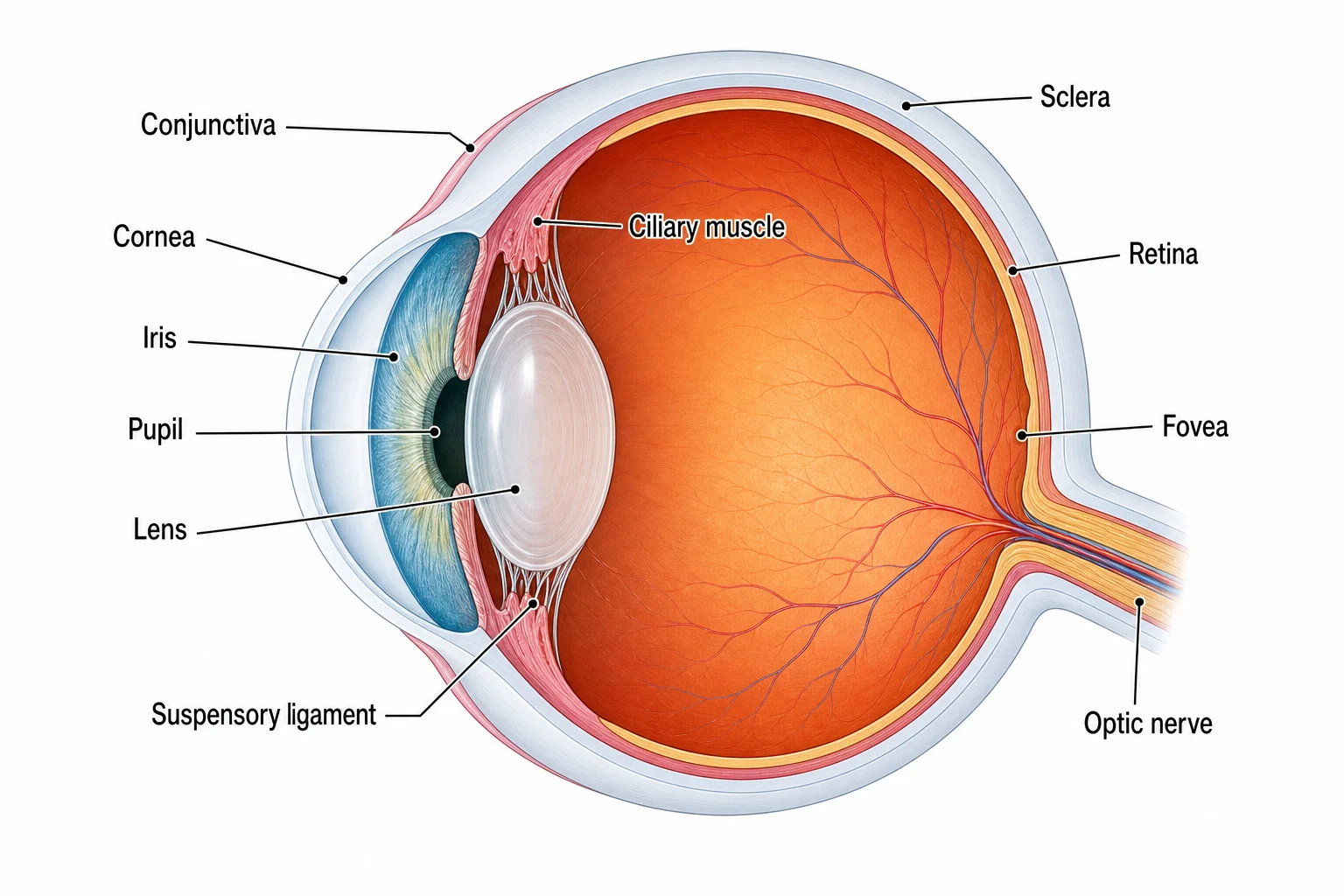
The eye is a highly specialised sense organ containing light receptor cells.
| Part | Function |
|---|---|
| Conjunctiva | Clear membrane covering the white of the eye and inside of the eyelids; lubricates and protects from irritants |
| Cornea / lens | Refract and focus light onto the retina |
| Suspensory ligaments | Connect the ciliary muscle to the lens |
| Retina | Contains receptor cells (rods and cones) sensitive to light |
| Fovea | Region of the retina with densely packed cones: detailed colour vision |
| Optic nerve | Carries impulses between the eye and the brain |
Part 4 of 6Accommodation: focusing near and distant objects
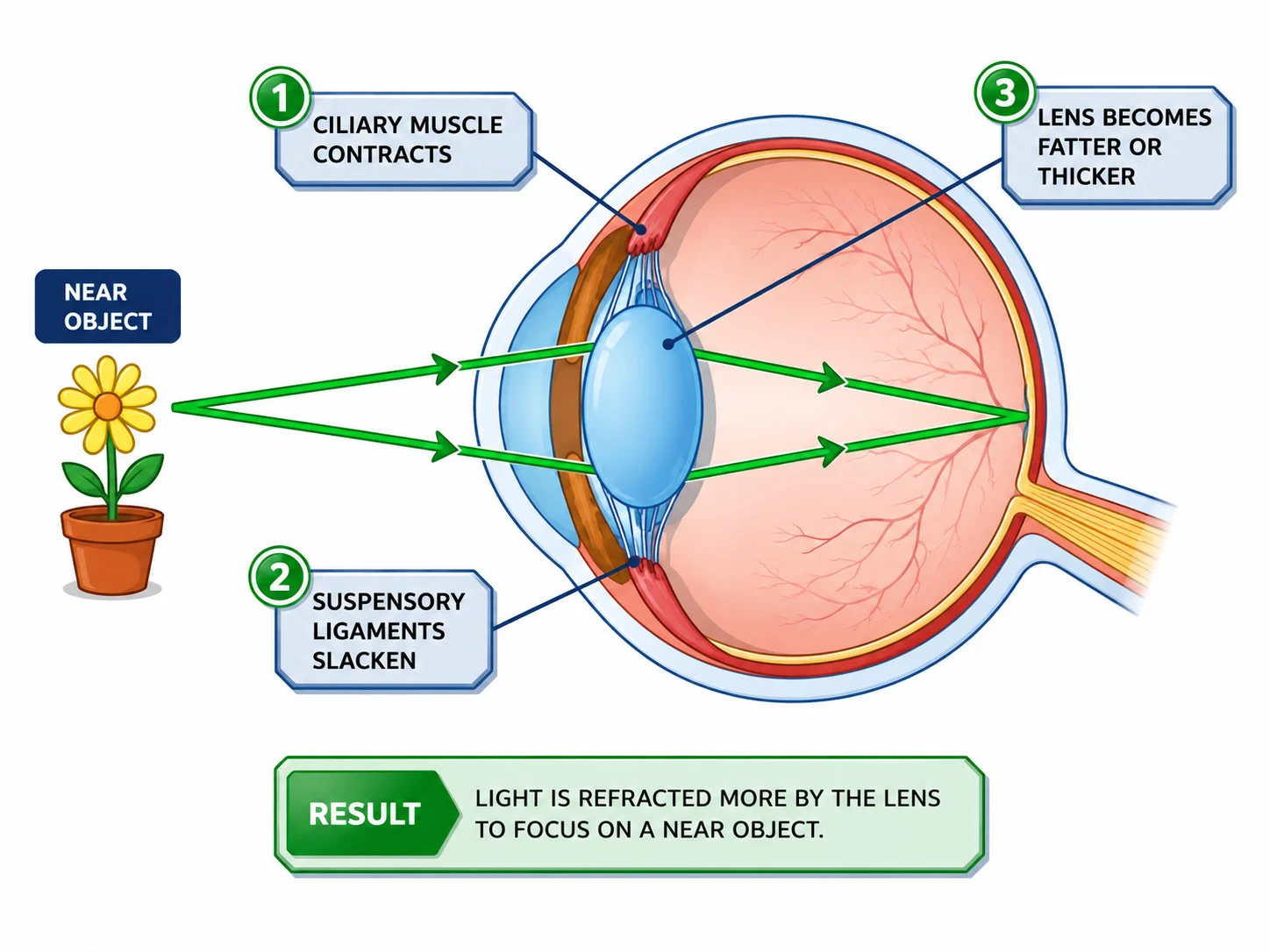
Fine focusing by the lens is called accommodation. The lens is elastic and its shape changes when the suspensory ligaments become tight or loose, controlled by the contraction or relaxation of the ciliary muscles.
| Near objects | Distant objects | |
|---|---|---|
| Ciliary muscles | Contract | Relax |
| Suspensory ligaments | Loose / slack | Tight / taut |
| Lens shape | Fatter (more curved) | Thinner (less curved) |
Part 5 of 6Comparing speed, duration and examples of responses
The nervous system gives fast, short-lived responses such as pulling a hand away from a hot object, while the endocrine system gives slower, longer-lasting responses such as growth, puberty or the control of blood glucose.
The effectors in the nervous system are muscles (which contract) and glands (which secrete). Remember the sequence for a coordinated response: stimulus, receptor, coordinator (CNS), effector, response.
Part 6 of 6Worked examples
Give two differences between nervous and hormonal control. [2]2 marks
Nervous control uses electrical impulses and is fast and short-lived; hormonal control uses chemicals in the blood and is slower and longer-lasting.
Describe how an impulse crosses a synapse. [3]3 marks
The impulse triggers release of neurotransmitter, which diffuses across the gap and binds to receptors on the next neurone, starting a new impulse.
Explain why reflexes protect the body. [2]2 marks
They are automatic and rapid, not involving conscious thought, so damage is minimised.
Describe how the eye focuses on a near object. [3]3 marks
Ciliary muscles contract, suspensory ligaments become loose, and the lens becomes fatter to refract light more.
State the function of the fovea. [1]1 mark
It has densely packed cones for detailed vision in colour.
Key terms
| Term | Meaning |
|---|---|
| Synapse | The gap between two neurones. |
| Neurotransmitter | A chemical released at a synapse that carries a signal across the gap. |
| Reflex arc | The pathway of a rapid automatic response from receptor to effector. |
| Accommodation | Change in lens shape to focus on near or distant objects. |
| Retina | Light-sensitive layer at the back of the eye. |
| Hormone | A chemical made by a gland and carried in the blood to target organs. |
Avoid these mistakes
Last updated:
\n