2.4Structures and Functions in Living Organisms
Movement of Substances Into and Out of Cells — Edexcel Linear - OL Revision Notes & Topical Questions
10 min read 18 parts Lesson 19 of 25 Unit quiz
Diffusion, Osmosis and Active Transport — EDEXCEL LINEAR - OL notes: Define and compare diffusion, osmosis and active transport and explain their effects on plant cells.Diffusion is the net movement of particles from a region of higher concentration to a region of lower concentra…
- plasmolysed
- Worked example 1
- Worked example 2
- Worked example 3
- Worked example 4
- Worked example 5
Part 1 of 5Diffusion
Diffusion is the net movement of particles from a region of higher concentration to a region of lower concentration, down a concentration gradient. The movement of individual particles is random, but the overall result is that particles spread out until they are at an even concentration throughout the space. It is a passive process requiring no energy from respiration.
Examples
- oxygen from the alveoli into the blood;
- carbon dioxide into a leaf;
- digested food (glucose) from the small intestine into the blood.
Part 2 of 5Osmosis
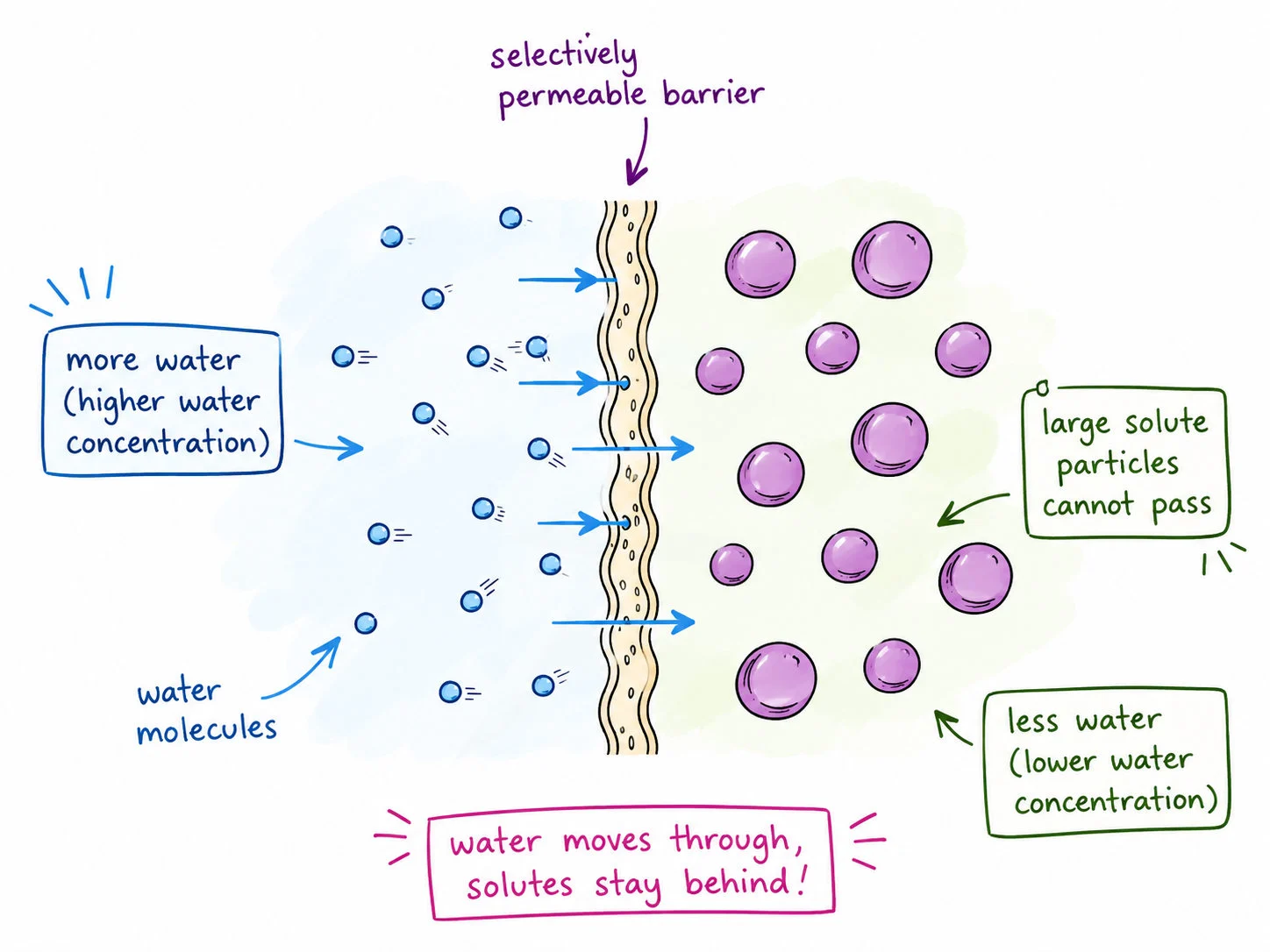
Osmosis is the diffusion of water through a partially permeable membrane, from a region of higher water concentration (dilute solution) to a region of lower water concentration (concentrated solution).
In an exam, first state “the diffusion of water through a partially permeable membrane”, then add “from a dilute to a concentrated solution” or “from high to low water potential”. Osmosis always refers to water and always occurs across a partially permeable membrane.
| Surroundings | Plant cell | Animal cell |
|---|---|---|
| Dilute solution / distilled water | Gains water; vacuole expands; membrane pushes against the wall; cell is turgid (the wall prevents bursting) | Gains water and may burst (lysis) |
| Concentrated solution | Loses water; cytoplasm shrinks away from the wall: plasmolysed (flaccid) | Loses water and shrinks (crenation) |
| Same concentration | No net movement | No net movement |
Turgor pressure keeps plant tissues firm and supports soft stems.
Part 3 of 5Active transport
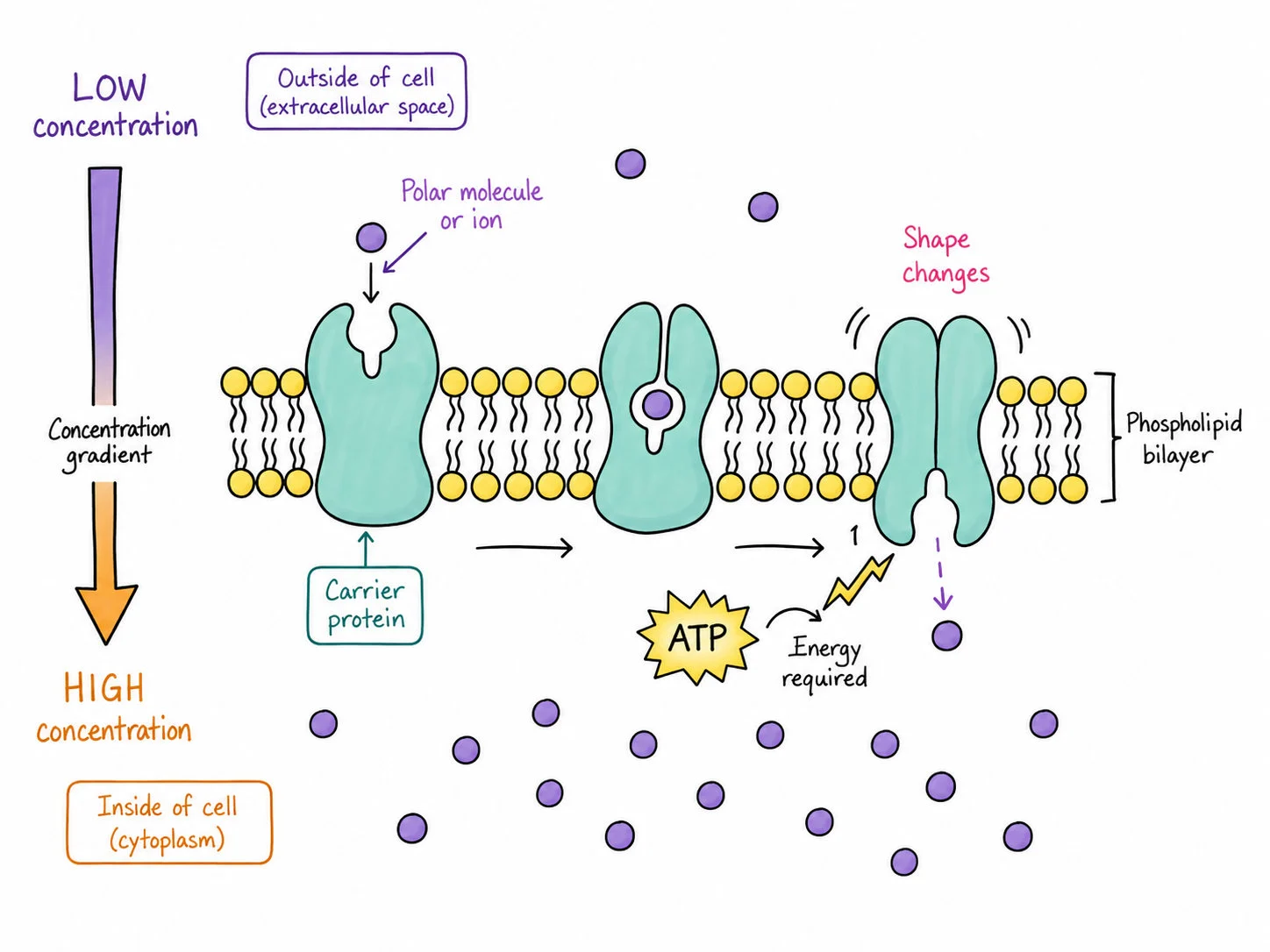
Active transport is the movement of particles against a concentration gradient (from a lower to a higher concentration) using energy from respiration. It needs carrier proteins in the cell membrane. Cells that carry out much active transport have many mitochondria.
| Feature | Diffusion | Osmosis | Active transport |
|---|---|---|---|
| Particles | Any | Water only | Ions, glucose |
| Direction | Down the gradient | High to low water potential | Against the gradient |
| Energy | No | No | Yes (respiration) |
| Membrane | Not needed | Partially permeable | Carrier proteins |
Examples
- absorption of the products of digestion from the lumen of the small intestine into the bloodstream (when glucose concentration in the gut is lower than in the blood);
- absorption of mineral ions from the soil into root hair cells, where the concentration of ions in the soil is lower than in the cell.
Part 4 of 5Real examples and worked reasoning
Diffusion explains how oxygen enters a cell, how carbon dioxide leaves a leaf and how the smell of food spreads through a room.
- and how the small intestine absorbs the last of the glucose from the gut.
Part 5 of 5Worked examples
Define osmosis. [2]2 marks
The diffusion of water through a partially permeable membrane from a region of higher water potential to a region of lower water potential.
Explain why a plant cell does not burst when placed in distilled water. [2]2 marks
Water enters and the cell becomes turgid, but the strong cell wall resists further expansion.
Give two differences between diffusion and active transport. [2]2 marks
Diffusion is down a gradient with no energy; active transport is against the gradient and requires energy from respiration.
Explain why root hair cells have many mitochondria. [2]2 marks
They absorb mineral ions by active transport, which needs energy from aerobic respiration.
Describe what happens to a plant cell in a concentrated sugar solution. [2]2 marks
Water leaves by osmosis, the vacuole and cytoplasm shrink and the membrane pulls away from the wall: the cell is plasmolysed.
Key terms
| Term | Meaning |
|---|---|
| Diffusion | Net movement of particles from high to low concentration. |
| Osmosis | Diffusion of water through a partially permeable membrane. |
| Active transport | Movement of particles against a concentration gradient using energy. |
| Water potential | A measure of the tendency of water to move; higher in dilute solutions. |
| Turgid | Firm because the cell is full of water. |
| Plasmolysed | Having lost water so the membrane pulls away from the cell wall. |
Avoid these mistakes
Last updated:
Magnification Triangle & Unit Conversion
Formula: M = I / A ⇔ A = I / M ⇔ I = M × A
Units: 1 mm = 1,000 μm = 1,000,000 nm.
Rule: Convert Image size (ruler mm) to μm by ×1,000 before dividing by Actual size.