2.4Structures and Functions in Living Organisms
Movement of Substances Into and Out of Cells — Edexcel Linear - OL Revision Notes & Topical Questions
10 min read 18 parts Lesson 19 of 25 Unit quiz
Diffusion, Osmosis and Active Transport — EDEXCEL LINEAR - OL notes: Define and compare diffusion, osmosis and active transport and explain their effects on plant cells.Diffusion is the net movement of particles from a region of higher concentration to a region of lower concentra…
- plasmolysed
- Worked example 1
- Worked example 2
- Worked example 3
- Worked example 4
- Worked example 5
Section 1 of 18Diffusion
Diffusion is the net movement of particles from a region of higher concentration to a region of lower concentration, down a concentration gradient. The movement of individual particles is random, but the overall result is that particles spread out until they are at an even concentration throughout the space. It is a passive process requiring no energy from respiration.
Examples
- oxygen from the alveoli into the blood;
- carbon dioxide into a leaf;
- digested food (glucose) from the small intestine into the blood.
Section 2 of 18Osmosis
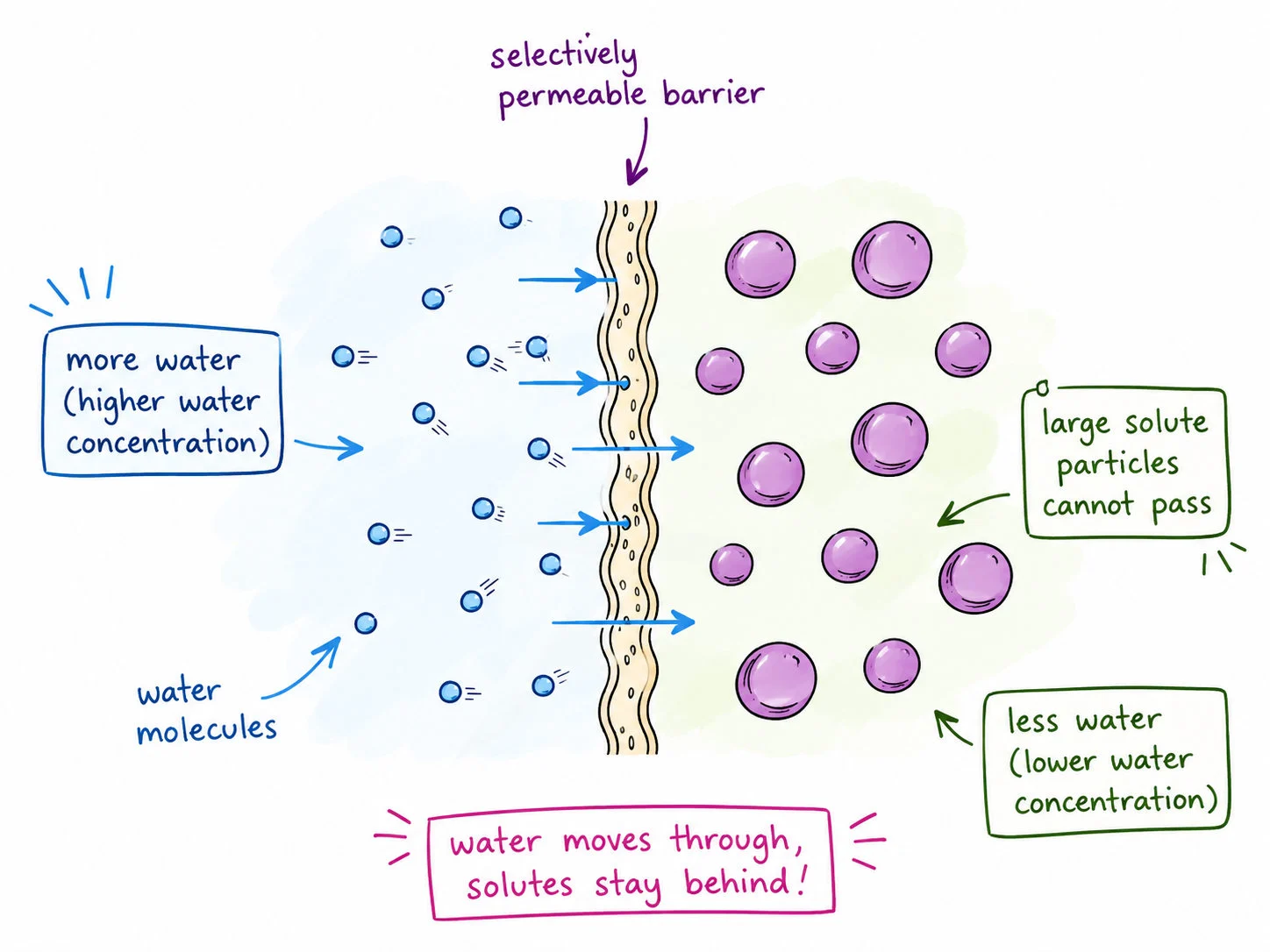
Osmosis is the diffusion of water through a partially permeable membrane, from a region of higher water concentration (dilute solution) to a region of lower water concentration (concentrated solution).
In an exam, first state “the diffusion of water through a partially permeable membrane”, then add “from a dilute to a concentrated solution” or “from high to low water potential”. Osmosis always refers to water and always occurs across a partially permeable membrane.
| Surroundings | Plant cell | Animal cell |
|---|---|---|
| Dilute solution / distilled water | Gains water; vacuole expands; membrane pushes against the wall; cell is turgid (the wall prevents bursting) | Gains water and may burst (lysis) |
| Concentrated solution | Loses water; cytoplasm shrinks away from the wall: plasmolysed (flaccid) | Loses water and shrinks (crenation) |
| Same concentration | No net movement | No net movement |
Turgor pressure keeps plant tissues firm and supports soft stems.
Section 3 of 18Active transport
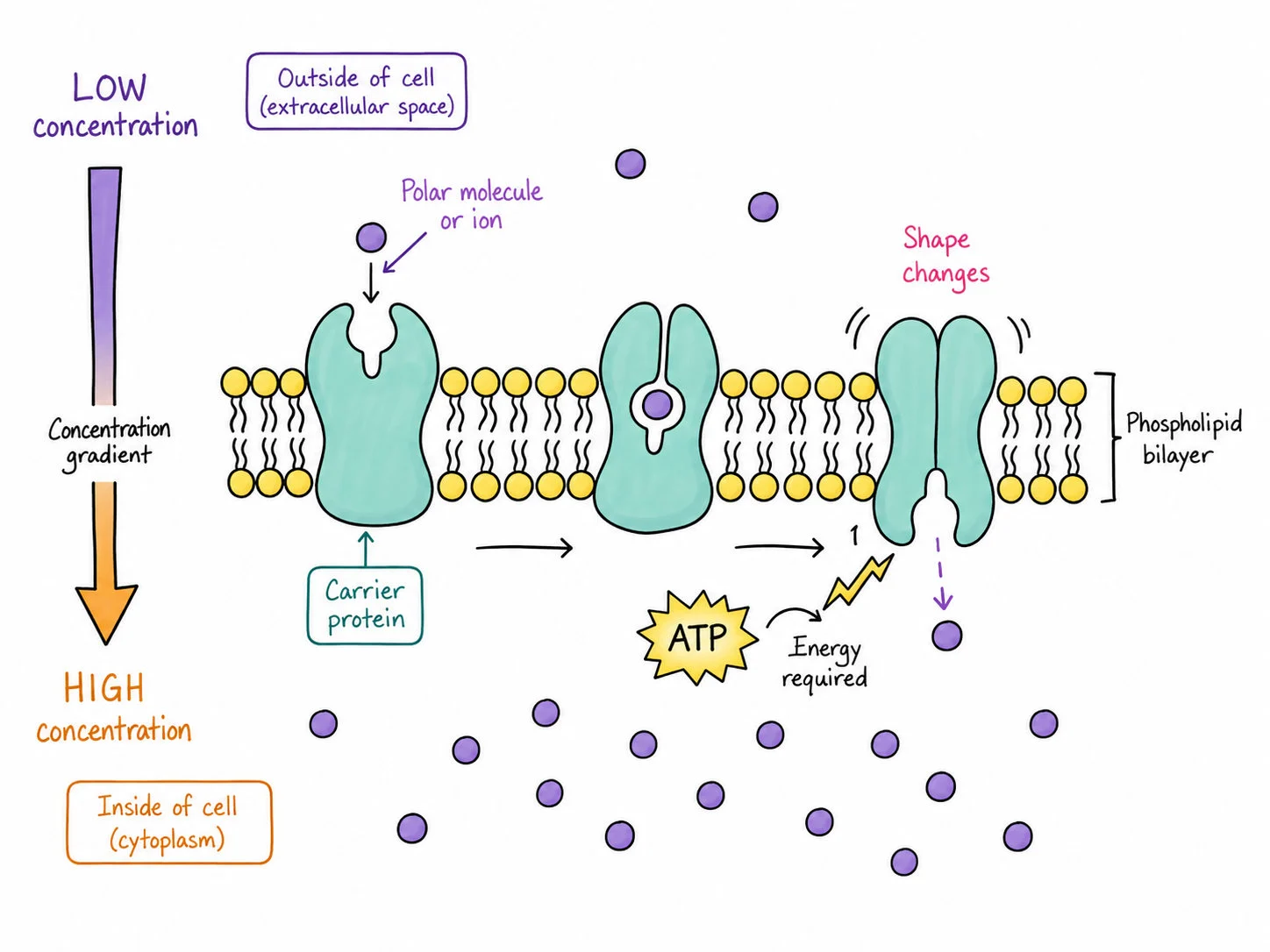
Active transport is the movement of particles against a concentration gradient (from a lower to a higher concentration) using energy from respiration. It needs carrier proteins in the cell membrane. Cells that carry out much active transport have many mitochondria.
| Feature | Diffusion | Osmosis | Active transport |
|---|---|---|---|
| Particles | Any | Water only | Ions, glucose |
| Direction | Down the gradient | High to low water potential | Against the gradient |
| Energy | No | No | Yes (respiration) |
| Membrane | Not needed | Partially permeable | Carrier proteins |
Examples
- absorption of the products of digestion from the lumen of the small intestine into the bloodstream (when glucose concentration in the gut is lower than in the blood);
- absorption of mineral ions from the soil into root hair cells, where the concentration of ions in the soil is lower than in the cell.
Section 4 of 18Real examples and worked reasoning
Diffusion explains how oxygen enters a cell, how carbon dioxide leaves a leaf and how the smell of food spreads through a room.
- and how the small intestine absorbs the last of the glucose from the gut.
Section 5 of 18Worked examples
Define osmosis. [2]2 marks
The diffusion of water through a partially permeable membrane from a region of higher water potential to a region of lower water potential.
Explain why a plant cell does not burst when placed in distilled water. [2]2 marks
Water enters and the cell becomes turgid, but the strong cell wall resists further expansion.
Give two differences between diffusion and active transport. [2]2 marks
Diffusion is down a gradient with no energy; active transport is against the gradient and requires energy from respiration.
Explain why root hair cells have many mitochondria. [2]2 marks
They absorb mineral ions by active transport, which needs energy from aerobic respiration.
Describe what happens to a plant cell in a concentrated sugar solution. [2]2 marks
Water leaves by osmosis, the vacuole and cytoplasm shrink and the membrane pulls away from the wall: the cell is plasmolysed.
Section 6 of 18Surface area to volume ratio
The surface area to volume ratio (SA:V) falls as an object gets bigger. For a cube with side length L: surface area = 6L2, volume = L3, so SA:V = 6 ÷ L.
| Side length (cm) | Surface area (cm2) | Volume (cm3) | SA:V |
|---|---|---|---|
| 0.5 | 1.5 | 0.125 | 12 : 1 |
| 1 | 6 | 1 | 6 : 1 |
| 2 | 24 | 8 | 3 : 1 |
Small organisms have a large SA:V, so diffusion alone is enough. Large organisms have a small SA:V and need specialised exchange surfaces and transport systems. The shorter the distance molecules must travel, the faster diffusion occurs, which is why alveoli and capillary walls are only one cell thick.
Section 7 of 18Factors affecting the rate of diffusion
| Factor | Effect |
|---|---|
| Concentration gradient | The greater the difference, the faster the diffusion; more random collisions occur against the membrane on the higher concentration side |
| Temperature | Higher temperature gives particles more kinetic energy, so faster diffusion |
| Surface area | Larger area gives more particles crossing at once |
| Diffusion distance | A shorter distance gives a faster rate |
Section 8 of 18Practical: diffusion in agar cubes
Agar prepared with sodium hydroxide and phenolphthalein indicator is pink.
- Use a ruler and a sharp scalpel to cut accurately.
Smaller cubes have a larger SA:V, so the acid has more area to enter per unit volume and they decolourise faster. Limitations: it is difficult to judge the endpoint (when the cube is completely colourless), which introduces human error; an improvement is to measure the distance in mm that the acid has diffused after a set time. It is also hard to cut cubes exactly the same size.
Section 9 of 18Practical set-up for osmosis in potato cylinders
Results are shown as percentage change in mass, calculated in the next stage.
Section 10 of 18Using the ratio in explanations
When asked why a small organism does not need a transport system, say that it has a large SA:V ratio and a short diffusion distance, so diffusion across its surface meets its needs.
Practice calculationa cell of side 4 cm has surface area 6 × 16 = 96 cm2, volume 64 cm3 and SA:V = 1.5 : 1, so it diffuses far more slowly than a 1 cm cube (6 : 1).
Section 11 of 18Worked examples
Calculate the SA:V of a cube of side 3 cm. [3]3 marks
Surface area = 6 × 9 = 54 cm2; volume = 27 cm3; ratio = 2 : 1.
Explain why a small cube decolourises faster than a large cube. [3]3 marks
It has a larger SA:V, so acid enters more quickly relative to its volume and a shorter distance to the centre.
State one limitation of timing the colour change. [1]1 mark
The endpoint is difficult to judge.
Why are capillary walls one cell thick? [1]1 mark
To give a short diffusion distance.
Suggest how to improve the agar-cube method. [1]1 mark
Measure the depth in mm the acid has diffused after a fixed time.
Section 12 of 18Calculating percentage change in mass
Because the potato cylinders may start with slightly different masses, results are expressed as a percentage change in mass:
percentage change = (final mass − initial mass) ÷ initial mass × 100
Gains are positive and losses negative.
Section 13 of 18Interpreting the results
| Solution | Water movement | Result for potato |
|---|---|---|
| Distilled water (0 mol/dm3) | Strong concentration gradient, water enters the cells by osmosis | Gains the most mass; turgor pressure increases; firm |
| Strongest sucrose solution | Water leaves by osmosis | Loses the most mass; cells flaccid and plasmolysed; soft |
| Concentration with no change | No net water movement | Same solute concentration as the cytoplasm, so no concentration gradient |
For osmosis questions, even about unfamiliar experiments, find the region of higher water potential (the more dilute solution, with few or no solutes) and explain that water moves from there to the lower water potential across the partially permeable membrane.
Section 14 of 18Reliability and CORMS evaluation
Slight differences between potato cylinders may mean the results are not reliable or comparable. Solution: for each sucrose concentration, repeat with several potato cylinders; any anomalous results can then be identified and ignored when a mean is calculated.
Apply CORMS: Change the concentration of sucrose solution; Organism: use cylinders cut from the same potato; Repeat for each concentration and calculate a mean; Measure the mass before and after, with the same balance; Same: control the volume of sucrose solution used, the dimensions of the potato cylinders, the time left in the solution and the temperature, and blot each cylinder before it is weighed each time.
Sources of error
- not blotting equally, cylinders with different surface areas, evaporation, and the time of immersion not being the same.
- To improve, use a cork borer for equal cylinders, use a narrower range of concentrations near the point of no change, and use more repeats.
Section 15 of 18Drawing the graph and choosing the concentration of no change
Plot sucrose concentration on the x-axis and percentage change in mass on the y-axis, with a ruler-drawn line of best fit or smooth curve through the points.
- so the solution has the same water potential as the potato cells;
- for example, a crossing at 0.3 mol/dm3 means the cell sap is equivalent to 0.3 mol/dm3 sucrose.
When answering a question about an unfamiliar osmosis experiment, name the region of higher water potential, state the direction of water movement and link it to the change in mass or in cell appearance. Do not say that the water “wants” to move; say that there is a net movement down a water potential gradient.
Section 16 of 18Worked examples
A potato cylinder has an initial mass of 3.00 g and a final mass of 2.40 g. Calculate the percentage change. [2]2 marks
(2.40 − 3.00) ÷ 3.00 × 100 = −20%.
Explain why the potato in distilled water gains mass. [3]3 marks
Distilled water has a higher water potential than the cells, so water enters by osmosis through the partially permeable membrane, increasing the mass.
A cylinder shows no change in mass in 0.3 mol/dm3 sucrose. What does this show? [2]2 marks
There is no net movement of water, so the solution has the same concentration as the cell sap.
State two variables to control. [2]2 marks
Volume of solution and size/surface area of the potato cylinders (or time, temperature).
Suggest how to make the results more reliable. [2]2 marks
Repeat with several cylinders for each concentration and calculate a mean, ignoring anomalous results.
Section 17 of 18Key terms
| Term | Meaning |
|---|---|
| Diffusion | Net movement of particles from high to low concentration. |
| Osmosis | Diffusion of water through a partially permeable membrane. |
| Active transport | Movement of particles against a concentration gradient using energy. |
| Water potential | A measure of the tendency of water to move; higher in dilute solutions. |
| Turgid | Firm because the cell is full of water. |
| Plasmolysed | Having lost water so the membrane pulls away from the cell wall. |
| Term | Meaning |
|---|---|
| SA:V ratio | Surface area divided by volume. |
| Concentration gradient | Difference in concentration between two regions. |
| Diffusion distance | The distance particles must travel across. |
| Phenolphthalein | An indicator that is pink in alkali and colourless in acid. |
| Cork borer | A tool for cutting potato cylinders of equal size. |
| Term | Meaning |
|---|---|
| Percentage change | Change divided by the original value, × 100. |
| Flaccid | Soft because the cell has lost water. |
| Turgor pressure | The pressure of cell contents pushing on the cell wall. |
| Anomalous result | A result that does not fit the pattern. |
| Reliability | How consistent repeated results are. |
Section 18 of 18Exam technique
Last updated:
Magnification Triangle & Unit Conversion
Formula: M = I / A ⇔ A = I / M ⇔ I = M × A
Units: 1 mm = 1,000 μm = 1,000,000 nm.
Rule: Convert Image size (ruler mm) to μm by ×1,000 before dividing by Actual size.