2.10Structures and Functions in Living Organisms
Co-ordination and Response — Edexcel Linear - OL Revision Notes & Topical Questions
15 min read 24 parts Lesson 25 of 25 Unit quiz
Response to the Environment, Homeostasis and Plant Responses — EDEXCEL LINEAR - OL notes: Explain why organisms respond to stimuli, how homeostasis is controlled by negative feedback and how auxin produces phototropism and geotropism.Organisms must detect changes (stimuli) in the…
- positive phototropism
- negative geotropism
- Worked example 1
- Worked example 2
- Worked example 3
- Worked example 4
Section 1 of 24Responding to change
Organisms must detect changes (stimuli) in their environment and respond to them to survive. In animals a stimulus is detected by a receptor, a coordinator (brain or spinal cord) decides the response, and an effector (muscle or gland) carries it out. Plants have no nervous system; they respond to stimuli by growth, controlled by hormones.
Section 2 of 24Homeostasis
Homeostasis is the maintenance of a constant internal environment.
- and works by negative feedback: if a level rises above normal, the response lowers it,
- and if it falls, the response raises it.
A coordinated response, such as that required when there is not enough water in the blood, needs a stimulus (low blood water potential detected by the brain), a coordinator (the brain and pituitary gland), a hormone (ADH) and an effector (the kidney), producing a response (more water reabsorbed).
Section 3 of 24Plant responses: tropisms and auxin
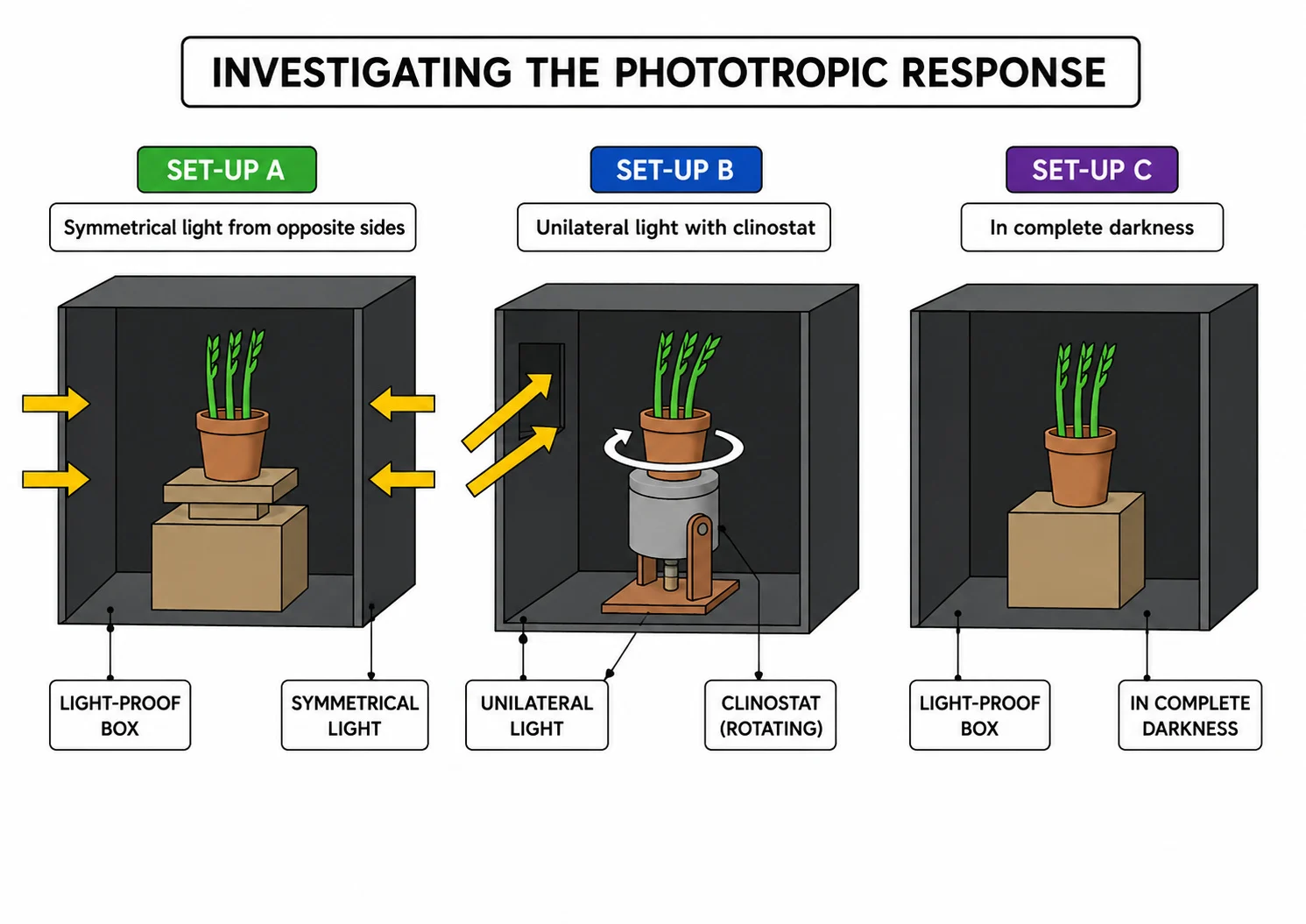
Plants grow in response to stimuli. Plant shoots display positive phototropism (growing towards a light source) and negative geotropism; roots display positive geotropism (growing down) and negative phototropism. The growth responses are controlled by the hormone auxin, produced in the shoot tip.
The benefit
- shoots growing towards light can photosynthesise more;
- roots growing downwards anchor the plant and reach water and minerals.
- Experiments with a shoot tip covered by foil, removed or with a mica barrier show that the tip detects light and makes auxin.
Section 4 of 24Exam practice: sequences and experiments
For a homeostasis question, write the sequence as a chain: change in the variable, detection by receptors, signal to the coordination centre, signal to the effector, response, and return to normal.
- whereas a shoot with the base covered did;
- later experiments with agar blocks showed that a chemical (auxin) produced in the tip moves down to the shaded side.
- and leave a third as a control, with light from one side; measure the angle of bend after a set time.
Remember that plant hormones act more slowly than animal nervous responses and that the response is a growth movement, not a movement by muscles. A further term is that auxin distribution is affected by gravity in roots and shoots: auxin collects on the lower side, which stimulates shoot cells to elongate (shoots grow up) but inhibits root cells (roots grow down).
Section 5 of 24Worked examples
Define homeostasis. [1]1 mark
The maintenance of a constant internal environment.
Explain how phototropism happens in a shoot. [4]4 marks
Auxin moves to the shaded side, causing cells there to elongate more, so the shoot bends towards the light.
Why is negative feedback important? [2]2 marks
It keeps conditions within narrow limits for enzymes and cells.
What is the effect of auxin on roots? [1]1 mark
High auxin inhibits elongation on the lower side, causing positive geotropism.
State the order of components in a response in animals. [3]3 marks
Stimulus, receptor, coordinator, effector, response.
Section 6 of 24Nervous and endocrine systems
| Nervous system | Endocrine system | |
|---|---|---|
| Made up of | Nerves, brain, spinal cord | Glands |
| Signals | Electrical impulses along neurones | Hormones in the blood |
| Speed | Fast | Slower |
| Duration | Short | Longer |
| Target | Specific effector | Target organs with receptors |
Section 7 of 24Structure of the nervous system
The human nervous system consists of the central nervous system (CNS: brain and spinal cord) and the peripheral nervous system (all nerves branching out from the CNS).
Section 8 of 24Synapses and the reflex arc
Neurones are not directly connected. At a synapse, an impulse arriving triggers release of neurotransmitter from vesicles; it diffuses across the gap and binds to receptors on the next neurone, starting a new impulse. Synapses ensure impulses pass in one direction only.
A reflex is an involuntary, automatic and rapid response that does not involve the conscious part of the brain. The pathway is: stimulus → receptor → sensory neurone → relay neurone in the CNS → motor neurone → effector → response. Reflexes such as pain withdrawal, blinking and coughing protect us from damage and choking.
Section 9 of 24Structure of the eye
| Part | Function |
|---|---|
| Conjunctiva | Clear membrane over the white of the eye and inside of the eyelids; lubricates and protects |
| Cornea | Transparent front that refracts light |
| Iris | Controls the size of the pupil |
| Lens | Focuses light onto the retina |
| Ciliary muscle | Changes the shape of the lens |
| Suspensory ligaments | Connect the ciliary muscle to the lens |
| Retina | Contains light receptor cells (rods and cones) |
| Fovea | Densely packed cones: detail and colour vision |
| Optic nerve | Carries impulses between the eye and the brain |
Section 10 of 24Describing the neurones and the speed of a reflex
A sensory neurone has a long dendron carrying impulses from the receptor to the cell body, which lies in a swelling outside the spinal cord, and a short axon entering the spinal cord.
- which are slower because the brain processes the information.
For a data question about reaction time, remember that the time for a reflex is short because there are only one or two synapses, whereas a voluntary response needs more neurones and the involvement of the conscious brain. Use these reasons to explain why a reflex is faster than a decision to move.
Section 11 of 24Worked examples
State two differences between nervous and hormonal control. [2]2 marks
Nervous control is faster and shorter; hormonal control uses blood and is slower and longer-lasting.
Name the three types of neurone in a reflex arc. [3]3 marks
Sensory, relay and motor neurones.
Describe how an impulse crosses a synapse. [3]3 marks
Neurotransmitter is released, diffuses across the gap and binds to receptors on the next neurone.
What is the function of the optic nerve? [1]1 mark
It carries impulses from the retina to the brain.
Explain why reflexes are useful. [2]2 marks
They are fast and automatic, protecting the body from harm.
Section 12 of 24Focusing: accommodation
The lens is elastic, and fine focusing is called accommodation. It is brought about by the contraction or relaxation of the ciliary muscles, which changes the tension in the suspensory ligaments and so the shape of the lens.
| Near objects | Distant objects | |
|---|---|---|
| Ciliary muscles | Contract | Relax |
| Suspensory ligaments | Loose (slack) | Tight (taut) |
| Lens shape | Fatter (more curved) | Thinner (flatter) |
| Light bending | More refraction | Less refraction |
The cornea does most of the refraction; the lens provides the fine adjustment so light is focused on the retina.
Section 13 of 24The pupil reflex
The iris contains radial and circular muscles that work antagonistically to change the pupil size and so the amount of light reaching the retina; this protects the retina from damage by bright light and allows vision in dim light.
| Stimulus | Radial muscles | Circular muscles | Pupil | Light entering |
|---|---|---|---|---|
| Bright light | Relaxed | Contracted | Narrow | Less |
| Dim light | Contracted | Relaxed | Wide | More |
Section 14 of 24The role of the skin in temperature regulation
The skin contains receptors for touch, pressure, pain, heat and cold. Structures in the skin play an important role in regulating body temperature, an example of homeostasis; the temperature must be maintained at about 37 °C. Temperature receptors send impulses to the brain, which coordinates a cooling or heating response.
| If too hot | If too cold |
|---|---|
| Vasodilation: muscles in arteriole walls relax, arterioles near the skin widen, more blood flows through skin capillaries, and more heat is lost by radiation | Vasoconstriction: muscles in arteriole walls contract, arterioles narrow, less blood flows through skin capillaries, so less heat is lost by radiation |
| Sweating: sweat evaporates from the skin, using heat energy from the body, cooling it | Sweating decreases, so less heat is lost by evaporation (and shivering generates heat) |
| Hair erector muscles relax: hairs lie flat, no insulating air layer | Hair erector muscles contract: hairs stand up, trapping insulating air (you do not need to mention this) |
If asked how the skin responds in a cold environment, focus on vasoconstriction and reduced sweating. Temperature regulation is an example of homeostasis because it must be maintained within a constant range.
Section 15 of 24Defects of vision and exam hints
In short sight (myopia) the eyeball is too long or the lens too curved, so distant objects are focused in front of the retina and look blurred; it is corrected by a concave (diverging) lens.
- so near objects are focused behind the retina; it is corrected by a convex (converging) lens.
- so the pathway is receptor, sensory neurone, relay neurone, motor neurone, iris muscles.
When describing the pupil reflex, state both stimulus and response, name the muscles and give the effect, for example: in bright light the circular muscles contract and the radial muscles relax, so the pupil gets smaller and less light reaches the retina, protecting it from damage.
Section 16 of 24Worked examples
Describe how the eye focuses on a nearby object. [4]4 marks
Ciliary muscles contract, suspensory ligaments slacken, and the lens becomes fatter so light is refracted more.
Explain what happens to the pupil in dim light. [3]3 marks
Radial muscles contract and circular muscles relax, so the pupil widens and more light enters.
Explain how vasodilation reduces body temperature. [3]3 marks
Arterioles to the skin widen, more blood flows near the surface, and more heat is lost by radiation.
Describe how the skin responds to cold. [3]3 marks
Vasoconstriction reduces blood flow to the skin and sweating decreases, reducing heat loss.
Why does sweating cool the body? [2]2 marks
Evaporating sweat takes heat energy from the skin.
Section 17 of 24What is a hormone?
A hormone is a chemical substance produced by a gland and carried by the blood, which alters the activity of one or more specific target organs. Hormones transmit information from one part of the organism to another and bring about a change.
Section 18 of 24Adrenaline and blood glucose
Adrenaline (adrenal glands) prepares the body for fight or flight: it increases heart rate and breathing rate, diverts blood to muscles, dilates the pupils and raises blood glucose, supplying muscles with more oxygen and glucose for respiration.
Blood glucose concentration must be kept within a narrow range, another example of homeostasis like body temperature.
- which is dangerous;
- if it is too low, the brain receives insufficient glucose for respiration, potentially causing a coma or death.
- which causes the liver to convert glucose to glycogen for storage;
- when it falls, glucagon causes the liver to convert glycogen to glucose.
Section 19 of 24Sex hormones
| Hormone | Source | Role |
|---|---|---|
| Testosterone | Testes | Male secondary sexual characteristics and sperm production |
| Oestrogen | Ovaries | Female secondary sexual characteristics (breast development, wider hips, pubic and underarm hair); rebuilds and thickens the uterus lining after menstruation |
| Progesterone | Ovaries (corpus luteum) | Maintains the uterus lining during pregnancy; prevents further ovulation |
Section 20 of 24ADH, FSH and LH
| Hormone | Source | Role | Effect |
|---|---|---|---|
| ADH | Pituitary | Controls blood water content | Increases permeability of the collecting ducts to water, so more water is reabsorbed |
| FSH | Pituitary | Causes a follicle to develop | Stimulates egg maturation and oestrogen release |
| LH | Pituitary | Causes ovary to release a mature egg cell | Stimulates ovulation and progesterone release |
Oestrogen and progesterone both prepare and maintain the uterus lining.
- from the corpus luteum, maintains the thick lining in case of pregnancy.
- (the empty egg follicle)
Section 21 of 24Diabetes and the comparison of hormone effects
Diabetes is a condition in which blood glucose is not controlled properly.
- so glucose stays high after meals;
- treatment is by monitoring blood glucose, controlling carbohydrate intake and injecting insulin.
- and the adrenal glands adrenaline.
In the exam, state the hormone, its source, its target and its effect in this order, because mark schemes follow this pattern. For example: insulin is released by the pancreas, acts on the liver and muscle cells, and lowers blood glucose by converting glucose to glycogen.
Section 22 of 24Worked examples
State the source and effect of insulin. [2]2 marks
The pancreas; it lowers blood glucose by causing the liver to store glucose as glycogen.
Explain why blood glucose must be controlled. [3]3 marks
Too high and cells lose water by osmosis; too low and the brain lacks glucose for respiration.
Describe the roles of FSH and LH. [4]4 marks
FSH causes follicle development; LH causes ovulation and progesterone release.
Name two effects of adrenaline. [2]2 marks
Increases heart rate and breathing rate.
What is the role of progesterone in pregnancy? [2]2 marks
It maintains the uterus lining and prevents ovulation.
Section 23 of 24Key terms
| Term | Meaning |
|---|---|
| Stimulus | A change in the environment detected by an organism. |
| Homeostasis | Maintenance of a constant internal environment. |
| Negative feedback | A response that reverses a change. |
| Auxin | A plant hormone controlling growth responses. |
| Phototropism | Growth in response to light. |
| Geotropism | Growth in response to gravity. |
| Term | Meaning |
|---|---|
| CNS | Central nervous system: brain and spinal cord. |
| Sensory neurone | Carries impulses from receptors to the CNS. |
| Motor neurone | Carries impulses from the CNS to effectors. |
| Relay neurone | Connects sensory and motor neurones in the CNS. |
| Synapse | The gap between neurones. |
| Reflex | A rapid automatic response. |
| Term | Meaning |
|---|---|
| Accommodation | Change in lens shape to focus on objects at different distances. |
| Ciliary muscle | Muscle that changes the lens shape. |
| Vasodilation | Widening of arterioles to the skin. |
| Vasoconstriction | Narrowing of arterioles to the skin. |
| Iris | Coloured part of the eye that controls pupil size. |
| Term | Meaning |
|---|---|
| Hormone | A chemical made by a gland and carried in the blood. |
| Insulin | Pancreatic hormone that lowers blood glucose. |
| Glucagon | Hormone that raises blood glucose by releasing glucose from glycogen. |
| Testosterone | Male sex hormone from the testes. |
| Corpus luteum | The empty follicle that makes progesterone. |
| Target organ | The organ affected by a hormone. |
Section 24 of 24Exam technique
Last updated:
\n