2.10Structures and Functions in Living Organisms
Co-ordination and Response — Edexcel Linear - OL Revision Notes & Topical Questions
15 min read 24 parts Lesson 25 of 25 Unit quiz
Response to the Environment, Homeostasis and Plant Responses — EDEXCEL LINEAR - OL notes: Explain why organisms respond to stimuli, how homeostasis is controlled by negative feedback and how auxin produces phototropism and geotropism.Organisms must detect changes (stimuli) in the…
- positive phototropism
- negative geotropism
- Worked example 1
- Worked example 2
- Worked example 3
- Worked example 4
Part 1 of 5Responding to change
Organisms must detect changes (stimuli) in their environment and respond to them to survive. In animals a stimulus is detected by a receptor, a coordinator (brain or spinal cord) decides the response, and an effector (muscle or gland) carries it out. Plants have no nervous system; they respond to stimuli by growth, controlled by hormones.
Part 2 of 5Homeostasis
Homeostasis is the maintenance of a constant internal environment.
- and works by negative feedback: if a level rises above normal, the response lowers it,
- and if it falls, the response raises it.
A coordinated response, such as that required when there is not enough water in the blood, needs a stimulus (low blood water potential detected by the brain), a coordinator (the brain and pituitary gland), a hormone (ADH) and an effector (the kidney), producing a response (more water reabsorbed).
Part 3 of 5Plant responses: tropisms and auxin
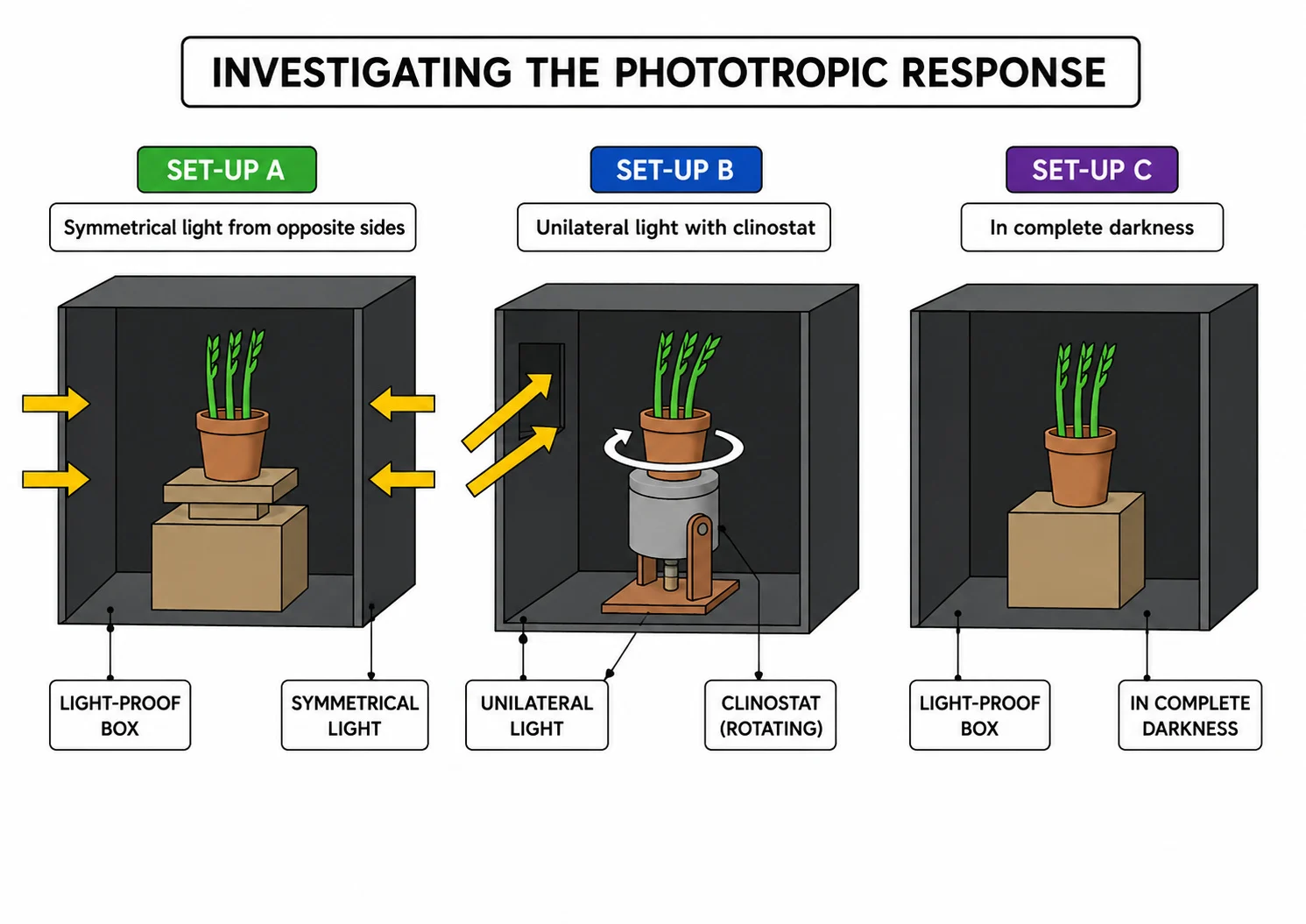
Plants grow in response to stimuli. Plant shoots display positive phototropism (growing towards a light source) and negative geotropism; roots display positive geotropism (growing down) and negative phototropism. The growth responses are controlled by the hormone auxin, produced in the shoot tip.
The benefit
- shoots growing towards light can photosynthesise more;
- roots growing downwards anchor the plant and reach water and minerals.
- Experiments with a shoot tip covered by foil, removed or with a mica barrier show that the tip detects light and makes auxin.
Part 4 of 5Exam practice: sequences and experiments
For a homeostasis question, write the sequence as a chain: change in the variable, detection by receptors, signal to the coordination centre, signal to the effector, response, and return to normal.
- whereas a shoot with the base covered did;
- later experiments with agar blocks showed that a chemical (auxin) produced in the tip moves down to the shaded side.
- and leave a third as a control, with light from one side; measure the angle of bend after a set time.
Remember that plant hormones act more slowly than animal nervous responses and that the response is a growth movement, not a movement by muscles. A further term is that auxin distribution is affected by gravity in roots and shoots: auxin collects on the lower side, which stimulates shoot cells to elongate (shoots grow up) but inhibits root cells (roots grow down).
Part 5 of 5Worked examples
Define homeostasis. [1]1 mark
The maintenance of a constant internal environment.
Explain how phototropism happens in a shoot. [4]4 marks
Auxin moves to the shaded side, causing cells there to elongate more, so the shoot bends towards the light.
Why is negative feedback important? [2]2 marks
It keeps conditions within narrow limits for enzymes and cells.
What is the effect of auxin on roots? [1]1 mark
High auxin inhibits elongation on the lower side, causing positive geotropism.
State the order of components in a response in animals. [3]3 marks
Stimulus, receptor, coordinator, effector, response.
Key terms
| Term | Meaning |
|---|---|
| Stimulus | A change in the environment detected by an organism. |
| Homeostasis | Maintenance of a constant internal environment. |
| Negative feedback | A response that reverses a change. |
| Auxin | A plant hormone controlling growth responses. |
| Phototropism | Growth in response to light. |
| Geotropism | Growth in response to gravity. |
Avoid these mistakes
Last updated:
\n