Theme C — Wave Behaviour
C.1.4 Time Period of a Simple Pendulum — IB Physics HL Revision Notes & Topical Questions
5 min read 11 parts Lesson 6 of 37 1 quiz
C.1.4 Time Period of a Simple Pendulum — IB PHYSICS SL notes: Use T = 2π√(l/g) for a simple pendulum and explain the small-angle condition.Simple pendulum — a small dense mass (the bob) on a light inextensible string of length l from a fixed pointThe string stays in tension throu…
- Restoring force
- Small angle
- What the symbols mean
- Seconds pendulum
- Angular frequency
- Reducing uncertainty
Section 1 of 11The simple pendulum
- Simple pendulum a small dense mass (the bob) on a light inextensible string of length l from a fixed point
- The string stays in tension throughout the oscillation.
- The bob is treated as a point mass and swings to and fro along a circular arc.
- Length l is measured from the pivot to the centre of mass of the bob
- Forces the bob feels its weight mg and the string tension
- The tension is perpendicular to the motion, so it provides the centripetal force and does no work.
- The component of weight along the arc controls the motion.
Section 2 of 11Why the motion is SHM
- Restoring force the component of weight along the arc is mg sin θ, directed back towards the lowest point
- Small angle for θ in radians sin θ ≈ θ, and the arc displacement is x = lθ
- F = −mgθ = −(mg/l)x.
- This is proportional to displacement and directed to equilibrium, so ω2 = g/l.
- Accuracy at 10° the approximation is accurate to about 0.5%, and at 30° the error is about 5%
- Condition the formula holds for angles below about 10°
- Beyond this the period grows with amplitude.
Section 3 of 11The period formula
- T = 2π√(l/g)What the symbols mean: T = period (s) · l = length of the pendulum (m) · g = 9.81 m s−2
- l is in m, g in m s−2 and T in s.
- T does not depend on the mass of the bob
- T does not depend on amplitude for small angles
- T depends on the gravitational field strength
- The period differs between Earth and the Moon.
- On the Moon, where g is about 1.6 m s−2, the same pendulum has a period about 2.5 times longer.
- Seconds pendulum a length of about 1 m gives a period of about 2 s
- ω = √(g/l)
Section 4 of 11Pendulum image: data and uncertainty questions
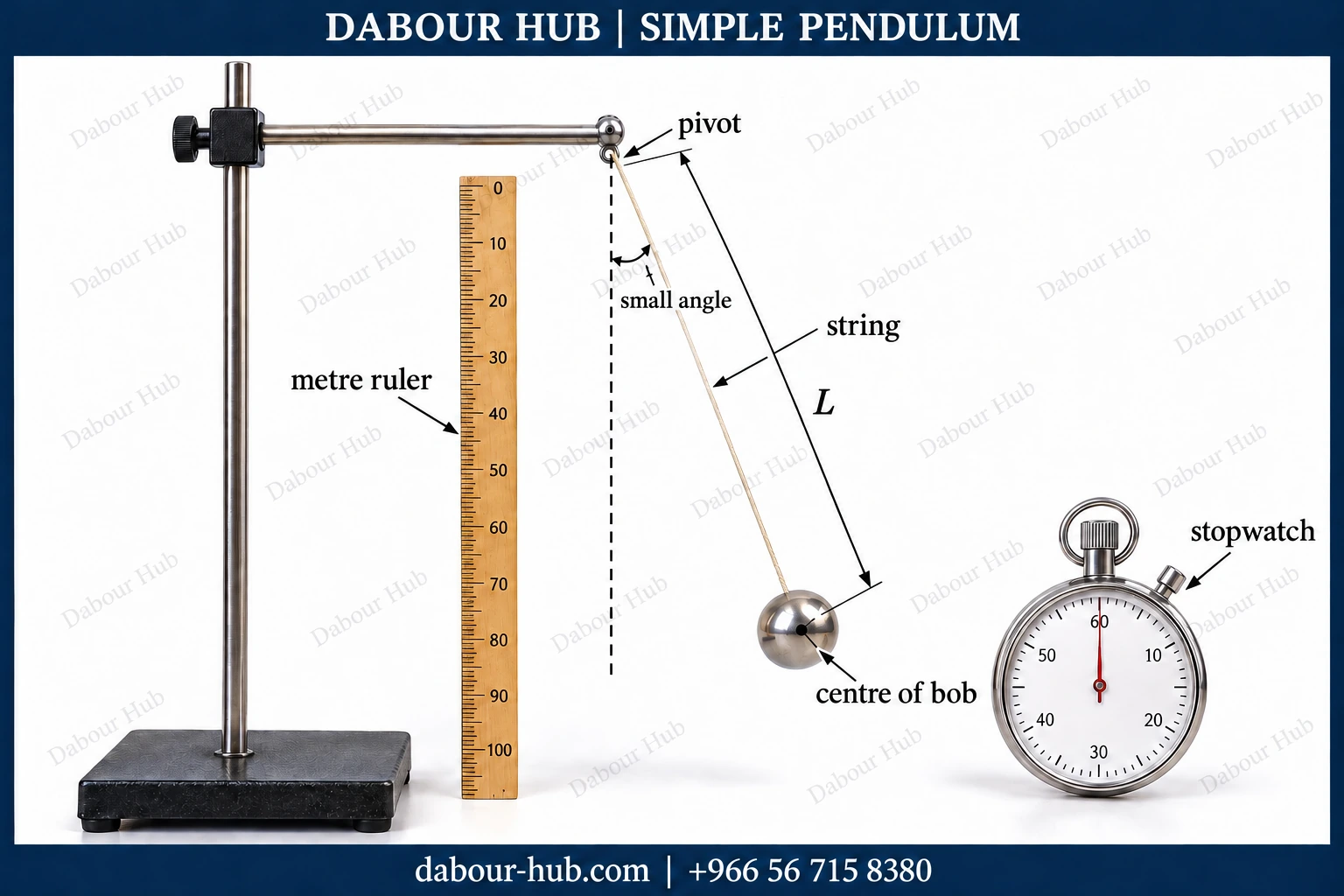
Use the existing apparatus model above. The following data are hypothetical practice data; do not read lengths or angles from the illustration.
1. The metal bob in the image is replaced by a denser bob of the same radius. The suspension-to-centre length and small release angle are unchanged. What happens to the period? (1 mark)
| Option | Statement |
|---|---|
| A | It increases in proportion to mass |
| B | It decreases in proportion to mass |
| C | It is unchanged in the ideal pendulum model |
| D | It doubles |
Show answer and explanation
C. The ideal small-angle formula T = 2π√(L/g) contains no mass. Changing mass alone does not change the period.
2. Why should the bob be released through a small angle in this experiment? (1 mark)
| Option | Statement |
|---|---|
| A | So sin θ is approximately θ in radians, making the restoring acceleration approximately proportional to displacement |
| B | So the string becomes slack at the bottom |
| C | So gravity becomes negligible |
| D | So all timing uncertainty disappears |
Show answer and explanation
A. For small angles, sin θ ≈ θ in radians. The tangential acceleration then has the form a = −(g/L)x, giving approximately simple harmonic motion.
3. Determine g from a graph. (3 marks)
A best-fit graph of T² on the vertical axis against L on the horizontal axis has gradient 3.98 s² m−1. Calculate g to 3 significant figures.
Show worked solution and marking points
- From T² = (4π²/g)L, gradient = 4π²/g. (1 mark)
- Rearrange to g = 4π²/gradient. (1 mark)
- g = 4π² / 3.98 = 9.92 m s−2, to 3 significant figures. (1 mark)
4. Convert a total time and its uncertainty. (3 marks)
A student records a time of (40.2 ± 0.2) s for 20 complete oscillations. Treat the count as exact. Find the period, its absolute uncertainty and its percentage uncertainty.
Show worked solution and marking points
- T = 40.2 / 20 = 2.01 s. (1 mark)
- ΔT = 0.2 / 20 = 0.01 s, so T = (2.01 ± 0.01) s. (1 mark)
- Percentage uncertainty = 100 × 0.01 / 2.01 = 0.50%, to 2 significant figures. (1 mark)
5. Propagate measurement uncertainty. (3 marks)
For g = 4π²L/T², measurements are L = (0.750 ± 0.005) m and T = (1.74 ± 0.02) s. Use the maximum percentage uncertainty rule to estimate the percentage uncertainty in g.
Show worked solution and marking points
- Fractional uncertainty in g ≈ ΔL/L + 2ΔT/T. (1 mark)
- Percentage uncertainty ≈ 100(0.005/0.750 + 2 × 0.02/1.74). (1 mark)
- The result is about 3.0%. This is a maximum uncertainty estimate using the stated rule. (1 mark)
6. Diagnose a length offset. (3 marks)
The student measures from the suspension point to the top of the spherical bob, recording Lm. A graph of T² against Lm has gradient 4.00 s² m−1 and vertical intercept 0.0200 s². Assume the only systematic error is the missing bob radius r. Find r.
Show worked solution and marking points
- The true length is L = Lm + r, so T² = (4π²/g)Lm + (4π²/g)r. (1 mark)
- Intercept = gradient × r, so r = intercept / gradient. (1 mark)
- r = 0.0200 / 4.00 = 0.00500 m = 5.00 mm.
- The positive intercept is consistent with measuring a length that is too short.
- (1 mark)
Section 5 of 11Experiment to find g
- T2 = (4π2/g)l, so the graph is a straight line through the origin
- Result g = 4π2/gradient
- Reducing uncertainty use a long thread, a small dense bob and many oscillations
Section 6 of 11Sources of error
- Systematic errors measuring l to the top of the bob instead of the centre, too large an amplitude, or an elliptical swing instead of a plane swing
- Random error reaction time, reduced by timing many oscillations
- Non-zero intercept a T2–l line with a non-zero intercept usually means a systematic error in l, such as missing the bob radius
- The line is shifted horizontally.
- Propagation g ∝ 1/T2, so a 1% uncertainty in T gives a 2% uncertainty in g
Section 7 of 11Related effects
- Mapping gravity pendulums were once used to map variations in g across the Earth
- Accelerating lift a pendulum in a lift accelerating upward feels a larger effective g, so its period is shorter
- Pendulum clock a rise in temperature expands the rod, so l increases, T grows and the clock runs slow
- On a mountain top, where g is slightly smaller, the period also lengthens.
- Energy the swing exchanges gravitational potential and kinetic energy (C.1.5)
Section 8 of 11More from the specification
- In simple harmonic motion (SHM), acceleration is directly proportional to displacement from the equilibrium position and directed in the opposite, negative direction (a = -ω²x).
- The time period of a simple pendulum depends on length and gravity (T = 2π√(L/g)),
- whereas a mass-spring system depends on mass and spring constant (T = 2π√(m/k)).What the symbols mean: T = period (s) · m = mass on the spring (kg) · k = spring constant (N m−1)
- Velocity reaches its maximum magnitude as an oscillating object passes through the central equilibrium position (x = 0),
- where potential energy is minimum.
- Graphical analysis shows a π/2 phase difference between displacement and velocity graphs,
- and a π phase difference between displacement and acceleration.
- Location relative to a reference point.
- Resonant mode of a stationary wave, with frequency a whole-number multiple of the fundamental where allowed.
- Not changing.
- Rate of change of displacement.
- Position where the net force is zero.
- A graph of displacement against time whose gradient is velocity.
- A graph of velocity against time whose gradient is acceleration and area is displacement.
- Stiffness k in N/m.
Section 9 of 11More from the specification
- Elastic potential
- It is stretched, squashed or bent.
Section 10 of 11Key terms
| Term | Meaning |
|---|---|
| Simple pendulum | A small mass on a light inextensible string oscillating through small angles. |
| Bob | The mass at the end of the pendulum. |
| Small-angle approximation | sin θ ≈ θ (radians) for small θ. |
| Seconds pendulum | A pendulum with a period of 2 s, about 1 m long. |
| Fiducial mark | A fixed reference point used to time the swings. |
Section 11 of 11Exam technique
Marked practiceQuizzes for this lesson
Last updated:
\n