6.2Plant Nutrition
Leaf structure — Cambridge IGCSE Biology 0610 Revision Notes & Topical Questions
5 min read 5 parts Lesson 3 of 6 1 quiz
Lesson summary
Photosynthesis and leaf structure — IGCSE BIOLOGY notes: Gas exchange in leaves; Leaf structure and adaptations.Pathway of CO2 — atmosphere → stomata → air spaces around spongy mesophyll → mesophyll cells → chloroplasts, all by diffusion.Day and night — plants respire all the tim…
- Hydrogencarbonate indicator
- Overall adaptations
- Guard cell
- Palisade mesophyll
- Vascular bundle
- In the dark only respiration occurs: oxygen is taken in and CO2 is released
Part 1 of 3Gas exchange in leaves
1Pathway of CO2
- Pathway of CO2 atmosphere → stomata → air spaces around spongy mesophyll → mesophyll cells → chloroplasts, all by diffusion.
2Day and night
- Day and night plants respire all the time but photosynthesise only in light.
- In bright light photosynthesis exceeds respiration: net uptake of CO2 and net release of O2.
- In the dark only respiration occursoxygen is taken in and CO2 is released.
3Hydrogencarbonate indicator
Hydrogencarbonate indicator shows CO2 level, because CO2 is acidic in water.
- Purple — low CO2; red — atmospheric level; yellow — high CO2.
| Tube | Conditions | Indicator | Conclusion |
|---|---|---|---|
| Leaf in light | Light | Purple | Net intake of CO2 |
| Leaf in dark | Dark | Yellow | Net release of CO2 by respiration |
| No leaf (control) | Light | Red | Control for comparison |
Part 2 of 3Leaf structure and adaptations
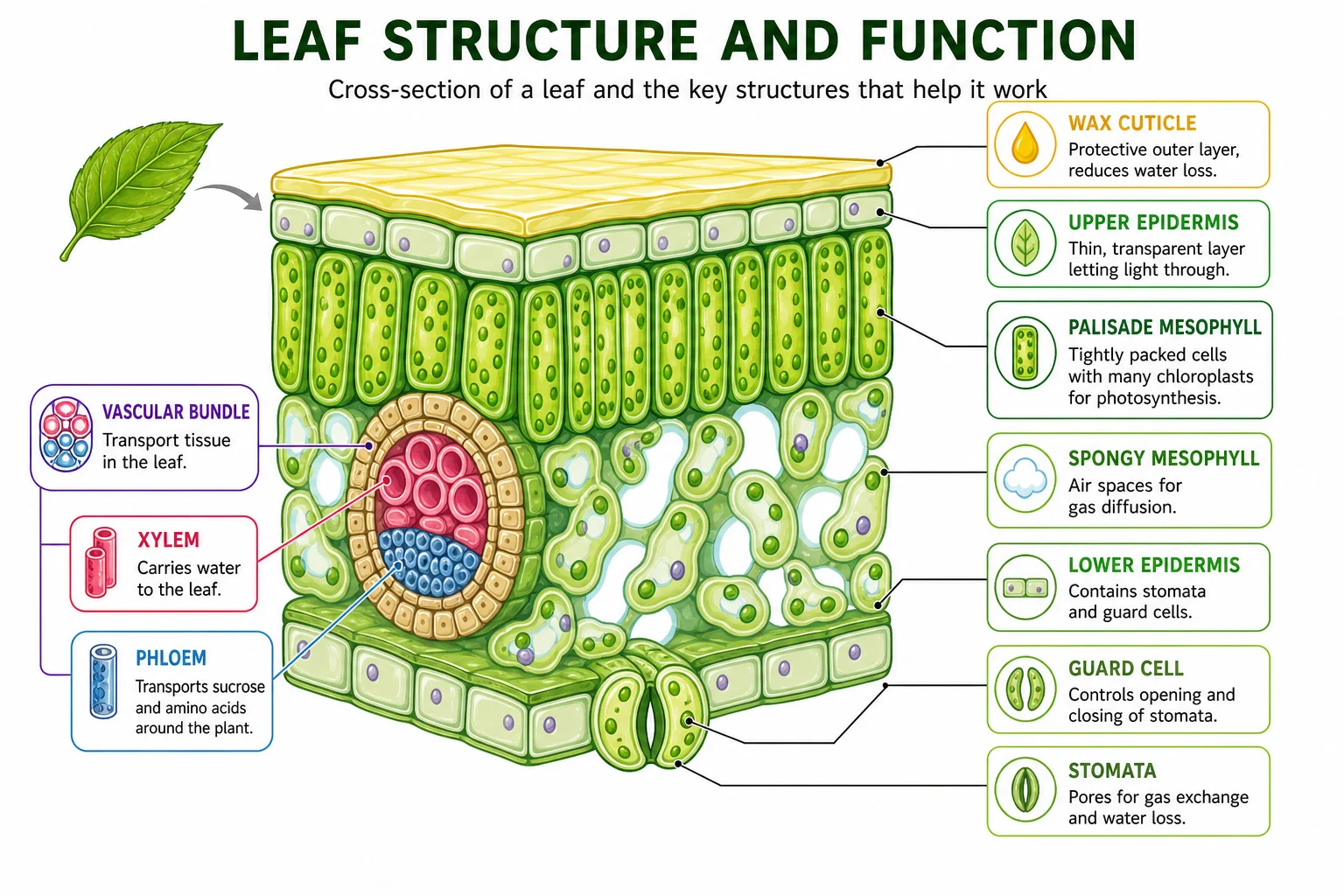
| Structure | Function / adaptation |
|---|---|
| Waxy cuticle | Waterproof layer that reduces water loss by evaporation; transparent so light passes through |
| Upper epidermis | Thin and transparent, so light reaches the palisade layer |
| Palisade mesophyll | Tall, tightly packed cells with many chloroplasts near the top surface, giving maximum light absorption |
| Spongy mesophyll | Loosely packed with large air spaces, so CO2 and O2 diffuse quickly; fewer chloroplasts |
| Lower epidermis with stomata and guard cells | Stomata allow gas exchange and can close to reduce water loss; guard cells change shape as they gain or lose water; more stomata on the lower surface reduce water loss |
| Vascular bundle (vein) | Xylem brings water and mineral ions; phloem carries away sucrose and amino acids; also supports the leaf |
- Overall adaptations of the leaf for photosynthesis.
- Large surface area absorbs more light and allows more gas exchange.
- Thin, so CO2 has a short diffusion distance to the mesophyll cells.
- Network of veins supplies water and removes products.
Part 3 of 3More from the specification
More from the specification
Balanced Chemical Equation for Photosynthesis
- The complete balanced biochemical reaction is6CO2 + 6H2O → C6H12O6 + 6O2, occurring inside chloroplasts in the presence of light and chlorophyll.
Interpreting Limiting Factor Curves
- On a rate-of-photosynthesis graph, the initial ascending slope indicates that the factor plotted on the x-axis limits the rate; once the curve plateaus, another environmental factor (temperature or carbon dioxide availability) has become limiting.
- (e.g. light intensity)
Carbohydrate Storage and Utilization
- Synthesized glucose is promptly converted into insoluble starch for osmotic neutrality and temporary leaf storage,
- or into sucrose for phloem translocation.
Light intensity
- Amount of light energy falling on a unit area.
Limiting factor
- Something in such short supply that it restricts a life process.
Chlorophyll
- A green pigment in chloroplasts that transfers energy from light into chemical energy.
Glucose
- A simple sugar; the unit that starch, glycogen and cellulose are built from.
Starch
- An insoluble polysaccharide of glucose used by plants for energy storage.
Carbohydrate
- A molecule of carbon, hydrogen and oxygen, including sugars, starch, glycogen and cellulose.
Key terms
| Term | Meaning |
|---|---|
| Stoma | A pore in the leaf epidermis, surrounded by two guard cells, that allows gas exchange. |
| Guard cell | One of a pair of cells that change shape to open or close a stoma. |
| Palisade mesophyll | A layer of tall, tightly packed cells with many chloroplasts; the main site of photosynthesis. |
| Spongy mesophyll | A layer of loosely packed cells with air spaces for gas diffusion. |
| Cuticle | A waxy waterproof layer covering the leaf that reduces water loss. |
| Vascular bundle | Xylem and phloem in a vein, transporting water and sucrose. |
Avoid these mistakes
- Plants respire only at night — they respire all the time and photosynthesise only in light.
Marked practiceQuizzes for this lesson
Last updated:
\n