16.1Reproduction
Asexual reproduction — Cambridge IGCSE Biology 0610 Revision Notes & Topical Questions
5 min read 8 parts Lesson 1 of 11 2 quizzes
Lesson summary
16.1 Asexual reproduction — IGCSE BIOLOGY notes: Define asexual reproduction, give examples, and weigh its advantages and disadvantages for wild species and crops.Asexual reproduction = a process resulting in genetically identical offspring from one parent.It involves no gametes,…
- Binary fission
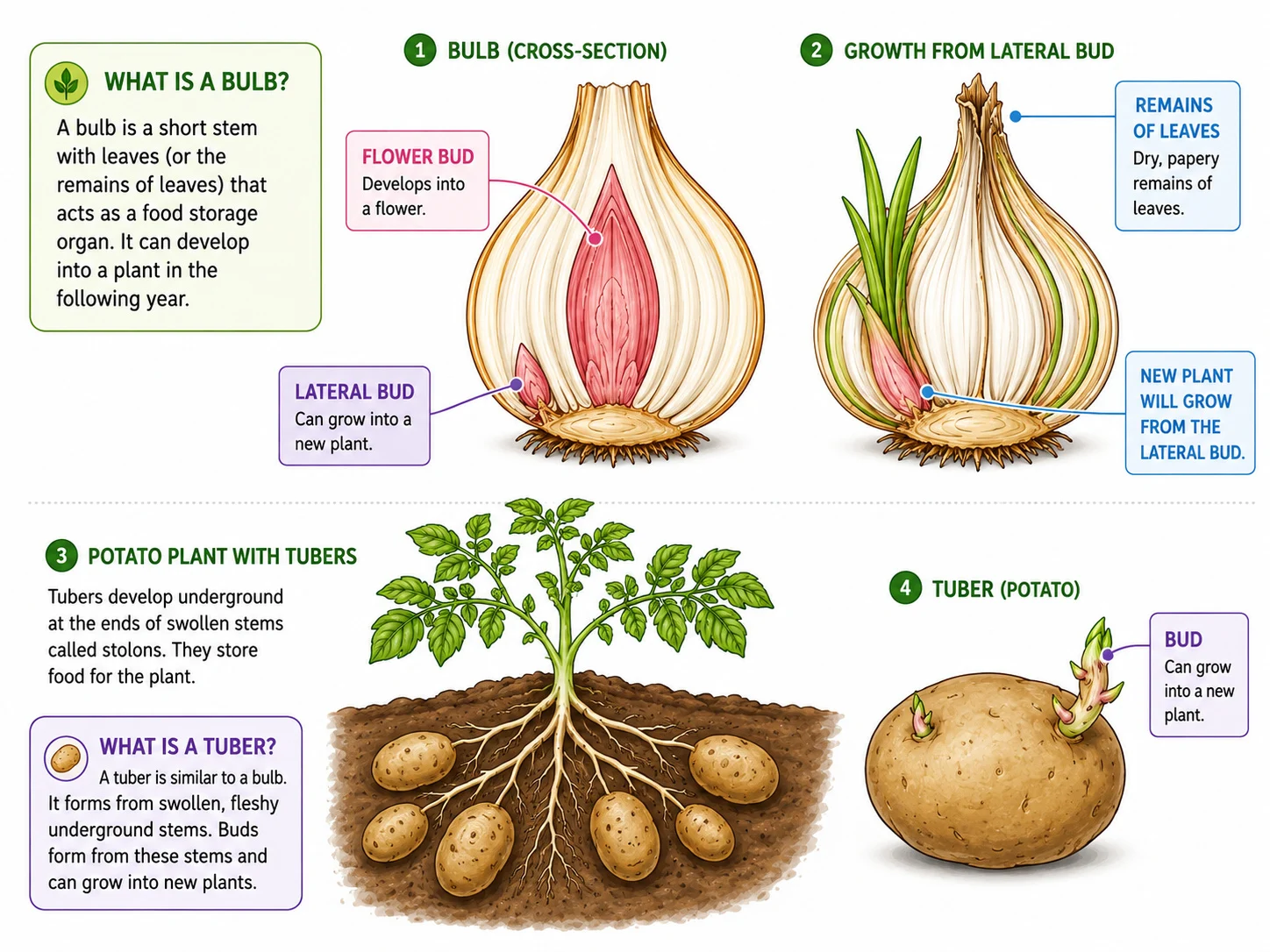
- Bulbs and tubers
- The offspring are clones of the parent and of each other
- Only mitosis is involved in making the new cells
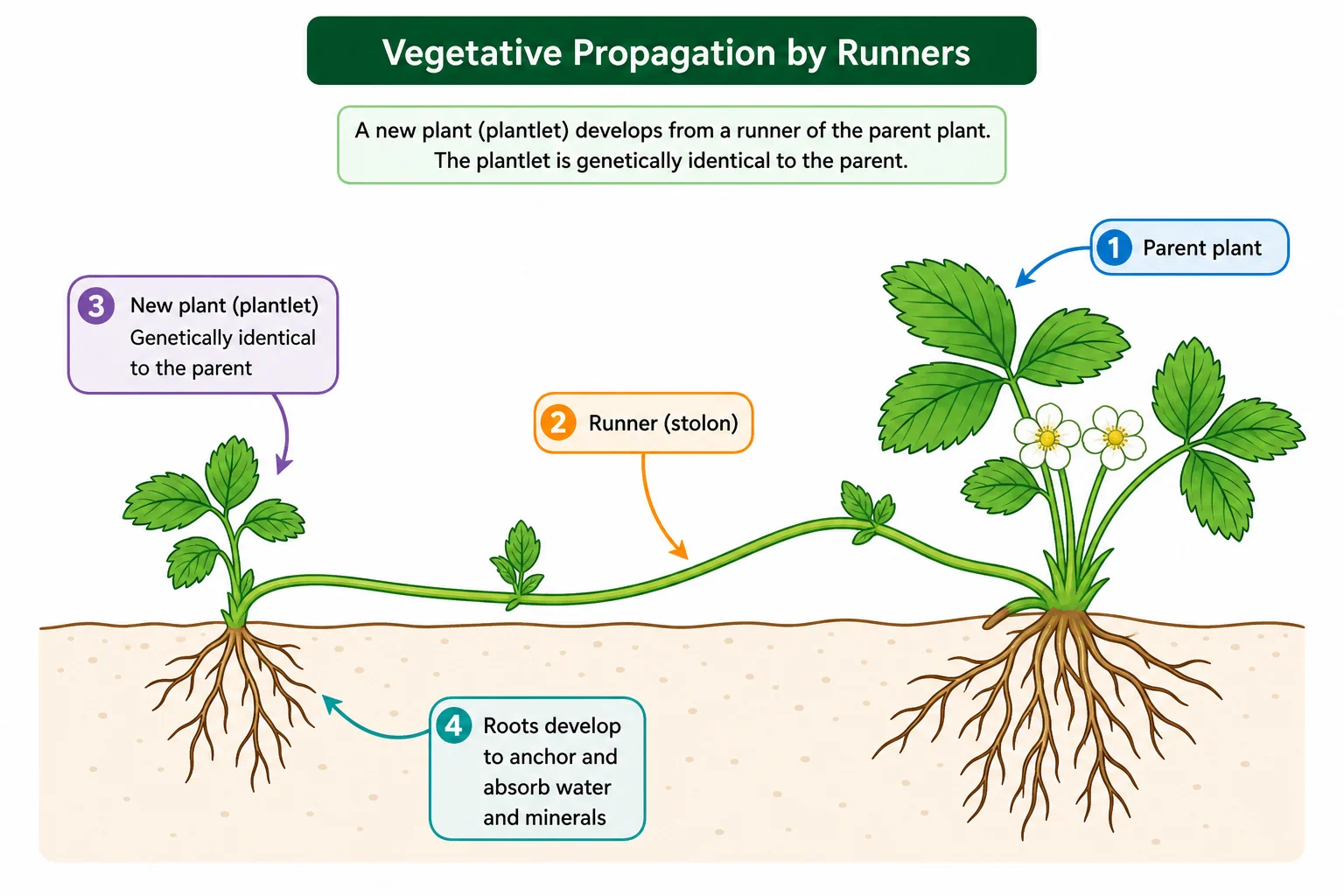
- Runners — side shoots with plantlets that root and become separate plants, as in strawberry
- Saying asexual offspring are similar — they are genetically identical
Part 1 of 6Asexual reproduction
Asexual reproduction
Asexual reproduction a process resulting in genetically identical offspring from one parent.
- It involves no gametes, no fertilisation and no mixing of genetic information.
- The offspring are clones of the parent and of each other.
Only mitosis is involved in making the new cells.
Part 2 of 6Examples in bacteria and plants
Binary fission
- Binary fission a bacterium divides to give two genetically identical daughter cells.
Bulbs and tubers
- Bulbs and tubers underground food storage organs from which buds grow into new plants, for example potato tubers.
Runners
- Runners side shoots with plantlets that root and become separate plants, as in strawberry.
Part 3 of 6Advantages and disadvantages: wild species
| Advantages | Disadvantages |
|---|---|
| Rapid population growth | Limited genetic variation as offspring are identical |
| Can exploit suitable environments quickly | Vulnerable to habitat changes such as temperature change, drought or new predators |
| More time and energy efficient | Disease is likely to affect the whole population |
| Completed much faster than sexual reproduction | No recombination of genes, so evolution is slow |
Part 4 of 6Advantages and disadvantages: crop plants
| Advantages | Disadvantages |
|---|---|
| Desired characteristics such as high yield or disease resistance are kept | Crops will not adapt to climate change |
| Uniform characteristics suit commercial sale | Requires human input and management |
| Production can be faster | A diseased parent gives diseased offspring |
| Cost is lower than buying seeds | Vulnerability to disease or pests may cause large financial losses |
Part 5 of 6Asexual compared with sexual reproduction
| Feature | Asexual | Sexual |
|---|---|---|
| Parents | One | Usually two |
| Gametes and fertilisation | None | Yes |
| Offspring | Genetically identical | Genetically varied |
| Speed and energy | Fast and efficient | Slower; needs a mate or pollinator |
Part 6 of 6More from the specification
1
Genetic Uniformity in Asexual Reproduction
- Asexual reproduction involves a single parent organism dividing by mitosis to yield genetically identical offspring (clones), preserving successful environmental adaptations without gametic fusion.
2
Natural Vegetative Propagation Mechanisms
- Many plant species propagate asexually through specialized vegetative organs such as horizontal runners (strawberries), stem tubers (potatoes),
- or bulbs (onions).
3
Commercial Advantages of Plant Micropropagation
- Cloning through tissue culture or vegetative cuttings allows agriculturalists to rapidly multiply crop varieties with desirable agronomic traits, high yields,
- and pathogen resistance.
4
Nucleus
- The part of the cell that controls its activities.
5
Germination
- The start of growth of a seed.
6
Oestrogen
- The main female sex hormone, made in the ovaries.
7
Progesterone
- A hormone that maintains the uterus lining.
8
Menstrual cycle
- A monthly series of changes in the female reproductive system controlled by hormones.
9
Pituitary gland
- The master gland whose hormones control other glands.
10
Structural adaptation
- An adaptation of body form.
11
Pollen
- Grains made by plants, each type with a different shape.
12
Uterus
- The organ in which the foetus develops.
13
Placenta
- The organ where substances are exchanged between mother and foetus.
14
Hormone
- A chemical substance produced by a gland and carried by the blood that alters the activity of specific target organs.
Key terms
| Term | Meaning |
|---|---|
| Asexual reproduction | Reproduction from one parent giving genetically identical offspring. |
| Clone | An organism genetically identical to its parent. |
| Binary fission | Division of one bacterial cell into two identical cells. |
| Tuber | An underground food storage organ that can grow into a new plant. |
| Runner | A side shoot carrying plantlets that root to form new plants. |
| Mitosis | Cell division producing genetically identical cells. |
Avoid these mistakes
Avoid these mistakes
Saying asexual offspring are similar — they are genetically identical.
Saying gametes are made by mitosis — gametes are haploid and made by meiosis; the zygote divides by mitosis.
Saying asexual reproduction needs fertilisation — it does not.
Marked practiceQuizzes for this lesson
Last updated:
\n