21.1Biotechnology and Genetic Modification
Biotechnology and genetic modification — Cambridge IGCSE Biology 0610 Revision Notes & Topical Questions
5 min read 12 parts Lesson 1 of 3 2 quizzes
Lesson summary
21.1 Biotechnology and genetic modification — IGCSE BIOLOGY notes: Describe why bacteria are useful, everyday uses of biotechnology, fermenters and mycoprotein, and genetic modification of bacteria and crops.Biotechnology = the use of living organisms, especially microorganisms, …
- Complex molecules
- Rapid reproduction
- Genetic code
- Anaerobic respiration
- Biofuel steps
- Biological washing powders
Part 1 of 10Why bacteria are useful
Biotechnology
Biotechnology the use of living organisms, especially microorganisms, or their enzymes to make useful products.
Complex molecules
- Complex molecules certain bacteria added to milk make enzymes that turn it into yoghurt.
Rapid reproduction
- Rapid reproduction the amount of product increases quickly.
Ethics
- Ethics few ethical concerns about growing them in large numbers.
Plasmids
- Plasmids an ideal way to transfer DNA between cells in genetic modification.
Genetic code
- Genetic code bacteria share the universal genetic code, so they can read a human gene and make the same protein.
Part 2 of 10Yeast: biofuels and bread
1Anaerobic respiration
- Anaerobic respiration yeast uses sugar and produces ethanol and carbon dioxide.
2Biofuel steps
- Biofuel steps break plant material into pieces and mix with yeast, yeast respires anaerobically to make ethanol, separate the liquid and remove water,
- then blend the ethanol with petrol or use it alone.
3Crop use
- Crop use waste parts of crops can be used, but crops grown for ethanol may reduce land for food.
4Bread
- Bread yeast mixed with flour and water respires anaerobically, and the carbon dioxide trapped in the dough makes it rise.
Part 3 of 10Fruit juice and washing powders
1Pectinase
- Pectinase breaks down pectin in plant cell walls, so cell walls break more easily.
2Juice
- Juice more juice is released and it is clearer because large polysaccharides are broken down.
3Biological washing powders
- Biological washing powders contain enzymes that break down fats and proteins into small soluble molecules.
4Advantages
- Advantages work at lower temperatures, saving energy, and suit delicate fabrics.
Part 4 of 10Lactose-free milk and penicillin
Lactose intolerance
- Lactose intolerance many people lose lactase as they get older, causing nausea, flatulence and diarrhoea after milk.
Lactose-free milk
- Lactose-free milk lactase is added to milk to break down the lactose.
Penicillin
- Penicillin the first antibiotic, discovered in 1928 by Alexander Fleming from the Penicillium mould, which kills certain bacteria.
Production
- Production now made on a large scale in industrial fermenters.
Part 5 of 10Industrial fermenters
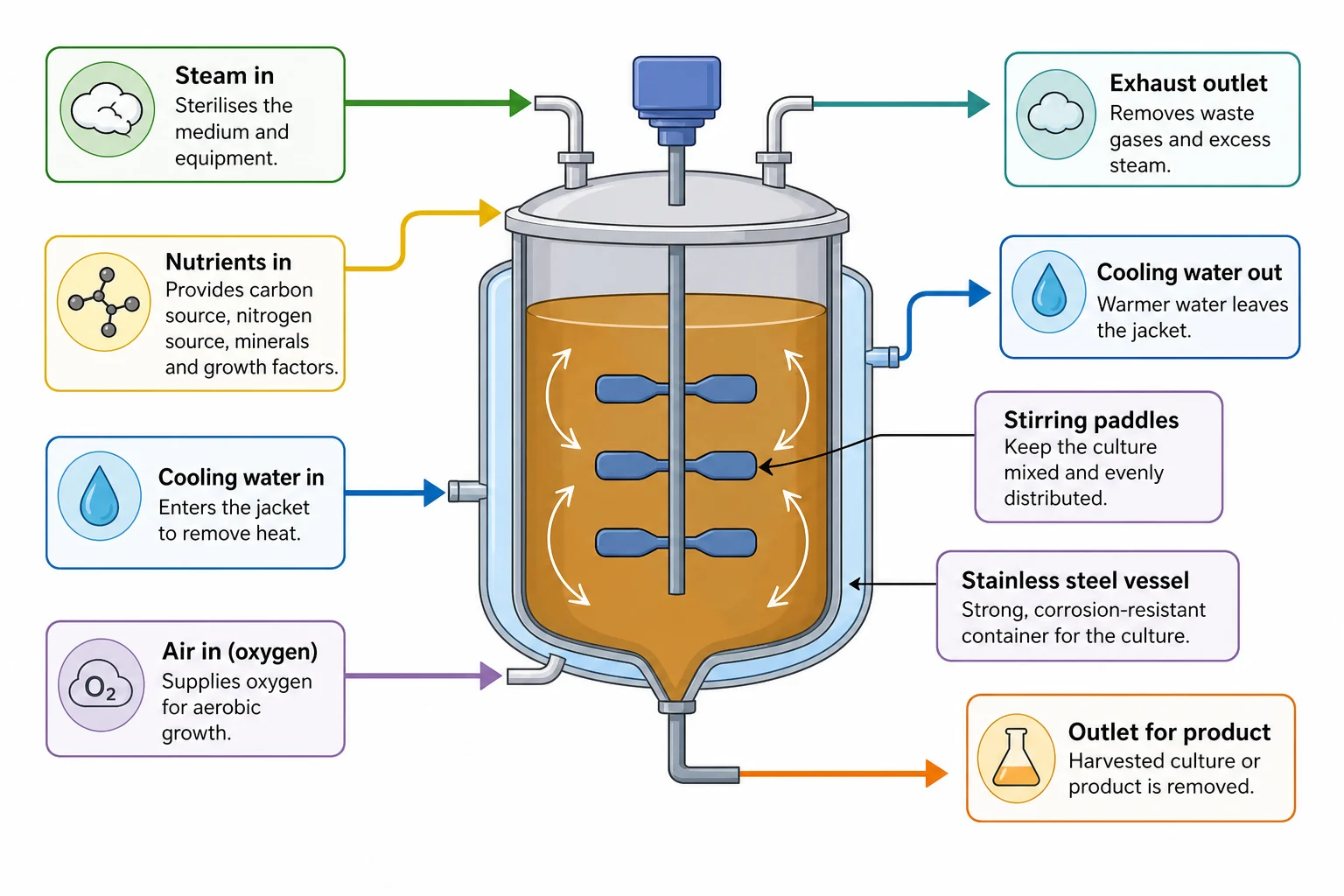
| Condition | How it is controlled |
|---|---|
| Aseptic precautions | Cleaned with steam to kill unwanted microorganisms |
| Nutrients | Supplied for respiration, growth and reproduction |
| Optimum temperature | Monitored by probes and kept using a water jacket |
| Optimum pH | Monitored by a probe and adjusted with acids and alkalis |
| Oxygenation | Oxygen supplied for aerobic respiration |
| Agitation | Stirring paddles distribute temperature, pH, nutrients and oxygen evenly |
| Waste | Contents are filtered to remove waste products |
Part 6 of 10Mycoprotein
1
The fungus Fusarium is cultured in large fermenters at optimum pH and temperature.
2
It is grown in aerobic conditions with glucose syrup as food.
3
The fungus grows and multiplies.
4
The fungal biomass is harvested and purified.
- Mycoprotein
- a protein-rich food suitable for vegetarians, used in Quorn products.
Part 7 of 10Genetic modification
Genetic modification
Genetic modification changing the genetic material of an organism by removing, changing or inserting individual genes from another organism.
Transgenic organism
- Transgenic organism the organism receiving the gene.
Recombinant DNA
- DNA containing DNA from another organism.
Examples
Examples insulin
- the human insulin gene is inserted into bacteria, which make insulin for diabetics.
Examples
Examples crops
- soya, maize and rice carry a bacterial gene for an insect-killing poison, or herbicide resistance.
Golden rice
- Golden rice has genes giving a chemical converted to vitamin A, helping prevent deficiency diseases.
Part 8 of 10Making a human protein in bacteria
1
Locate the human gene, for example for insulin.
2
Cut it out with restriction enzymes, leaving sticky ends.
3
Cut a bacterial plasmid with the same enzyme, giving matching sticky ends.
4
Join the gene and plasmid with DNA ligase.
5
Insert the recombinant plasmid into a bacterial cell.
6
The bacteria reproduce, copying the plasmid, and all make the human protein.
7
Grow the bacteria in a fermenter in controlled conditions to make large quantities.
Part 9 of 10GM crops
| Advantages | Disadvantages |
|---|---|
| Less use of herbicides and pesticides | Higher seed costs, which can disadvantage poorer farmers |
| Cheaper and less time-consuming for farmers | Greater dependence on certain chemicals |
| Higher yields as crops face less competition and pest damage | Inserted genes may spread to wild plants by pollination |
| Reduced biodiversity, affecting insects and insect-eating birds | |
| Some GM plants grow less well than non-GM plants |
Part 10 of 10More from the specification
- Genetically modified
- Having had genes from another organism inserted.
Key terms
| Term | Meaning |
|---|---|
| Biotechnology | Use of organisms or their enzymes to make useful products. |
| Fermenter | A container for growing microorganisms in large amounts. |
| Mycoprotein | Protein-rich food made from the fungus Fusarium. |
| Genetic modification | Changing an organism's genes by inserting, removing or altering them. |
| Plasmid | A circle of DNA in a bacterial cell used as a vector. |
| Restriction enzyme | An enzyme that cuts DNA at specific sequences, leaving sticky ends. |
| DNA ligase | An enzyme that joins pieces of DNA. |
| Transgenic | Containing a gene from another organism. |
Avoid these mistakes
1
Saying bacteria are used only because they are small — they reproduce rapidly, make complex molecules and have plasmids.
2
Saying yeast in bread respires aerobically only — it respires anaerobically and carbon dioxide raises the dough.
3
Mixing up restriction enzymes and ligase — restriction enzymes cut DNA and ligase joins it.
4
Saying GM crops have no risks — gene transfer, cost and biodiversity are concerns.
Marked practiceQuizzes for this lesson
Last updated:
\n