Curriculum
Mathematics
Unit 1
0/12
1.1Key terms1.2Laws and key relationships1.3Rigorous Derivation of Reciprocal Trigonometric Functions1.4Logarithmic and General Exponential Differentiation Techniques1.5Parametric and Implicit Second-Order Derivatives1.6Worked examples1.7Exam tips1.8Real-world applications1.9Key Scientific Tables & Anatomical Diagrams Extracted from Official Curricula1.10📌 Comprehensive Scientific Terminology Dictionary:1.11🔍 In-Depth Explanations, Deductions & Multi-Book Insights:1.12Lesson summary
Unit 2
0/141.1The counting principle1.2Permutations (nPr)1.3Combinations (nCr)1.4Worked examples on counting, permutations and combinations1.5Recall: counting principle, permutations and combinations1.61-1 (a) Pascal's triangle and the binomial expansion1.71-1 (b) The general term1.81-1 (c) The middle term1.91-2 The term containing xk and the term free of x1.101-3 (a) The ratio between two consecutive terms1.111-3 (b) The greatest term1.12Key Scientific Tables & Anatomical Diagrams Extracted from Official Curricula1.13Lesson 1 - Counting Principle, Permutations and Combinations and the Binomial Theorem1.14Lesson summary
Unit 3
0/131.1Key terms1.2Laws and key relationships1.3Geometry of 3D Vectors and Scalar/Cross Product Physics1.4Equations of Straight Lines in Three Dimensions1.5Equations of Planes and Perpendicular Distance Formulas1.6Worked examples1.7Exam tips1.8Real-world applications1.9Key Scientific Tables & Anatomical Diagrams Extracted from Official Curricula1.10📌 Comprehensive Scientific Terminology Dictionary:1.11⚖️ Governing Physical Laws & Mathematical Relations:1.12🔍 In-Depth Explanations, Deductions & Multi-Book Insights:1.13Lesson summary
Unit 4
0/81.11 Smooth and rough surfaces1.22 Properties of the static friction force1.33 Kinetic friction force1.44 The resultant reaction R′1.55 The angle of friction1.66 Equilibrium of a body on a rough horizontal plane1.77 Equilibrium of a body on a rough inclined plane1.88 Conditions of equilibrium and rigid bodies with friction
Unit 5
0/121.13-1 (a) Indefinite integrals of exponential functions1.23-1 (b) Indefinite integrals of logarithmic functions1.33-2 (a) The differential and the standard integrals1.43-2 (b) Integration by substitution1.53-2 (c) Integration by parts1.63-2 (d) Applications of the indefinite integral1.73-3 (a) The definite integral and the fundamental theorem of calculus1.83-3 (b) Properties of the definite integral1.93-3 (c) Definite integral by substitution, odd and even functions1.103-4 (a) Area of a plane region1.113-4 (b) Volumes of solids of revolution1.12Key Scientific Tables & Anatomical Diagrams Extracted from Official Curricula
Unit 6
0/81.12-1 (a) Polar coordinates and the Argand plane1.22-1 (b) Modulus, amplitude and principal amplitude1.32-1 (c) The trigonometric (polar) form of a complex number1.42-1 (d) Product and quotient in trigonometric form1.52-1 (e) The exponential (Euler) form1.62-2 (a) De Moivre's theorem for a positive integer power1.72-2 (b) De Moivre's theorem for a rational power and the roots of a complex number1.82-3 The cube roots of unity
Unit 7
0/101.11 Momentum and its change1.22 Newton's first law, inertia and force1.33 Newton's second law, the equation of motion and variable mass1.44 Newton's third law, lifts and scales1.55 Bodies connected by a string over a smooth pulley1.66 Impulse1.77 Work1.88 Kinetic energy and the work-energy principle1.99 Potential energy and conservation of energy1.1010 Power
Text lesson
Lesson 1 – Arithmetic and Geometric Sequences and Series
Lesson 1 – Arithmetic and Geometric Sequences and Series
Overview
Overview
🌳 Concept tree
- Lesson 1 – Arithmetic and Geometric Sequences and Series
├── Key terms
├── Laws and key relationships
- ├── Sequence Foundations and Theory of Arithmetic Progressions (A.P.)
- ├── Theory of Geometric Progressions (G.P.) and Convergence to Infinity
- ├── Sigma Notation (∑) and Analytical Summation Theorems
├── Worked examples
├── Exam tips
└── Real-world applications
Lesson 1 – Arithmetic and Geometric Sequences and Series · 1 / 9
Key terms
Key terms
| Comparison aspect | Main idea | Keywords |
|---|---|---|
| Sequence |
| functionwhosedomainpositive |
| Arithmetic Sequence (A.P.) | A sequence in which the difference between any term and its immediate predecessor is a constant real number d: T_(n+1) – Tn = d for all n ∈ ℤ+. | differencebetweentermimmediate |
| Geometric Sequence (G.P.) | A sequence in which the ratio of any term to its immediate predecessor is a constant non-zero real number r: T_(n+1) / Tn = r for all n ∈ ℤ+. | ratiotermimmediatepredecessor |
| Arithmetic Mean |
| realnumbersthreeform |
| Geometric Mean |
| numberssamesignthree |
Lesson 1 – Arithmetic and Geometric Sequences and Series · 2 / 9
Laws and key relationships
Laws and key relationships
| Comparison aspect | Main idea | Keywords |
|---|---|---|
| General Term of an Arithmetic Progression | [ Formula: Tn = a + (n – 1)d ] Where a is the first term, d is the common difference, and n is the term rank (n ∈ ℤ+). | Formulafirstcommondifference |
| Sum of First n Terms of an Arithmetic Progression | [ Formula: Sn = (n / 2)[2a + (n – 1)d] = (n / 2)[a + l] ] Where l is the last term (l = Tn). Represents the area under the linear sequence staircase. | FormulalastRepresentsarea |
| General Term and Infinite Sum of a Geometric Progression | [ Formula: Tn = a · rn – 1; S_∞ = a / (1 – r) (valid if and only if |r| < 1) ] If the common ratio satisfies -1 < r < 1, the infinite geometric series converges to a finite limiting value S_∞. | Formulavalidcommonratio |
Lesson 1 – Arithmetic and Geometric Sequences and Series · 3 / 9
Sequence Foundations and Theory of Arithmetic Progressions (A.P.)
Sequence Foundations and Theory of Arithmetic Progressions (A.P.)
- A sequence is formally defined as a mathematical mapping f ℤ+ → ℝ.
- Unlike continuous real functions defined on intervals, a sequence consists exclusively of discrete, ordered elements.
- The functional value f(n) is universally designated as the n-th term, denoted Tn.
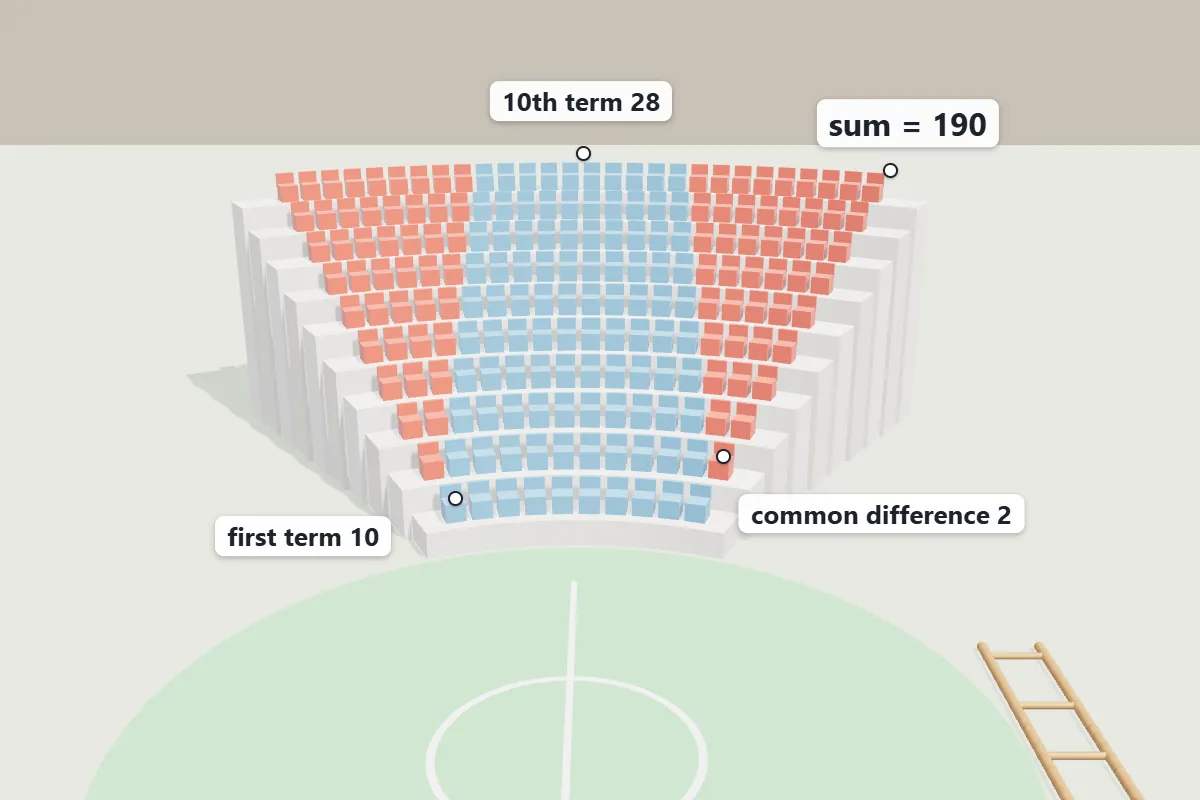
- An Arithmetic Progression (A.P.) is defined by the invariant linear recurrence relation: T_(n+1) – Tn = d (constant common difference).
- If d > 0, the progression is strictly increasing; if d < 0, it is strictly decreasing; if d = 0, it is a constant sequence.
- General Term Formula By mathematical induction, T1 = a, T2 = a + d, T3 = a + 2d, yielding the universal general term: Tn = a + (n – 1)d. Notice that Tn is a linear polynomial in n whose leading coefficient equals d.
- Summation of an A.P. (Gauss Formula): The sum Sn = T1 + T2 + … + Tn of the first n terms can be written forwards and backwards, summing pairs to yield: 2 Sn = n(a + l) → Sn = (n / 2)[a + l] = (n / 2)[2a + (n – 1)d], where l = Tn is the last term.
- Arithmetic Means When k terms are inserted between two numbers A and B to form an A.P., the total number of terms becomes n = k + 2. The common difference is: d = (B – A) / (k + 1). The first inserted mean is T2 = A + d, and the last inserted mean is T_(n-1) = B – d.
Lesson 1 – Arithmetic and Geometric Sequences and Series · 4 / 9
Theory of Geometric Progressions (G.P.) and Convergence to Infinity
Theory of Geometric Progressions (G.P.) and Convergence to Infinity
- A Geometric Progression (G.P.) is characterized by an invariant multiplicative factor: T_(n+1) / Tn = r (constant common ratio, r ≠ 0).
- General Term: T1 = a, T2 = ar, T3 = ar2, giving: Tn = a · rn – 1.
- Partial Sum Formula Multiplying the partial sum Sn = a + ar + ar2 + … + arn−1 by r and subtracting gives: Sn – r Sn = a – a rn → Sn = [a(1 – rn)] / (1 – r) = (a – l r) / (1 – r), where r ≠ 1.
- Infinite Series & Convergence What happens when the number of terms n approaches infinity? If |r| < 1 (i.e., -1 < r < 1), the term rn decays asymptotically to zero: limn -> ∞ rn = 0. Therefore, the infinite sum converges to: S_∞ = limn -> ∞ Sn = a / (1 – r). If |r| ≥ 1, rn diverges, and the sum to infinity does NOT exist.
Geometric Means→Inserting k geometric means between A and B produces a G.P. of n = k + 2 terms. Common ratio: r = (B / A)1 / (k + 1)).
Lesson 1 – Arithmetic and Geometric Sequences and Series · 5 / 9
Sigma Notation (∑) and Analytical Summation Theorems
Sigma Notation (∑) and Analytical Summation Theorems
| Comparison aspect | Main idea | Keywords |
|---|---|---|
| • | The Greek capital letter Sigma (∑) is used to denote series sums compactly: ∑_{r=1}n Tr = T1 + T2 + … + Tn. | GreekcapitalletterSigma |
| Analytical Summation Theorems |
| constantLinearity |
| (3) Sum of the first n positive integers | ∑{r=1}n r = 1 + 2 + … + n = [n(n + 1)] / 2. (4) Sum of the first n squares: ∑{r=1}n r2 = 12 + 22 + … + n2 = [n(n + 1)(2n + 1)] / 6 | squares |
| Index Shift Property |
| evaluateapply |
Lesson 1 – Arithmetic and Geometric Sequences and Series · 6 / 9
Worked examples
Worked examples
✍️ Worked examples
| Comparison aspect | Main idea | Keywords |
|---|---|---|
| Worked Example 1 | Finding the Maximum Partial Sum of an Arithmetic Sequence | FindingMaximumPartialArithmetic |
| Problem Statement |
| GivenarithmeticprogressionFind |
| Detailed Solution & Derivation |
| StepFirsttermCommon |
✍️ Worked examples→Geometric Sequence Formulation from Conditions
| Comparison aspect | Main idea | Keywords |
|---|---|---|
| Problem Statement |
| geometricsequencepositiveterms |
| • | Find the sequence and calculate the sum of its first 6 terms | Findsequencecalculatefirst |
| Detailed Solution & Derivation |
| StepSubstituteFactorSince |
Lesson 1 – Arithmetic and Geometric Sequences and Series · 7 / 9
Exam tips
Exam tips
| Comparison aspect | Main idea | Keywords |
|---|---|---|
| Exam Secret | To find the rank of the first negative term in an A.P., solve Tn < 0. The first integer strictly greater than the resulting decimal fraction is the rank. | findrankfirstnegative |
| Crucial Property | In any A.P., Tn = Sn – S_(n-1) for all n ≥ 2. For n = 1, T1 = S1. | |
| • |
| Rememberalternatinggeometricsequence |
Lesson 1 – Arithmetic and Geometric Sequences and Series · 8 / 9
Real-world applications
Real-world applications
| Comparison aspect | Main idea | Keywords |
|---|---|---|
| Financial Mathematics & Compound Interest | Bank investments compounding annually at interest rate i form a geometric progression: An = P(1 + i)n. | Bankinvestmentscompoundingannually |
| Nuclear Chain Reactions |
| uraniumfissionneutrongenerates |
| Depreciation of Capital Assets | Equipment book values diminishing at a constant annual depreciation percentage d follow a geometric decay curve: Vt = V0(1 – d)t. | Equipmentbookvaluesdiminishing |
| • |
| margin18pxbordersolid |
Lesson 1 – Arithmetic and Geometric Sequences and Series · 9 / 9
Well done! You finished this lesson
What would you like to do next?