Curriculum
Mathematics
Unit 1
0/12
1.1Key terms1.2Laws and key relationships1.3Rigorous Derivation of Reciprocal Trigonometric Functions1.4Logarithmic and General Exponential Differentiation Techniques1.5Parametric and Implicit Second-Order Derivatives1.6Worked examples1.7Exam tips1.8Real-world applications1.9Key Scientific Tables & Anatomical Diagrams Extracted from Official Curricula1.10📌 Comprehensive Scientific Terminology Dictionary:1.11🔍 In-Depth Explanations, Deductions & Multi-Book Insights:1.12Lesson summary
Unit 2
0/141.1The counting principle1.2Permutations (nPr)1.3Combinations (nCr)1.4Worked examples on counting, permutations and combinations1.5Recall: counting principle, permutations and combinations1.61-1 (a) Pascal's triangle and the binomial expansion1.71-1 (b) The general term1.81-1 (c) The middle term1.91-2 The term containing xk and the term free of x1.101-3 (a) The ratio between two consecutive terms1.111-3 (b) The greatest term1.12Key Scientific Tables & Anatomical Diagrams Extracted from Official Curricula1.13Lesson 1 - Counting Principle, Permutations and Combinations and the Binomial Theorem1.14Lesson summary
Unit 3
0/131.1Key terms1.2Laws and key relationships1.3Geometry of 3D Vectors and Scalar/Cross Product Physics1.4Equations of Straight Lines in Three Dimensions1.5Equations of Planes and Perpendicular Distance Formulas1.6Worked examples1.7Exam tips1.8Real-world applications1.9Key Scientific Tables & Anatomical Diagrams Extracted from Official Curricula1.10📌 Comprehensive Scientific Terminology Dictionary:1.11⚖️ Governing Physical Laws & Mathematical Relations:1.12🔍 In-Depth Explanations, Deductions & Multi-Book Insights:1.13Lesson summary
Unit 4
0/81.11 Smooth and rough surfaces1.22 Properties of the static friction force1.33 Kinetic friction force1.44 The resultant reaction R′1.55 The angle of friction1.66 Equilibrium of a body on a rough horizontal plane1.77 Equilibrium of a body on a rough inclined plane1.88 Conditions of equilibrium and rigid bodies with friction
Unit 5
0/121.13-1 (a) Indefinite integrals of exponential functions1.23-1 (b) Indefinite integrals of logarithmic functions1.33-2 (a) The differential and the standard integrals1.43-2 (b) Integration by substitution1.53-2 (c) Integration by parts1.63-2 (d) Applications of the indefinite integral1.73-3 (a) The definite integral and the fundamental theorem of calculus1.83-3 (b) Properties of the definite integral1.93-3 (c) Definite integral by substitution, odd and even functions1.103-4 (a) Area of a plane region1.113-4 (b) Volumes of solids of revolution1.12Key Scientific Tables & Anatomical Diagrams Extracted from Official Curricula
Unit 6
0/81.12-1 (a) Polar coordinates and the Argand plane1.22-1 (b) Modulus, amplitude and principal amplitude1.32-1 (c) The trigonometric (polar) form of a complex number1.42-1 (d) Product and quotient in trigonometric form1.52-1 (e) The exponential (Euler) form1.62-2 (a) De Moivre's theorem for a positive integer power1.72-2 (b) De Moivre's theorem for a rational power and the roots of a complex number1.82-3 The cube roots of unity
Unit 7
0/101.11 Momentum and its change1.22 Newton's first law, inertia and force1.33 Newton's second law, the equation of motion and variable mass1.44 Newton's third law, lifts and scales1.55 Bodies connected by a string over a smooth pulley1.66 Impulse1.77 Work1.88 Kinetic energy and the work-energy principle1.99 Potential energy and conservation of energy1.1010 Power
Text lesson
Lesson 1 – Rate of Change and Differentiation Rules
Lesson 1 – Rate of Change and Differentiation Rules
Overview
Overview
🌳 Concept tree
- Lesson 1 – Rate of Change and Differentiation Rules
├── Key terms
├── Laws and key relationships
- ├── Foundational Limits Variation, Average Rate, and the Derivative
- ├── Fundamental Algebraic Rules and Theorems of Differentiation
- ├── The Chain Rule, Tangent Lines, and Kinematic Motion
├── Worked examples
├── Exam tips
└── Real-world applications
Lesson 1 – Rate of Change and Differentiation Rules · 1 / 9
Key terms
Key terms
| Comparison aspect | Main idea | Keywords |
|---|---|---|
| Variation Function V(h) | The absolute change in the dependent variable y = f(x) corresponding to an increment h in the independent variable x: V(h) = f(x1 + h) – f(x1) | absolutechangedependentvariable |
| Average Rate of Change A(h) |
| ratiovariationfunctionvalue |
| Instantaneous Rate of Change (First Derivative f'(x)) | The limiting value of the average rate of change as h approaches zero: f'(x) = limh -> 0 [f(x + h) – f(x)] / h. Represents the slope of the tangent line to the curve at x. | limitingvalueaverageapproaches |
| Differentiability | A function f is differentiable at x = a if the limit definition of the derivative exists and is finite. Differentiability strictly implies continuity at that point | functiondifferentiablelimitdefinition |
| Normal Line | The straight line perpendicular to the tangent line at the exact point of tangency. Its slope satisfies: mnormal = -1 / mtangent (provided mtangent ≠ 0). | straightperpendiculartangentexact |
Lesson 1 – Rate of Change and Differentiation Rules · 2 / 9
Laws and key relationships
Laws and key relationships
| Comparison aspect | Main idea | Keywords |
|---|---|---|
| Limit Definition of the First Derivative (First Principles) | [ Formula: f'(x) = dy/dx = limh -> 0 [f(x + h) – f(x)] / h ] Calculates the instantaneous rate of change of f(x) by taking the limit of secant slopes as the distance between points collapses to zero. | FormulalimhCalculatesinstantaneous |
| Quotient Rule of Differentiation |
| Formuladerivativeequalsdenominator |
| The Chain Rule for Composite Functions | [ Formula: dy/dx = (dy/du) · (du/dx); d/dx [u(x)]n = n [u(x)]n – 1 · u'(x) ] Enables differentiation of nested functions by multiplying the derivative of the outer function by the derivative of the inner function. | FormulaEnablesdifferentiationnested |
Lesson 1 – Rate of Change and Differentiation Rules · 3 / 9
Foundational Limits: Variation, Average Rate, and the Derivative
Foundational Limits: Variation, Average Rate, and the Derivative
- Differential calculus originated from two classical geometric and physical problems: determining the slope of a tangent line to an arbitrary plane curve (Fermat and Leibniz) and calculating the instantaneous velocity of a moving body (Newton).
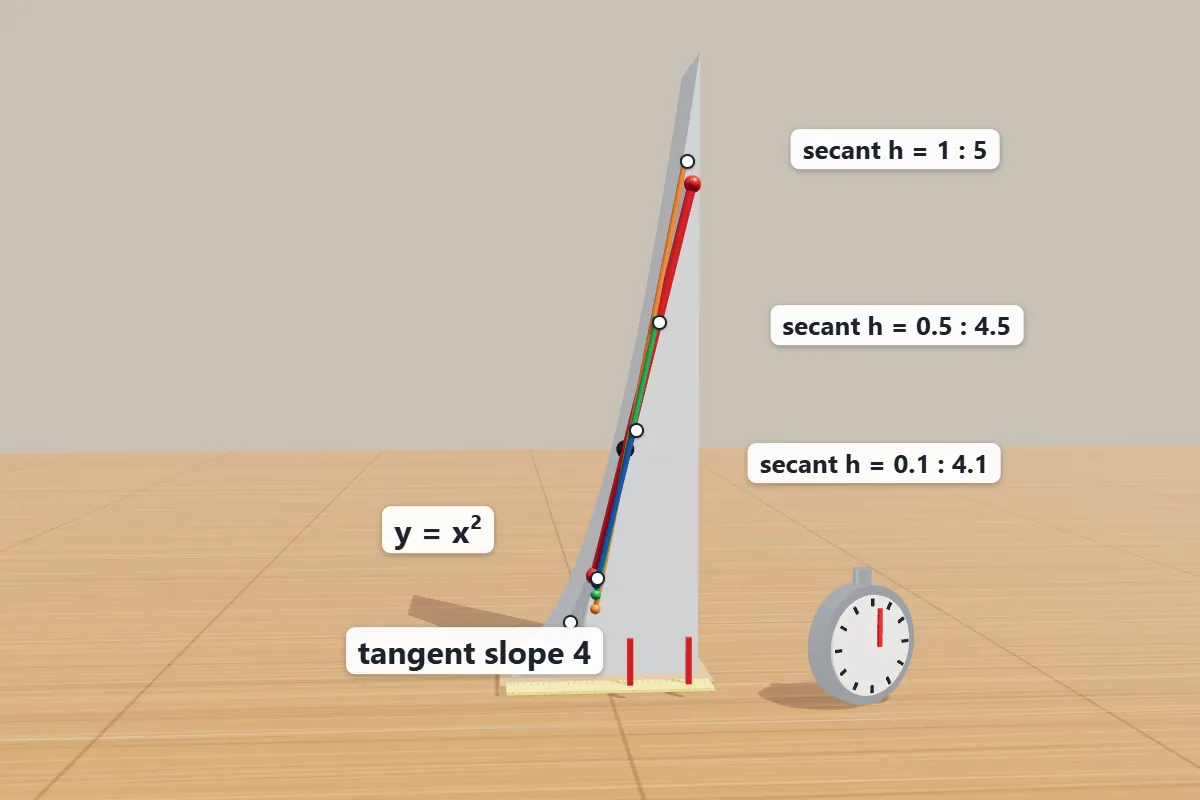
- Consider a function y = f(x). When x changes from an initial value x1 to x1 + h (where h = Δx is a non-zero increment):
- (1) The Variation Function V(h) measures the vertical displacement: V(h) = f(x1 + h) – f(x1).
- (2) The Average Rate of Change Function A(h) normalizes this variation per unit increment: A(h) = V(h) / h = [f(x1 + h) – f(x1)] / h.
- Geometrically, A(h) represents the slope msecant of the secant line cutting the curve through points P(x1, f(x1)) and Q(x1 + h, f(x1 + h)).
- (3) The Instantaneous Rate of Change (The First Derivative dy/dx or f'(x1)) is the limiting behavior as the increment h shrinks towards zero: dy/dx = limh -> 0 A(h) = limh -> 0 [f(x1 + h) – f(x1)] / h.
- As h → 0, point Q travels along the curve towards P, and the secant line PQ transitions smoothly into the unique Tangent Line at point P.
- The derivative equals the tangent slope: f'(x1) = tan θ, where θ is the positive angle made with the positive x-axis.
Lesson 1 – Rate of Change and Differentiation Rules · 4 / 9
Fundamental Algebraic Rules and Theorems of Differentiation
Fundamental Algebraic Rules and Theorems of Differentiation
| Comparison aspect | Main idea | Keywords |
|---|---|---|
| • |
| Evaluatinglimitdefinitionevery |
| (1) Constant Rule | The derivative of any constant real number c is zero: d/dx [c] = 0 (since a horizontal line y = c has zero slope) | derivativerealnumberzero |
| (2) Power Rule |
| realexponentExamples |
| (3) Constant Multiple Rule | d/dx [c · f(x)] = c · f'(x) | |
| (4) Sum and Difference Rule | d/dx [f(x) ± g(x)] = f'(x) ± g'(x) | |
| (5) Product Rule | The derivative of a product of two differentiable functions: d/dx [u(x) · v(x)] = u(x) · v'(x) + v(x) · u'(x) (First × derivative of second + Second × derivative of first) | derivativedifferentiablefunctionsFirst |
(6) Quotient Rule→For rational functions where denominator v(x) ≠ 0: d/dx [u(x) / v(x)] = [v(x) · u'(x) – u(x) · v'(x)] / [v(x)]2 (Denominator × derivative of numerator – Numerator × derivative of denominator, divided by denominator squared).
Lesson 1 – Rate of Change and Differentiation Rules · 5 / 9
The Chain Rule, Tangent Lines, and Kinematic Motion
The Chain Rule, Tangent Lines, and Kinematic Motion
- The Chain Rule If y is a differentiable function of u, and u is a differentiable function of x, then: dy/dx = (dy/du) · (du/dx). In particular, for a function raised to a power: d/dx [f(x)]n = n [f(x)]n – 1 · f'(x).
- Tangent and Normal Lines At any regular point P(x1, y1) lying on the curve y = f(x):
- A.
- Tangent Line Equation: Calculate slope m = f'(x1).
- The tangent line equation is: y – y1 = m(x – x1).
- If m = 0, the tangent is horizontal (y = y1).
- If the denominator of f'(x1) is zero, the tangent is vertical (x = x1).
- B.
- Normal Line Equation: Because the normal line is perpendicular to the tangent, its slope is mnormal = -1 / m.
- The normal line equation is: y – y1 = (-1 / m)(x – x1).
Kinematic Physical Applications→If s(t) represents the position vector of a particle at time t: (1) Instantaneous Velocity v(t) = ds/dt = s'(t). (2) Instantaneous Acceleration a(t) = dv/dt = d2s/dt2 = s”(t). When a particle changes its direction of motion, it comes to instantaneous rest: v(t) = 0.
Lesson 1 – Rate of Change and Differentiation Rules · 6 / 9
Worked examples
Worked examples
✍️ Worked examples
| Comparison aspect | Main idea | Keywords |
|---|---|---|
| Worked Example 1 | Tangent and Normal Equations to a Rational Function | TangentNormalEquationsRational |
| Problem Statement | Find the equations of both the tangent line and the normal line to the curve y = (3x – 1) / (x + 1) at the point where x = 1 | Findequationsbothtangent |
| Detailed Solution & Derivation |
| StepFindcoordinateTangency |
| Comparison aspect | Main idea | Keywords |
|---|---|---|
| Worked Example 2 | Kinematic Motion Analysis via Derivatives | KinematicMotionAnalysisDerivatives |
| Problem Statement |
| projectilemovesalongstraight |
| Detailed Solution & Derivation |
| StepVelocityParticlerest |
Lesson 1 – Rate of Change and Differentiation Rules · 7 / 9
Exam tips
Exam tips
| Comparison aspect | Main idea | Keywords |
|---|---|---|
| Exam Secret |
| Continuitydoesimplydifferentiability |
| Exam Trap |
| tangentlinemakesobtuse |
| • |
| findingratechangearea |
Lesson 1 – Rate of Change and Differentiation Rules · 8 / 9
Real-world applications
Real-world applications
| Comparison aspect | Main idea | Keywords |
|---|---|---|
| Economic Marginal Analysis |
| macroeconomicscostderivativetotal |
| Aerospace Trajectory Optimization | Rocket guidance computers calculate instantaneous rates of velocity change to adjust propellant throttle and maintain stable orbital insertion | Rocketguidancecomputerscalculate |
| Civil Engineering Stress Analysis | Structural deflection of suspension bridges under vehicle loads is modeled using fourth-order differential equations derived from curvature slopes | Structuraldeflectionsuspensionbridges |
| • |
| margin18pxbordersolid |
Lesson 1 – Rate of Change and Differentiation Rules · 9 / 9
Well done! You finished this lesson
What would you like to do next?