Curriculum
Mathematics
Unit 1
0/12
1.1Key terms1.2Laws and key relationships1.3Rigorous Derivation of Reciprocal Trigonometric Functions1.4Logarithmic and General Exponential Differentiation Techniques1.5Parametric and Implicit Second-Order Derivatives1.6Worked examples1.7Exam tips1.8Real-world applications1.9Key Scientific Tables & Anatomical Diagrams Extracted from Official Curricula1.10📌 Comprehensive Scientific Terminology Dictionary:1.11🔍 In-Depth Explanations, Deductions & Multi-Book Insights:1.12Lesson summary
Unit 2
0/141.1The counting principle1.2Permutations (nPr)1.3Combinations (nCr)1.4Worked examples on counting, permutations and combinations1.5Recall: counting principle, permutations and combinations1.61-1 (a) Pascal's triangle and the binomial expansion1.71-1 (b) The general term1.81-1 (c) The middle term1.91-2 The term containing xk and the term free of x1.101-3 (a) The ratio between two consecutive terms1.111-3 (b) The greatest term1.12Key Scientific Tables & Anatomical Diagrams Extracted from Official Curricula1.13Lesson 1 - Counting Principle, Permutations and Combinations and the Binomial Theorem1.14Lesson summary
Unit 3
0/131.1Key terms1.2Laws and key relationships1.3Geometry of 3D Vectors and Scalar/Cross Product Physics1.4Equations of Straight Lines in Three Dimensions1.5Equations of Planes and Perpendicular Distance Formulas1.6Worked examples1.7Exam tips1.8Real-world applications1.9Key Scientific Tables & Anatomical Diagrams Extracted from Official Curricula1.10📌 Comprehensive Scientific Terminology Dictionary:1.11⚖️ Governing Physical Laws & Mathematical Relations:1.12🔍 In-Depth Explanations, Deductions & Multi-Book Insights:1.13Lesson summary
Unit 4
0/81.11 Smooth and rough surfaces1.22 Properties of the static friction force1.33 Kinetic friction force1.44 The resultant reaction R′1.55 The angle of friction1.66 Equilibrium of a body on a rough horizontal plane1.77 Equilibrium of a body on a rough inclined plane1.88 Conditions of equilibrium and rigid bodies with friction
Unit 5
0/121.13-1 (a) Indefinite integrals of exponential functions1.23-1 (b) Indefinite integrals of logarithmic functions1.33-2 (a) The differential and the standard integrals1.43-2 (b) Integration by substitution1.53-2 (c) Integration by parts1.63-2 (d) Applications of the indefinite integral1.73-3 (a) The definite integral and the fundamental theorem of calculus1.83-3 (b) Properties of the definite integral1.93-3 (c) Definite integral by substitution, odd and even functions1.103-4 (a) Area of a plane region1.113-4 (b) Volumes of solids of revolution1.12Key Scientific Tables & Anatomical Diagrams Extracted from Official Curricula
Unit 6
0/81.12-1 (a) Polar coordinates and the Argand plane1.22-1 (b) Modulus, amplitude and principal amplitude1.32-1 (c) The trigonometric (polar) form of a complex number1.42-1 (d) Product and quotient in trigonometric form1.52-1 (e) The exponential (Euler) form1.62-2 (a) De Moivre's theorem for a positive integer power1.72-2 (b) De Moivre's theorem for a rational power and the roots of a complex number1.82-3 The cube roots of unity
Unit 7
0/101.11 Momentum and its change1.22 Newton's first law, inertia and force1.33 Newton's second law, the equation of motion and variable mass1.44 Newton's third law, lifts and scales1.55 Bodies connected by a string over a smooth pulley1.66 Impulse1.77 Work1.88 Kinetic energy and the work-energy principle1.99 Potential energy and conservation of energy1.1010 Power
Text lesson
Lesson 1: Complex Numbers in Trigonometric and Exponential Form and De Moivres Theorem
Lesson 1: Complex Numbers in Trigonometric and Exponential Form and De Moivres Theorem
Overview
Overview
- Represent a complex number and its conjugate on the Argand plane and find its modulus and (principal) amplitude.
- Write a complex number in trigonometric and exponential (Euler) form, and multiply and divide in these forms.
- Use De Moivre’s theorem for powers, identities and the n-th roots of a complex number.
- Know the cube roots of unity, their properties and their applications.
🌳 Concept tree
- Lesson 1 Complex Numbers in Trigonometric and Exponential Form and De Moivres Theorem
- ├── 2-1 (a) Polar coordinates and the Argand plane
│ ├── Polar and Cartesian coordinates
│ ├── Argand plane
│ └── Symmetry on the Argand plane
- ├── 2-1 (b) Modulus
- amplitude and principal amplitude
│ ├── Definitions
- │ ├── Finding the principal amplitude from the quadrant of
│ └── Properties of the modulus and amplitude
- ├── 2-1 (c) The trigonometric (polar) form of a complex number
│ ├── The form
│ ├── Useful special values
│ └── Numbers that are not in standard form
- ├── 2-1 (d) Product and quotient in trigonometric form
│ ├── Rules
│ └── Consequences
├── 2-1 (e) The exponential (Euler) form
│ ├── Series that lead to Euler's formula
│ ├── Euler's formula
│ ├── Product and quotient in exponential form
- │ └── Expressing sine and cosine with exponentials
- ├── 2-2 (a) De Moivre's theorem for a positive integer power
│ ├── Statement
- │ └── Using the theorem to prove trigonometric identities
- ├── 2-2 (b) De Moivre's theorem for a rational power and the roots of a complex number
│ ├── Rational power
│ ├── The n-th roots of a complex number
- │ ├── Square roots of a complex number in algebraic form
- │ └── Quadratic equations with complex coefficients
└── 2-3 The cube roots of unity
├── Finding them
├── Properties of the cube roots of unity
└── Applications
Lesson 1: Complex Numbers in Trigonometric and Exponential Form and De Moivres Theorem · 1 / 10
2-1 (a) Polar coordinates and the Argand plane
2-1 (a) Polar coordinates and the Argand plane
Polar and Cartesian coordinates
| Comparison aspect | Main idea | Keywords |
|---|---|---|
| • | A point at distance from the origin, with the radius making angle with the positive -axis, has polar coordinates . | pointdistanceoriginradius |
| Polar axis | the positive part of the -axis, from which the angle is measured. | positivepartanglemeasured |
| Polar to Cartesian |
| rcosrsin |
| Cartesian to polar |
| |
| • | So the Cartesian point can be written as . | Cartesianpointwrittenrcos |
- Argand plane (Argand diagram): a Cartesian plane in which the -axis is the real axis and the -axis is the imaginary axis.
- The complex number is represented by the point (or by the vector from the origin to that point).
- Jean-Robert Argand was the first to study complex numbers in detail; he used them to show that every algebraic equation has roots, real or imaginary.
- The points representing and are symmetric about the origin.
- The points representing and its conjugate are symmetric about the real axis (-axis).
- The point representing is the fourth vertex of the parallelogram built on the vectors of and .
- Example z1=2+i and z2=−2−i are symmetric about O; z1=2+i and zˉ1=2−i are symmetric about the real axis.
Lesson 1: Complex Numbers in Trigonometric and Exponential Form and De Moivres Theorem · 2 / 10
2-1 (b) Modulus, amplitude and principal amplitude
2-1 (b) Modulus, amplitude and principal amplitude
Definitions
Modulus: the distance of the point from the origin.
Amplitude (argument) of : the angle from the positive real axis to the vector of , with .
Principal amplitudethe value of the amplitude lying in the interval .
| Comparison aspect | Main idea | Keywords |
|---|---|---|
| • | First find the quadrant in which the point lies, then use as the acute reference angle. | Firstfindquadrantpoint |
| First quadrant (x>0, y>0) | θ=α | |
| Second quadrant (x<0, y>0) | θ=π−α | |
| Third quadrant (x<0, y<0) | θ=−π+α | |
| Fourth quadrant (x>0, y<0) | θ=−α | |
| On the axes |
| positiverealaxisnegative |
| • | Radians convert to degrees with . | Radiansconvertdegrees |
✍️ Worked examples
- Example 1 Find the modulus and the principal amplitude of and .
- Solution:
- For z1 x=−3, y=1, so z1 lies in the second quadrant.
- .
- Reference angle .
- .
- For z2 x=−1, y=−1, so z2 lies in the third quadrant.
- .
- Reference angle .
- .
Properties of the modulus and amplitude
- for every complex number .
- θ+2πn where n∈Z.
- .
- .
- If the principal amplitude of is , then that of is .
Lesson 1: Complex Numbers in Trigonometric and Exponential Form and De Moivres Theorem · 3 / 10
2-1 (c) The trigonometric (polar) form of a complex number
2-1 (c) The trigonometric (polar) form of a complex number
The form
| Comparison aspect | Main idea | Keywords |
|---|---|---|
| • | If has modulus and principal amplitude , then and . | modulusprincipalamplitudethen |
| The trigonometric form (polar form) is | z=r(cosθ+isinθ) | isin |
| The conversion is done in three steps |
| findquadrant |
- , .
- , .
- .
✍️ Worked examples
- Example 2 Write in trigonometric form.
- Solution:
- , , so lies in the fourth quadrant.
- .
- .
- .
- Example 3 Write and in trigonometric form.
- Solution:
- −4i lies on the negative imaginary axis r=4, θ=−π2.
- .
- −3 lies on the negative real axis r=3, θ=π.
- .
- A form such as is not a trigonometric form because the coefficient is negative.
- Use reduction formulas to turn it into with .
- Reduction rules sin(π2+θ)=cosθ, cos(π2+θ)=−sinθ, sin(π+θ)=−sinθ, cos(π+θ)=−cosθ.
✍️ Worked examples
- Example 4 Find the modulus and principal amplitude of .
- Solution:
- and .
- .
- 225∘ is not in ]−180∘,180∘], so subtract 360∘ 225∘−360∘=−135∘.
- and the principal amplitude is .
- Example 5 Find the modulus and principal amplitude of .
- Solution:
- Write the sine and cosine with π2 sin5π6=cosπ3 and −cos5π6=sinπ3.
- .
- and the principal amplitude is .
Lesson 1: Complex Numbers in Trigonometric and Exponential Form and De Moivres Theorem · 4 / 10
2-1 (d) Product and quotient in trigonometric form
2-1 (d) Product and quotient in trigonometric form
Rules
- Let and .
- Multiplication moduli multiply, amplitudes add. z1z2=r1r2[cos(θ1+θ2)+isin(θ1+θ2)]
- Division moduli divide, amplitudes subtract. z1z2=r1r2[cos(θ1−θ2)+isin(θ1−θ2)]
- Therefore , , , .
For z=r(cosθ+isinθ)1z=1r[cos(−θ)+isin(−θ)],z2=r2(cos2θ+isin2θ)
For a product of several numbers zk=rk(cosθk+isinθk)z1z2⋯zn=r1r2⋯rn[cos(θ1+⋯+θn)+isin(θ1+⋯+θn)]
When all the numbers are equal to z=r(cosθ+isinθ)zn=rn(cosnθ+isinnθ)
✍️ Worked examples
- Example 6 Write in the form .
- Solution:
- Multiply the moduli 3×4=12.
- Add the amplitudes π3+π6=π2.
- The product is .
- .
- Example 7 Find in the form .
- Solution:
- Divide the moduli 6÷3=2.
- Subtract the amplitudes 100∘−40∘=60∘.
- The quotient is .
- .
- Example 8 Write in trigonometric form, then find .
- Solution:
- x=1, y=−1 fourth quadrant, r=2, θ=−π4.
- .
- .
- .
Lesson 1: Complex Numbers in Trigonometric and Exponential Form and De Moivres Theorem · 5 / 10
2-1 (e) The exponential (Euler) form
2-1 (e) The exponential (Euler) form
Series that lead to Euler’s formula
- A function can be written as a Taylor series in powers of .
- (an odd function, so only odd powers).
- (an even function, so only even powers).
ex=1+x+x22!+x33!+⋯
Replace x by ix and use i2=−1, i3=−i, i4=1→the real terms form the cosine series and the imaginary terms form i times the sine series.
Euler’s formula
- It links the most famous constants eiπ+1=0.
- The exponential form (Euler form) of a complex number is
- It comes from ; the angle must be in radians.
- If z1=r1eiθ1 and z2=r2eiθ2 z1z2=r1r2 ei(θ1+θ2),z1z2=r1r2 ei(θ1−θ2)
- Convert degrees to radians with .
✍️ Worked examples
- Example 9 Write in exponential form: (a) (b) (c) (d) .
- Solution:
- (a) , first quadrant, , so .
- (b) , second quadrant, , so .
- (c) −2i lies on the negative imaginary axis r=2, θ=−π2, so −2i=2e−π2i.
- (d) 5 lies on the positive real axis r=5, θ=0, so 5=5e0.
- Example 10 Find in exponential form.
- Solution:
- Multiply the moduli 2×3=6.
- Add the amplitudes 25∘+68∘=93∘.
- Convert to radians 93∘×π180∘=31π60.
- The result is .
- Example 11 Find in exponential form.
- Solution:
- and .
- Divide the moduli 22=1.
- Subtract the amplitudes 45∘−(−45∘)=90∘=π2.
- The result is (which equals ).
- Example 12 Write in the algebraic form .
- Solution:
- .
- and .
- .
Expressing sine and cosine with exponentials
From eiθ=cosθ+isinθ and e−iθ=cosθ−isinθ→cosθ=eiθ+e−iθ2,sinθ=eiθ−e−iθ2i
Lesson 1: Complex Numbers in Trigonometric and Exponential Form and De Moivres Theorem · 6 / 10
2-2 (a) De Moivre’s theorem for a positive integer power
2-2 (a) De Moivre’s theorem for a positive integer power
Statement
| Comparison aspect | Main idea | Keywords |
|---|---|---|
| For every positive integer n | (cosθ+isinθ)n=cosnθ+isinnθ | isin |
| • | Consequently . | Consequentlyisin |
| In exponential form | (reiθ)n=rneinθ | reiθrneinθ |
Using the theorem to prove trigonometric identities
- Expand with the binomial theorem.
- Equate it with .
- Equate the real parts to get and the imaginary parts to get .
- Use (or the reverse) to write the result in a single function.
✍️ Worked examples
| Comparison aspect | Main idea | Keywords |
|---|---|---|
| Example 13 | Express in terms of . | Expressterms |
| • | Solution | Solution |
| By De Moivre | (cosθ+isinθ)3=cos3θ+isin3θ | isin |
| By the binomial theorem | (cosθ+isinθ)3=cos3θ+3icos2θsinθ−3cosθsin2θ−isin3θ | isin3icos2θsin3cos |
| Equate the real parts | cos3θ=cos3θ−3cosθsin2θ | 3cosθsin |
| Replace sin2θ=1−cos2θ | cos3θ=cos3θ−3cosθ+3cos3θ | 3cos |
| • | . | 4cos3cos |
| • | In the same way, equating the imaginary parts gives . | sameequatingimaginaryparts |
Lesson 1: Complex Numbers in Trigonometric and Exponential Form and De Moivres Theorem · 7 / 10
2-2 (b) De Moivre’s theorem for a rational power and the roots of a complex number
2-2 (b) De Moivre’s theorem for a rational power and the roots of a complex number
Rational power
- Since for any integer , a root has several values.
- For a positive integer k (cosθ+isinθ)1k=cosθ+2πrk+isinθ+2πrk
- This gives exactly different values, taking as consecutive integers (such as or values that keep the angle within ).
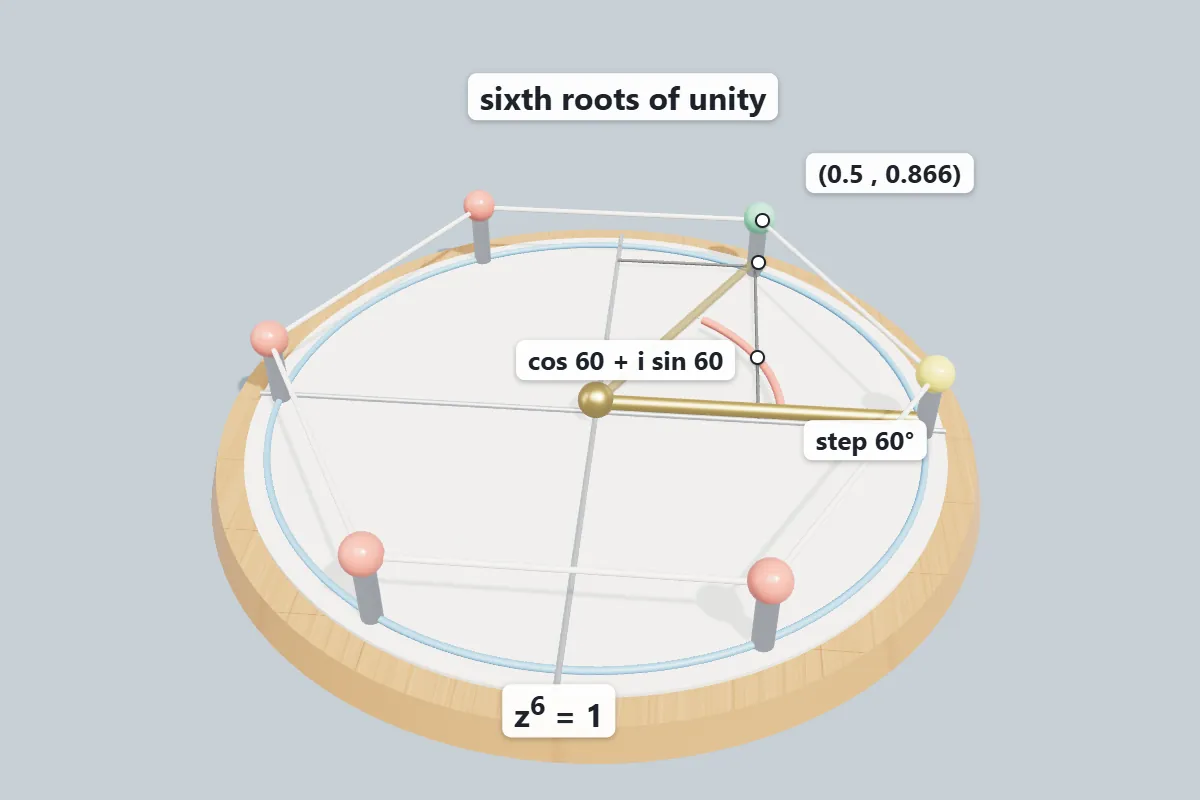
- The equation (where is a complex number) has exactly roots.
- Method write a in trigonometric form, then apply the rational-power rule with r=0,1,…,n−1.
- All the roots have the same modulus , so they lie on a circle with centre and radius .
- The angle between two successive roots is , so the roots are the vertices of a regular polygon with sides.
✍️ Worked examples
- Example 14 Find in the roots of in exponential form.
- Solution:
- x=8, y=−83 fourth quadrant, r=64+192=16, θ=tan−1(−3)=−π3.
- .
- .
- r=0 z1=2e−π12i.
- r=1 z2=2e5π12i.
- r=−1 z3=2e−7π12i.
- r=2 z4=2e11π12i.
- Example 15 Find the roots of and represent them on the Argand plane.
- Solution:
- , so .
- r=0 z1=cos0∘+isin0∘=1.
- r=1 z2=cos120∘+isin120∘.
- r=−1 z3=cos(−120∘)+isin(−120∘).
- The three points lie on the unit circle and divide it into three equal arcs of .
- They are the vertices of an equilateral triangle.
- Example 16 Find the fifth roots of and represent them on the Argand plane.
- Solution:
- .
- .
- For the amplitude is .
- The angle between successive roots is .
- .
- .
- .
- .
- .
- The five points lie on a circle of radius 2 and form a regular pentagon.
Square roots of a complex number in algebraic form
- Put a+bi=x+yi and square both sides a+bi=x2−y2+2xyi.
- Equate the real parts and the imaginary parts x2−y2=a and 2xy=b.
- Use to find .
- Solve the two equations in and ; the signs of and must satisfy .
✍️ Worked examples
- Example 17 Find the square roots of .
- Solution:
- Let , then (1) and (2).
- Square (1) and (2) and add (x2+y2)2=9+16=25, so x2+y2=5 (3).
- Add (1) and (3) 2x2=8, so x=±2.
- From (2) x=2⇒y=1 and x=−2⇒y=−1.
- The square roots are and .
- Use the general formula ; the square root of the discriminant is found by the method above.
✍️ Worked examples
| Comparison aspect | Main idea | Keywords |
|---|---|---|
| Example 18 | Solve in . | Solve |
| • | Solution | Solution |
| Divide by 1−i | 6−4i1−i=(6−4i)(1+i)2=5+i and 9−7i1−i=(9−7i)(1+i)2=8+i | |
| • | The equation becomes . | equationbecomes |
| Discriminant | (5+i)2−4(8+i)=24+10i−32−4i=−8+6i | |
| Let −8+6i=a+bi |
| |
| • | , so or . | |
| Solution set |
|
Lesson 1: Complex Numbers in Trigonometric and Exponential Form and De Moivres Theorem · 8 / 10
2-3 The cube roots of unity
2-3 The cube roots of unity
Finding them
- Solve z3=1 with De Moivre’s theorem the roots are 1, −12+32i and −12−32i.
- Algebraic check z3−1=(z−1)(z2+z+1)=0 gives z=1 or z=−1±3 i2.
- The square of one complex root equals the other, so the roots are written as where:
- On the Argand plane the roots lie on the unit circle, at angles , and , and form an equilateral triangle.
Properties of the cube roots of unity
| Comparison aspect | Main idea | Keywords |
|---|---|---|
| The sum of the roots is zero | 1+ω+ω2=0 | |
| • | Hence , , . | Hence |
| The product is one |
| integer |
| Reciprocals |
| |
| The difference of the two complex roots | ω−ω2=3 i and ω2−ω=−3 i | |
| All three roots have modulus 1 | ∣1∣=∣ω∣=∣ω2∣=1 | |
| • | To simplify a power of , divide the exponent by 3 and keep the remainder. | simplifypowerdivideexponent |
✍️ Worked examples
- Example 19 Find the value of and of .
- Solution:
- .
- Use and .
- First bracket 1−2ω2−2ω=1−2(ω+ω2)=1+2=3.
- Second bracket 3+5(ω+ω2)=3−5=−2.
- The product is .
- Example 20 If are the cube roots of unity, prove that .
- Solution:
- , so .
- , so .
- The product is .
- Example 21 Prove that is a root of .
- Solution:
- , one of the complex cube roots of unity.
- .
- .
- , so is a root.
- The same holds for x=ω2 (ω2)10=ω2 and (ω2)5=ω, giving again ω2+ω+1=0.
Applications
- Forming a quadratic equation from two roots that are expressed in : find the sum and product of the roots using and , then write .
- Reducing expressions replace 1/ω by ω2, group terms into 1+ω+ω2 and reduce powers modulo 3.
- Complex numbers are used in many fields, including electricity, dynamics, relativity and other physical applications.
Lesson 1: Complex Numbers in Trigonometric and Exponential Form and De Moivres Theorem · 9 / 10
Part 10
Part 10
- 📖
🔍 In-Depth Explanations, Deductions & Multi-Book Insights:
Mathematics Thanaweya Amma (2026/2027)
- Lesson 1 – Complex Numbers in Trigonometric and Exponential Form and De Moivres Theorem
- Complex numbers extend real numbers by introducing imaginary unit i = √(-1).
- A complex number z = x + iy is represented on the Argand diagram and transformed into trigonometric form z = r(cos θ + i sin θ) and exponential form z = r·eiθ.
- De Moivre's theorem evaluates powers and roots of unity.
🌳 Conceptual Hierarchy Tree
Complex Number Algebra
├── 1. Representations of Complex Numbers
│ ├── Algebraic Formz = x + i y (Modulus r = √(x2 + y2), Argument tan θ = y/x)
│ ├── Trigonometric Formz = r · (cos θ + i sin θ)
│ └── Exponential (Euler) Formz = r · ei θ (where θ is in radians)
├── 2. De Moivre's Theorem & Roots of Unity
- │ ├── Power Theorem [r(cos θ + i sin θ)]n = rn · [cos(nθ) + i sin(nθ)]
- │ └── Cube Roots of Unity (1, ω, ω2):
│ ├── 1 + ω + ω2 = 0
│ ├── ω3 = 1 and ω2 = 1/ω = ω̅
│ └── (ω – ω2) = ± i √3
📋 Master Teacher's Blackboard Secrets
RULE 1Principal amplitude (argument) of a complex number must lie in the interval: -π < θ ≤ π.
RULE 2Cube roots of unity fundamental property: 1 + ω + ω2 = 0, which implies 1 + ω = -ω2, 1 + ω2 = -ω, and ω + ω2 = -1.
RULE 3Multiplication of complex numbers: Moduli multiply and amplitudes add (z1 · z2 = r1 r2 [cos(θ1 + θ2) + i sin(θ1 + θ2)]).
📊 MatrixProperties of the Cube Roots of Unity (1, ω, ω2)
| Property | Mathematical Identity | Application Shortcut |
|---|---|---|
| Sum of all 3 roots | 1 + ω + ω2 = 0 | Any two roots equal negative of third |
| Product of all 3 roots | 1 · ω · ω2 = ω3 = 1 | ω3n = 1 for any integer n |
| Difference between imaginary roots | ω – ω2 = ± i √3 | Squares yield: (ω – ω2)2 = -3 |
| Modulus of each root | |1| = |ω| = |ω2| = 1 | All lie on unit circle centered at origin |
Lesson 1: Complex Numbers in Trigonometric and Exponential Form and De Moivres Theorem · 10 / 10
Well done! You finished this lesson
What would you like to do next?