Curriculum
Mathematics
Unit 1
0/12
1.1Key terms1.2Laws and key relationships1.3Rigorous Derivation of Reciprocal Trigonometric Functions1.4Logarithmic and General Exponential Differentiation Techniques1.5Parametric and Implicit Second-Order Derivatives1.6Worked examples1.7Exam tips1.8Real-world applications1.9Key Scientific Tables & Anatomical Diagrams Extracted from Official Curricula1.10📌 Comprehensive Scientific Terminology Dictionary:1.11🔍 In-Depth Explanations, Deductions & Multi-Book Insights:1.12Lesson summary
Unit 2
0/141.1The counting principle1.2Permutations (nPr)1.3Combinations (nCr)1.4Worked examples on counting, permutations and combinations1.5Recall: counting principle, permutations and combinations1.61-1 (a) Pascal's triangle and the binomial expansion1.71-1 (b) The general term1.81-1 (c) The middle term1.91-2 The term containing xk and the term free of x1.101-3 (a) The ratio between two consecutive terms1.111-3 (b) The greatest term1.12Key Scientific Tables & Anatomical Diagrams Extracted from Official Curricula1.13Lesson 1 - Counting Principle, Permutations and Combinations and the Binomial Theorem1.14Lesson summary
Unit 3
0/131.1Key terms1.2Laws and key relationships1.3Geometry of 3D Vectors and Scalar/Cross Product Physics1.4Equations of Straight Lines in Three Dimensions1.5Equations of Planes and Perpendicular Distance Formulas1.6Worked examples1.7Exam tips1.8Real-world applications1.9Key Scientific Tables & Anatomical Diagrams Extracted from Official Curricula1.10📌 Comprehensive Scientific Terminology Dictionary:1.11⚖️ Governing Physical Laws & Mathematical Relations:1.12🔍 In-Depth Explanations, Deductions & Multi-Book Insights:1.13Lesson summary
Unit 4
0/81.11 Smooth and rough surfaces1.22 Properties of the static friction force1.33 Kinetic friction force1.44 The resultant reaction R′1.55 The angle of friction1.66 Equilibrium of a body on a rough horizontal plane1.77 Equilibrium of a body on a rough inclined plane1.88 Conditions of equilibrium and rigid bodies with friction
Unit 5
0/121.13-1 (a) Indefinite integrals of exponential functions1.23-1 (b) Indefinite integrals of logarithmic functions1.33-2 (a) The differential and the standard integrals1.43-2 (b) Integration by substitution1.53-2 (c) Integration by parts1.63-2 (d) Applications of the indefinite integral1.73-3 (a) The definite integral and the fundamental theorem of calculus1.83-3 (b) Properties of the definite integral1.93-3 (c) Definite integral by substitution, odd and even functions1.103-4 (a) Area of a plane region1.113-4 (b) Volumes of solids of revolution1.12Key Scientific Tables & Anatomical Diagrams Extracted from Official Curricula
Unit 6
0/81.12-1 (a) Polar coordinates and the Argand plane1.22-1 (b) Modulus, amplitude and principal amplitude1.32-1 (c) The trigonometric (polar) form of a complex number1.42-1 (d) Product and quotient in trigonometric form1.52-1 (e) The exponential (Euler) form1.62-2 (a) De Moivre's theorem for a positive integer power1.72-2 (b) De Moivre's theorem for a rational power and the roots of a complex number1.82-3 The cube roots of unity
Unit 7
0/101.11 Momentum and its change1.22 Newton's first law, inertia and force1.33 Newton's second law, the equation of motion and variable mass1.44 Newton's third law, lifts and scales1.55 Bodies connected by a string over a smooth pulley1.66 Impulse1.77 Work1.88 Kinetic energy and the work-energy principle1.99 Potential energy and conservation of energy1.1010 Power
Text lesson
Lesson 1: Counting Principle, Permutations (nPr) and Combinations (nCr)
Lesson 1: Counting Principle, Permutations (nPr) and Combinations (nCr)
Overview
Overview
- Recall the counting principle, permutations and combinations, and use them in the binomial theorem.
- Expand for a positive integer and use Pascal’s triangle and the general term.
- Find the middle term(s), the term containing , the term free of , and the ratio between consecutive terms.
- Find the greatest term of an expansion and use the expansion to prove relations between combinations.
🌳 Concept tree
Lesson 1Counting Principle, Permutations (nPr) and Combinations (nCr)
├── Recallcounting principle, permutations and combinations
│ ├── Counting principle
│ ├── Permutations (nPr)
│ └── Combinations (nCr)
- ├── 1-1 (a) Pascal's triangle and the binomial expansion
│ ├── Patterns in the expansions
│ ├── Pascal's triangle
│ ├── Sum of a row and the number of subsets
│ ├── The binomial theorem
│ └── Special cases
├── 1-1 (b) The general term
│ ├── Rule
│ ├── Term counted from the end
│ ├── Sum and difference of two expansions
│ ├── Recognising an expansion in disguise
│ └── Finding unknowns from coefficients
├── 1-1 (c) The middle term
│ ├── Rule
│ └── Middle term of a sum of two expansions
- ├── 1-2 The term containing and the term free of
│ ├── Method
│ └── Equal middle terms
- ├── 1-3 (a) The ratio between two consecutive terms
│ └── Ratio of terms
└── 1-3 (b) The greatest term
├── Method
- └── Using the binomial expansion to prove relations
Lesson 1: Counting Principle, Permutations (nPr) and Combinations (nCr) · 1 / 16
The counting principle
The counting principle
- Counting principle questions ask how many outcomes a whole process has
- without listing them. There are two basic rules.
| Comparison aspect | Main idea | Keywords |
|---|---|---|
| Multiplication rule (AND) |
| choicemadewayssecond |
| Addition rule (OR) |
| choicescannothappentogether |
| Example. |
| studentshirtspairstrousers |
Factorial notation
- For a whole number n ≥ 1, the factorial is n! = n × (n − 1) × … × 2 × 1.
- By definition, 0! = 1.
- For example, 5! = 5 × 4 × 3 × 2 × 1 = 120.
Lesson 1: Counting Principle, Permutations (nPr) and Combinations (nCr) · 2 / 16
Permutations (nPr)
Permutations (nPr)
- A permutation is an arrangement in which the order matters.
- The number of ways to arrange r objects chosen from n different objects is written nPr:
- nPr = n! ÷ (n − r)! = n × (n − 1) × … × (n − r + 1)
- The product has exactly r factors.
- For example, 7P3 = 7 × 6 × 5 = 210, and 5P5 = 5! = 120.
- When r = n, every object is used and the formula gives n!.
- Seats, rankings, passwords, codes and arrangements on a shelf, where ABC and BCA are different results.
- Choosing a president and a secretary from a group, because the two posts are different.
Lesson 1: Counting Principle, Permutations (nPr) and Combinations (nCr) · 3 / 16
Combinations (nCr)
Combinations (nCr)
- A combination is a selection in which the order does not matter. The number of ways to choose r objects from n is written nCr:
- nCr = n! ÷ (r! × (n − r)!) = nPr ÷ r!
- Since each group of r objects can be ordered in r! ways, the number of combinations is the number of permutations divided by r!.
- For example, 6C2 = 6! ÷ (2! × 4!) = 15.
- nC0 = nCn = 1, and nC1 = n.
- nCr = nCn−r. For example, 9C7 = 9C2 = 36.
- Pascal rule nCr + nCr+1 = n+1Cr+1. For example, 5C2 + 5C3 = 10 + 10 = 20 = 6C3.
Permutations or combinations?
- Ask whether swapping two chosen objects creates a new result.
- If it does, use permutations.
- If it does not, as in a committee, use combinations.
Lesson 1: Counting Principle, Permutations (nPr) and Combinations (nCr) · 4 / 16
Worked examples on counting, permutations and combinations
Worked examples on counting, permutations and combinations
| Comparison aspect | Main idea | Keywords |
|---|---|---|
| Example 1 (permutation with no repetition). | How many 3-letter codes can be made from 26 letters if no letter may be repeated? | manylettercodesmade |
| Solution |
| ordermatters26P3 |
| Example 2 (combination). | A committee of 3 is chosen from 8 people. How many committees are possible? | committeechosenpeoplemany |
| Solution |
| ordermembersdoesmatter |
| Example 3 (combinations with the multiplication rule). |
| teamchosenboysgirls |
| Solution |
| Chooseboysgirlsseparately |
| Comparison aspect | Main idea | Keywords |
|---|---|---|
| Example 4 (arrangements with repeated letters). | How many different arrangements are there of the letters of the word LEVEL? | manydifferentwordLEVEL |
| Solution |
| lettersrepeatedtwiceDivide |
| Example 5 (a block arrangement). |
| peopleparticularmustnext |
| Solution |
| TreatpeopleblockThen |
| Example 6 (at least a condition). |
| groupchosenwomenFind |
Solution→All groups of 5 number 10C5 = 252. Subtract the groups with fewer than 2 women. With no women, there are 6C5 = 6 groups. With exactly 1 woman, there are 4C1 × 6C4 = 4 × 15 = 60 groups. So the answer is 252 − 6 − 60 = 186.
Lesson 1: Counting Principle, Permutations (nPr) and Combinations (nCr) · 5 / 16
Recall: counting principle, permutations and combinations
Recall: counting principle, permutations and combinations
Counting principle
Multiplication rule (AND)if one task can be done in ways and, after it, a second task in ways, the two tasks together can be done in ways.
Addition rule (OR)if two tasks cannot happen together and they can be done in and ways, then one of them can be done in ways.
Factorial, with .
- Permutation an arrangement of objects chosen from different objects, where the order matters.
- and .
- Arranging different objects around a circle (no fixed reference point) gives ways.
| Comparison aspect | Main idea | Keywords |
|---|---|---|
| Combination | a selection of objects out of different objects, where the order does not matter. | selectionobjectsdifferentorder |
| • | , and , . | |
| • | If , then either or . | theneither |
| Pascal’s rule | . | |
| Ratio of consecutive combinations | nCrnCr−1=n−r+1r | nCrnCr |
| Point of comparison | Permutations | Combinations |
|---|---|---|
| Order | Matters | Does not matter |
| Formula | ||
| Typical use | Forming numbers, passwords, rankings | Choosing committees, cards, subsets |
| Size |
✍️ Worked examples
- Example 1:
- How many different 3-digit numbers can be formed from the digits 1, 2, 3, 4, 5 without repetition?
- In how many ways can a committee of 3 be chosen from 7 people?
- Solution:
- Numbers the order matters, so 5P3=5×4×3=60.
- Committee the order does not matter, so 7C3=7×6×53×2×1=35.
- Example 2 Solve and .
- Solution:
- , so , , hence (reject ).
- , so , hence .
Lesson 1: Counting Principle, Permutations (nPr) and Combinations (nCr) · 6 / 16
1-1 (a) Pascal’s triangle and the binomial expansion
1-1 (a) Pascal’s triangle and the binomial expansion
Patterns in the expansions
- and .
- .
- The expansion of has terms.
- The powers of go down and the powers of go up, and in every term the two powers add to .
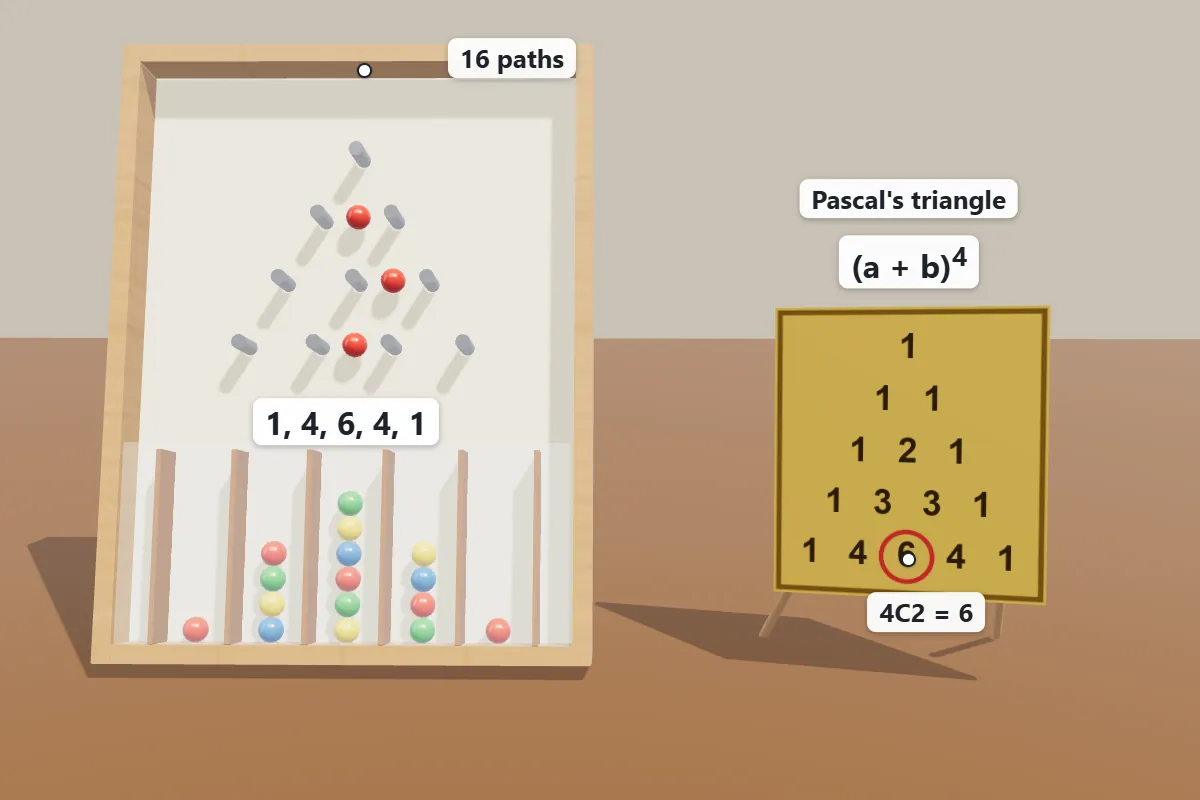
Pascal’s triangle
- Pascal’s triangle a triangle of numbers whose row gives the coefficients of .
- Each row starts and ends with 1, and every other number is the sum of the two numbers above it.
- Written with combinations, row is .
- Rows 1; 1 1; 1 2 1; 1 3 3 1; 1 4 6 4 1; 1 5 10 10 5 1.
Sum of a row and the number of subsets
- A set of elements has subsets.
- Therefore the sum of the numbers in row is
The binomial theorem
- For x,a∈R and a positive integer n (x+a)n=xn+nC1 xn−1a+nC2 xn−2a2+⋯+nCn−1 x an−1+an
- The number of terms is .
- Powers of descend and powers of ascend, and the sum of the powers in every term is .
- In the value of equals the order of the term minus one.
✍️ Worked examples
- Example 3 Expand .
- Solution:
- .
- .
- .
Special cases
- Putting x=1 and a=x (1+x)n=1+nC1 x+nC2 x2+⋯+xn
- Putting a=−x gives alternating signs (1−x)n=1−nC1 x+nC2 x2−⋯+(−1)nxn
- Putting in gives the sum of the coefficients, .
- Putting in gives .
✍️ Worked examples
- Example 4 Write the expansion of and use it to find .
- Solution:
- .
- Put on both sides.
- .
- The sum is .
Lesson 1: Counting Principle, Permutations (nPr) and Combinations (nCr) · 7 / 16
1-1 (b) The general term
1-1 (b) The general term
Rule
- The general term is the term of order in the expansion of , with :
- The coefficient of is , including signs.
✍️ Worked examples
- Example 5 In the expansion of in descending powers of , find the sixth term and its coefficient.
- Solution:
- Sixth term means , so .
- .
- .
- The coefficient is .
- The term of order from the end in an expansion with terms is the term of order from the beginning.
✍️ Worked examples
- Example 6 Find the fourth term from the end in the expansion of .
- Solution:
- The expansion has terms, so the order from the beginning is .
- .
- .
- The expansions of and differ only in the signs of the terms of even order, so:
- where are the terms of .
✍️ Worked examples
- Simplify .
- Solution:
- The sum equals .
- .
- .
- .
- An expression such as is the expansion of , which simplifies before you pick a term.
- Write the coefficients as combinations
- then divide one equation by the other to cancel the unknown.
✍️ Worked examples
- Example 8 If and , find and (where ).
- Solution:
- Coefficient of x nC1 c=20, so nc=20 (1).
- and .
- , so .
- Use nC3nC2=n−23 16=(n−2) c (2).
- From (2) nc−2c=16; with (1): 20−2c=16, so c=2.
- Then .
Lesson 1: Counting Principle, Permutations (nPr) and Combinations (nCr) · 8 / 16
1-1 (c) The middle term
1-1 (c) The middle term
Rule
- The expansion of has terms.
- If is even, the number of terms is odd and there is one middle term of order .
- If is odd, the number of terms is even and there are two middle terms of orders and .
✍️ Worked examples
- Example 9 Find the middle term in the expansion of .
- Solution:
- is even, so the middle term has order .
- .
- .
- Example 10 Find the two middle terms in the expansion of .
- Solution:
- is odd, so the orders are and .
- .
- .
- If has terms, only the odd-order terms survive (doubled), so the middle term of the sum is when its order is odd.
Lesson 1: Counting Principle, Permutations (nPr) and Combinations (nCr) · 9 / 16
1-2 The term containing xk and the term free of x
1-2 The term containing xk and the term free of x
Method
- Writing the whole expansion to find one term is slow, so use the general term.
- Step 1 write Tr+1 in terms of r.
- Step 2 add the powers of x in Tr+1 (an expression in r) and put the sum equal to k.
- Step 3 solve for r. If r is a natural number (and 0≤r≤n), the required term is Tr+1.
- If is not a natural number, there is no term containing .
- For the term free of , put the sum of the powers of equal to .
✍️ Worked examples
- Example 11 In the expansion of find the coefficient of , the term free of , and show that there is no term containing .
- Solution:
- .
- Coefficient of x6 18−3r=6, so r=4 and the term is T5 with coefficient 9C4×24=126×16=2016.
- Free of x 18−3r=0, so r=6 and the term is T7=9C6×26=84×64=5376.
- For x7 18−3r=7 gives r=113, which is not a natural number.
- So the expansion has no term containing .
- Example 12 If is a positive integer, show that the expansion of has a term free of only when is a multiple of 7, and find that term for .
- Solution:
- .
- Free of x 5n−7r=0, so r=5n7.
- is a whole number only when is a multiple of 7.
- For n=7 r=5, so the term is T6=7C5=21.
Equal middle terms
- To find the value of a quantity that makes two middle terms equal
- write both middle terms with the general term and equate them.
✍️ Worked examples
- Example 13 In the expansion of find if the two middle terms are equal.
- Solution:
- is odd, so the middle terms are and .
- and .
- C4=9C5, so equate 25(x3)4=24(x3)5.
- Divide by 24(x3)4 2=x3, so x=6.
Lesson 1: Counting Principle, Permutations (nPr) and Combinations (nCr) · 10 / 16
1-3 (a) The ratio between two consecutive terms
1-3 (a) The ratio between two consecutive terms
Ratio of terms
| Comparison aspect | Main idea | Keywords |
|---|---|---|
| For consecutive terms Tr and Tr+1 of (x+a)n | Tr+1Tr=n−r+1r×ax | |
| • | For the coefficients (when the terms are written with a common variable), the factor is replaced by the ratio of the coefficients of the second and first terms of the binomial. | coefficientstermswrittencommon |
| For (1+x)n | coefficient of Tr+1coefficient of Tr=n−r+1r | coefficient1coefficient |
| Proof of the ratio | nCrnCr−1=n!r!(n−r)!×(r−1)!(n−r+1)!n!=n−r+1r | nCrnCr |
✍️ Worked examples
- Example 14 In the expansion of find and the ratio .
- Solution:
- For T4T3 take r=3 12−3+13⋅yx=103⋅yx.
- .
- T9T8 has r=8 12−8+18⋅yx=58⋅yx.
- T8T7 has r=7 12−7+17⋅yx=67⋅yx.
- .
- Example 15 In the expansion of , if , find .
- Solution:
- Divide the equation by T5 2=T4T5+T6T5.
- , so .
- .
- 2=4x5y+4y5x; multiply by 5xy 10xy=4x2+4y2.
- , so .
- Hence or , i.e. or .
- Example 16 The coefficients of three consecutive terms of in ascending powers are . Find and the orders of the terms.
- Solution:
- Let the terms be .
- , so and (1).
- , so and (2).
- Multiply (2) by 2 6n−8r=2; subtract (1): n=7.
- From (2) 21−4r=1, so r=5.
- The terms are , and indeed , , .
Lesson 1: Counting Principle, Permutations (nPr) and Combinations (nCr) · 11 / 16
1-3 (b) The greatest term
1-3 (b) The greatest term
Method
- Compare with using the ratio at the given numerical values.
- Solve to find the values of for which the terms are still increasing.
- The greatest term is the last one for which the ratio is greater than (or equal to) 1; if the ratio equals 1 for some , two terms are equal and both are greatest.
✍️ Worked examples
- Example 17 Find the greatest term in the expansion of when and .
- Solution:
- .
- The ratio is when , i.e. , i.e. .
- So in the sense that the terms increase up to (use ).
- For the ratio is below 1, so and the terms decrease after .
- The greatest term is .
Using the binomial expansion to prove relations
- Put suitable values of in to prove results such as and .
- Adding the two results gives the sum of the even-ranked combinations equal to the sum of the odd-ranked ones, each equal to .
Lesson 1: Counting Principle, Permutations (nPr) and Combinations (nCr) · 12 / 16
Key Scientific Tables & Anatomical Diagrams Extracted from Official Curricula
Key Scientific Tables & Anatomical Diagrams Extracted from Official Curricula
💡 Core Diagrams & Reference Data→All data, reference comparison tables, and anatomical figures have been accurately digitized from official curriculum textbooks.
🔬 binomial_theorem_and_pascal_triangle
- Scientific details and precise observational breakdown:
- (a) moTeACing (bh) decreasing (c) alternating. (cl) finite
(21) The eequence (T,) = (| Win’ 4 1)) is
- ja) NCTeASINg ih) decreasing (c) alternating. (d) constant.
- 2) Which of the following sequences (T,) is decreasing where n € T°?
- iaviT y= n’) (by (Ty = in) (ce) (T= (n’) (I(T y= (n+ 1)
- (23) Which of the following represents a general term of a decreasing sequence ?
(ayn (b)n? (c)n’ ~§ (dy ‘4
(24) The sequence (1 +467 11 +.) is
- (a) decreasing. (b) alternating. (c) finite. (d) infinite.
(25) |.) The sequence (3 +5 +7 +96… +21) is
Lesson 1: Counting Principle, Permutations (nPr) and Combinations (nCr) · 13 / 16
Part 14
Part 14
- 📖
🔍 In-Depth Explanations, Deductions & Multi-Book Insights:
Mathematics Thanaweya Amma (2026/2027)
- Lesson 1 – Counting Principle, Permutations (nPr) and Combinations (nCr)
- Combinatorics analyzes discrete counting arrangements where order matters (Permutations) versus selection groupings where order is irrelevant (Combinations).
- We apply factorial properties and pascal identity in solving algebraic ministerial problems.
🌳 Hierarchy Classification & Concept Tree
Combinatorial Foundations
├── 1. Fundamental Counting Principle
│ ├── 'And' ruleOperations performed simultaneously → Multiply possibilities (m × n)
│ └── 'Or' ruleMutually exclusive alternative operations → Add possibilities (m + n)
├── 2. Permutations (nPr)
│ ├── Arrangements where order mattersnPr = n! / (n – r)!
│ └── Circular permutations(n – 1)! without fixed reference point
└── 3. Combinations (nCr)
├── Selections where order does NOT matternCr = n! / [r! · (n – r)!] = nPr / r!
├── Complement rulenCr = nC(n-r)
└── Addition identity (Pascal's rule)nCr + nC(r-1) = (n+1)Cr
📋 Master Teacher's Blackboard & Exam Secrets
RULE 1Ratio between consecutive combinations: nCr / nC(r-1) = (n – r + 1) / r.
RULE 2Pascal's Identity: nCr + nC(r-1) = (n+1)Cr.
RULE 3If nCx = nCy, then either x = y or x + y = n.
📊 Comparative AnalysisDistinction Between Permutations and Combinations
| Criterion | Permutations (nPr) | Combinations (nCr) |
|---|---|---|
| Order Sensitivity | Order is CRUCIAL and strictly matters | Order is IRRELEVANT (set grouping) |
| Typical Real Application |
|
|
| Mathematical Formula | n! / (n – r)! | n! / [r! · (n – r)!] |
| Relative Magnitude | nPr ≥ nCr for all r ≥ 1 | nCr ≤ nPr |
Lesson 1: Counting Principle, Permutations (nPr) and Combinations (nCr) · 14 / 16
Lesson 1 – Counting Principle, Permutations and Combinations and the Binomial Theorem
Lesson 1 – Counting Principle, Permutations and Combinations and the Binomial Theorem
- ★ Comprehensive Study & Detailed Pedagogical Guide ★
- Comprehensive Explanation Fundamental Principle of Counting, Permutations, Combinations, and the Binomial Theorem
- 🎯 Targeted Learning Outcomes & Pedagogical Objectives:
- • Apply the Fundamental Principle of Counting (Multiplication and Addition rules).
- • Distinguish conceptually and algebraically between Permutations (nPr) and Combinations (nCr).
- • Expand (x + a)n using the Binomial Theorem and compute the general term Tr+1.
- • Determine the middle term(s) and find the term independent of x.
- 📖 Core Terminology, Scientific Definitions & Glossaries:
- 🔹 Fundamental Counting Principle If an operation can be performed in m ways and a second independent operation in n ways, both operations in succession can be performed in m × n ways.
| Comparison aspect | Main idea | Keywords |
|---|---|---|
| 🔹 Permutation (nPr) | An arrangement of r objects selected from n distinct objects where ORDER MATTERS: nPr = (n!) / ((n-r)!) | arrangementobjectsselecteddistinct |
| 🔹 Combination (nCr) | A selection of r objects from n distinct objects where ORDER DOES NOT MATTER: nCr = (n!) / (r!(n-r)!) = nPr / (r!) | selectionobjectsdistinctORDER |
| 🔹 Binomial Theorem | An algebraic expansion of the power of a sum of two terms: (x + a)n = Σr=0n nCr xn-r ar | algebraicexpansionpowerterms |
| 🔹 Term Independent of x |
| specificbinomialexpansionoverall |
| • |
| GoverningScientificLawsTheorems |
| ★ Permutations and Combinations Formulas | [ Formula: nPr = (n!) / ((n-r)!) | nCr = (n!) / (r!(n-r)!) | nCr = nCn-r (Symmetry Law)nCr + nCr-1 = n+1Cr (Pascal’s Addition Law) | nCr / (nCr-1) = (n – r + 1) / r (Ratio Law). ] | SymmetryPascalAdditionRatio |
- ★ General Term in Binomial Expansion [ Formula: In (x + a)n: Tr+1 = nCr xn-r ar (Notice the lower index is r for term (r+1)). ]
- ★ Ratio Law for Successive Terms [ Formula: (Tr+1) / Tr = (n – r + 1) / r × (second term) / (first term) = (n – r + 1) / r · a / x. ]
- ★ Middle Term Rules [ Formula: If n is EVEN: Exactly ONE middle term T(n / 2 + 1).If n is ODD: Exactly TWO middle terms T((n+1) / 2) and T((n+3) / 2). ]
- 📌 Exhaustive In-Depth Pedagogical Breakdown:
- ◄ I. Foundational Combinatorics: Order vs Unordered Selection
- Combinatorics governs the mathematics of finite discrete structures.
- When selecting r items from n possibilities, the deciding question is: “Does sequence or order matter?”- Order Matters ⇒ Permutations (nPr): Arranging runners on a podium (1st, 2nd, 3rd), forming multi-digit passwords, or electing President, Secretary, and Treasurer.- Order Irrelevant ⇒ Combinations (nCr): Selecting a committee of 3 students from a class of 20, drawing a lottery hand of cards, or choosing 4 points on a circle to form a quadrilateral.
- Pascal’s Identity nCr + nCr-1 = n+1Cr mathematically proves that choosing a committee of r from n+1 people equals the sum of committees excluding a specific leader plus committees including that leader.
- Figure (binomial_theorem_and_pascal_triangle.png): Figure (7): Pascal’s Triangle coefficients and binomial expansion distribution curves
- ◄ II. The Binomial Expansion Architecture and the (r+1)-th Term
- The expansion of (x + a)n produces exactly (n + 1) terms.
- The powers of the first term x descend steadily from n to 0, while powers of the second term a ascend from 0 to n.
- The sum of the exponents of x and a in every individual term is perpetually equal to n.
- To locate any term without writing out the full polynomial, mathematicians rely on the General Term: Tr+1 = nCr xn-r ar.
- When terms involve fractional powers, such as (x2 + 1 / x)12, one simplifies the expression into xpower and equates that power to 0 to identify the term independent of x, or equates it to k to find the coefficient of xk.
- ◄ III. Ratio Rules and Greatest Term Identification
- Calculating consecutive terms by direct evaluation is tedious.
- The Ratio Property (Tr+1) / Tr = (n – r + 1) / r × a / x provides a swift recursive tool.
- To locate the Greatest Term in magnitude for a given numerical substitution x = x0, one solves the simultaneous inequalities (Tr+1) / Tr ≥ 1 and Tr / (Tr-1) ≥ 1, bounding the optimal integer index r.
| Comparison aspect | Main idea | Keywords |
|---|---|---|
| • | 🧮 Exemplary Step-by-Step Worked Problems & Applied Exercises | ExemplaryStepWorkedProblems |
| Worked Example 1 | Worked Problem 1 – Binomial General Term and Constant Evaluation | ProblemBinomialGeneralTerm |
| Problem Statement |
| expansiondescendingpowersFind |
| Comparison aspect | Main idea | Keywords |
|---|---|---|
| • | 💡 Master Teacher Insights & Critical Exam Cautions | MasterTeacherInsightsCritical |
| ★ Exam Trap |
| secondtermnegativesign |
| ★ Number of Terms | The expansion of (x + a)n always contains (n + 1) terms | expansionalwayscontains |
| ★ Sum of Coefficients |
| findsimplysubstitute |
| • |
| PracticalRealWorldIndustrial |
| ✔ Cryptography & Cybersecurity | Combinatorics and binomial distributions form the cryptographic backbone of RSA public-key encryption and password entropy calculations | Combinatoricsbinomialdistributionsform |
✔ Bioinformatics & Gene Sequencing→Combinatorial permutations determine the number of possible nucleotide base permutations in genetic DNA sequencing.
Lesson 1: Counting Principle, Permutations (nPr) and Combinations (nCr) · 15 / 16
Lesson summary
Lesson summary
| Comparison aspect | Main idea | Keywords |
|---|---|---|
| • |
| HighYieldSummaryMind |
| Summary |
| FundamentalPrincipleCountingPermutations |
| • | 🗺️ Core Concept Map & Knowledge Architecture | CoreConceptKnowledgeArchitecture |
| ✔ Counting | Multiplication (m × n) | Addition (m + n) | MultiplicationAddition |
| ✔ Permutations vs Combinations | nPr (order matters) vs nCr (order does not matter) | ordermattersdoesmatter |
| ✔ Binomial Expansion | (x+a)n = Σ nCr xn-r ar | Tr+1 = nCr xn-r ar | |
| ✔ Key Terms | Independent of x (power = 0) | Middle term (n/2 + 1 if even) | IndependentpowerMiddleeven |
| • | 📊 Classification & Comparative Summary Tables | ClassificationComparativeSummaryTables |
| Table | Comparison Between Permutations and Combinations | ComparisonBetweenPermutationsCombinations |
| Criterion | Permutations (nPr) | Combinations (nCr) |
|---|---|---|
| Order Relevance | Order is strictly significant (AB ≠ BA) | Order is completely irrelevant (AB = BA) |
| Formula | nPr = (n!) / ((n-r)!) | $nC_r = (n!) / (r!(n-r)!) = nPr / (r!) |
| Relation | nPr gt; nCr (for r gt; 1) | nCr = nPr / (r!) ≤ nPr |
| Standard Scenarios |
|
|
- 💡 Exam Flashcard Capsules & High-Yield Secrets:
- ★ nC0 = nCn = 1 and nC1 = n.
- ★ nPn = n! and nP0 = 1.
- ★ Ratio of consecutive terms (Tr+1) / Tr = (n-r+1) / r · 2nd / 1st.
- ★ If (x+a)n has an odd power n, it has two middle terms.
Lesson 1: Counting Principle, Permutations (nPr) and Combinations (nCr) · 16 / 16
Well done! You finished this lesson
What would you like to do next?