Curriculum
Mathematics
Unit 1
0/12
1.1Key terms1.2Laws and key relationships1.3Rigorous Derivation of Reciprocal Trigonometric Functions1.4Logarithmic and General Exponential Differentiation Techniques1.5Parametric and Implicit Second-Order Derivatives1.6Worked examples1.7Exam tips1.8Real-world applications1.9Key Scientific Tables & Anatomical Diagrams Extracted from Official Curricula1.10📌 Comprehensive Scientific Terminology Dictionary:1.11🔍 In-Depth Explanations, Deductions & Multi-Book Insights:1.12Lesson summary
Unit 2
0/141.1The counting principle1.2Permutations (nPr)1.3Combinations (nCr)1.4Worked examples on counting, permutations and combinations1.5Recall: counting principle, permutations and combinations1.61-1 (a) Pascal's triangle and the binomial expansion1.71-1 (b) The general term1.81-1 (c) The middle term1.91-2 The term containing xk and the term free of x1.101-3 (a) The ratio between two consecutive terms1.111-3 (b) The greatest term1.12Key Scientific Tables & Anatomical Diagrams Extracted from Official Curricula1.13Lesson 1 - Counting Principle, Permutations and Combinations and the Binomial Theorem1.14Lesson summary
Unit 3
0/131.1Key terms1.2Laws and key relationships1.3Geometry of 3D Vectors and Scalar/Cross Product Physics1.4Equations of Straight Lines in Three Dimensions1.5Equations of Planes and Perpendicular Distance Formulas1.6Worked examples1.7Exam tips1.8Real-world applications1.9Key Scientific Tables & Anatomical Diagrams Extracted from Official Curricula1.10📌 Comprehensive Scientific Terminology Dictionary:1.11⚖️ Governing Physical Laws & Mathematical Relations:1.12🔍 In-Depth Explanations, Deductions & Multi-Book Insights:1.13Lesson summary
Unit 4
0/81.11 Smooth and rough surfaces1.22 Properties of the static friction force1.33 Kinetic friction force1.44 The resultant reaction R′1.55 The angle of friction1.66 Equilibrium of a body on a rough horizontal plane1.77 Equilibrium of a body on a rough inclined plane1.88 Conditions of equilibrium and rigid bodies with friction
Unit 5
0/121.13-1 (a) Indefinite integrals of exponential functions1.23-1 (b) Indefinite integrals of logarithmic functions1.33-2 (a) The differential and the standard integrals1.43-2 (b) Integration by substitution1.53-2 (c) Integration by parts1.63-2 (d) Applications of the indefinite integral1.73-3 (a) The definite integral and the fundamental theorem of calculus1.83-3 (b) Properties of the definite integral1.93-3 (c) Definite integral by substitution, odd and even functions1.103-4 (a) Area of a plane region1.113-4 (b) Volumes of solids of revolution1.12Key Scientific Tables & Anatomical Diagrams Extracted from Official Curricula
Unit 6
0/81.12-1 (a) Polar coordinates and the Argand plane1.22-1 (b) Modulus, amplitude and principal amplitude1.32-1 (c) The trigonometric (polar) form of a complex number1.42-1 (d) Product and quotient in trigonometric form1.52-1 (e) The exponential (Euler) form1.62-2 (a) De Moivre's theorem for a positive integer power1.72-2 (b) De Moivre's theorem for a rational power and the roots of a complex number1.82-3 The cube roots of unity
Unit 7
0/101.11 Momentum and its change1.22 Newton's first law, inertia and force1.33 Newton's second law, the equation of motion and variable mass1.44 Newton's third law, lifts and scales1.55 Bodies connected by a string over a smooth pulley1.66 Impulse1.77 Work1.88 Kinetic energy and the work-energy principle1.99 Potential energy and conservation of energy1.1010 Power
Text lesson
Lesson 1: Differentiation of Trigonometric, Exponential and Logarithmic Functions
Lesson 1: Differentiation of Trigonometric, Exponential and Logarithmic Functions
Overview
Overview
🎯 Learning outcomes
- Master the derivatives of basic and reciprocal trigonometric functions (sin, cos, tan, sec, csc, cot).
- Differentiate natural and general exponential functions ( and ) and logarithmic functions ( and ).
- Apply the Chain Rule, Implicit Differentiation, and Parametric Differentiation.
- Determine equations of tangent and normal lines and analyze critical points and curve sketching.
🌳 Concept tree
Lesson 1→Differentiation of Trigonometric, Exponential and Logarithmic Functions
├── Key terms
├── Laws and key relationships
- ├── Rigorous Derivation of Reciprocal Trigonometric Functions
- ├── Logarithmic and General Exponential Differentiation Techniques
- ├── Parametric and Implicit Second-Order Derivatives
├── Worked examples
├── Exam tips
└── Real-world applications
Lesson 1: Differentiation of Trigonometric, Exponential and Logarithmic Functions · 1 / 14
Key terms
Key terms
| Comparison aspect | Main idea | Keywords |
|---|---|---|
| Derivative (Rate of Change) | The instantaneous rate of change of a function with respect to its variable, defined rigorously as the limit of the difference quotient: . | instantaneousfunctionrespectvariable |
| Natural Exponential Function (ex) |
| uniquemathematicalwhosederivative |
| Natural Logarithm (lnx) |
| baseservinginversefunction |
| Implicit Differentiation | A differentiation technique applied to equations where the dependent variable cannot be explicitly isolated as , using the chain rule on terms (e.g., ). | techniqueappliedequationsdependent |
| Slope of Tangent Line (m) |
| numericalvaluefirstderivative |
Lesson 1: Differentiation of Trigonometric, Exponential and Logarithmic Functions · 2 / 14
Laws and key relationships
Laws and key relationships
| Comparison aspect | Main idea | Keywords |
|---|---|---|
| Trigonometric Derivative Rules | [ Formula: | | | | . ] | Formulautanucot |
| Exponential and Logarithmic Rules | [ Formula: | | . ] | Formulaauln |
| Equation of Tangent and Normal Lines | [ Formula: Tangent: where .Normal: (provided ). ] | Formuladydxprovided |
| Parametric Differentiation Rule | [ Formula: If and , then , and . ] | Formulathendydxdθdx |
Lesson 1: Differentiation of Trigonometric, Exponential and Logarithmic Functions · 3 / 14
Rigorous Derivation of Reciprocal Trigonometric Functions
Rigorous Derivation of Reciprocal Trigonometric Functions
- While basic calculus introduces derivatives of sine and cosine, advanced calculus requires fluency in reciprocal trigonometric derivatives derived via the Quotient Rule:- .- .- .Notice the mnemonic rule: any co-function (cos, csc, cot) yields a NEGATIVE derivative!
Lesson 1: Differentiation of Trigonometric, Exponential and Logarithmic Functions · 4 / 14
Logarithmic and General Exponential Differentiation Techniques
Logarithmic and General Exponential Differentiation Techniques
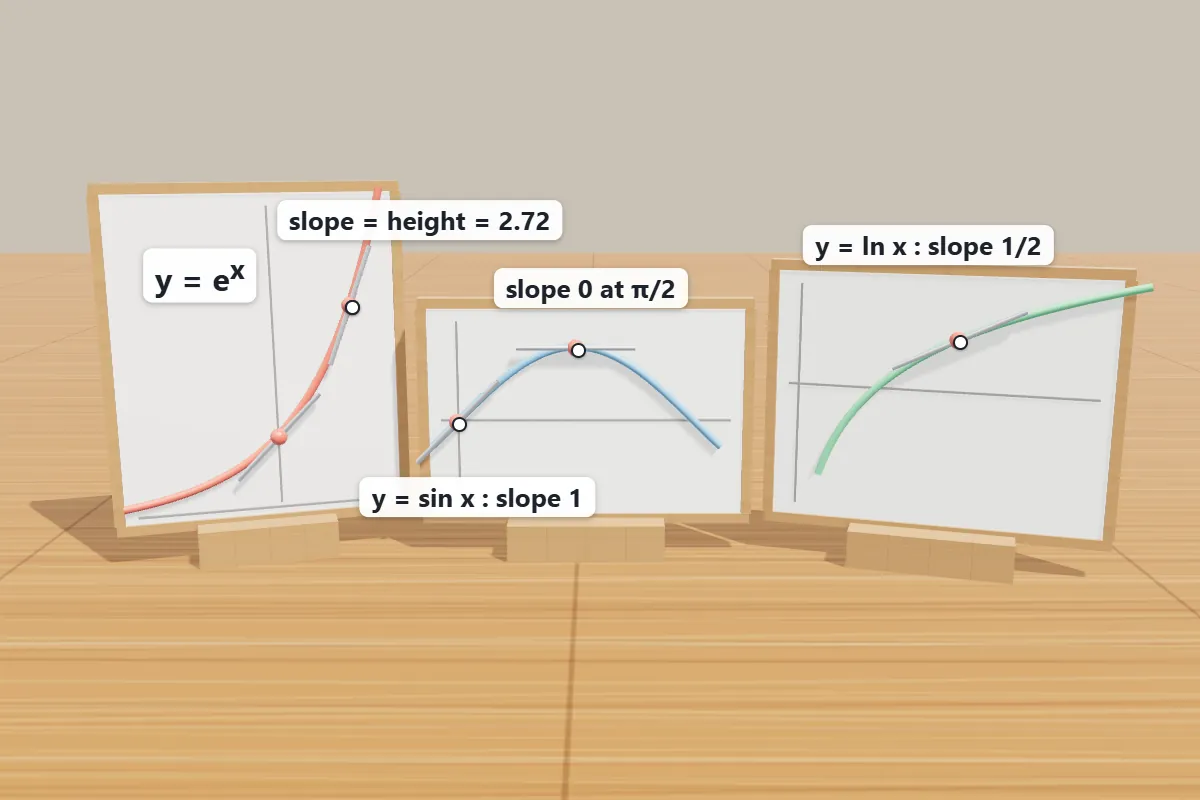
- Exponential functions of arbitrary base are differentiated by expressing in natural base as .
- Applying the chain rule gives .
- Similarly, general logarithm is transformed via the change-of-base formula: , producing .
- When confronted with variable-base, variable-exponent expressions such as , conventional power or exponential rules fail.
- The universal remedy is Logarithmic Differentiation take the natural logarithm of both sides lny=g(x)ln[f(x)], differentiate implicitly with respect to x: 1ydydx=g′(x)ln[f(x)]+g(x)f′(x)f(x), and finally multiply through by y.
Lesson 1: Differentiation of Trigonometric, Exponential and Logarithmic Functions · 5 / 14
Parametric and Implicit Second-Order Derivatives
Parametric and Implicit Second-Order Derivatives
- A common pitfall in higher-order calculus involves parametric second derivatives.
- For a curve defined parametrically by and , the first derivative is .
- However, the second derivative is NOT !
- The chain rule dictates d2ydx2=ddx(dydx)=ddt(dydx)⋅dtdx=ddt(dy/dx)dx/dt.Neglecting to multiply by dtdx is one of the most frequent errors in secondary school examinations.
Lesson 1: Differentiation of Trigonometric, Exponential and Logarithmic Functions · 6 / 14
Worked examples
Worked examples
✍️ Worked examples
| Comparison aspect | Main idea | Keywords |
|---|---|---|
| Worked Example 1 | Worked Problem 3 – Tangent Line and Parametric Higher Derivative | ProblemTangentLineParametric |
| Problem Statement |
| Givencurvedefinedparametrically |
Lesson 1: Differentiation of Trigonometric, Exponential and Logarithmic Functions · 7 / 14
Exam tips
Exam tips
| Comparison aspect | Main idea | Keywords |
|---|---|---|
| Critical Exam Warning | In parametric second derivative , NEVER divide the second derivatives directly! You must differentiate with respect to and multiply by . | parametricsecondderivatived2ydx2 |
| Co-Function Sign Rule |
| trigonometricfunctionsstartingMINUS |
| Derivative of xx | Let y=xx⇒lny=xlnx⇒y′y=lnx+1⇒y′=xx(1+lnx). Memorize this high-yield result! | Memorizehighyieldresult |
Lesson 1: Differentiation of Trigonometric, Exponential and Logarithmic Functions · 8 / 14
Real-world applications
Real-world applications
| Comparison aspect | Main idea | Keywords |
|---|---|---|
| Structural Engineering & Bridge Design | Derivatives model the bending moment and deflection curves of reinforced concrete beams under highway traffic loads (). | Derivativesmodelbendingmoment |
| Aerospace Trajectory Optimization | Parametric calculus computes the instantaneous velocity and acceleration vectors of launch vehicles escaping Earth’s gravitational pull | Parametriccalculuscomputesinstantaneous |
| • |
| margin18pxbordersolid |
Lesson 1: Differentiation of Trigonometric, Exponential and Logarithmic Functions · 9 / 14
Key Scientific Tables & Anatomical Diagrams Extracted from Official Curricula
Key Scientific Tables & Anatomical Diagrams Extracted from Official Curricula
💡 Core Diagrams & Reference Data→All data, reference comparison tables, and anatomical figures have been accurately digitized from official curriculum textbooks.
🔬 figure_diagram_1
- Scientific details and precise observational breakdown:
(4). x-2y-1=0 oo X=2y+l
- Substituting in the second equation :
« (2y+1)P?-y(2y+1)=0
o4y?+4y4+1-2y?-y=0
2 2y?4+3y+1=0
nys-dorys-1
From (1)→«. X=OorxX=-1
+. The $.S.= {(0 – 4) 515-1}
(5). x+2y=4
- Substituting in the second equation :
🔬 differentiation_curves_and_tangent_lines
- Scientific details and precise observational breakdown:
(a) zero (b) 1 (c)— 1 (d) 10
n n
8)lf © (r)=136sthen & (n=
r=] rea]
(a) 140 (b) 544 (c) 272 (d) 34
10 35
9) X Gr+2)+ 2 Gr+2)=-
re |
35 35 35
- (a) > (3r+2) (b) x (3r+2) (c) 3 (6r+4) (d) 2 (31r+4)
Lesson 1: Differentiation of Trigonometric, Exponential and Logarithmic Functions · 10 / 14
Part 11
Part 11
- 📖
Lesson 1: Differentiation of Trigonometric, Exponential and Logarithmic Functions · 11 / 14
📌 Comprehensive Scientific Terminology Dictionary:
📌 Comprehensive Scientific Terminology Dictionary:
- Derivative (Rate of Change):
- The instantaneous rate of change of a function with respect to its variable, defined rigorously as the limit of the difference quotient: f #x27;(x) = lim h → 0 (f(x+h) – f(x)) / h.
- Natural Exponential Function (ex):
- The unique mathematical function whose derivative equals itself: d / dx(ex) = ex, where e ≈ 2.71828 is Euler's number.
- Natural Logarithm (ln x):
- The logarithm to the base e, serving as the inverse function of ex, characterized by d / dx(ln x) = 1 / x for x gt; 0.
- Implicit Differentiation:
- A differentiation technique applied to equations where the dependent variable y cannot be explicitly isolated as y = f(x), using the chain rule on y terms (e.g., d / dx(y2 = 2y dy / dx).
- Slope of Tangent Line (m):
- The numerical value of the first derivative dy / dx evaluated at a specific point of tangency $(x1, y1)$.
- ⚖️ Governing Scientific Laws, Theorems & Mathematical Models:
- Trigonometric Derivative Rules:
- [ Formula d / dx(sin u) = cos u · u #x27; | d / dx(cos u) = -sin u · u #x27; | d / dx(tan u) = sec 2 u · u #x27;
- d / dx(sec u) = sec u tan u · u #x27; | d / dx(csc u) = -csc u cot u · u #x27; | d / dx(cot u) = -csc 2 u · u #x27;. ]
- Exponential and Logarithmic Rules:
- [ Formula d / dx(eu) = eu · u #x27; | d / dx(au) = au ln a · u #x27;
- d / dx(ln u) = (u #x27;) / u | d / dx(log a u) = (u #x27;) / (u ln a). ]
- Equation of Tangent and Normal Lines:
- [ Formula Tangent: \(y – y1 = m (x – x1)\) where m =.dy / dx|(x1, y1).
- Normal y – y1 = -1 / m (x – x1) (provided m ≠ 0). ]
- Parametric Differentiation Rule:
- [ Formula If x = f(θ) and y = g(θ), then dy / dx = (dy/dθ) / (dx/dθ), and d2y / dx2 = d / dθ(dy / dx) · dθ / dx. ]
- 📌 Exhaustive In:
- Depth Pedagogical Breakdown:
- ◄ I. Rigorous Derivation of Reciprocal Trigonometric Functions
- While basic calculus introduces derivatives of sine and cosine, advanced calculus requires fluency in reciprocal trigonometric derivatives derived via the Quotient Rule:
- – sec x = 1 / (cos x) ⇒ d / dx(sec x) = (0 – (-sin x)) / (cos 2 x) = (sin x) / (cos x · cos x) = sec x tan x.
- – csc x = 1 / (sin x) ⇒ d / dx(csc x) = (0 – (cos x)) / (sin 2 x) = -csc x cot x.
- – cot x = (cos x) / (sin x) ⇒ d / dx(cot x) = ((-sin x)(sin x) – (cos x)(cos x)) / (sin 2 x) = (-(sin 2 x + cos 2 x)) / (sin 2 x) = -csc 2 x.
- Notice the mnemonic rule any co-function (cos, csc, cot) yields a NEGATIVE derivative!
- Figure (differentiation_curves_and_tangent_lines.png):
- Figure (5) Geometry of tangent and normal lines to parametric curves and inflection points
- ◄ II. Logarithmic and General Exponential Differentiation Techniques
- Exponential functions of arbitrary base a gt; 0 are differentiated by expressing ax in natural base as ex ln a.
- Applying the chain rule gives d / dx(ax) = ax ln a.
- Similarly, general logarithm is transformed via the change:
- of-base formula log a x = (ln x) / (ln a), producing d / dx(log a x) = 1 / (x ln a).
- When confronted with variable:
- base, variable-exponent expressions such as y = [f(x)]g(x), conventional power or exponential rules fail.
- The universal remedy is Logarithmic Differentiation: take the natural logarithm of both sides ln y = g(x) ln [f(x)], differentiate implicitly with respect to x: 1 / y dy / dx = g #x27;(x) ln [f(x)] + g(x) (f #x27;(x)) / (f(x)), and finally multiply through by y.
- ◄ III. Parametric and Implicit Second:
Order Derivatives
- A common pitfall in higher:
- order calculus involves parametric second derivatives.
- For a curve defined parametrically by x = x(t) and y = y(t), the first derivative is dy / dx = (y #x27;(t)) / (x #x27;(t)).
- However, the second derivative is NOT (y #x27; #x27;(t)) / (x #x27; #x27;(t))! The chain rule dictates:
- d2y / dx2 = d / dx(dy / dx) = d / dt(dy / dx) · dt / dx = (d / dt(dy/dx)) / (dx/dt).
- Neglecting to multiply by dt / dx is one of the most frequent errors in secondary school examinations.
- 🧮 Exemplary Step:
- by-Step Worked Problems & Applied Exercises:
- Worked Example 1:
- Worked Problem 3 – Tangent Line and Parametric Higher Derivative
- Problem Statement:
- Problem Given a curve defined parametrically by x = 2cos θ and y = 3sin θ for θ ∈ [0, 2π].
- 1) Find the slope of the tangent and the equation of the tangent line at θ = π / 4.
- 2) Calculate the second derivative $d2y / dx2$ at θ = π / 4.
- Detailed Solution:
- 1) At θ = π / 4:
- x1 = 2cos (π/4) = 2 × √2 / 2 = √2.
- y1 = 3sin (π/4) = 3 × √2 / 2 = 3√2 / 2.
- Differentiating with respect to θ:
- dx / dθ = -2sin θ | dy / dθ = 3cos θ.
- First derivative dy / dx = (3cos θ) / (-2sin θ) = -3 / 2cot θ.
- At θ = π/4 m = -3 / 2cot (π/4) = -3 / 2(1) = -1.5.
- Equation of tangent line y – y1 = m(x – x1) ⇒ y – 3√2 / 2 = -3 / 2(x – √2).
- Multiplying by 2 2y – 3√2 = -3x + 3√2 ⇒ 3x + 2y – 6√2 = 0.
- 2) Second derivative:
- d2y / dx2 = d / dθ(-3 / 2cot θ) · dθ / dx = (-3 / 2(-csc 2 θ)) · (1 / (-2sin θ)) = -3 / 4 csc 3 θ.
- At θ = π/4 csc (π/4) = √2 ⇒ (√2)3 = 2√2.
- d2y / dx2 = -3 / 4(2√2) = -3√2 / 2.
- 💡 Master Teacher Insights & Critical Exam Cautions:
- Critical Exam Warning:
- In parametric second derivative $d2y / dx2$, NEVER divide the second derivatives directly!
- You must differentiate $dy / dx$ with respect to t and multiply by dt / dx.
- Co:
- Function Sign Rule All trigonometric functions starting with "co" (cos, cot, csc) have a MINUS sign in their derivatives.
- Derivative of xx:
- Let y = xx ⇒ ln y = x ln x ⇒ (y #x27;) / y = ln x + 1 ⇒ y #x27; = xx(1 + ln x). Memorize this high-yield result!
- 🌍 Practical Real:
- World, Industrial & Societal Connections:
- ✔ Structural Engineering & Bridge Design:
- Derivatives model the bending moment and deflection curves of reinforced concrete beams under highway traffic loads (EI d4y / dx4 = w(x)).
- ✔ Aerospace Trajectory Optimization:
- Parametric calculus computes the instantaneous velocity and acceleration vectors of launch vehicles escaping Earth's gravitational pull.
Lesson 1: Differentiation of Trigonometric, Exponential and Logarithmic Functions · 12 / 14
🔍 In-Depth Explanations, Deductions & Multi-Book Insights:
🔍 In-Depth Explanations, Deductions & Multi-Book Insights:
- ★ Comprehensive Study & Detailed Pedagogical Guide ★
- Comprehensive Explanation Differentiation of Trigonometric, Exponential, and Logarithmic Functions and Higher Derivatives
| | 2026/2027 |
- 🎯 Targeted Learning Outcomes & Pedagogical Objectives:
- • Master the derivatives of basic and reciprocal trigonometric functions (sin, cos, tan, sec, csc, cot).
- • Differentiate natural and general exponential functions (eu and au) and logarithmic functions (ln u and log a u).
- • Apply the Chain Rule, Implicit Differentiation, and Parametric Differentiation.
- • Determine equations of tangent and normal lines and analyze critical points and curve sketching.
Lesson 1: Differentiation of Trigonometric, Exponential and Logarithmic Functions · 13 / 14
Lesson summary
Lesson summary
- ★ High-Yield Summary, Mind Maps & Comparison Tables ★
- 🗺️ Core Concept Map & Knowledge Architecture:
- ✔ Trig Derivatives sin → cos | cos → -sin | tan → sec 2 | sec → sec tan | csc → -csc cot | cot → -csc 2.
- ✔ Exp & Log (eu)’ = eu u’ | (au)’ = au ln a u’ | (ln u)’ = u’/u | (log a u)’ = u’/(u ln a).
- ✔ Techniques Chain Rule | Implicit Diff | Parametric Diff dy / dx = (dy/dt) / (dx/dt).
- 📊 Classification & Comparative Summary Tables:
- Table Master Summary Table of Advanced Calculus Differentiation Rules
| Function y = f(x) | Derivative dy / dx | Chain Rule Generalized Form (u = g(x)) |
|---|---|---|
| sin x | cos x | cos u · du / dx |
| cos x | -sin x | -sin u · du / dx |
| tan x | sec 2 x | sec 2 u · du / dx |
| sec x | sec x tan x | sec u tan u · du / dx |
| csc x | -csc x cot x | -csc u cot u · du / dx |
| cot x | -csc 2 x | -csc 2 u · du / dx |
| ex | ex | eu · du / dx |
| ax | ax ln a | au ln a · du / dx |
| ln x | 1 / x | 1 / u · du / dx |
- 💡 Exam Flashcard Capsules & High-Yield Secrets:
- ★ If two curves intersect orthogonally, the product of their tangent slopes is -1 (m1 · m2 = -1).
- ★ The derivative of an odd function is ALWAYS an even function, and the derivative of an even function is ALWAYS odd.
- ★ At a horizontal tangent line, dy / dx = 0. At a vertical tangent line, dx / dy = 0 (undefined slope).
- ★ Logarithmic differentiation must be used whenever the variable appears in both the base and exponent (xx, xsin x).
Lesson 1: Differentiation of Trigonometric, Exponential and Logarithmic Functions · 14 / 14
Well done! You finished this lesson
What would you like to do next?