Curriculum
Mathematics
Unit 1
0/12
1.1Key terms1.2Laws and key relationships1.3Rigorous Derivation of Reciprocal Trigonometric Functions1.4Logarithmic and General Exponential Differentiation Techniques1.5Parametric and Implicit Second-Order Derivatives1.6Worked examples1.7Exam tips1.8Real-world applications1.9Key Scientific Tables & Anatomical Diagrams Extracted from Official Curricula1.10📌 Comprehensive Scientific Terminology Dictionary:1.11🔍 In-Depth Explanations, Deductions & Multi-Book Insights:1.12Lesson summary
Unit 2
0/141.1The counting principle1.2Permutations (nPr)1.3Combinations (nCr)1.4Worked examples on counting, permutations and combinations1.5Recall: counting principle, permutations and combinations1.61-1 (a) Pascal's triangle and the binomial expansion1.71-1 (b) The general term1.81-1 (c) The middle term1.91-2 The term containing xk and the term free of x1.101-3 (a) The ratio between two consecutive terms1.111-3 (b) The greatest term1.12Key Scientific Tables & Anatomical Diagrams Extracted from Official Curricula1.13Lesson 1 - Counting Principle, Permutations and Combinations and the Binomial Theorem1.14Lesson summary
Unit 3
0/131.1Key terms1.2Laws and key relationships1.3Geometry of 3D Vectors and Scalar/Cross Product Physics1.4Equations of Straight Lines in Three Dimensions1.5Equations of Planes and Perpendicular Distance Formulas1.6Worked examples1.7Exam tips1.8Real-world applications1.9Key Scientific Tables & Anatomical Diagrams Extracted from Official Curricula1.10📌 Comprehensive Scientific Terminology Dictionary:1.11⚖️ Governing Physical Laws & Mathematical Relations:1.12🔍 In-Depth Explanations, Deductions & Multi-Book Insights:1.13Lesson summary
Unit 4
0/81.11 Smooth and rough surfaces1.22 Properties of the static friction force1.33 Kinetic friction force1.44 The resultant reaction R′1.55 The angle of friction1.66 Equilibrium of a body on a rough horizontal plane1.77 Equilibrium of a body on a rough inclined plane1.88 Conditions of equilibrium and rigid bodies with friction
Unit 5
0/121.13-1 (a) Indefinite integrals of exponential functions1.23-1 (b) Indefinite integrals of logarithmic functions1.33-2 (a) The differential and the standard integrals1.43-2 (b) Integration by substitution1.53-2 (c) Integration by parts1.63-2 (d) Applications of the indefinite integral1.73-3 (a) The definite integral and the fundamental theorem of calculus1.83-3 (b) Properties of the definite integral1.93-3 (c) Definite integral by substitution, odd and even functions1.103-4 (a) Area of a plane region1.113-4 (b) Volumes of solids of revolution1.12Key Scientific Tables & Anatomical Diagrams Extracted from Official Curricula
Unit 6
0/81.12-1 (a) Polar coordinates and the Argand plane1.22-1 (b) Modulus, amplitude and principal amplitude1.32-1 (c) The trigonometric (polar) form of a complex number1.42-1 (d) Product and quotient in trigonometric form1.52-1 (e) The exponential (Euler) form1.62-2 (a) De Moivre's theorem for a positive integer power1.72-2 (b) De Moivre's theorem for a rational power and the roots of a complex number1.82-3 The cube roots of unity
Unit 7
0/101.11 Momentum and its change1.22 Newton's first law, inertia and force1.33 Newton's second law, the equation of motion and variable mass1.44 Newton's third law, lifts and scales1.55 Bodies connected by a string over a smooth pulley1.66 Impulse1.77 Work1.88 Kinetic energy and the work-energy principle1.99 Potential energy and conservation of energy1.1010 Power
Text lesson
Lesson 1: Equilibrium of a Particle, Friction and Limiting Static Friction
Lesson 1: Equilibrium of a Particle, Friction and Limiting Static Friction
Overview
Overview
- Explain smooth and rough surfaces, the normal reaction and the friction force.
- State the properties of static friction, limiting static friction and the coefficient of friction.
- Use the resultant reaction, the angle of friction and the relation .
- Solve problems on the equilibrium of a body on a rough horizontal plane, on a rough inclined plane, and of rods and ladders with friction.
🌳 Concept tree
Lesson 1→Equilibrium of a Particle, Friction and Limiting Static Friction
├── 1 Smooth and rough surfaces
│ ├── Where friction comes from
│ ├── The coefficient of friction
│ └── The reaction at a contact
├── 2 Properties of the static friction force
│ ├── Properties
│ └── Coefficient of static friction
├── 3 Kinetic friction force
├── 4 The resultant reaction R′
├── 5 The angle of friction
│ ├── Definition
│ └── Relation with the coefficient of friction
- ├── 6 Equilibrium of a body on a rough horizontal plane
│ ├── Setting
│ └── Equations of equilibrium
- ├── 7 Equilibrium of a body on a rough inclined plane
│ ├── Forces and equations
│ └── The relation between θ and λ
- └── 8 Conditions of equilibrium and rigid bodies with friction
- ├── Equilibrium of a particle and of a rigid body
└── Method for rods and ladders on rough ground
Lesson 1: Equilibrium of a Particle, Friction and Limiting Static Friction · 1 / 10
1 Smooth and rough surfaces
1 Smooth and rough surfaces
Where friction comes from
- Even a surface that looks smooth has tiny cavities and projections.
- When two surfaces touch, these projections and cavities interlock; this produces the friction force.
- That is why we feel resistance when we try to slide one surface over the other.
- The coefficient of friction measures how rough the contact is: the bigger it is, the rougher the surfaces.
- If there is no friction at all (a smooth contact).
- depends on the nature of the two surfaces, not on their size, shape or mass; it has no unit.
- Smooth contact the reaction is perpendicular (normal) to the common tangent plane of the two bodies.
- Rough contact the reaction has two components.
- The component perpendicular to the tangent plane is the normal reaction .
- The component along the tangent plane is the static friction force .
Lesson 1: Equilibrium of a Particle, Friction and Limiting Static Friction · 2 / 10
2 Properties of the static friction force
2 Properties of the static friction force
Properties
| Comparison aspect | Main idea | Keywords |
|---|---|---|
| Direction | static friction opposes sliding; it acts opposite to the direction in which the body tends to slide. | staticfrictionopposessliding |
| Magnitude | equals the tangential (sliding) force that tries to move the body, and it stays equal to it as long as the body is balanced. | equalstangentialslidingforce |
| Growth | as the tangential force increases, increases, until it reaches a maximum value that it cannot exceed. | tangentialforceincreasesuntil |
| • | At that stage the body is about to slide, and the friction is called the limiting static friction . | stagebodyslidefriction |
| • | Therefore . | Therefore |
- The ratio between the limiting friction and the normal reaction is constant for two given surfaces. It is the coefficient of static friction :
- It depends on the nature of the surfaces, not on the shape of the contact area or on the masses.
- Use only when the body is about to move; otherwise find from the equilibrium equations.
Lesson 1: Equilibrium of a Particle, Friction and Limiting Static Friction · 3 / 10
3 Kinetic friction force
3 Kinetic friction force
- When a body moves over a rough surface, it is acted on by the kinetic friction force .
- is opposite to the direction of motion.
- is the coefficient of kinetic friction.
| Point of comparison | Static friction | Kinetic friction |
|---|---|---|
| When it acts | The body is at rest or about to move | The body is moving |
| Value | Equals the sliding force, up to a maximum | Fixed value |
| Law | (equal at the limit) | |
| Direction | Opposite to the tendency to slide | Opposite to the motion |
Lesson 1: Equilibrium of a Particle, Friction and Limiting Static Friction · 4 / 10
4 The resultant reaction R′
4 The resultant reaction R′
- On a rough surface the resultant reaction is the resultant of the normal reaction and the friction force ; it is inclined to the normal.
Its magnitude is R′=N2+F2
- At the limiting state , so
- At limiting equilibrium the angle of friction λ is linked to the coefficient of static friction by μs = tan λ.
- The resultant reaction can then be written as R′ = R sec λ, where R is the normal reaction.
Lesson 1: Equilibrium of a Particle, Friction and Limiting Static Friction · 5 / 10
5 The angle of friction
5 The angle of friction
Definition
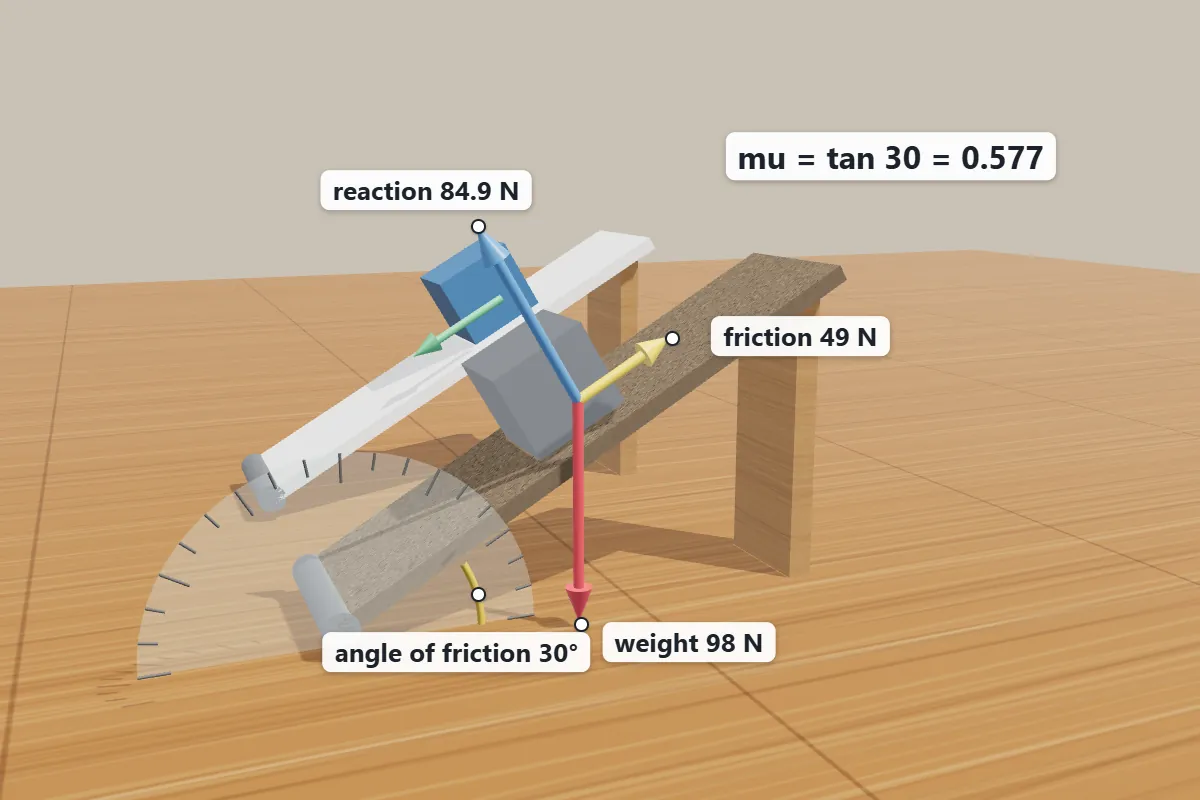
- The angle between the normal reaction and the resultant reaction grows as the friction force grows (with constant).
- Its largest value is reached when the friction is limiting. This angle is the angle of friction .
Relation with the coefficient of friction
- In the limiting state tanλ=FsN=μs
- So in limiting friction the coefficient of friction equals the tangent of the angle of friction.
- Also .
Lesson 1: Equilibrium of a Particle, Friction and Limiting Static Friction · 6 / 10
6 Equilibrium of a body on a rough horizontal plane
6 Equilibrium of a body on a rough horizontal plane
Setting
- A body of weight rests on a rough horizontal plane and a force is applied at angle above the horizontal.
- The forces are the weight w (down), the force P, the normal reaction N (up) and the friction F (horizontal, opposing the motion).
| Comparison aspect | Main idea | Keywords |
|---|---|---|
| • | Resolve into (horizontal) and (vertical). | ResolvePcoshorizontalPsin |
| Horizontal | F=Pcosθ | Pcos |
| Vertical | N+Psinθ=w | Psin |
| If the body is about to move | F=μsN | |
| If P is horizontal (θ=0) | N=w and F=P |
✍️ Worked examples
- Example 1:
- A box of weight N is on a horizontal road and the coefficient of friction is .
- Find the horizontal force that makes the box about to move.
- Solution:
- Vertical equilibrium N=w=124 N.
- About to move F=μsN=0.45×124=55.8 N.
- The horizontal force needed is N.
- Example 2:
- A body of weight kg.wt is on a rough horizontal plane.
- Two horizontal forces of and kg.wt, with an angle of between them, act on it and the body is about to move.
- Find and the angle of friction.
- Solution:
- kg.wt.
- The resultant of the two forces equals the limiting friction Fs=42+42+2(4)(4)cos60∘=48=43 kg.wt.
- .
- , so .
- Example 3:
- A body of weight N rests on a rough horizontal plane with .
- A force pulls it at an angle above the horizontal where and .
- Find when the body is about to move.
- Solution:
- Horizontal F=0.8P.
- Vertical N=60−0.6P.
- About to move F=μsN, so 0.8P=13(60−0.6P).
- , so and N.
- Check N=60−12=48 N, F=16 N, and 1648=13.
Lesson 1: Equilibrium of a Particle, Friction and Limiting Static Friction · 7 / 10
7 Equilibrium of a body on a rough inclined plane
7 Equilibrium of a body on a rough inclined plane
Forces and equations
- A body of weight rests on a rough plane inclined at angle to the horizontal.
- The weight and the resultant reaction are the only forces, so is vertical upward and .
- Resolve the weight along and perpendicular to the plane:
- Along the plane (line of greatest slope) F=wsinθ, directed up the slope (opposing the tendency to slide down).
- Perpendicular to the plane N=wcosθ.
- If the body is about to slip, the friction is limiting, so .
- Therefore the angle of the plane equals the angle of friction: .
- The angle of friction can be measured by raising the plane until the body is about to slide.
| Inclination | State of the body | Friction |
|---|---|---|
| At rest, in equilibrium | (less than ) | |
| About to slide down | ||
| Cannot stay at rest, slides down | once moving |
✍️ Worked examples
- Example 4:
- A block of weight N is about to slide down a rough plane inclined at .
- Find the friction force, the normal reaction and the coefficient of friction.
- Solution:
- N.
- N.
- .
- So as expected.
Lesson 1: Equilibrium of a Particle, Friction and Limiting Static Friction · 8 / 10
8 Conditions of equilibrium and rigid bodies with friction
8 Conditions of equilibrium and rigid bodies with friction
Equilibrium of a particle and of a rigid body
- A particle under concurrent forces is in equilibrium when the resultant force is zero: the sum of the components along is and along is .
- A rigid body under a system of coplanar forces is in equilibrium when two conditions hold:
- The resultant vector is zero R⃗=0⃗.
- The sum of the moments about any point is zero M⃗=0⃗.
- In components ∑X=0,∑Y=0,∑M=0.
- These conditions are necessary and sufficient for equilibrium.
Method for rods and ladders on rough ground
- Draw all the forces weights at the centres of uniform bodies, the reaction of the rough ground with components N (vertical) and F (horizontal), and the reaction of a smooth wall or wedge, which is perpendicular to the surface it touches.
- Write , and take moments about the point where most unknown forces meet (usually the foot of the rod).
- If the body is about to slip, use .
✍️ Worked examples
- Example 5:
- A uniform bar of weight kg.wt and length cm rests with end on rough horizontal ground and a point on a smooth wedge cm above the ground.
- The bar is about to slip when inclined at to the ground.
- Find the reaction of the wedge and the coefficient of friction at .
- Solution:
- cm.
- Forces weight 5 at the midpoint (15 cm from A), wedge reaction R2 perpendicular to the bar at C, and at A the normal R1 (up) and friction F (horizontal).
- Moments about A 5×15cos30∘−R2×25=0.
- kg.wt.
- Horizontal F=R2sin30∘=334 kg.wt.
- Vertical R1+R2cos30∘=5, so R1=5−332⋅32=5−94=114 kg.wt.
- About to slip μs=FR1=33/411/4=3311.
- Example 6:
- A uniform ladder of weight kg.wt rests with one end on rough horizontal ground and the other on a smooth vertical wall, inclined at to the horizontal.
- The coefficient of friction at the ground is .
- Show that a girl of weight kg.wt can climb at most half the length of the ladder.
- Solution:
- Let the ladder length be and the girl’s greatest distance from the foot be ; then the ladder is about to slip.
- Vertical R1=20+60=80 kg.wt (ground normal reaction).
- Horizontal the wall reaction R2 equals the friction, so R2=μsR1=8023=403 kg.wt.
- Moments about A R2×ℓsin60∘=20×ℓ2cos60∘+60×xcos60∘.
- Left side 403⋅32 ℓ=20ℓ.
- Right side 5ℓ+30x.
- , so and .
Lesson 1: Equilibrium of a Particle, Friction and Limiting Static Friction · 9 / 10
Part 10
Part 10
- 📖
🔍 In-Depth Explanations, Deductions & Multi-Book Insights:
Mathematics Thanaweya Amma (2026/2027)
- Lesson 1 – Equilibrium of a Particle, Friction and Limiting Static Friction
- Statics examines mechanical systems in translational and rotational equilibrium under balanced forces.
- We evaluate limiting static friction (Fs = μs · R), the angle of friction (λ), and equilibrium on rough horizontal and inclined planes.
🌳 Hierarchy Classification & Concept Tree
Statics and Friction Mechanics
├── 1. Rough Surfaces and Friction Force (F)
| Comparison aspect | Main idea | Keywords |
|---|---|---|
| • | │ ├── Static friction F ranges from 0 to its limiting value Fs (0 ≤ F ≤ Fs) | Staticfrictionrangeslimiting |
| │ └── Limiting static friction | Fs = μs · R (where μs is coefficient of static friction) | coefficient |
| • | ├── 2. Resultant Reaction (R') and Angle of Friction (λ) | ResultantReactionAngleFriction |
| • | │ ├── R' = √(R2 + Fs2) = R · √(1 + μs2) = R · sec λ | |
| │ └── Relationship | μs = tan λ | |
| • | └── 3. Equilibrium on Rough Inclined Plane (Angle θ) | EquilibriumRoughInclinedPlane |
| ├── Component along plane | W sin θ | Component perpendicular: W cos θ | perpendicular |
| ├── If θ < λ | Body remains at rest in equilibrium without slipping | Bodyremainsrestequilibrium |
| ├── If θ = λ | Body is on the verge of sliding down under gravity alone | Bodyvergeslidingdown |
| └── If θ > λ | Body accelerates down unless supported by upward force | Bodyacceleratesdownunless |
📋 Master Teacher's Blackboard & Exam Secrets
RULE 1When a body placed on a rough plane inclined at angle θ is on the verge of sliding under its own weight alone, then θ = λ, and μs = tan θ.
RULE 2Resultant reaction R' = R · sec λ.
RULE 3Friction force F opposes the impending direction of motion; it acts opposite to the direction the body tends to move.
📊 Comparative AnalysisBehavior of Body on Rough Inclined Plane
| Inclination Angle (θ) vs. Friction Angle (λ) | Mechanical State of the Body | Static Friction Force Value |
|---|---|---|
| θ < λ | At rest in static equilibrium | F = W sin θ < Fs |
| θ = λ | On the verge of sliding downward | F = Fs = μs R = W sin θ |
| θ > λ | Cannot remain in equilibrium (Slides down) | Kinetic friction Fk = μk R takes over |
Lesson 1: Equilibrium of a Particle, Friction and Limiting Static Friction · 10 / 10
Well done! You finished this lesson
What would you like to do next?