Curriculum
Mathematics
Unit 1
0/12
1.1Key terms1.2Laws and key relationships1.3Rigorous Derivation of Reciprocal Trigonometric Functions1.4Logarithmic and General Exponential Differentiation Techniques1.5Parametric and Implicit Second-Order Derivatives1.6Worked examples1.7Exam tips1.8Real-world applications1.9Key Scientific Tables & Anatomical Diagrams Extracted from Official Curricula1.10📌 Comprehensive Scientific Terminology Dictionary:1.11🔍 In-Depth Explanations, Deductions & Multi-Book Insights:1.12Lesson summary
Unit 2
0/141.1The counting principle1.2Permutations (nPr)1.3Combinations (nCr)1.4Worked examples on counting, permutations and combinations1.5Recall: counting principle, permutations and combinations1.61-1 (a) Pascal's triangle and the binomial expansion1.71-1 (b) The general term1.81-1 (c) The middle term1.91-2 The term containing xk and the term free of x1.101-3 (a) The ratio between two consecutive terms1.111-3 (b) The greatest term1.12Key Scientific Tables & Anatomical Diagrams Extracted from Official Curricula1.13Lesson 1 - Counting Principle, Permutations and Combinations and the Binomial Theorem1.14Lesson summary
Unit 3
0/131.1Key terms1.2Laws and key relationships1.3Geometry of 3D Vectors and Scalar/Cross Product Physics1.4Equations of Straight Lines in Three Dimensions1.5Equations of Planes and Perpendicular Distance Formulas1.6Worked examples1.7Exam tips1.8Real-world applications1.9Key Scientific Tables & Anatomical Diagrams Extracted from Official Curricula1.10📌 Comprehensive Scientific Terminology Dictionary:1.11⚖️ Governing Physical Laws & Mathematical Relations:1.12🔍 In-Depth Explanations, Deductions & Multi-Book Insights:1.13Lesson summary
Unit 4
0/81.11 Smooth and rough surfaces1.22 Properties of the static friction force1.33 Kinetic friction force1.44 The resultant reaction R′1.55 The angle of friction1.66 Equilibrium of a body on a rough horizontal plane1.77 Equilibrium of a body on a rough inclined plane1.88 Conditions of equilibrium and rigid bodies with friction
Unit 5
0/121.13-1 (a) Indefinite integrals of exponential functions1.23-1 (b) Indefinite integrals of logarithmic functions1.33-2 (a) The differential and the standard integrals1.43-2 (b) Integration by substitution1.53-2 (c) Integration by parts1.63-2 (d) Applications of the indefinite integral1.73-3 (a) The definite integral and the fundamental theorem of calculus1.83-3 (b) Properties of the definite integral1.93-3 (c) Definite integral by substitution, odd and even functions1.103-4 (a) Area of a plane region1.113-4 (b) Volumes of solids of revolution1.12Key Scientific Tables & Anatomical Diagrams Extracted from Official Curricula
Unit 6
0/81.12-1 (a) Polar coordinates and the Argand plane1.22-1 (b) Modulus, amplitude and principal amplitude1.32-1 (c) The trigonometric (polar) form of a complex number1.42-1 (d) Product and quotient in trigonometric form1.52-1 (e) The exponential (Euler) form1.62-2 (a) De Moivre's theorem for a positive integer power1.72-2 (b) De Moivre's theorem for a rational power and the roots of a complex number1.82-3 The cube roots of unity
Unit 7
0/101.11 Momentum and its change1.22 Newton's first law, inertia and force1.33 Newton's second law, the equation of motion and variable mass1.44 Newton's third law, lifts and scales1.55 Bodies connected by a string over a smooth pulley1.66 Impulse1.77 Work1.88 Kinetic energy and the work-energy principle1.99 Potential energy and conservation of energy1.1010 Power
Text lesson
Lesson 1: Integration Techniques (Substitution and By Parts) and Definite Integrals
Lesson 1: Integration Techniques (Substitution and By Parts) and Definite Integrals
Overview
Overview
- Integrate exponential and logarithmic functions and use integration to find a curve from its slope.
- Use the differential, integration by substitution and integration by parts.
- Evaluate definite integrals with the fundamental theorem of calculus, including odd and even functions.
- Use the definite integral to find areas of plane regions and volumes of solids of revolution.
🌳 Concept tree
- Lesson 1 Integration Techniques (Substitution and By Parts) and Definite Integrals
- ├── 3-1 (a) Indefinite integrals of exponential functions
│ ├── Reminder
│ └── Rules for ex
- ├── 3-1 (b) Indefinite integrals of logarithmic functions
│ ├── Rules
│ └── Geometric and physical applications
- ├── 3-2 (a) The differential and the standard integrals
│ ├── The differential
- │ └── Standard integrals (reverse of the standard derivatives)
├── 3-2 (b) Integration by substitution
│ ├── Idea
- │ ├── When the integrand has an extra factor of
│ └── Two rules proved by substitution
├── 3-2 (c) Integration by parts
│ ├── Rule
│ └── How to choose y and dz
- ├── 3-2 (d) Applications of the indefinite integral
│ └── Finding a function from its rate of change
- ├── 3-3 (a) The definite integral and the fundamental theorem of calculus
│ ├── Meaning
│ └── Fundamental theorem of calculus
├── 3-3 (b) Properties of the definite integral
│ ├── Rules
│ └── The modulus function
- ├── 3-3 (c) Definite integral by substitution
- odd and even functions
│ ├── Substitution in a definite integral
│ └── Odd and even functions
├── 3-4 (a) Area of a plane region
│ ├── Rule
│ ├── Method when the curve crosses the x-axis
│ └── Application→cost of covering an arch
└── 3-4 (b) Volumes of solids of revolution
├── Solid of revolution
├── Rule→revolution about the x-axis
└── Volume formulas proved by integration
Lesson 1: Integration Techniques (Substitution and By Parts) and Definite Integrals · 1 / 14
3-1 (a) Indefinite integrals of exponential functions
3-1 (a) Indefinite integrals of exponential functions
Reminder
| Comparison aspect | Main idea | Keywords |
|---|---|---|
| Antiderivative | of : a function with . | function |
| Indefinite integral | the whole family of antiderivatives, written where is an arbitrary constant. The curves are parallel curves with equal slopes at the same . | wholefamilyantiderivativeswritten |
| Properties | ∫[f(x)±g(x)] dx=∫f(x) dx±∫g(x) dx and ∫k f(x) dx=k∫f(x) dx | |
| • | for . |
Rules for ex
- .
- for .
- ∫f′(x) ef(x) dx=ef(x)+c.
- for , .
✍️ Worked examples
- Example 1 Find (a) (b) (c) .
- Solution:
- (a) .
- (b) Expand first (ex+1)2=e2x+2ex+1.
- .
- (c) Put , so .
- .
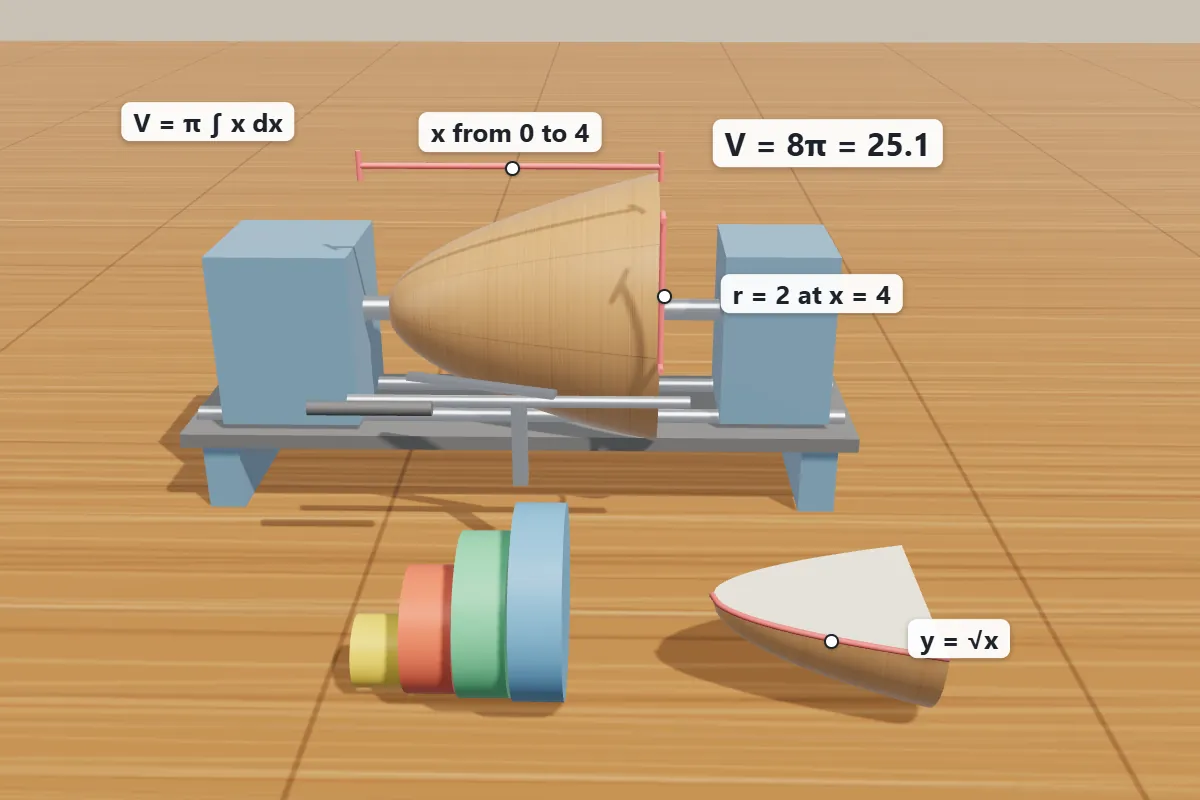
Integration Techniques (Substitution→a lathe turning the curve y = √x into a vase shows integration techniques and definite integrals: the volume of revolution is 8π.: 3-1 (a) Indefinite integrals of exponential functions
Lesson 1: Integration Techniques (Substitution and By Parts) and Definite Integrals · 2 / 14
3-1 (b) Indefinite integrals of logarithmic functions
3-1 (b) Indefinite integrals of logarithmic functions
Rules
- ∫1x dx=ln∣x∣+c(x≠0)
- ∫f′(x)f(x) dx=ln∣f(x)∣+c
- .
- .
✍️ Worked examples
- Example 2 Find (a) (b) (c) .
- Solution:
- (a) .
- (b) .
- (c) The derivative of the denominator is , which is the numerator.
- So the integral is .
- If the slope of the tangent at any point is , then the curve is , and the point given on the curve fixes .
- If the rate of change is given, then , and the starting value fixes .
✍️ Worked examples
- Example 3 The slope of the tangent to a curve at any point is , and the curve passes through . Find its equation.
- Solution:
- (for ).
- Substitute (e,3e+5) 3e+5=3e+2lne+c=3e+2+c.
- So .
- The curve is .
- Example 4 The area of a lamina changes at the rate cm/s, and its area at is cm. Find its area after 10 seconds.
- Solution:
- .
- At t=0 80=−10+c, so c=90.
- .
- At t=10 A=90−10e−1≈86.3 cm2.
Lesson 1: Integration Techniques (Substitution and By Parts) and Definite Integrals · 3 / 14
3-2 (a) The differential and the standard integrals
3-2 (a) The differential and the standard integrals
The differential
- If is differentiable, the differential of is
- The differential of is .
- It comes from as .
- For a product of two functions z and ℓ of x d(zℓ)=z dℓ+ℓ dz.
✍️ Worked examples
- Example 5 Find the differential of (a) (b) with respect to .
- Solution:
- (a) .
- (b) .
- , .
- and .
- .
- and .
- .
Lesson 1: Integration Techniques (Substitution and By Parts) and Definite Integrals · 4 / 14
3-2 (b) Integration by substitution
3-2 (b) Integration by substitution
Idea
- Used for integrals of the form .
- If then , so
- Steps choose z; find dz; rewrite the whole integral in z (including x and dx); integrate; return to x.
- Choose so that the new integral is simpler and a standard one; if the first choice fails, try another.
✍️ Worked examples
- Find (a) (b) .
- Solution:
- (a) Put , so .
- .
- .
- (b) Put , so .
- .
- .
- Put equal to the inner expression and write in terms of too.
✍️ Worked examples
- Example 7 Find (a) (b) .
- Solution:
- (a) Put , so and .
- .
- .
- (b) Put , so and .
- .
- .
- Example 8 Find (a) (b) .
- Solution:
- (a) Put , so and .
- .
- .
- (b) Put , so .
- .
- Example 9 Find (a) (b) .
- Solution:
- (a) Put , so .
- .
- (b) Put , so .
- .
Two rules proved by substitution
Put z=f(x) in ∫[f(x)]nf′(x) dxit becomes ∫zn dz=zn+1n+1+c, so ∫[f(x)]nf′(x) dx=[f(x)]n+1n+1+c(n≠−1)
Put z=f(x) in ∫f′(x)f(x) dxit becomes ∫dzz=ln∣z∣+c.
Lesson 1: Integration Techniques (Substitution and By Parts) and Definite Integrals · 5 / 14
3-2 (c) Integration by parts
3-2 (c) Integration by parts
Rule
| Comparison aspect | Main idea | Keywords |
|---|---|---|
| Start from the derivative of a product | ddx(yz)=ydzdx+zdydx | ydzdxzdydx |
| Integrate both sides and rearrange | ∫y dz=yz−∫z dy | |
| • | It is used for the integral of a product of two functions when neither is the derivative of the other | usedintegralproductfunctions |
- Choose so that is simpler than (for example or ).
- Choose so that it is easy to integrate to get .
- The integral must be easier than the one you started with.
- Adding a constant to does not change the final result.
✍️ Worked examples
- Example 10 Find (a) (b) .
- Solution:
- (a) Let and , so and .
- .
- (b) Let and , so and .
- .
- Use part (a) =x2ex−2ex(x−1)+c.
- .
- Example 11 Find (a) (b) .
- Solution:
- (a) Let and , so and .
- .
- (b) Let and , so and .
- .
- .
- Example 12 Find .
- Solution:
- Let and .
- Then and .
- .
- .
Lesson 1: Integration Techniques (Substitution and By Parts) and Definite Integrals · 6 / 14
3-2 (d) Applications of the indefinite integral
3-2 (d) Applications of the indefinite integral
Finding a function from its rate of change
- If is the slope of the tangent (or a rate of change or a marginal function) of , then .
- The integral has an arbitrary constant, found from a given point on the curve.
✍️ Worked examples
- Example 13 The slope of the tangent to a curve at any point is and the curve passes through . Find its equation.
- Solution:
- By Example 12, .
- Substitute (0,1) 1=11+c, so c=0.
- The curve is .
Lesson 1: Integration Techniques (Substitution and By Parts) and Definite Integrals · 7 / 14
3-3 (a) The definite integral and the fundamental theorem of calculus
3-3 (a) The definite integral and the fundamental theorem of calculus
Meaning
- The indefinite integral contains an arbitrary constant, so it does not give a definite number.
- The difference between its values at and does not depend on the constant:
- This number is the definite integral.
- If is continuous on and is any antiderivative of on :
- and are the lower and upper limits of the integral.
- The value is a real number that depends only on , and ; the name of the variable does not matter: .
- You may drop the constant when evaluating, because it cancels in .
- Every rule of indefinite integration and every standard integral still applies.
- A continuous function on is integrable on .
| Point of comparison | Indefinite integral | Definite integral |
|---|---|---|
| Result | A family of functions | One real number |
| Constant | Present | Not needed |
| Limits | None | Lower and upper |
✍️ Worked examples
- Find .
- Solution:
- is a continuous polynomial.
- .
- .
- .
Lesson 1: Integration Techniques (Substitution and By Parts) and Definite Integrals · 8 / 14
3-3 (b) Properties of the definite integral
3-3 (b) Properties of the definite integral
Rules
- For a continuous on and :
- .
- .
- .
- .
- .
✍️ Worked examples
- Example 15 If is continuous on , and , find .
- Solution:
- .
- .
- .
- Write for and for , then split the integral at .
✍️ Worked examples
- Example 16 Find .
- Solution:
- .
- .
- .
- The total is (two triangles, each of base 2 and height 2).
Lesson 1: Integration Techniques (Substitution and By Parts) and Definite Integrals · 9 / 14
3-3 (c) Definite integral by substitution, odd and even functions
3-3 (c) Definite integral by substitution, odd and even functions
Substitution in a definite integral
Method 1find the indefinite integral by substitution, return to x, then use the limits of x.
Method 2change the limits with the substitution, so you do not need to return to x.
✍️ Worked examples
- Find .
- Solution:
- Put , so .
- When , ; when , .
- .
- and .
- The value is .
If f is continuous and odd on [−a,a] (that is f(−x)=−f(x))∫−aaf(x) dx=0
If f is continuous and even on [−a,a] (that is f(−x)=f(x))∫−aaf(x) dx=2∫0af(x) dx
✍️ Worked examples
- Find (a) (b) .
- Solution:
- (a) , so is odd.
- The integral over equals .
- (b) is an even polynomial.
- .
- .
Lesson 1: Integration Techniques (Substitution and By Parts) and Definite Integrals · 10 / 14
3-4 (a) Area of a plane region
3-4 (a) Area of a plane region
Rule
- If is continuous on and , the area bounded by the curve , the -axis and the lines , is
- In general the area is .
- The area is measured in square units, and it is never negative.
- Find the zeros of by putting .
- Study the sign of on each sub-interval between the zeros and the limits.
- Integrate on each sub-interval separately, taking the absolute value of each integral where .
- Add the areas.
✍️ Worked examples
- Example 19 Find the area bounded by , the -axis and the lines and .
- Solution:
- on (its zeros are , i.e. about and , both outside ).
- .
- .
- square units.
- Example 20 Find the area bounded by , the -axis and the line .
- Solution:
- Zero of f 2x+2=0 gives x=−1, and f>0 for x>−1.
- .
- square units.
- Example 21 Find the area of the region above the -axis bounded by and the -axis, for .
- Solution:
- , so the zeros are .
- on and on .
- .
- .
- square units.
- Example 22 Find the area bounded by , the -axis and the lines and .
- Solution:
- on and on .
- .
- , so .
- square units.
Application: cost of covering an arch
✍️ Worked examples
- Example 23 A hotel entrance arch has equation with in metres. Find the cost of covering it with glass at 1500 LE per square metre.
- Solution:
- Cost = area 1500.
- The zeros are and , and between them.
- .
- .
- square metres.
- Cost LE.
Lesson 1: Integration Techniques (Substitution and By Parts) and Definite Integrals · 11 / 14
3-4 (b) Volumes of solids of revolution
3-4 (b) Volumes of solids of revolution
Solid of revolution
- A solid of revolution is generated when a plane region makes a complete revolution about a fixed line in its plane, called the axis of revolution.
- Examples a right circular cone, a right circular cylinder and a sphere.
Rule: revolution about the x-axis
- If is continuous on and , the region bounded by , the -axis and the lines , generates a solid of volume
✍️ Worked examples
- Example 24 Find the volume generated by revolving the region bounded by , the -axis and the lines and about the -axis.
- Solution:
- .
- The integrand is even, so .
- cubic units.
- Example 25 Find the volume generated by revolving the region bounded by , the -axis and the line about the -axis, and name the solid.
- Solution:
- cubic units.
- The solid is a right circular cone with and .
- Check 13πr2h=13π(9)(3)=9π.
Volume formulas proved by integration
Conethe line for revolves to a cone, so .
Spherethe circle , so and .
Cylinderthe line for gives .
✍️ Worked examples
- Example 26 Find the volume generated by revolving the region bounded by the ellipse about the -axis.
- Solution:
- , and the limits are , i.e. .
- (even function).
- .
- cubic units.
- Example 27 Find the volume generated by revolving the region bounded by and the -axis about the -axis.
- Solution:
- The curve meets the -axis where , i.e. and .
- .
- .
- cubic units.
Lesson 1: Integration Techniques (Substitution and By Parts) and Definite Integrals · 12 / 14
Key Scientific Tables & Anatomical Diagrams Extracted from Official Curricula
Key Scientific Tables & Anatomical Diagrams Extracted from Official Curricula
💡 Core Diagrams & Reference Data→All data, reference comparison tables, and anatomical figures have been accurately digitized from official curriculum textbooks.
🔬 integration_areas_and_volumes_of_revolution
- Scientific details and precise observational breakdown:
(a) 14 (b) 16 (c) 18 (d) 21
- 4) If (T,,) is an arithmetic sequence »T,
- + Tyg = 68 »
- Ty + Tyg = err
(a) 68 (b) 136 (c) 34 (d) 204
- 5) In the arithmetic sequence (2a+5b>53a+8b 54a+11b >…)
- Tyg So
(a)a+9b (b)10a+30b = (c) lla+32b (d) 12a+35b
- 6) If (T,,) is an arithmetic sequence in which 7 = + »
- z TE seceesesnenees
@) 3 () $ (c) $ (a) 3
7) In any arithmetic sequence (T,,) » Les
(a) 2 )3 “(a (d) 5
- 8) An arithmetic sequence in which T
- = m
- T,
- = » where m #n »
- the common
Lesson 1: Integration Techniques (Substitution and By Parts) and Definite Integrals · 13 / 14
Part 14
Part 14
- 📖
🔍 In-Depth Explanations, Deductions & Multi-Book Insights:
Mathematics Thanaweya Amma (2026/2027)
- Lesson 1 – Integration Techniques (Substitution and By Parts) and Definite Integrals
- Integration is the inverse operation of differentiation.
- We explore integration by substitution, integration by parts (∫ u dv = u v – ∫ v du), standard integral forms, and the properties of definite integrals to evaluate plane areas and volumes of revolution.
🌳 Conceptual Hierarchy Tree
Advanced Integration Calculus
├── 1. Standard Integral Forms
- │ ├── ∫ [f(x)]n · f'(x) dx = [f(x)]n+1 / (n + 1) + C
│ ├── ∫ [f'(x) / f(x)] dx = ln |f(x)| + C
│ └── ∫ ef(x) · f'(x) dx = ef(x) + C
├── 2. Integration by Parts (LIATE Rule)
| Comparison aspect | Main idea | Keywords |
|---|---|---|
| │ └── Formula |
| LogarithmicInversetrigAlgebraic |
| • | └── 3. Geometric Applications of Definite Integrals | GeometricApplicationsDefiniteIntegrals |
| ├── Plane Area between two curves | Area = ∫ [yupper – ylower] dx | yupperylower |
| ├── Volume of Revolution about x-axis | V = π · ∫ [y2] dx | |
| └── Volume of Revolution about y-axis | V = π · ∫ [x2] dy |
📋 Master Teacher's Blackboard Secrets
RULE 1If f(x) is an odd continuous function on [-a, a], then ∫₋ₐᵃ f(x) dx = 0.
RULE 2If f(x) is an even continuous function on [-a, a], then ∫₋ₐᵃ f(x) dx = 2 · ∫₀ᵃ f(x) dx.
RULE 3Volume of solid generated by revolving region around x-axis between x = a and x = b is V = π · ∫ₐᵇ y2 dx.
📊 MatrixIntegration Methods and Applications
| Integration Method | Mathematical Condition | Fundamental Formula |
|---|---|---|
| Direct Form | Integrand contains function and its derivative | ∫ [f(x)]n · f'(x) dx = [f(x)]n+1 / (n+1) + C |
| Logarithmic Form | Numerator is exact derivative of denominator | ∫ [f'(x) / f(x)] dx = ln |f(x)| + C |
| By Parts | Product of two distinct mathematical families | ∫ u dv = u v – ∫ v du |
| Volume around x-axis | Revolution of y = f(x) through 360° | V = π ∫ y2 dx |
Lesson 1: Integration Techniques (Substitution and By Parts) and Definite Integrals · 14 / 14
Well done! You finished this lesson
What would you like to do next?