Curriculum
Mathematics
Unit 1
0/12
1.1Key terms1.2Laws and key relationships1.3Rigorous Derivation of Reciprocal Trigonometric Functions1.4Logarithmic and General Exponential Differentiation Techniques1.5Parametric and Implicit Second-Order Derivatives1.6Worked examples1.7Exam tips1.8Real-world applications1.9Key Scientific Tables & Anatomical Diagrams Extracted from Official Curricula1.10📌 Comprehensive Scientific Terminology Dictionary:1.11🔍 In-Depth Explanations, Deductions & Multi-Book Insights:1.12Lesson summary
Unit 2
0/141.1The counting principle1.2Permutations (nPr)1.3Combinations (nCr)1.4Worked examples on counting, permutations and combinations1.5Recall: counting principle, permutations and combinations1.61-1 (a) Pascal's triangle and the binomial expansion1.71-1 (b) The general term1.81-1 (c) The middle term1.91-2 The term containing xk and the term free of x1.101-3 (a) The ratio between two consecutive terms1.111-3 (b) The greatest term1.12Key Scientific Tables & Anatomical Diagrams Extracted from Official Curricula1.13Lesson 1 - Counting Principle, Permutations and Combinations and the Binomial Theorem1.14Lesson summary
Unit 3
0/131.1Key terms1.2Laws and key relationships1.3Geometry of 3D Vectors and Scalar/Cross Product Physics1.4Equations of Straight Lines in Three Dimensions1.5Equations of Planes and Perpendicular Distance Formulas1.6Worked examples1.7Exam tips1.8Real-world applications1.9Key Scientific Tables & Anatomical Diagrams Extracted from Official Curricula1.10📌 Comprehensive Scientific Terminology Dictionary:1.11⚖️ Governing Physical Laws & Mathematical Relations:1.12🔍 In-Depth Explanations, Deductions & Multi-Book Insights:1.13Lesson summary
Unit 4
0/81.11 Smooth and rough surfaces1.22 Properties of the static friction force1.33 Kinetic friction force1.44 The resultant reaction R′1.55 The angle of friction1.66 Equilibrium of a body on a rough horizontal plane1.77 Equilibrium of a body on a rough inclined plane1.88 Conditions of equilibrium and rigid bodies with friction
Unit 5
0/121.13-1 (a) Indefinite integrals of exponential functions1.23-1 (b) Indefinite integrals of logarithmic functions1.33-2 (a) The differential and the standard integrals1.43-2 (b) Integration by substitution1.53-2 (c) Integration by parts1.63-2 (d) Applications of the indefinite integral1.73-3 (a) The definite integral and the fundamental theorem of calculus1.83-3 (b) Properties of the definite integral1.93-3 (c) Definite integral by substitution, odd and even functions1.103-4 (a) Area of a plane region1.113-4 (b) Volumes of solids of revolution1.12Key Scientific Tables & Anatomical Diagrams Extracted from Official Curricula
Unit 6
0/81.12-1 (a) Polar coordinates and the Argand plane1.22-1 (b) Modulus, amplitude and principal amplitude1.32-1 (c) The trigonometric (polar) form of a complex number1.42-1 (d) Product and quotient in trigonometric form1.52-1 (e) The exponential (Euler) form1.62-2 (a) De Moivre's theorem for a positive integer power1.72-2 (b) De Moivre's theorem for a rational power and the roots of a complex number1.82-3 The cube roots of unity
Unit 7
0/101.11 Momentum and its change1.22 Newton's first law, inertia and force1.33 Newton's second law, the equation of motion and variable mass1.44 Newton's third law, lifts and scales1.55 Bodies connected by a string over a smooth pulley1.66 Impulse1.77 Work1.88 Kinetic energy and the work-energy principle1.99 Potential energy and conservation of energy1.1010 Power
Text lesson
Lesson 1: Three-Dimensional Cartesian Coordinates and Vector Operations
Lesson 1: Three-Dimensional Cartesian Coordinates and Vector Operations
Overview
Overview
🎯 Learning outcomes
- Establish the 3D Cartesian Coordinate System and distance/midpoint formulas.
- Calculate Dot Product (Scalar) and Cross Product (Vector) and determine angles between vectors.
- Derive the vector, parametric, and Cartesian forms of straight line equations in space.
- Formulate vector and general scalar equations of a plane in 3D space ().
🌳 Concept tree
Lesson 1→Three-Dimensional Cartesian Coordinates and Vector Operations
├── Key terms
├── Laws and key relationships
- ├── Geometry of 3D Vectors and Scalar/Cross Product Physics
- ├── Equations of Straight Lines in Three Dimensions
- ├── Equations of Planes and Perpendicular Distance Formulas
├── Worked examples
├── Exam tips
└── Real-world applications
Lesson 1: Three-Dimensional Cartesian Coordinates and Vector Operations · 1 / 15
Key terms
Key terms
| Comparison aspect | Main idea | Keywords |
|---|---|---|
| D Coordinate System | A spatial coordinate frame defined by three mutually perpendicular axes () intersecting at the origin , governed by the right-hand rule. | spatialframedefinedthree |
| Dot (Scalar) Product | An algebraic operation between two vectors yielding a scalar: . | algebraicoperationbetweenvectors |
| Cross (Vector) Product | An algebraic operation yielding a vector perpendicular to both vectors: , evaluated via a determinant. | algebraicoperationyieldingperpendicular |
| Direction Vector of a Line (d⃗) |
| zeroparallelstraightspace |
| Normal Vector to a Plane (n⃗) |
| zeroperpendiculareveryline |
Lesson 1: Three-Dimensional Cartesian Coordinates and Vector Operations · 2 / 15
Laws and key relationships
Laws and key relationships
Vector Norm & Distance Formula[ Formula: | Distance . ]
Orthogonality and Parallelism Conditions[ Formula: Orthogonal: . Parallel: . ]
Straight Line Equations in Space[ Formula: Vector form: . Parametric: .Cartesian (Symmetric): . ]
Plane Equation in Space[ Formula: Vector form: . General scalar: . ]
Lesson 1: Three-Dimensional Cartesian Coordinates and Vector Operations · 3 / 15
Geometry of 3D Vectors and Scalar/Cross Product Physics
Geometry of 3D Vectors and Scalar/Cross Product Physics
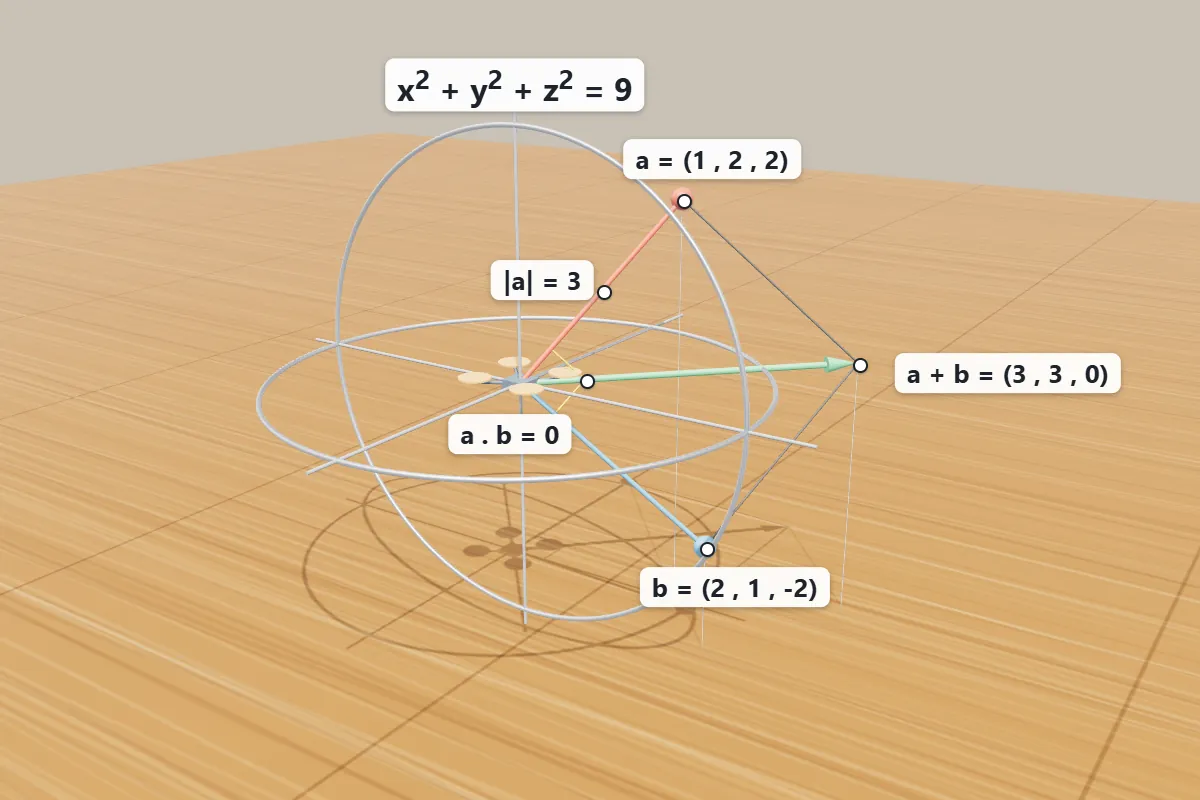
- In three dimensions, any vector is represented by components .
- Direction cosines satisfy the identity .- Dot Product: .
- It calculates the angle between vectors and the scalar projection of onto ().
- Two non-zero vectors are perpendicular if and only if .- Cross Product: .
- Its magnitude geometrically represents the AREA of the parallelogram spanned by and .
- The triangle area is half of this magnitude.
Lesson 1: Three-Dimensional Cartesian Coordinates and Vector Operations · 4 / 15
Equations of Straight Lines in Three Dimensions
Equations of Straight Lines in Three Dimensions
- A line in 3D is uniquely fixed by a point and a direction vector .
- The position vector of any point on the line is , where is the scalar parameter. Expressing each coordinate gives the parametric equations .
- Solving for t yields the symmetric Cartesian form x−x0a=y−y0b=z−z0c.
- If any direction number is zero (e.g., ), the line lies in a plane parallel to the xy-plane, written as .
Lesson 1: Three-Dimensional Cartesian Coordinates and Vector Operations · 5 / 15
Equations of Planes and Perpendicular Distance Formulas
Equations of Planes and Perpendicular Distance Formulas
- A plane in space is defined by a point and a normal vector perpendicular to the plane.
- For any point on the plane, the vector is orthogonal to , giving , where .
- The perpendicular length from an external point to the plane is given by the elegant formula: .
Lesson 1: Three-Dimensional Cartesian Coordinates and Vector Operations · 6 / 15
Worked examples
Worked examples
✍️ Worked examples→Worked Problem 2 – Line-Plane Intersection and Perpendicular Distance
- Problem Statement Problem: Given the plane 2x−y+2z−6=0 and the point P(3,4,−1):1) Find the perpendicular distance from point P to the plane.2) Find the Cartesian equation of the straight line passing through P perpendicular to the plane. Detailed Solution:1) Normal to plane: n⃗=(2,−1,2).
- .Perpendicular distance:.2) Since the line is perpendicular to the plane, its direction vector is parallel to the normal vector :.The line passes through :Cartesian symmetric equation: .
Lesson 1: Three-Dimensional Cartesian Coordinates and Vector Operations · 7 / 15
Exam tips
Exam tips
Angle Between Two PlanesThe angle between two planes is the angle between their normal vectors: .
Line Parallel to PlaneIf a line is parallel to a plane, its direction vector is PERPENDICULAR to the plane’s normal: .
Direction Cosines Identity. Consequently, .
Lesson 1: Three-Dimensional Cartesian Coordinates and Vector Operations · 8 / 15
Real-world applications
Real-world applications
| Comparison aspect | Main idea | Keywords |
|---|---|---|
| Robotics & Computer Graphics | 3D transformation matrices and vector cross products govern the rendering of 3D computer animation and robotic arm inverse kinematics | transformationmatricesvectorcross |
| GPS & Satellite Positioning |
| Triangulatingradiosignalsfour |
| • |
| margin18pxbordersolid |
Lesson 1: Three-Dimensional Cartesian Coordinates and Vector Operations · 9 / 15
Key Scientific Tables & Anatomical Diagrams Extracted from Official Curricula
Key Scientific Tables & Anatomical Diagrams Extracted from Official Curricula
💡 Core Diagrams & Reference Data→All data, reference comparison tables, and anatomical figures have been accurately digitized from official curriculum textbooks.
🔬 solid_geometry_vectors_and_planes
- Scientific details and precise observational breakdown:
(1) » (r2) (2) 2 (-r)
3) ¥ (= (4yc9 & (L-+)
( »d (Sy rat \rtl or
- (1) Find in two different methods :
(1) ¥ (2r?-3r45) (2) % G-2r+r’)
r=1 ts
If you know that→pant) and ye r= onmetent’ , use the properti
ie) r=1 r=
- of the summation notation = to find the value of each of the following :
n 6
Lesson 1: Three-Dimensional Cartesian Coordinates and Vector Operations · 10 / 15
Part 11
Part 11
- 📖
Lesson 1: Three-Dimensional Cartesian Coordinates and Vector Operations · 11 / 15
📌 Comprehensive Scientific Terminology Dictionary:
📌 Comprehensive Scientific Terminology Dictionary:
- 3D Coordinate System:
- A spatial coordinate frame defined by three mutually perpendicular axes (x, y, z) intersecting at the origin (0, 0, 0), governed by the right-hand rule.
- Dot (Scalar) Product:
- An algebraic operation between two vectors yielding a scalar A⃗ · B⃗ = ||A⃗|| ||B⃗|| cos θ = Ax Bx + Ay By + Az Bz.
- Cross (Vector) Product:
- An algebraic operation yielding a vector perpendicular to both vectors: A⃗ × B⃗ = ||A⃗|| ||B⃗|| sin θ n̂, evaluated via a 3 × 3 determinant.
- Direction Vector of a Line (d⃗):
- A non-zero vector $(a, b, c)$ that is parallel to the straight line in space.
- Normal Vector to a Plane (n⃗):
- A non-zero vector $(A, B, C)$ perpendicular to every line lying entirely within the plane.
- ⚖️ Governing Scientific Laws, Theorems & Mathematical Models:
- Vector Norm & Distance Formula:
- [ Formula ||A⃗|| = √(Ax2 + Ay2 + Az2) | Distance AB = √((x2-x1)2 + (y2-y1)2 + (z2-z1)2). ]
- Orthogonality and Parallelism Conditions:
- [ Formula Orthogonal: A⃗ · B⃗ = 0. Parallel: A⃗ × B⃗ = 0⃗ ⇔ Ax / Bx = Ay / By = Az / Bz. ]
- Straight Line Equations in Space:
- [ Formula Vector form: r⃗ = r⃗0 + t d⃗. Parametric: \(x = x0 + at, y = y0 + bt, z = z0 + ct\).
- Cartesian (Symmetric) (x – x0) / a = (y – y0) / b = (z – z0) / c. ]
- Plane Equation in Space:
- [ Formula Vector form: n⃗ · r⃗ = n⃗ · r⃗0. General scalar: A(x – x0) + B(y – y0) + C(z – z0) = 0 ⇒ Ax + By + Cz + D = 0. ]
- 📌 Exhaustive In:
- Depth Pedagogical Breakdown:
- ◄ I. Geometry of 3D Vectors and Scalar/Cross Product Physics
- In three dimensions, any vector is represented by components A⃗ = Ax î + Ay ĵ + Az k̂.
- Direction cosines satisfy the identity cos 2 α + cos 2 β + cos 2 γ = 1.:
- Dot Product A⃗ · B⃗ = Ax Bx + Ay By + Az Bz. It calculates the angle between vectors cos θ = (A⃗ · B⃗) / (||A⃗|| ||B⃗||) and the scalar projection of \(\vec{A}\) onto \(\vec{B}\) (= A⃗ · ûB). Two non-zero vectors are perpendicular if and only if A⃗ · B⃗ = 0.
- – Cross Product A⃗ × B⃗ = î amp; ĵ amp; k̂ Ax amp; Ay amp; Az Bx amp; By amp; Bz. Its magnitude ||A⃗ × B⃗|| geometrically represents the AREA of the parallelogram spanned by \(\vec{A}\) and \(\vec{B}\). The triangle area is half of this magnitude.
- Figure (solid_geometry_vectors_and_planes.png):
- Figure (8) Spatial 3D coordinate planes, vector projections, and normal vector to a plane
- ◄ II. Equations of Straight Lines in Three Dimensions
- A line in 3D is uniquely fixed by a point $P0(x0, y0, z0)$ and a direction vector \(\vec{d} = (a, b, c)\).
- The position vector of any point on the line is r⃗ = r⃗0 + t d⃗, where t ∈ ℝ is the scalar parameter.
- Expressing each coordinate gives the parametric equations \(x = x0 + at, y = y0 + bt, z = z0 + ct\).
- Solving for t yields the symmetric Cartesian form:
- (x – x0) / a = (y – y0) / b = (z – z0) / c.
- If any direction number is zero (e.g., c = 0), the line lies in a plane parallel to the xy-plane, written as (x – x0) / a = (y – y0) / b, z = z0.
Lesson 1: Three-Dimensional Cartesian Coordinates and Vector Operations · 12 / 15
⚖️ Governing Physical Laws & Mathematical Relations:
⚖️ Governing Physical Laws & Mathematical Relations:
- A plane in space is defined by a point $P0(x0, y0, z0)$ and a normal vector \(\vec{n} = (A, B, C)\) perpendicular to the plane.
- For any point P(x, y, z) on the plane, the vector \(\vec{P0 P}\) is orthogonal to \(\vec{n}\), giving n⃗ · (r⃗ – r⃗0) = 0 ⇒ Ax + By + Cz + D = 0, where D = -(Ax0 + By0 + Cz0).
- The perpendicular length L from an external point $(x1, y1, z1)$ to the plane is given by the elegant formula: L = (|A x1 + B y1 + C z1 + D|) / (√(A2 + B2 + C2)).
- 🧮 Exemplary Step-by-Step Worked Problems & Applied Exercises:
- Worked Example 1 Worked Problem 2 – Line-Plane Intersection and Perpendicular Distance
- Problem Statement Problem: Given the plane 2x – y + 2z – 6 = 0 and the point P(3, 4, -1):
- 1) Find the perpendicular distance from point P to the plane.
- 2) Find the Cartesian equation of the straight line passing through P perpendicular to the plane.
- Detailed Solution:
- 1) Normal to plane n⃗ = (2, -1, 2). A = 2, B = -1, C = 2, D = -6.
- Perpendicular distance:
- L = (|A x1 + B y1 + C z1 + D|) / (√(A2 + B2 + C2)) = (|2(3) + (-1)(4) + 2(-1) – 6|) / (√(22 + (-1)2 + 22)) = (|6 – 4 – 2 – 6|) / (√(4 + 1 + 4)) = (|-6|) / √9 = 6 / 3 = 2 units of length.
- 2) Since the line is perpendicular to the plane, its direction vector d⃗ is parallel to the normal vector n⃗:
- d⃗ = n⃗ = (2, -1, 2).
- The line passes through P(3, 4, -1):
- Cartesian symmetric equation (x – 3) / 2 = (y – 4) / (-1) = (z + 1) / 2.
| Comparison aspect | Main idea | Keywords |
|---|---|---|
| • | 💡 Master Teacher Insights & Critical Exam Cautions | MasterTeacherInsightsCritical |
| Angle Between Two Planes | The angle between two planes is the angle between their normal vectors: cos θ = (|n⃗1 · n⃗2|) / (||n⃗1|| ||n⃗2||) | normalvectors |
| Line Parallel to Plane |
| directionvectorPERPENDICULARnormal |
| Direction Cosines Identity |
| Consequently |
| • |
| PracticalRealWorldIndustrial |
| ✔ Robotics & Computer Graphics | 3D transformation matrices and vector cross products govern the rendering of 3D computer animation and robotic arm inverse kinematics | transformationmatricesvectorcross |
✔ GPS & Satellite Positioning→Triangulating radio signals from four orbital GPS satellites to compute the precise latitude, longitude, and elevation of a mobile user.
Lesson 1: Three-Dimensional Cartesian Coordinates and Vector Operations · 13 / 15
🔍 In-Depth Explanations, Deductions & Multi-Book Insights:
🔍 In-Depth Explanations, Deductions & Multi-Book Insights:
- ★ Comprehensive Study & Detailed Pedagogical Guide ★
- Comprehensive Explanation Three-Dimensional Cartesian Coordinates, Vectors, Dot and Cross Products, and Planes in Space
| | 2026/2027 |
- 🎯 Targeted Learning Outcomes & Pedagogical Objectives:
- • Establish the 3D Cartesian Coordinate System $(x, y, z)$ and distance/midpoint formulas.
- • Calculate Dot Product (Scalar) and Cross Product (Vector) and determine angles between vectors.
- • Derive the vector, parametric, and Cartesian forms of straight line equations in space.
- • Formulate vector and general scalar equations of a plane in 3D space (Ax + By + Cz + D = 0).
Lesson 1: Three-Dimensional Cartesian Coordinates and Vector Operations · 14 / 15
Lesson summary
Lesson summary
- ★ High-Yield Summary, Mind Maps & Comparison Tables ★
- 🗺️ Core Concept Map & Knowledge Architecture:
- ✔ 3D Vectors Norm ||A⃗|| = √(x2+y2+z2) | Direction Cosines cos 2α + cos 2β + cos 2γ = 1.
- ✔ Products Dot Product (scalar, A⃗ · B⃗ = 0 ⇔ ⊥) | Cross Product (vector, area of parallelogram).
- ✔ Planes Ax + By + Cz + D = 0 | Distance L = (|Ax1+By1+Cz1+D|) / (√(A2+B2+C2)).
- 📊 Classification & Comparative Summary Tables:
- Table Comparison Between Line and Plane Equations in Three Dimensions
| Geometric Entity | Defining Spatial Elements | Vector Form | Cartesian General Form |
|---|---|---|---|
| Straight Line | Point P0(x0, y0, z0) and direction vector d⃗ = (a, b, c) | r⃗ = r⃗0 + t d⃗ | (x – x0) / a = (y – y0) / b = (z – z0) / c |
| Plane | Point P0(x0, y0, z0) and normal vector n⃗ = (A, B, C) | n⃗ · r⃗ = n⃗ · r⃗0 | Ax + By + Cz + D = 0 |
- 💡 Exam Flashcard Capsules & High-Yield Secrets:
- ★ Distance from (x1, y1, z1) to xy-plane is |z1|, to yz-plane is |x1|, and to xz-plane is |y1|.
- ★ Distance from point to the x-axis is √(y12 + z12).
- ★ Parallel planes have identical normal vectors A1/A2 = B1/B2 = C1/C2.
- ★ Two non-parallel lines that do not intersect in 3D space are called SKEW LINES.
Lesson 1: Three-Dimensional Cartesian Coordinates and Vector Operations · 15 / 15
Well done! You finished this lesson
What would you like to do next?