Curriculum
Login

Curriculum

Mathematics

Text lesson

Lesson 1 Summary: Arithmetic and Geometric Sequences and Series

Mathematics

Lesson 1 Summary: Arithmetic and Geometric Sequences and Series

Key ideas at a glance

Key ideas at a glance

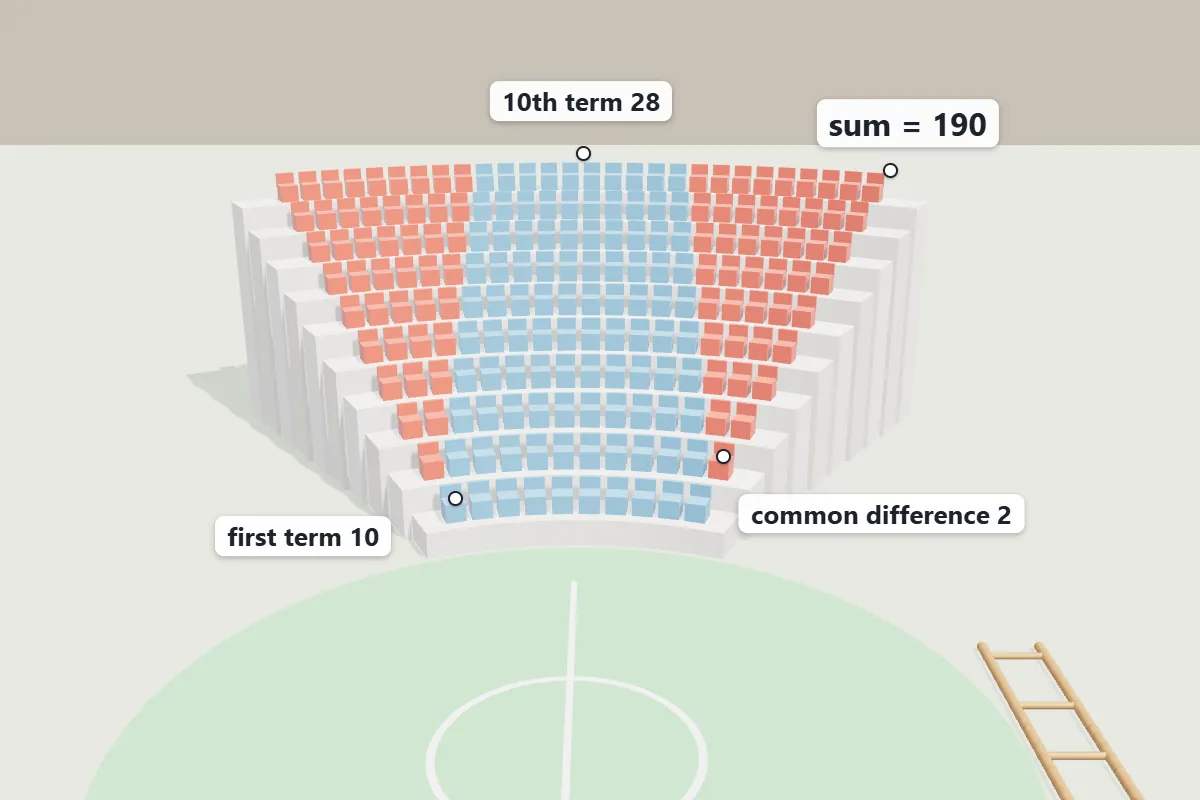
Arithmetic and Geometric Sequences: a grandstand with rows of 10, 12, 14 seats and so on shows arithmetic and geometric sequences and series: the 10th row has 28 and the total is 190.
Comparison aspectMain ideaKeywords
Sequence
  • a function whose domain is the positive integers
  • with terms T₁
functionwhosedomainpositive
Arithmetic sequencethe difference between consecutive terms is constant. This constant is the common difference d = Tₙ₊₁ − Tₙdifferencebetweenconsecutiveterms
Geometric sequencethe ratio between consecutive terms is constant and not zero. This constant is the common ratio r = Tₙ₊₁ ÷ Tₙratiobetweenconsecutiveterms
Arithmetic meanof a and b is (a + b) ÷ 2
Geometric mean
  • of a and b
  • when both have the same sign
  • is √(ab) with a positive or negative sign
bothsamesignpositive
Figure 1 – Arithmetic Sequence Formulations and Common Difference
Figure 1 – Arithmetic Sequence Formulations and Common Difference→Key ideas at a glance
Lesson 1 Summary: Arithmetic and Geometric Sequences and Series · 1 / 5
Rules and formulas

Rules and formulas

  • Arithmetic sequence
Comparison aspectMain ideaKeywords
n-th termTₙ = a + (n − 1)d
Sum of the first n terms
  • Sₙ = (n ÷ 2)[2a + (n − 1)d] = (n ÷ 2)(a + l)
  • where l is the last term
last
•Geometric sequenceGeometricsequence
Comparison aspectMain ideaKeywords
n-th termTₙ = a × rn−1
Sum of the first n terms
  • Sₙ = a(1 − rn) ÷ (1 − r)
  • when r ≠ 1
Sum to infinity
  • S∞ = a ÷ (1 − r)
  • which exists only when |r| < 1
exists
•Any sequencesequence
  1. For n ≥ 2
  2. the n-th term equals Sₙ − Sₙ₋₁. Also T₁ = S₁.
Table 1 – Summation Formulas and Mathematical Induction Rules
Table 1 – Summation Formulas and Mathematical Induction Rules→Rules and formulas
Lesson 1 Summary: Arithmetic and Geometric Sequences and Series · 2 / 5
Comparison table

Comparison table

Figure 2 – Geometric Sequences and Convergence to Infinity
Feature Arithmetic Geometric
Constant that defines it Difference d Ratio r (r ≠ 0)
n-th term a + (n − 1)d a × rn−1
Sum of first n terms (n/2)[2a + (n − 1)d] a(1 − rn)/(1 − r)
Sum to infinity Does not exist a/(1 − r) when |r| < 1
Middle term between a and b (a + b)/2 ±√(ab)
Lesson 1 Summary: Arithmetic and Geometric Sequences and Series · 3 / 5
One short worked example for each rule

One short worked example for each rule

  • Rule 1 (n-th term of an A.P.). Find T₁₀ of 4, 7, 10, …
  • d = 3, so T₁₀ = 4 + 9 × 3 = 31.
  • Rule 2 (sum of an A.P.). Find S₂₀ of 4, 7, 10, …
  • S₂₀ = (20 ÷ 2)[2(4) + 19 × 3] = 10 × 65 = 650.
  • Rule 3 (n-th term of a G.P.). Find T₅ of 3, 6, 12, …
  • T₅ = 3 × 24 = 48.
  • Rule 4 (sum of a G.P.). Find S₅ of 2, 6, 18, …
  • r = 3, so S₅ = 2(35 − 1) ÷ (3 − 1) = 2 × 242 ÷ 2 = 242.
  • Rule 5 (sum to infinity). Find S∞ of 18 + 6 + 2 + …
  • r = 1/3, which satisfies |r| < 1. So S∞ = 18 ÷ (1 − 1/3) = 27.
  • Rule 6 (means). Find the arithmetic mean of 5 and 17, then the geometric mean of 4 and 16.
  • Arithmetic mean = (5 + 17) ÷ 2 = 11. Geometric mean = √(4 × 16) = 8.
  1. If S₃ = 28 and S₄ = 40, find T₄.
  2. T₄ = S₄ − S₃ = 40 − 28 = 12.
Lesson 1 Summary: Arithmetic and Geometric Sequences and Series · 4 / 5
Lesson summary

Lesson summary

  • An arithmetic sequence adds the same d each step. A geometric sequence multiplies by the same r each step.
  • Check the type first subtract consecutive terms for d, then divide them for r.
  • Use Sₙ = (n/2)[2a + (n − 1)d] for arithmetic sums and Sₙ = a(1 − rn)/(1 − r) for geometric sums.
  • Use S∞ = a/(1 − r) only when |r| < 1. When |r| ≥ 1 the infinite sum does not exist.
  • The n-th term can always be found from the sums Tₙ = Sₙ − Sₙ₋₁.
Lesson 1 Summary: Arithmetic and Geometric Sequences and Series · 5 / 5