Curriculum
Mathematics
Unit 1
0/12
1.1Key terms1.2Laws and key relationships1.3Rigorous Derivation of Reciprocal Trigonometric Functions1.4Logarithmic and General Exponential Differentiation Techniques1.5Parametric and Implicit Second-Order Derivatives1.6Worked examples1.7Exam tips1.8Real-world applications1.9Key Scientific Tables & Anatomical Diagrams Extracted from Official Curricula1.10📌 Comprehensive Scientific Terminology Dictionary:1.11🔍 In-Depth Explanations, Deductions & Multi-Book Insights:1.12Lesson summary
Unit 2
0/141.1The counting principle1.2Permutations (nPr)1.3Combinations (nCr)1.4Worked examples on counting, permutations and combinations1.5Recall: counting principle, permutations and combinations1.61-1 (a) Pascal's triangle and the binomial expansion1.71-1 (b) The general term1.81-1 (c) The middle term1.91-2 The term containing xk and the term free of x1.101-3 (a) The ratio between two consecutive terms1.111-3 (b) The greatest term1.12Key Scientific Tables & Anatomical Diagrams Extracted from Official Curricula1.13Lesson 1 - Counting Principle, Permutations and Combinations and the Binomial Theorem1.14Lesson summary
Unit 3
0/131.1Key terms1.2Laws and key relationships1.3Geometry of 3D Vectors and Scalar/Cross Product Physics1.4Equations of Straight Lines in Three Dimensions1.5Equations of Planes and Perpendicular Distance Formulas1.6Worked examples1.7Exam tips1.8Real-world applications1.9Key Scientific Tables & Anatomical Diagrams Extracted from Official Curricula1.10📌 Comprehensive Scientific Terminology Dictionary:1.11⚖️ Governing Physical Laws & Mathematical Relations:1.12🔍 In-Depth Explanations, Deductions & Multi-Book Insights:1.13Lesson summary
Unit 4
0/81.11 Smooth and rough surfaces1.22 Properties of the static friction force1.33 Kinetic friction force1.44 The resultant reaction R′1.55 The angle of friction1.66 Equilibrium of a body on a rough horizontal plane1.77 Equilibrium of a body on a rough inclined plane1.88 Conditions of equilibrium and rigid bodies with friction
Unit 5
0/121.13-1 (a) Indefinite integrals of exponential functions1.23-1 (b) Indefinite integrals of logarithmic functions1.33-2 (a) The differential and the standard integrals1.43-2 (b) Integration by substitution1.53-2 (c) Integration by parts1.63-2 (d) Applications of the indefinite integral1.73-3 (a) The definite integral and the fundamental theorem of calculus1.83-3 (b) Properties of the definite integral1.93-3 (c) Definite integral by substitution, odd and even functions1.103-4 (a) Area of a plane region1.113-4 (b) Volumes of solids of revolution1.12Key Scientific Tables & Anatomical Diagrams Extracted from Official Curricula
Unit 6
0/81.12-1 (a) Polar coordinates and the Argand plane1.22-1 (b) Modulus, amplitude and principal amplitude1.32-1 (c) The trigonometric (polar) form of a complex number1.42-1 (d) Product and quotient in trigonometric form1.52-1 (e) The exponential (Euler) form1.62-2 (a) De Moivre's theorem for a positive integer power1.72-2 (b) De Moivre's theorem for a rational power and the roots of a complex number1.82-3 The cube roots of unity
Unit 7
0/101.11 Momentum and its change1.22 Newton's first law, inertia and force1.33 Newton's second law, the equation of motion and variable mass1.44 Newton's third law, lifts and scales1.55 Bodies connected by a string over a smooth pulley1.66 Impulse1.77 Work1.88 Kinetic energy and the work-energy principle1.99 Potential energy and conservation of energy1.1010 Power
Text lesson
Lesson 2 – Geometric Sequences, Series and Applications
Lesson 2 – Geometric Sequences, Series and Applications
Overview
Overview
🎯 Learning outcomes
- Define a geometric sequence and determine its common ratio r = T(n) / T(n-1).
- Deduce the general nth term formula Tn = a × rn – 1.
- Calculate the sum of the first n terms of a geometric series Sn = a(1 – rn) / (1 – r).
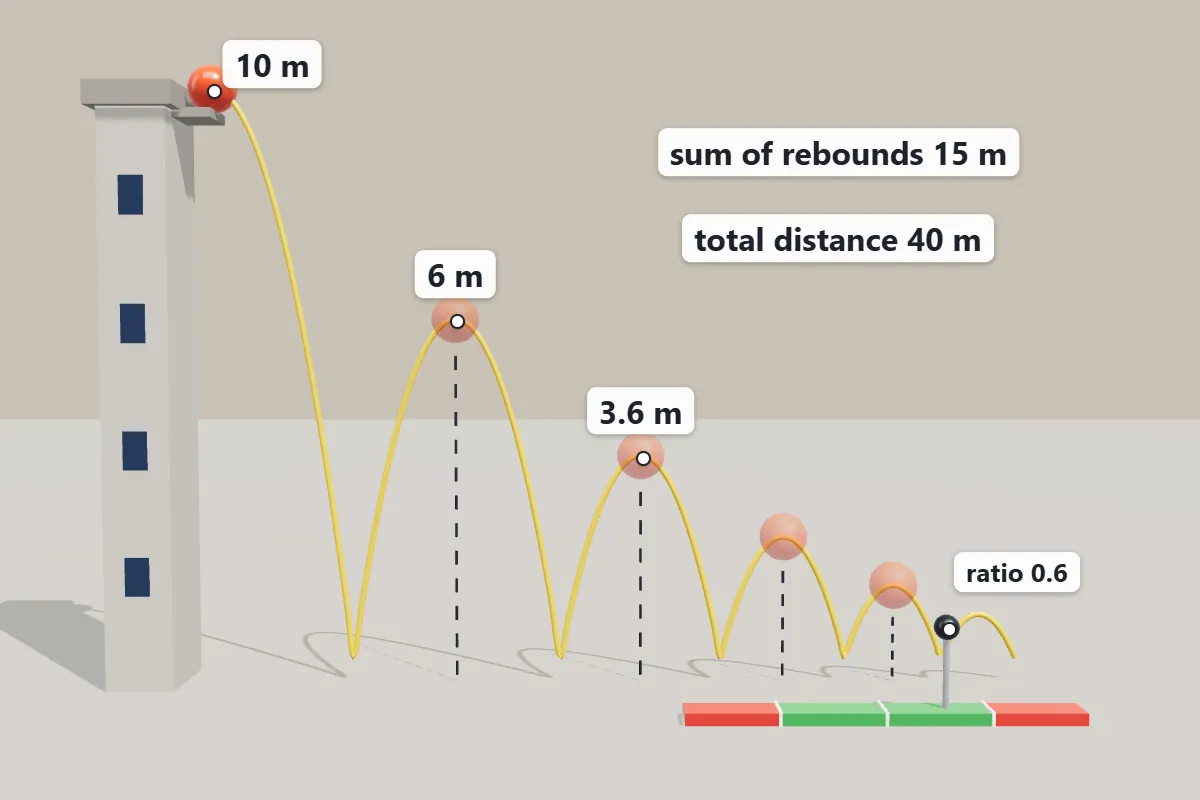
- Evaluate the sum of an infinite converging geometric series when |r| < 1: Sinf = a / (1 – r).
- Solve real-world financial and scientific applications involving compound interest, population growth, and radioactive decay.
🌳 Concept tree
- Lesson 2 – Geometric Sequences
- Series and Applications
├── Key terms
├── Laws and key relationships
- ├── Definitions and Formulations of Geometric Sequences
- ├── Summation of Finite Geometric Series and Sum to Infinity
├── Real-world applications
├── Comparison
├── Worked examples
└── Exam tips
Lesson 2 – Geometric Sequences, Series and Applications · 1 / 13
Key terms
Key terms
| Comparison aspect | Main idea | Keywords |
|---|---|---|
| Geometric Sequence (Progression) | A sequence of non-zero numbers where each term after the first is obtained by multiplying the preceding term by a constant non-zero value called the common ratio (r): T(n+1) / T(n) = r | zeronumberstermafter |
| Common Ratio (r) |
| fixedmultipliergeometricsequence |
| Geometric Mean | The geometric mean between two positive numbers a and b is given by: G.M. = ±√(a × b) | betweenpositivenumbersgiven |
| Convergent Geometric Series | An infinite geometric series whose common ratio satisfies |r| < 1 (-1 < r < 1), possessing a finite sum to infinity: Sinf = a / (1 – r). | infinitewhosecommonratio |
| Divergent Geometric Series |
| infinitewhosegrowsinfinitely |
Lesson 2 – Geometric Sequences, Series and Applications · 2 / 13
Laws and key relationships
Laws and key relationships
General nth Term of a Geometric Sequence[ Formula: Tn = a × rn – 1 ] Where a is the first term, r is the common ratio, n is the term position.
Sum of First n Terms (Sn)[ Formula: Sn = [a × (1 – rn)] / (1 – r) = (a – l × r) / (1 – r) ] Valid for r ≠ 1, where l is the last term.
Sum to Infinity (Sinf)[ Formula: Sinf = a / (1 – r) ] Strict condition: |r| < 1 (convergent series).
Compound Interest Growth Law[ Formula: A = P × (1 + R / 100)n ] Where P is principal, R is interest rate per period, n is number of periods.
Lesson 2 – Geometric Sequences, Series and Applications · 3 / 13
Definitions and Formulations of Geometric Sequences
Definitions and Formulations of Geometric Sequences
- A sequence (Tn) is geometric if the ratio of any term to its immediately preceding term is a constant non-zero number: Tn+1 / Tn = r.
- Formulating Terms Let the first term be a and the common ratio be r:
| Comparison aspect | Main idea | Keywords |
|---|---|---|
| Term 1 | T1 = a | |
| Term 2 | T2 = a r | |
| Term 3 | T3 = a r2 | |
| Term n | Tn = a rn – 1 | |
| • | Behaviors of Geometric Sequences | BehaviorsGeometricSequences |
If r > 1 and a > 0Increasing progression (exponential growth, e.g., 2, 6, 18, 54…).
If 0 < r < 1Decreasing progression (exponential decay, e.g., 64, 32, 16, 8…).
If r < 0Alternating sequence oscillating between positive and negative values (e.g., 3, -6, 12, -24…).
Lesson 2 – Geometric Sequences, Series and Applications · 4 / 13
Summation of Finite Geometric Series and Sum to Infinity
Summation of Finite Geometric Series and Sum to Infinity
- The sum of the first n terms of a geometric series is derived by multiplying Sn by r and subtracting:
Sn = a + a r + a r2 + … + a rn−1
r Sn = a r + a r2 + … + a rn
- Subtracting Sn (1 – r) = a (1 – rn) ==> Sn = a(1 – rn) / (1 – r).
- Infinite Sum to Infinity (|r| < 1):
- As n approaches infinity, if the common ratio is a proper fraction (|r| < 1), the term rn approaches zero (lim(n → inf) rn = 0).
- Substituting rn = 0 into the sum formula yields the elegant limit:
- Sinf = a / (1 – r).
- If |r| ≥ 1, the series diverges and the sum to infinity cannot be evaluated.
Lesson 2 – Geometric Sequences, Series and Applications · 5 / 13
Real-world applications
Real-world applications
- Geometric progressions model real-life compounding phenomena:
| Comparison aspect | Main idea | Example | Keywords |
|---|---|---|---|
| Compound Interest | Investment of principal P at annual rate r% compounded annually follows a geometric sequence where a = P(1+r) and ratio is (1+r): Future Value A = P(1 + r)n | — | Investmentprincipalannualrate |
| Population Biology | Bacterial colony division (doubling every hour) follows a geometric progression with r = 2 | — | Bacterialcolonydivisiondoubling |
| Radioactive Decay and Half-Life | The remaining mass of an isotope after n half-lives follows a geometric progression with r = 1/2: M = M0 (1/2)n | — | remainingmassisotopeafter |
| Converting Repeating Decimals to Rational Fractions | A repeating decimal | 0.333… or 0.272727… is an infinite geometric series with a = 0.27 and r = 0.01: Sinf = 0.27 / (1 – 0.01) = 0.27 / 0.99 = 27/99 = 3/11 | 272727infinitegeometricseries |
Lesson 2 – Geometric Sequences, Series and Applications · 6 / 13
Comparison
Comparison
Table→Comparison Between Arithmetic and Geometric Sequences
| Property / Feature | Arithmetic Sequence (A.P.) | Geometric Sequence (G.P.) |
|---|---|---|
| Generating Operation | Repeated addition of common difference d | Repeated multiplication by common ratio r |
| General nth Term | Tn = a + (n – 1) d | Tn = a × rn – 1 |
| Sum of n Terms | Sn = n/2 [2a + (n-1)d] | Sn = [a(1 – rn)] / (1 – r) |
| Sum to Infinity | Impossible (diverges to ±∞) | Possible if /r/ < 1: Sinf = a / (1 – r) |
| Growth Character | Linear growth (straight line) | Exponential growth or decay (curved) |
Lesson 2 – Geometric Sequences, Series and Applications · 7 / 13
Worked examples
Worked examples
- Calculating Sum of Terms and Sum to Infinity of a G.P.Problem Statement & Given Data: In a geometric sequence, the first term is 32 and the third term is 8. If all terms are positive, find: (1) The common ratio r, (2) The 6th term T6, (3) The sum of the first 6 terms S6, (4) The sum of the series to infinity Sinf.Step-by-Step Mathematical & Chemical Solution: [1] Given: First term a = 32. Positive terms ==> r > 0. [2] Third term T3 = a r2 = 8. [3] 32 r2 = 8 ==> r2 = 8 / 32 = 1/4. [4] Since terms are positive: r = +√(1/4) = 1/2. [5] Step 1: The common ratio r is 1/2. [6] Step 2: Calculate the 6th term T6: T6 = a r5 = 32 × (1/2)5 = 32 × (1/32) = 1. [7] Step 3: Calculate the sum of the first 6 terms S6: Sn = a(1 – rn) / (1 – r). [8] S6 = [32 × (1 – (1/2)6)] / (1 – 1/2) = [32 × (1 – 1/64)] / (1/2) = 64 × (63 / 64) = 63. [9] Step 4: Calculate the sum to infinity Sinf (condition |r| = 1/2 < 1 is satisfied): [10] Sinf = a / (1 – r) = 32 / (1 – 1/2) = 32 / (1/2) = 64.💡 High-Yield Exam Shortcut & Pitfall Alert: Exam Tip: The sum to infinity is only valid when |r| < 1. If r = 2, Sinf does not exist!
Lesson 2 – Geometric Sequences, Series and Applications · 8 / 13
Exam tips
Exam tips
- In a geometric sequence, Tn = a rn−1 and each term is multiplied by r.
- The sum to infinity Sinf = a / (1 – r) is strictly valid only when |r| < 1.
- The geometric mean between a and b is ±√(a × b).
- Compound interest, population growth, and radioactive half-life are physical models of geometric sequences.
- Sn = a(1 – rn) / (1 – r) for r ≠ 1.
- .egp-ex{margin:18px 0;border:1px solid rgba(79,63,224,.2);border-radius:16px;overflow:hidden;background:#fff}.egp-ex-h{padding:10px 16px;font-weight:800;background:linear-gradient(90deg,#4f3fe0,#22c1c3);color:#fff}.egp-ex-tabs{display:flex;flex-wrap:wrap;gap:6px;padding:10px 12px;background:#f7f6ff}.egp-ex-b{border:1px solid rgba(79,63,224,.3);background:#fff;border-radius:20px;padding:5px 14px;font-weight:700;cursor:pointer}.egp-ex-b.on{background:#4f3fe0;color:#fff}.egp-ex-p{padding:12px 16px}
Lesson 2 – Geometric Sequences, Series and Applications · 9 / 13
Key Scientific Tables & Anatomical Diagrams Extracted from Official Curricula
Key Scientific Tables & Anatomical Diagrams Extracted from Official Curricula
💡 Core Diagrams & Reference Data→All data, reference comparison tables, and anatomical figures have been accurately digitized from official curriculum textbooks.
🔬 Geometric_Sequence_and_Infinite_Series
- Scientific details and precise observational breakdown:
- Geometric Sequence Terms T,, = a-r
- n-1
- 70 4
- 60 4
- A
- oO
- L
- Term Value (T,,)
- w
- oO
Lesson 2 – Geometric Sequences, Series and Applications · 10 / 13
Part 11
Part 11
- 📖
Lesson 2 – Geometric Sequences, Series and Applications · 11 / 13
🔍 In-Depth Explanations, Deductions & Multi-Book Insights:
🔍 In-Depth Explanations, Deductions & Multi-Book Insights:
- ★ Comprehensive Ministry-Approved Academic Textbook 2026 / 2027 ★
- Textbook Chapter Geometric Sequences, Series and Applications
- Second Secondary / Grade 11 | Unit 1 – Sequences and Series | Modern Egyptian Curriculum 2026/2027
- 🎯 Ministerial Learning Outcomes & Key Competencies 2026/2027:
- • Define a geometric sequence and determine its common ratio r = T(n) / T(n-1).
- • Deduce the general nth term formula Tn = a × rn – 1.
- • Calculate the sum of the first n terms of a geometric series: Sn = a(1 – rn) / (1 – r).
- • Evaluate the sum of an infinite converging geometric series when |r| < 1: Sinf = a / (1 – r).
- • Solve real-world financial and scientific applications involving compound interest, population growth, and radioactive decay.
| Comparison aspect | Main idea | Keywords |
|---|---|---|
| • | 📖 Core Scientific Terminology & Definitions | CoreScientificTerminologyDefinitions |
| 🔹 Geometric Sequence (Progression) | A sequence of non-zero numbers where each term after the first is obtained by multiplying the preceding term by a constant non-zero value called the common ratio (r): T(n+1) / T(n) = r | zeronumberstermafter |
| 🔹 Common Ratio (r) |
| fixedmultipliergeometricsequence |
| 🔹 Geometric Mean | The geometric mean between two positive numbers a and b is given by: G.M. = ±√(a × b) | betweenpositivenumbersgiven |
| 🔹 Convergent Geometric Series |
| infinitewhosecommonratio |
| Comparison aspect | Main idea | Keywords |
|---|---|---|
| 🔹 Divergent Geometric Series |
| infinitewhosegrowsinfinitely |
| • | ⚖️ Governing Mathematical & Physical Laws and Principles | GoverningMathematicalPhysicalLaws |
| ★ General nth Term of a Geometric Sequence |
| Formulafirstcommonratio |
| ★ Sum of First n Terms (Sn) |
| FormulaValidlast |
| ★ Sum to Infinity (Sinf) | [ Formula: Sinf = a / (1 – r) ] Strict condition: |r| < 1 (convergent series) | FormulaStrictconditionconvergent |
| ★ Compound Interest Growth Law |
| Formulaprincipalrateperiod |
- 📌 Exhaustive In-Depth Academic Explanation & Scientific Analysis:
1. Definitions and Formulations of Geometric Sequences
| Comparison aspect | Main idea | Keywords |
|---|---|---|
| • | A sequence (Tn) is geometric if the ratio of any term to its immediately preceding term is a constant non-zero number: Tn+1 / Tn = r | sequencegeometricratioterm |
| Formulating Terms | Let the first term be a and the common ratio be r | firstcommonratio |
| – Term 1 | T1 = a | |
| – Term 2 | T2 = a r | |
| – Term 3 | T3 = a r2 | |
| – Term n | Tn = a rn – 1 | |
| • | Behaviors of Geometric Sequences | BehaviorsGeometricSequences |
| – If r > 1 and a > 0 |
| Increasingprogressionexponentialgrowth |
| – If 0 < r < 1 |
| Decreasingprogressionexponentialdecay |
| – If r < 0 |
| Alternatingsequenceoscillatingbetween |
2. Summation of Finite Geometric Series and Sum to Infinity
- The sum of the first n terms of a geometric series is derived by multiplying Sn by r and subtracting:
Sn = a + a r + a r2 + … + a rn−1
r Sn = a r + a r2 + … + a rn
- Subtracting Sn (1 – r) = a (1 – rn) ==> Sn = a(1 – rn) / (1 – r).
- Infinite Sum to Infinity (|r| < 1):
- As n approaches infinity, if the common ratio is a proper fraction (|r| < 1), the term rn approaches zero (lim(n → inf) rn = 0).
- Substituting rn = 0 into the sum formula yields the elegant limit:
- Sinf = a / (1 – r).
- If |r| ≥ 1, the series diverges and the sum to infinity cannot be evaluated.
3. Financial and Real-World Mathematical Applications
- Geometric progressions model real-life compounding phenomena:
- 📊 Detailed Comparative Analysis & Data Classifications:
- Table Comparison Between Arithmetic and Geometric Sequences
- ✏️ Step-by-Step Fully Solved Exemplary Numerical Problems & Proofs:
- ★ Calculating Sum of Terms and Sum to Infinity of a G.P.
- Problem Statement & Given Data In a geometric sequence, the first term is 32 and the third term is 8. If all terms are positive, find: (1) The common ratio r, (2) The 6th term T6, (3) The sum of the first 6 terms S6, (4) The sum of the series to infinity Sinf.
- Step-by-Step Mathematical & Chemical Solution:
- [1] Given First term a = 32. Positive terms ==> r > 0.
- [2] Third term T3 = a r2 = 8.
- [3] 32 r2 = 8 ==> r2 = 8 / 32 = 1/4.
- [4] Since terms are positive r = +√(1/4) = 1/2.
- [5] Step 1 The common ratio r is 1/2.
- [6] Step 2 Calculate the 6th term T6: T6 = a r5 = 32 × (1/2)5 = 32 × (1/32) = 1.
- [7] Step 3 Calculate the sum of the first 6 terms S6: Sn = a(1 – rn) / (1 – r).
- [8] S6 = [32 × (1 – (1/2)6)] / (1 – 1/2) = [32 × (1 – 1/64)] / (1/2) = 64 × (63 / 64) = 63.
- [9] Step 4 Calculate the sum to infinity Sinf (condition |r| = 1/2 < 1 is satisfied):
- [10] Sinf = a / (1 – r) = 32 / (1 – 1/2) = 32 / (1/2) = 64.
- 💡 High-Yield Exam Shortcut & Pitfall Alert Exam Tip: The sum to infinity is only valid when |r| < 1. If r = 2, Sinf does not exist!
| Property / Feature | Arithmetic Sequence (A.P.) | Geometric Sequence (G.P.) |
|---|---|---|
| Generating Operation | Repeated addition of common difference d | Repeated multiplication by common ratio r |
| General nth Term | Tn = a + (n – 1) d | Tn = a × rn – 1 |
| Sum of n Terms | Sn = n/2 [2a + (n-1)d] | Sn = [a(1 – rn)] / (1 – r) |
| Sum to Infinity | Impossible (diverges to ±∞) | Possible if |r| < 1: Sinf = a / (1 – r) |
| Growth Character | Linear growth (straight line) | Exponential growth or decay (curved) |
💡 💡 Essential Exam Traps, Tips & High-Yield Insights:
- In a geometric sequence, Tn = a rn−1 and each term is multiplied by r.
- The sum to infinity Sinf = a / (1 – r) is strictly valid only when |r| < 1.
- The geometric mean between a and b is ±√(a × b).
- Compound interest, population growth, and radioactive half-life are physical models of geometric sequences.
- Sn = a(1 – rn) / (1 – r) for r ≠ 1.
Lesson 2 – Geometric Sequences, Series and Applications · 12 / 13
Lesson summary
Lesson summary
- ★ High-Yield Summary, Mind Maps & Comparison Tables ★
- Summary Lesson 2 – Geometric Sequences, Series and Applications
- Pure Mathematics – Secondary Stage (Egyptian Curriculum 2026-2027) | 2026 / 2027 | 2026 / 2027 | Unit 1: Sequences and Series
- 🗺️ Core Concept Map & Knowledge Architecture:
- ✔ Arithmetic Mean >= Geometric Mean for any two positive real numbers.
- ✔ Recurring decimals can always be expressed as convergent infinite geometric series.
- 📊 Classification & Comparative Summary Tables:
| Concept / Property | Mathematical Formula | Condition / Notes |
|---|---|---|
| Common Ratio (r) | r = T_{n+1} / T_n | Constant for all n >= 1 (r != 0) |
| General Term (T_n) | T_n = a * rn−1 | a = first term, n = term order |
| Geometric Mean of a, c | G.M. = ±sqrt(a * c) | a and c must have the same sign |
| Sum of n Terms (S_n) | S_n = a(1 – rn) / (1 – r) | Valid for any r != 1 |
| Sum to Infinity (S_inf) | S_inf = a / (1 – r) | Converges if and only if |r| < 1 |
- 💡 Exam Flashcard Capsules & High-Yield Secrets:
- ★ An infinite geometric series converges to a finite sum S_inf = a / (1 – r) if and only if |r| < 1 (i.e., -1 < r < 1, r != 0).
- ★ Arithmetic Mean >= Geometric Mean for any two positive real numbers.
- ★ Recurring decimals can always be expressed as convergent infinite geometric series.
Lesson 2 – Geometric Sequences, Series and Applications · 13 / 13
Well done! You finished this lesson
What would you like to do next?