Curriculum
Login

Curriculum

Mathematics

Text lesson

Lesson 2 Summary: Geometric Sequences, Series and Applications

Mathematics

Lesson 2 Summary: Geometric Sequences, Series and Applications

Key ideas at a glance

Key ideas at a glance

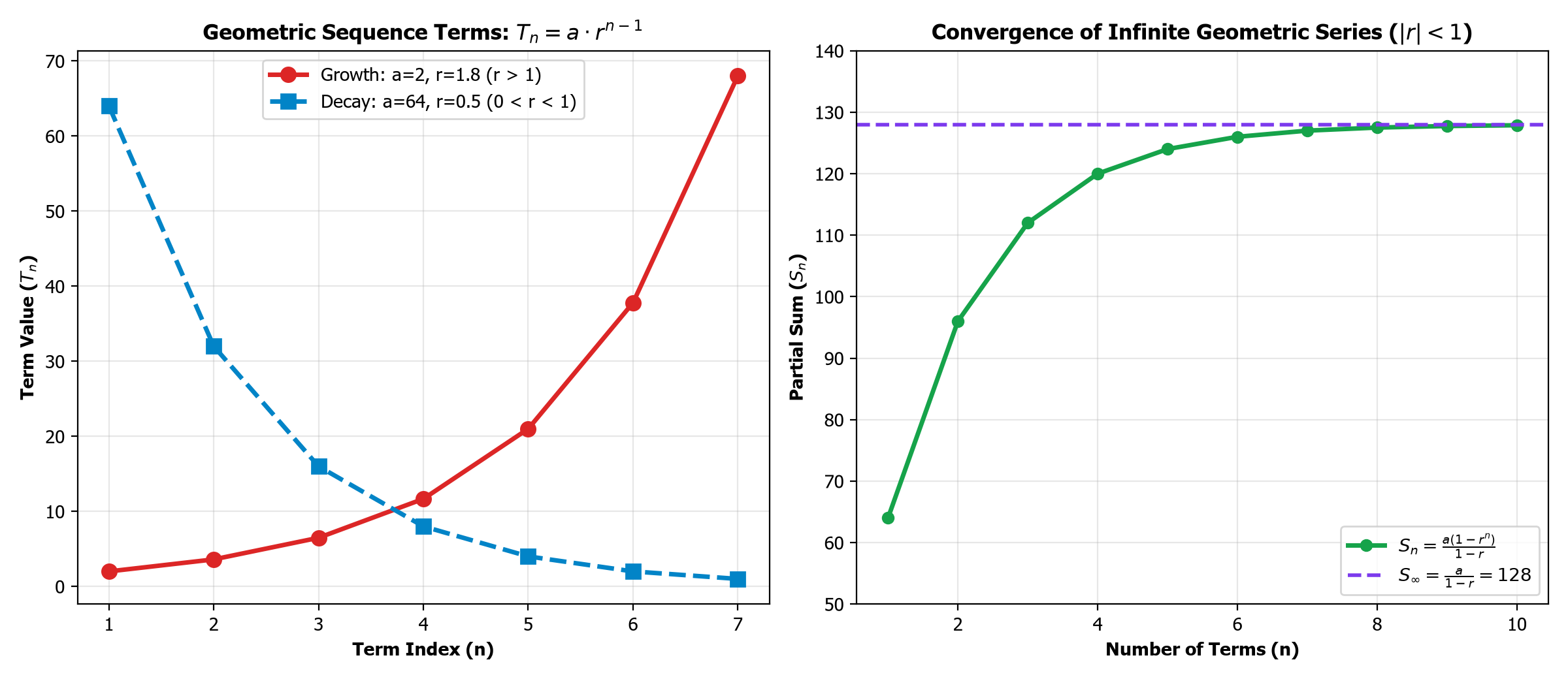
Figure 2 – Geometric Sequences and Convergence to Infinity
  • A geometric sequence has a constant ratio r between consecutive terms, and r is not zero.
  • If r is positive, all terms keep one sign. If r is negative, the signs alternate.
  • Geometric means are the terms inserted between two given numbers so that the whole list is geometric.
  • The sum to infinity exists only when −1 < r < 1.
Geometric_Sequence_and_Infinite_Series
Geometric_Sequence_and_Infinite_Series→Key ideas at a glance
Lesson 2 Summary: Geometric Sequences, Series and Applications · 1 / 5
Rules to remember

Rules to remember

Comparison aspectMain ideaKeywords
n-th termTₙ = a × rn−1
Sum of n terms
  • Sₙ = a(1 − rn) ÷ (1 − r)
  • when r ≠ 1
Sum to infinity
  • S∞ = a ÷ (1 − r)
  • when |r| < 1
Geometric means
  • if k means are inserted between A and B
  • the ratio is r = (B ÷ A)1/(k + 1)
insertedbetweenratio
Three terms in G.P.
  • if a
  • c are in G.P
  • then b2 = ac
then
Lesson 2 Summary: Geometric Sequences, Series and Applications · 2 / 5
Convergence table

Convergence table

Common ratio r Behaviour of the terms Sum to infinity
0 < r < 1 Decrease towards 0 Exists: a ÷ (1 − r)
−1 < r < 0 Alternate in sign, shrinking Exists: a ÷ (1 − r)
r = 1 Constant Does not exist
r ≤ −1 or r ≥ 1 Do not shrink Does not exist
Lesson 2 Summary: Geometric Sequences, Series and Applications · 3 / 5
One short example for each rule

One short example for each rule

Comparison aspectMain ideaKeywords
•0.777… = 0.7 + 0.07 + … with a = 0.7 and r = 0.1. So S∞ = 0.7 ÷ 0.9 = 7/9
Rule 6 (bouncing ball).A ball dropped from 16 m rebounds to half its previous height. Find the total distancedroppedreboundshalfprevious
First drop
  • 16 m. Rebounds: 8
  • … m
  • each followed by a fall of the same height. Total = 16 + 2 × [8 ÷ (1 − 1/2)] = 16 + 32 = 48 m
Reboundsfollowedfallsame
Rule 7 (divergent case).Explain why 1 + 2 + 4 + 8 + … has no sum to infinityExplaininfinity
•
  • Here r = 2
  • so |r| ≥ 1. The terms grow without limit
  • so the partial sums grow without limit too
Heretermsgrowwithout
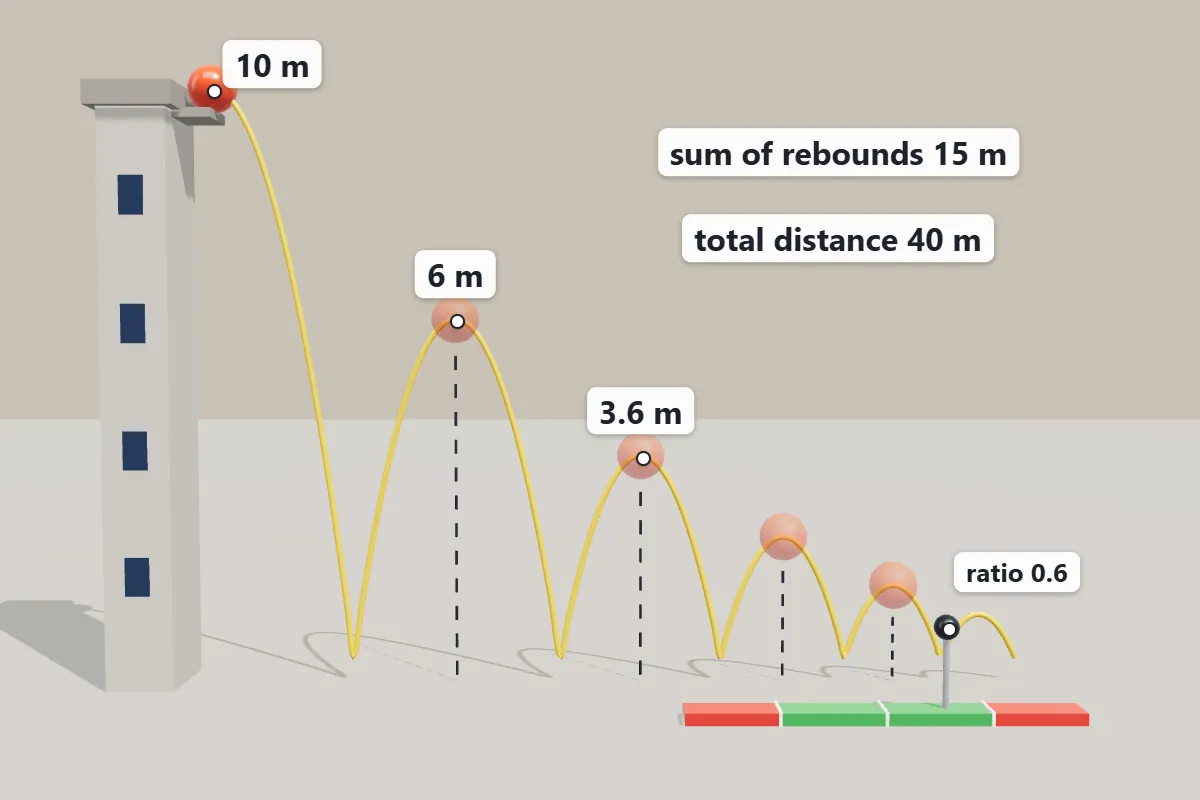
Geometric Sequences, Series and Applications: a rubber ball bouncing to 0.6 of its previous height shows geometric sequences, series and applications: the total distance is 40 m.
Comparison aspectMain ideaKeywords
Rule 1 (compound growth).
  • 1000 is invested at 5% a year
  • compounded yearly. Find the value after 3 years
1000investedyearcompounded
•The values form a G.P. with a = 1000 and r = 1.05. T₄ = 1000 × 1.053 = 1157.63valuesform10001157
Rule 2 (decay).A sample of 80 g halves every hour. How much remains after 3 hours?samplehalveseveryhour
•a = 80 and r = 1/2. T₄ = 80 × (1/2)3 = 10 g
Rule 3 (geometric means).Insert two geometric means between 3 and 24Insertbetween
Four terms
  • 24. Then r3 = 24 ÷ 3 = 8
  • so r = 2. The means are 6 and 12
Thenmeans
Rule 4 (sum to infinity).Find the sum of 16 + 8 + 4 + 2 + …Find
•a = 16 and r = 1/2. S∞ = 16 ÷ (1 − 1/2) = 32
Rule 5 (repeating decimal).Write 0.777… as a fractionWritefraction
Lesson 2 Summary: Geometric Sequences, Series and Applications · 4 / 5
Lesson summary

Lesson summary

  • Find r by dividing any term by the term before it. Check that the same r works for the next pair.
  • Growth and decay problems (interest, depreciation, half-life) are geometric with the factor per period as r.
  • Use S∞ = a/(1 − r) only when |r| < 1. Otherwise, state that the infinite sum does not exist.
  • In a bouncing problem, the first drop is added once and each bounce is counted up and down.
Lesson 2 Summary: Geometric Sequences, Series and Applications · 5 / 5