Curriculum
Login

Curriculum

Mathematics

Text lesson

Lesson 2 Summary: Rules of Differentiation, Chain Rule and Tangent Lines

Mathematics

Lesson 2 Summary: Rules of Differentiation, Chain Rule and Tangent Lines

Key ideas at a glance

Key ideas at a glance

  • A composite function is a function inside another, such as (2x + 1)4. The chain rule differentiates it from the outside in.
  • The tangent line at a point (x₁, y₁) with slope m is y − y₁ = m(x − x₁).
  • The normal line is perpendicular to the tangent, so its slope is −1/m when m ≠ 0.
  • A horizontal tangent occurs where dy/dx = 0.
Lesson 2 Summary: Rules of Differentiation, Chain Rule and Tangent Lines · 1 / 5
Chain rule and tangent formulas

Chain rule and tangent formulas

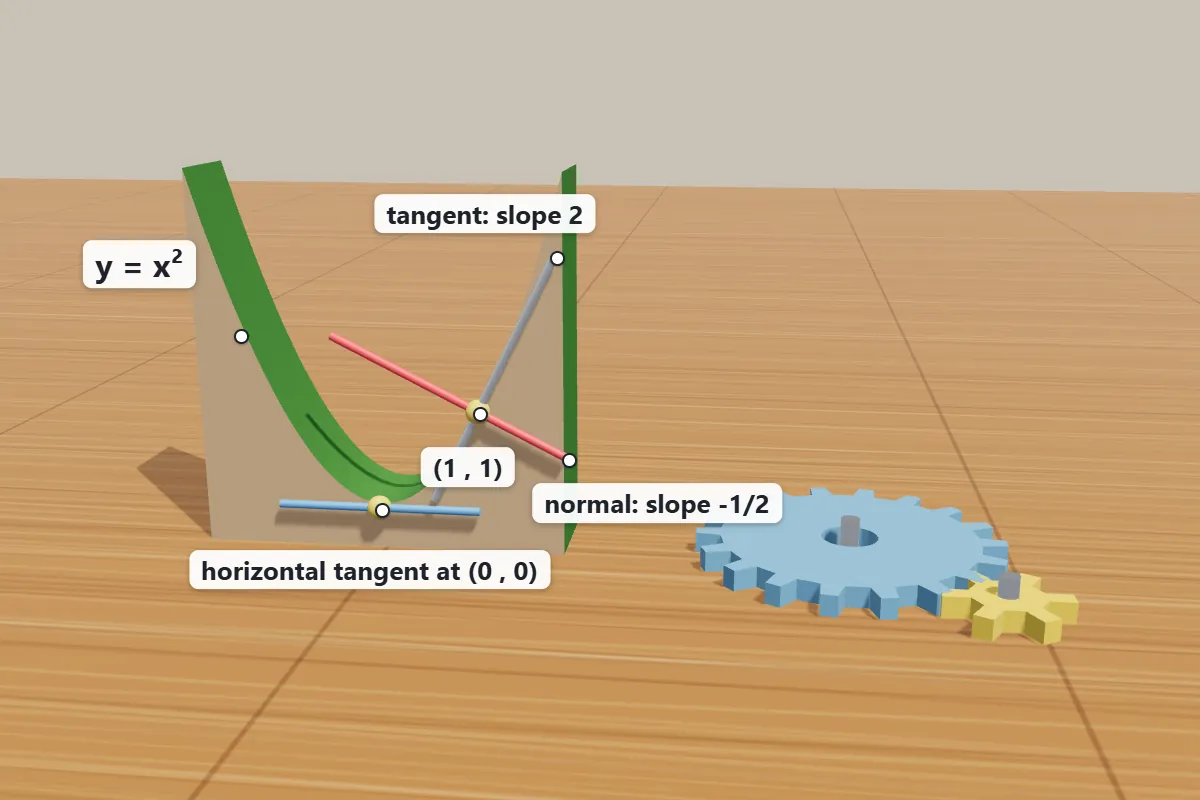
Rules of Differentiation, Chain Rule: a hill model with a tangent rod and a normal rod shows rules of differentiation, the chain rule and tangent lines: slope 2 at (1, 1).
Chain rule (Leibniz form)dy/dx = (dy/du) × (du/dx) when y depends on u and u depends on x.
Trigonometric examplesd/dx [sin(kx)] = k cos(kx), and d/dx [cos(kx)] = −k sin(kx).
Tangenty − y₁ = m(x − x₁), where m = f′(x₁).
Normaly − y₁ = (−1/m)(x − x₁), where m ≠ 0.
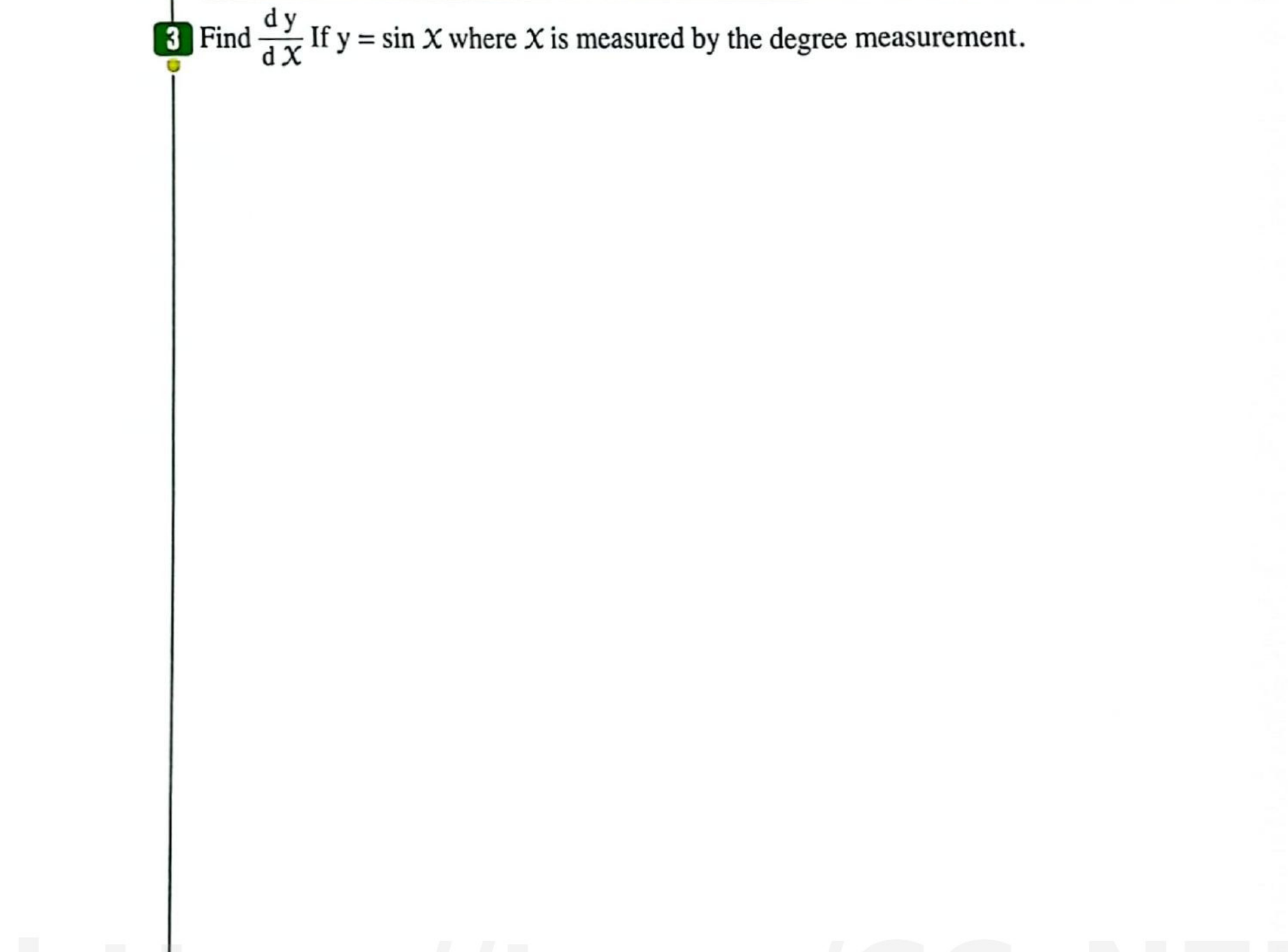
Table 1 – Standard Derivative Formulas and Tangent Equations
Table 1 – Standard Derivative Formulas and Tangent Equations→Chain rule and tangent formulas
Lesson 2 Summary: Rules of Differentiation, Chain Rule and Tangent Lines · 2 / 5
Tangent, normal and horizontal comparison

Tangent, normal and horizontal comparison

Line Slope How to get it
Tangent m = f′(x₁) Differentiate, then substitute x₁
Normal −1/m Take the negative reciprocal of the tangent slope
Horizontal tangent 0 Solve f′(x) = 0 for x, then find y
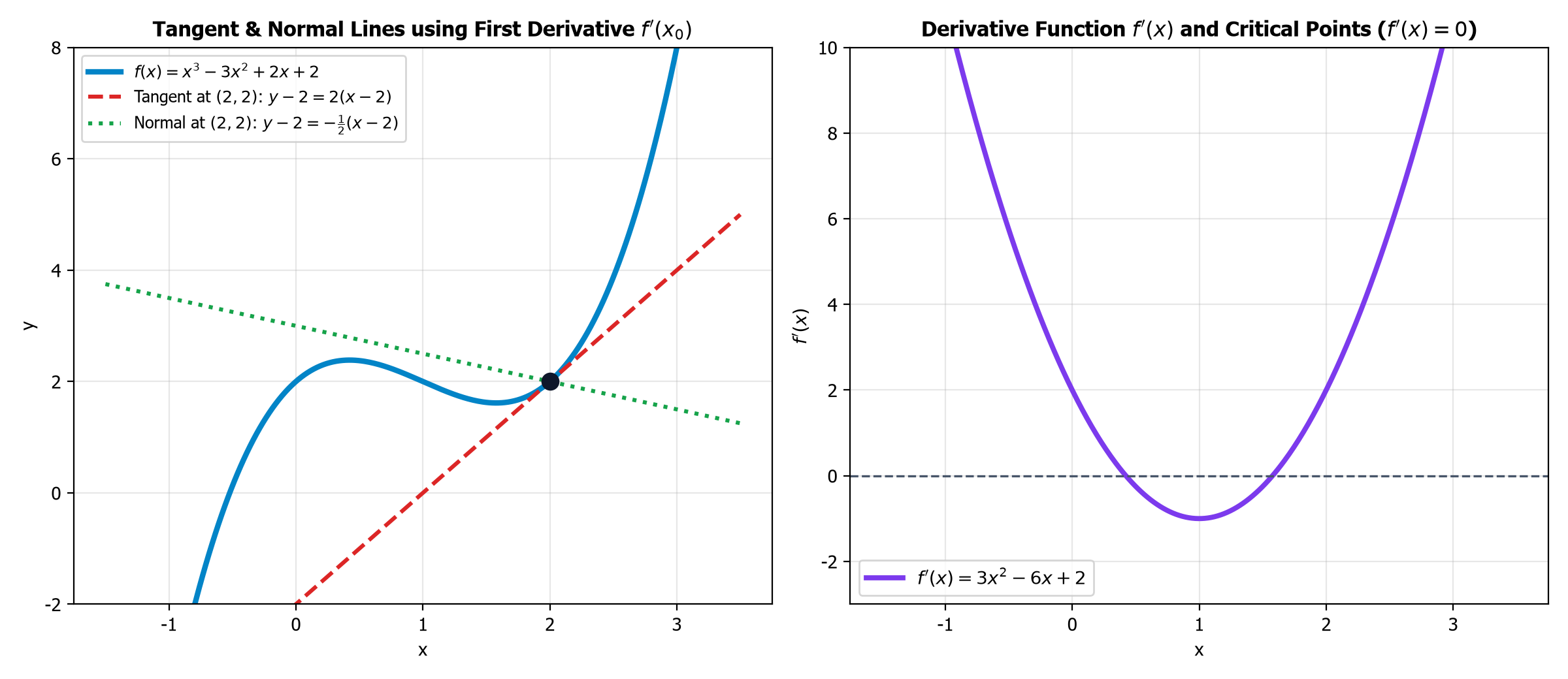
Tangent_Normal_and_Derivative_Curve
  • To find the tangent at a point P(x₁, y₁), differentiate the function, substitute x₁ to get the slope m, and write y − y₁ = m(x − x₁).
  • The normal is perpendicular to the tangent at P, so its slope is −1/m (when m ≠ 0), and its equation is y − y₁ = (−1/m)(x − x₁).
  • Special cases if m = 0, the tangent is horizontal with equation y = y₁, and the normal is vertical with equation x = x₁. If the slope is undefined, the tangent is vertical with equation x = x₁, and the normal is horizontal with equation y = y₁.
  • Worked example for y = (2x − 1)/(x + 2) at x = 1, the point is (1, 1/3). The derivative is 5/(x + 2)2, so m = 5/9. The tangent is 5x − 9y − 2 = 0. The normal slope is −9/5, which gives 27x + 15y − 32 = 0. Check: (5/9)(−9/5) = −1.
Lesson 2 Summary: Rules of Differentiation, Chain Rule and Tangent Lines · 3 / 5
One short worked example for each idea

One short worked example for each idea

Comparison aspectMain ideaKeywords
Chain rule.
  • For y = (2x + 1)4
  • dy/dx = 4(2x + 1)3 × 2 = 8(2x + 1)3. At x = 0
  • dy/dx = 8
Trigonometric chain rule.
  • For y = sin(2x)
  • dy/dx = 2 cos(2x). At x = 0
  • dy/dx = 2
Tangent line.
  • For y = x2 at x = 2: the point is (2
  • 4) and the slope is 2x = 4. So y − 4 = 4(x − 2)
  • which gives y = 4x − 4
pointslopegives
Normal line.
  • For the same curve at (2
  • the normal slope is −1/4. So y − 4 = −(1/4)(x − 2)
  • which gives y = −x/4 + 4.5
samecurveslopegives
Horizontal tangent.
  • For y = x2 − 4x
  • dy/dx = 2x − 4 = 0 gives x = 2. The point is (2
  • −4)
givespoint
Tangent from a rule.
  • For y = x3 − 3x2 + 2x + 2 at x = 2
  • the point is (2
  • 2) and the slope is 2. So the tangent is y = 2x − 2
pointslope
Lesson 2 Summary: Rules of Differentiation, Chain Rule and Tangent Lines · 4 / 5
Lesson summary

Lesson summary

  • Differentiate the outer function first, then multiply by the derivative of the inner function.
  • To find a tangent, you need a point and a slope. The slope comes from substituting the x-value into dy/dx.
  • A normal line uses the negative reciprocal of the tangent slope.
  • A horizontal tangent comes from setting dy/dx = 0.
  • Check a tangent line by substituting its point into its equation. The point must satisfy the equation, and the slope must match the derivative at that x-value.
  • Mixing up the chain rule with the product rule is a common error, so identify the outer and inner functions before you differentiate.
Lesson 2 Summary: Rules of Differentiation, Chain Rule and Tangent Lines · 5 / 5