Curriculum
Mathematics
Unit 1
0/12
1.1Key terms1.2Laws and key relationships1.3Rigorous Derivation of Reciprocal Trigonometric Functions1.4Logarithmic and General Exponential Differentiation Techniques1.5Parametric and Implicit Second-Order Derivatives1.6Worked examples1.7Exam tips1.8Real-world applications1.9Key Scientific Tables & Anatomical Diagrams Extracted from Official Curricula1.10📌 Comprehensive Scientific Terminology Dictionary:1.11🔍 In-Depth Explanations, Deductions & Multi-Book Insights:1.12Lesson summary
Unit 2
0/141.1The counting principle1.2Permutations (nPr)1.3Combinations (nCr)1.4Worked examples on counting, permutations and combinations1.5Recall: counting principle, permutations and combinations1.61-1 (a) Pascal's triangle and the binomial expansion1.71-1 (b) The general term1.81-1 (c) The middle term1.91-2 The term containing xk and the term free of x1.101-3 (a) The ratio between two consecutive terms1.111-3 (b) The greatest term1.12Key Scientific Tables & Anatomical Diagrams Extracted from Official Curricula1.13Lesson 1 - Counting Principle, Permutations and Combinations and the Binomial Theorem1.14Lesson summary
Unit 3
0/131.1Key terms1.2Laws and key relationships1.3Geometry of 3D Vectors and Scalar/Cross Product Physics1.4Equations of Straight Lines in Three Dimensions1.5Equations of Planes and Perpendicular Distance Formulas1.6Worked examples1.7Exam tips1.8Real-world applications1.9Key Scientific Tables & Anatomical Diagrams Extracted from Official Curricula1.10📌 Comprehensive Scientific Terminology Dictionary:1.11⚖️ Governing Physical Laws & Mathematical Relations:1.12🔍 In-Depth Explanations, Deductions & Multi-Book Insights:1.13Lesson summary
Unit 4
0/81.11 Smooth and rough surfaces1.22 Properties of the static friction force1.33 Kinetic friction force1.44 The resultant reaction R′1.55 The angle of friction1.66 Equilibrium of a body on a rough horizontal plane1.77 Equilibrium of a body on a rough inclined plane1.88 Conditions of equilibrium and rigid bodies with friction
Unit 5
0/121.13-1 (a) Indefinite integrals of exponential functions1.23-1 (b) Indefinite integrals of logarithmic functions1.33-2 (a) The differential and the standard integrals1.43-2 (b) Integration by substitution1.53-2 (c) Integration by parts1.63-2 (d) Applications of the indefinite integral1.73-3 (a) The definite integral and the fundamental theorem of calculus1.83-3 (b) Properties of the definite integral1.93-3 (c) Definite integral by substitution, odd and even functions1.103-4 (a) Area of a plane region1.113-4 (b) Volumes of solids of revolution1.12Key Scientific Tables & Anatomical Diagrams Extracted from Official Curricula
Unit 6
0/81.12-1 (a) Polar coordinates and the Argand plane1.22-1 (b) Modulus, amplitude and principal amplitude1.32-1 (c) The trigonometric (polar) form of a complex number1.42-1 (d) Product and quotient in trigonometric form1.52-1 (e) The exponential (Euler) form1.62-2 (a) De Moivre's theorem for a positive integer power1.72-2 (b) De Moivre's theorem for a rational power and the roots of a complex number1.82-3 The cube roots of unity
Unit 7
0/101.11 Momentum and its change1.22 Newton's first law, inertia and force1.33 Newton's second law, the equation of motion and variable mass1.44 Newton's third law, lifts and scales1.55 Bodies connected by a string over a smooth pulley1.66 Impulse1.77 Work1.88 Kinetic energy and the work-energy principle1.99 Potential energy and conservation of energy1.1010 Power
Text lesson
Implicit Differentiation, Parametric Differentiation and Higher Derivatives
Implicit Differentiation, Parametric Differentiation and Higher Derivatives
Overview
Overview
- This lesson covers lessons 1-1 and 1-2 of the calculus unit "Differentiation and its Applications".
- After it you should be able to:
- differentiate a relation in and when cannot be isolated;
- find for a curve given by a parameter, and the derivative of one function with respect to another;
- find second, third and th derivatives, including for implicit and parametric curves.
🌳 Concept tree
- Implicit Differentiation
- Parametric Differentiation and Higher Derivatives
├── 1-1 (a) Explicit and implicit relations
│ ├── Explicit functions
│ └── Implicit relations
├── 1-1 (b) Implicit differentiation
│ ├── The method
│ ├── The chain-rule step
│ └── Important remarks
├── 1-1 (c) Parametric differentiation
│ ├── Parametric curves
│ └── The rule
- ├── 1-1 (d) Derivative of one function with respect to another
│ └── The idea
├── 1-2 (a) Higher-order derivatives
│ ├── Definition and notation
│ ├── A common confusion
│ ├── Patterns for the nth derivative
│ └── Proving relations between derivatives
- ├── 1-2 (b) Second derivative of implicit relations
│ └── Method
- ├── 1-2 (c) Second derivative of parametric curves
│ └── The rule
└── 1-2 (d) Meaning of the derivatives
├── Graph connection
└── Summary table
Implicit Differentiation, Parametric Differentiation and Higher Derivatives · 1 / 9
1-1 (a) Explicit and implicit relations
1-1 (a) Explicit and implicit relations
Explicit functions
- An explicit function gives directly in terms of , for example or .
- For such a function the derivative is found by the ordinary rules.
- An implicit relation links and in one equation , for example or .
- Sometimes y can be isolated xy+y−4=0 gives y=4x+1 for x≠−1.
- Sometimes one equation hides several functions x2+y2=9 is a circle, which fails the vertical-line test, but it splits into two functions.
- The upper half is (domain , range ) and the lower half is (range ).
- Each half is differentiable for .
- In many equations, such as , isolating is impossible or very awkward, so we differentiate the equation as it stands.
Implicit Differentiation, Parametric Differentiation and Higher Derivatives · 2 / 9
1-1 (b) Implicit differentiation
1-1 (b) Implicit differentiation
The method
- Differentiate both sides of the equation with respect to .
- Treat as a differentiable function of and apply the chain rule to every term containing .
- Collect all terms containing on one side, factorise, and divide.
The chain-rule step
- .
- and .
- (product rule).
- If you differentiate with respect to instead, the factor appears.
✍️ Worked examples
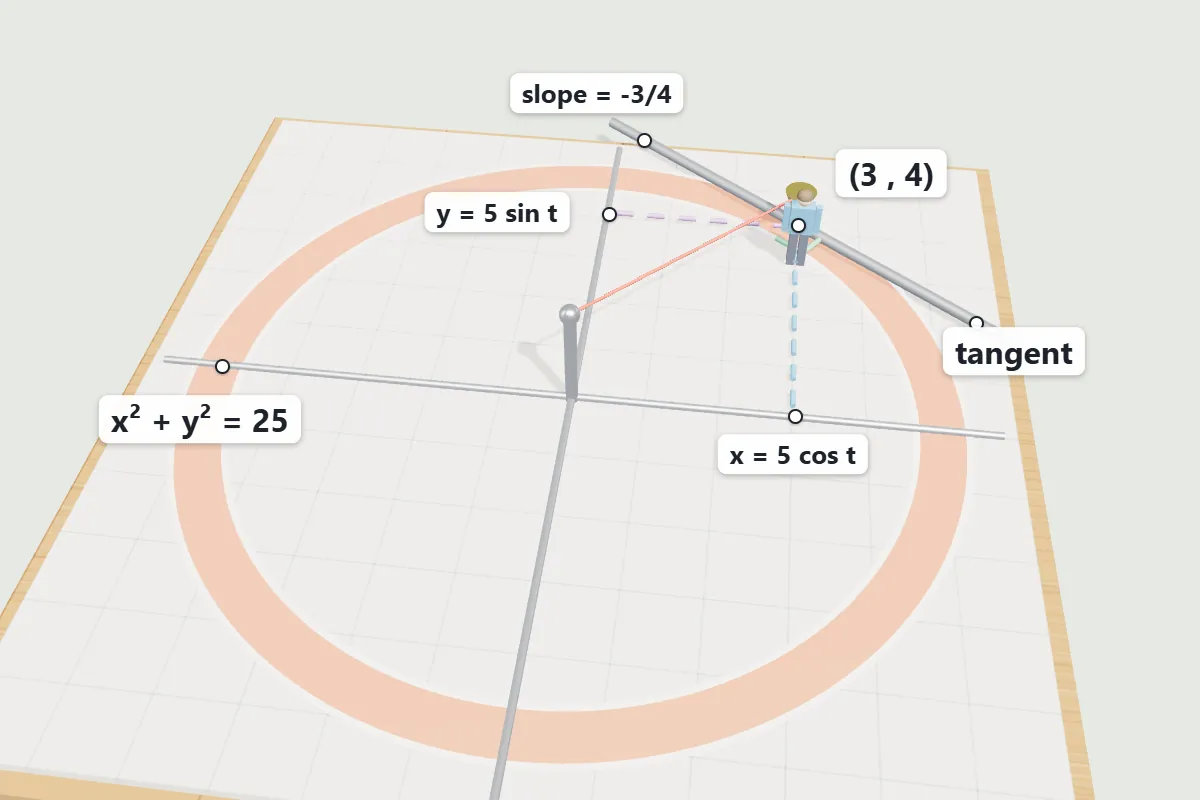
- Example 1 Find if , then find the tangent and normal at .
- Solution:
- Differentiate 2x+2ydydx=0.
- So .
- At the slope is .
- Tangent y−4=−34(x−3), that is 3x+4y=25.
- Normal slope is the negative reciprocal, , so the normal is .
- Example 2 Find for and evaluate it at .
- Solution:
- Differentiate both sides 3x2+3y2dydx=6y+6xdydx.
- Group (3y2−6x)dydx=6y−3x2.
- So .
- At (3,3) 6−99−6=−1.
- Example 3 Find if .
- Solution:
- Differentiate siny+xcosydydx+cosxdydx−ysinx=0.
- Group (xcosy+cosx)dydx=ysinx−siny.
- So .
- Example 4 Find if .
- Solution:
- Differentiate 2sec22x−csc2ydydx=y+xdydx.
- Group −(x+csc2y)dydx=y−2sec22x.
- So .
- Example 5 Find if .
- Solution:
- Differentiate ey+xeydydx=dydx.
- Group (1−xey)dydx=ey.
- So .
Important remarks
- The final formula usually contains both and .
- To find the slope at a given you must first find the matching from the original equation.
- A point must lie on the curve before you substitute it; check it in the equation.
- A horizontal tangent needs the numerator of equal to zero; a vertical tangent needs the denominator equal to zero.
Implicit Differentiation, Parametric Differentiation and Higher Derivatives · 3 / 9
1-1 (c) Parametric differentiation
1-1 (c) Parametric differentiation
Parametric curves
- If and with the same domain, the pair of equations describes one curve, and is the parameter.
- Each value of gives one point of the curve.
| Comparison aspect | Main idea | Keywords |
|---|---|---|
| • | If and are differentiable in and , then | differentiabledxdtthendydx |
| This is just the chain rule | dydt=dydx⋅dxdt | dydtdydxdxdt |
| Horizontal tangent | dydt=0 and dxdt≠0 | dydtdxdt |
| Vertical tangent | dxdt=0 and dydt≠0 | dxdtdydt |
✍️ Worked examples
- Example 6 For and find when .
- Solution:
- and .
- .
- At t=2 12−34=94.
- Example 7 For and find at .
- Solution:
- and .
- .
- At θ=π4 cos3π4=−22 and sinπ2=1.
- So .
- Example 8 Find the points where the curve , has a horizontal or vertical tangent.
- Solution:
- and .
- Horizontal tangent 2t−4=0 gives t=2, where dxdt=9≠0. The point is (2,−4).
- Vertical tangent dxdt=0 gives t=±1, where dydt≠0 (it is −2 and −6).
- The points are for and for .
Implicit Differentiation, Parametric Differentiation and Higher Derivatives · 4 / 9
1-1 (d) Derivative of one function with respect to another
1-1 (d) Derivative of one function with respect to another
The idea
- To differentiate with respect to , treat as the parameter of both.
✍️ Worked examples
- Example 9 Find the derivative of with respect to .
- Solution:
- Let and .
- and .
- .
- Example 10 Find the derivative of with respect to at .
- Solution:
- and .
- .
- At x=π3 1−1232=13=33.
Implicit Differentiation, Parametric Differentiation and Higher Derivatives · 5 / 9
1-2 (a) Higher-order derivatives
1-2 (a) Higher-order derivatives
Definition and notation
- If is differentiable, then is a new function.
- If is differentiable, its derivative is the second derivative: .
- Repeating gives the third derivative and, in general, the th derivative , with a positive integer.
- Derivatives from the second onwards are called higher derivatives.
- means the derivative of .
- means the square of the first derivative.
- They are different quantities; never mix them.
✍️ Worked examples
- Example 11 Find the third derivative of .
- Solution:
- .
- .
- .
- Example 12 Find the second derivative of .
- Solution:
- .
- .
- Example 13 Find the second derivative of and of .
- Solution:
- For the sine y′=3cos(3x−2) and y′′=−9sin(3x−2).
- For the root y=(3x−2)1/2, so y′=32(3x−2)−1/2.
- Then .
- gives , and every later derivative is .
- gives .
- gives ; for use .
- Differentiating four times returns , so the pattern repeats every four steps.
- Differentiate the given relation as many times as the required relation demands
- then eliminate constants.
✍️ Worked examples
- Example 14 If prove that .
- Solution:
- .
- .
- Example 15 If prove that .
- Solution:
- .
- .
- Hence .
Implicit Differentiation, Parametric Differentiation and Higher Derivatives · 6 / 9
1-2 (b) Second derivative of implicit relations
1-2 (b) Second derivative of implicit relations
Method
- Find first, simplify it, then differentiate again.
- Replace any that appears by its formula, and use the original equation to simplify.
✍️ Worked examples
- Example 16 If prove that .
- Solution:
- , so .
- .
- Since , , so .
- Example 17 If find a relation containing , and .
- Solution:
- Differentiate 2yy′+2y+2xy′=0, so (x+y)y′+y=0.
- Differentiate again (1+y′)y′+(x+y)y′′+y′=0.
- Therefore .
Implicit Differentiation, Parametric Differentiation and Higher Derivatives · 7 / 9
1-2 (c) Second derivative of parametric curves
1-2 (c) Second derivative of parametric curves
The rule
If x=f(t) and y=g(t) then d2ydx2=ddt(dydx)dxdt
- First find as a function of , differentiate it with respect to , then divide by .
- A frequent mistake is to write ; this is wrong.
✍️ Worked examples
- Example 18 If and find at .
- Solution:
- and .
- .
- .
- .
- At the value is .
- Example 19 For , show that .
- Solution:
- and .
- .
- .
- and .
- .
- Since , , so .
Implicit Differentiation, Parametric Differentiation and Higher Derivatives · 8 / 9
1-2 (d) Meaning of the derivatives
1-2 (d) Meaning of the derivatives
Graph connection
- is the slope of the tangent; tells how that slope changes.
- Where the slope is increasing, so the graph bends upwards like a cup; where the slope is decreasing and the graph bends downwards like a cap.
- For a polynomial, each differentiation lowers the degree by one, so and have simpler graphs than .
- Plotting , and with graphing software shows that crosses the -axis at the turning points of , and crosses it at the points where the bending changes.
| Point of comparison | Implicit differentiation | Parametric differentiation |
|---|---|---|
| Data given | One equation in and | , |
| First derivative | Differentiate both sides, solve for | |
| Answer contains | Usually and | Only the parameter |
| Second derivative | Differentiate again and substitute |
Implicit Differentiation, Parametric Differentiation and Higher Derivatives · 9 / 9
Well done! You finished this lesson
What would you like to do next?