Curriculum
Mathematics
Unit 1
0/12
1.1Key terms1.2Laws and key relationships1.3Rigorous Derivation of Reciprocal Trigonometric Functions1.4Logarithmic and General Exponential Differentiation Techniques1.5Parametric and Implicit Second-Order Derivatives1.6Worked examples1.7Exam tips1.8Real-world applications1.9Key Scientific Tables & Anatomical Diagrams Extracted from Official Curricula1.10📌 Comprehensive Scientific Terminology Dictionary:1.11🔍 In-Depth Explanations, Deductions & Multi-Book Insights:1.12Lesson summary
Unit 2
0/141.1The counting principle1.2Permutations (nPr)1.3Combinations (nCr)1.4Worked examples on counting, permutations and combinations1.5Recall: counting principle, permutations and combinations1.61-1 (a) Pascal's triangle and the binomial expansion1.71-1 (b) The general term1.81-1 (c) The middle term1.91-2 The term containing xk and the term free of x1.101-3 (a) The ratio between two consecutive terms1.111-3 (b) The greatest term1.12Key Scientific Tables & Anatomical Diagrams Extracted from Official Curricula1.13Lesson 1 - Counting Principle, Permutations and Combinations and the Binomial Theorem1.14Lesson summary
Unit 3
0/131.1Key terms1.2Laws and key relationships1.3Geometry of 3D Vectors and Scalar/Cross Product Physics1.4Equations of Straight Lines in Three Dimensions1.5Equations of Planes and Perpendicular Distance Formulas1.6Worked examples1.7Exam tips1.8Real-world applications1.9Key Scientific Tables & Anatomical Diagrams Extracted from Official Curricula1.10📌 Comprehensive Scientific Terminology Dictionary:1.11⚖️ Governing Physical Laws & Mathematical Relations:1.12🔍 In-Depth Explanations, Deductions & Multi-Book Insights:1.13Lesson summary
Unit 4
0/81.11 Smooth and rough surfaces1.22 Properties of the static friction force1.33 Kinetic friction force1.44 The resultant reaction R′1.55 The angle of friction1.66 Equilibrium of a body on a rough horizontal plane1.77 Equilibrium of a body on a rough inclined plane1.88 Conditions of equilibrium and rigid bodies with friction
Unit 5
0/121.13-1 (a) Indefinite integrals of exponential functions1.23-1 (b) Indefinite integrals of logarithmic functions1.33-2 (a) The differential and the standard integrals1.43-2 (b) Integration by substitution1.53-2 (c) Integration by parts1.63-2 (d) Applications of the indefinite integral1.73-3 (a) The definite integral and the fundamental theorem of calculus1.83-3 (b) Properties of the definite integral1.93-3 (c) Definite integral by substitution, odd and even functions1.103-4 (a) Area of a plane region1.113-4 (b) Volumes of solids of revolution1.12Key Scientific Tables & Anatomical Diagrams Extracted from Official Curricula
Unit 6
0/81.12-1 (a) Polar coordinates and the Argand plane1.22-1 (b) Modulus, amplitude and principal amplitude1.32-1 (c) The trigonometric (polar) form of a complex number1.42-1 (d) Product and quotient in trigonometric form1.52-1 (e) The exponential (Euler) form1.62-2 (a) De Moivre's theorem for a positive integer power1.72-2 (b) De Moivre's theorem for a rational power and the roots of a complex number1.82-3 The cube roots of unity
Unit 7
0/101.11 Momentum and its change1.22 Newton's first law, inertia and force1.33 Newton's second law, the equation of motion and variable mass1.44 Newton's third law, lifts and scales1.55 Bodies connected by a string over a smooth pulley1.66 Impulse1.77 Work1.88 Kinetic energy and the work-energy principle1.99 Potential energy and conservation of energy1.1010 Power
Text lesson
Related Time Rates
Related Time Rates
Overview
Overview
- This lesson covers lesson 1-4 of the calculus unit. After it you should be able to:
- explain what a related rate is and how its sign shows increase or decrease;
- turn a geometric, physical or life problem into an equation linking quantities that change with time;
- differentiate that equation with respect to time and substitute the data to find the required rate.
🌳 Concept tree
Related Time Rates
├── 1-4 (a) The idea of related rates
│ ├── Quantities that change with time
│ ├── Sign of a rate
│ └── Constant rate
- ├── 1-4 (b) Steps for solving a related-rates problem
│ ├── Procedure
│ ├── Warnings
│ └── Useful relations
├── 1-4 (c) Geometric problems
│ ├── Balloon and sphere
│ ├── Growing sand pile
│ ├── Sliding ladder
│ ├── Triangle with changing legs
│ ├── Rectangular box
│ ├── Shadow problem
│ ├── Triangle with a changing angle
│ └── Observer and rising balloon
├── 1-4 (d) Moving point on a curve
│ └── Idea
├── 1-4 (e) Physical and life applications
│ ├── Electric circuit
│ ├── Gas under constant temperature
│ └── Production and growth models
└── 1-4 (f) Common mistakes
└── Checklist
Related Time Rates · 1 / 7
1-4 (a) The idea of related rates
1-4 (a) The idea of related rates
Quantities that change with time
- When a circular metal plate is heated its radius grows with time , and so does its area .
- Both and are functions of time, and they are tied together by .
- Differentiating this relation with respect to time gives a new relation between the rates:
- Such an equation is called the equation of related rates it links the time rate of one variable to the time rate of another.
Sign of a rate
- A rate is positive when increases as time passes (expanding, growing, rising, filling, approaching a larger value).
- It is negative when decreases (shrinking, melting, leaking, falling, draining).
- Always write the sign with the data "decreasing at 3 cm/s" means dxdt=−3.
Constant rate
- If a variable starts at and changes at a constant rate , then after time
- Example a 15-tonne rocket loses fuel at 200 kg/s. After 30 s its mass is 15000−200×30=9000 kg.
Related Time Rates · 2 / 7
1-4 (b) Steps for solving a related-rates problem
1-4 (b) Steps for solving a related-rates problem
Procedure
- Draw a figure and name every variable that changes with time (, , , , , …).
- Write which rates are given and which one is required, with signs.
- Write an equation connecting the variables (a volume or area formula, Pythagoras, similar triangles, a trigonometric ratio, a physics law).
- Differentiate both sides with respect to , using the chain rule on every variable.
- Only now substitute the values at the required moment, then solve for the required rate.
- Never substitute a changing value (such as ) before differentiating, or its derivative will be lost.
- Constants (a ladder length, a lamp height, the base of a fixed triangle) stay as numbers and differentiate to zero.
- Keep units consistent (cm with cm/s, m with m/s).
- Give the answer in words increasing or decreasing, and at what rate.
| Point of comparison | Relation | Differentiated with respect to |
|---|---|---|
| Circle area | ||
| Sphere volume | ||
| Sphere surface | ||
| Cube volume | ||
| Right triangle | when is constant | |
| Triangle area with angle | product rule on , and |
Related Time Rates · 3 / 7
1-4 (c) Geometric problems
1-4 (c) Geometric problems
Balloon and sphere
✍️ Worked examples
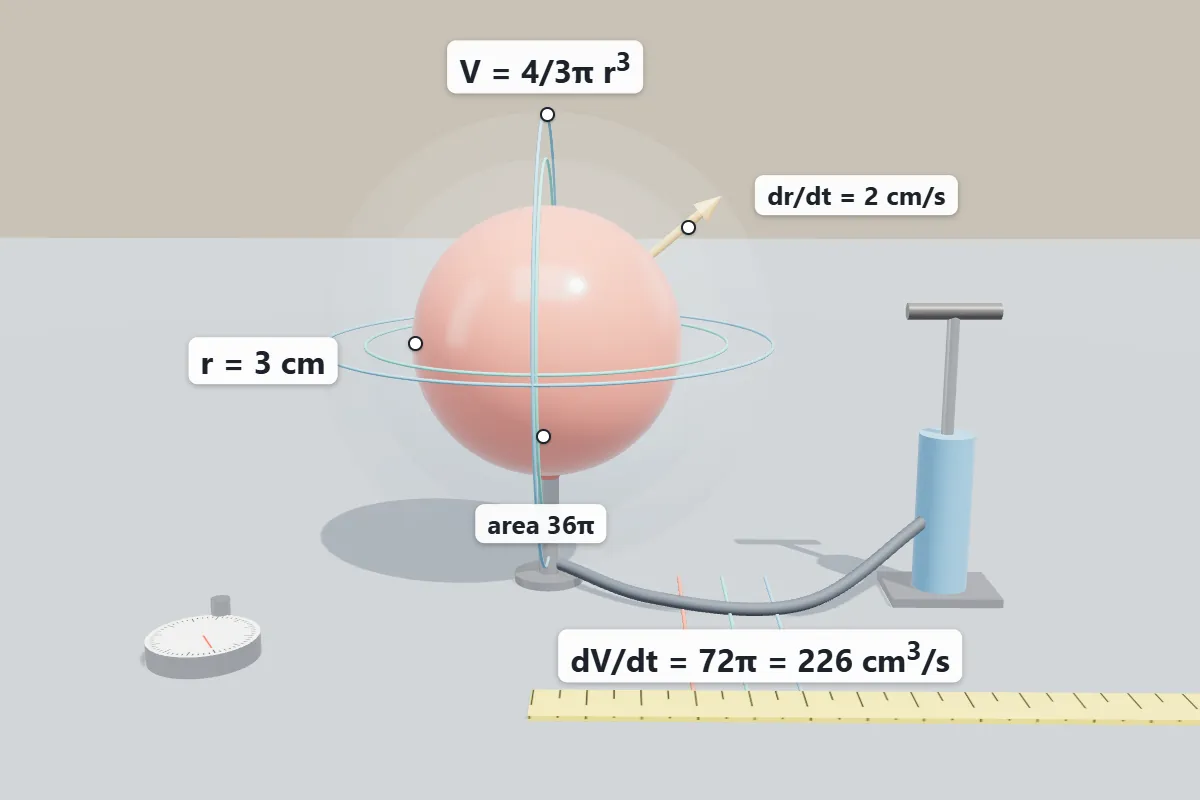
- Example 1:
- A spherical balloon is inflated so that its volume grows at cm/s.
- Find the rate of increase of the radius and of the surface area when cm.
- Solution:
- , so .
- Substitute 8π=4π(16)drdt, hence drdt=18 cm/s.
- , so cm/s.
Growing sand pile
✍️ Worked examples
- Example 2 Sand falls at cm/s forming a cone whose height always equals its base radius. How fast is the radius increasing when cm?
- Solution:
- With h=r V=13πr2h=13πr3.
- .
- , so cm/s.
Sliding ladder
✍️ Worked examples
- Example 3:
- A 250 cm ladder leans against a vertical wall.
- Its top slides down at 10 cm/s.
- When the foot is 70 cm from the wall find (a) the speed of the foot, (b) the rate of change of the angle between the ladder and the ground.
- Solution:
- Let be the foot’s distance from the wall and the height of the top: .
- When x=70 y=62500−4900=240 cm.
- Differentiate 2xdxdt+2ydydt=0, so dxdt=−yxdydt.
- With dydt=−10 dxdt=−24070(−10)=2407≈34.3 cm/s. The foot slides away from the wall.
- (b) , so .
- , hence and rad/s.
- The angle is decreasing at rad/s.
Triangle with changing legs
✍️ Worked examples
- Example 4:
- The legs of a right triangle are 12 cm and 16 cm.
- The first leg grows at 2 cm/s and the second shrinks at 1 cm/s.
- Find the rate of change of the area after 2 s and the time when the triangle becomes isosceles.
- Solution:
- After seconds the legs are and .
- , so .
- At t=2 dAdt=6 cm2/s.
- Isosceles when x=y 12+2t=16−t, so t=43 s.
Rectangular box
✍️ Worked examples
- Example 5:
- A cuboid has a square base of side that increases at 1 cm/min, and a height that decreases at 2 cm/min.
- When cm and cm find the rate of change of the volume, and the time after which the volume stops increasing.
- Solution:
- , so .
- Now 2(5)(20)(1)+25(−2)=200−50=150 cm3/min.
- The volume stops increasing when , i.e. , so .
- Here and , so and min.
Shadow problem
✍️ Worked examples
- Example 6:
- A man 1.8 m tall walks toward a lamp post 5.4 m high at 1.2 m/s.
- Find the rate of change of the length of his shadow, and the rate of change of the distance from his head to the lamp when he is 4.8 m from the post.
- Solution:
- Let be his distance from the post and the length of his shadow.
- Similar triangles 5.41.8=x+yy, so 3y=x+y and y=x2.
- m/s: the shadow shortens at 0.6 m/s.
- The vertical gap between lamp and head is m, so the head-to-lamp distance satisfies .
- When : m.
- , so m/s.
Triangle with a changing angle
✍️ Worked examples
- Example 7:
- Two sides and of a triangle grow at 0.1 cm/s each, and the angle between them grows at 0.05 rad/s.
- Find the rate of change of the area when cm and .
- Solution:
- .
- .
- cm/s.
Observer and rising balloon
✍️ Worked examples
- Example 8:
- A balloon rises vertically from point .
- An observer at , 200 m from on the ground, sees the elevation angle increase at 0.12 rad/min.
- How fast is the balloon rising when ?
- Solution:
- , so .
- At , .
- m/min.
Related Time Rates · 4 / 7
1-4 (d) Moving point on a curve
1-4 (d) Moving point on a curve
Idea
- If a point moves on a curve , then and both depend on time and are related by the curve’s equation.
- Differentiate the equation with respect to (implicit differentiation) to link and .
- The slope of the tangent at the point equals .
✍️ Worked examples
- Example 9:
- A point moves on the circle .
- When it passes its -coordinate increases at 4 units/s.
- Find the rate of change of its -coordinate.
- Solution:
- Check the point 9+1−12+8−6=0, so it is on the curve.
- Differentiate 2xdxdt+2ydydt−4dxdt+8dydt=0.
- So .
- At (3,1) 2(4)+10dydt=0, hence dydt=−0.8 units/s.
- Example 10 The point moves on . At which points do and change at the same rate?
- Solution:
- .
- Equal rates (non-zero) require , so .
- The points are and .
Related Time Rates · 5 / 7
1-4 (e) Physical and life applications
1-4 (e) Physical and life applications
Electric circuit
✍️ Worked examples
- Example 11:
- In a circuit .
- The potential difference rises at 1 volt/s while the current falls at A/s.
- Find the rate of change of the resistance when V and A.
- Solution:
- ohm at that moment.
- Differentiate dVdt=IdRdt+RdIdt.
- , so and ohm/s.
- If instead the current rose at 1 A/s 1=2dRdt+6(1), so dRdt=−2.5 ohm/s.
Gas under constant temperature
✍️ Worked examples
- Example 12:
- A gas at constant temperature is compressed so that its volume falls at 2 cm/s.
- The pressure is inversely proportional to the volume and equals 1000 gf/cm when cm.
- Find the rate of change of the pressure when cm.
- Solution:
- , so .
- .
- At V=100 dPdt=−25000010000(−2)=50 gf/cm2 per second.
- The pressure is increasing.
Production and growth models
✍️ Worked examples
- Example 13 The daily output of a factory after days is units. Find the rate of change of output on the tenth day.
- Solution:
- .
- At t=10 40e−1≈14.7 units per day.
- The output is still rising, but more and more slowly.
- Example 14 Honey production of a hive is grams after days. Is the production rising or falling at ?
- Solution:
- .
- At t=5 ln10+10510≈2.30+10.5=12.8>0.
- The production is increasing at about 12.8 g per day.
Related Time Rates · 6 / 7
1-4 (f) Common mistakes
1-4 (f) Common mistakes
Checklist
- Substituting numbers before differentiating.
- Forgetting the sign of a decreasing quantity.
- Using where the question asks for a time rate .
- Dropping the chain-rule factor, for example writing instead of .
- Mixing units, such as metres with centimetres per second.
- Forgetting that for an object sliding on a ladder, the ladder’s length is constant but both distances change.
- .egp-ex{margin:18px 0;border:1px solid rgba(79,63,224,.2);border-radius:16px;overflow:hidden;background:#fff}.egp-ex-h{padding:10px 16px;font-weight:800;background:linear-gradient(90deg,#4f3fe0,#22c1c3);color:#fff}.egp-ex-tabs{display:flex;flex-wrap:wrap;gap:6px;padding:10px 12px;background:#f7f6ff}.egp-ex-b{border:1px solid rgba(79,63,224,.3);background:#fff;border-radius:20px;padding:5px 14px;font-weight:700;cursor:pointer}.egp-ex-b.on{background:#4f3fe0;color:#fff}.egp-ex-p{padding:12px 16px}
Related Time Rates · 7 / 7
Well done! You finished this lesson
What would you like to do next?