Curriculum
Mathematics
Unit 1
0/12
1.1Key terms1.2Laws and key relationships1.3Rigorous Derivation of Reciprocal Trigonometric Functions1.4Logarithmic and General Exponential Differentiation Techniques1.5Parametric and Implicit Second-Order Derivatives1.6Worked examples1.7Exam tips1.8Real-world applications1.9Key Scientific Tables & Anatomical Diagrams Extracted from Official Curricula1.10📌 Comprehensive Scientific Terminology Dictionary:1.11🔍 In-Depth Explanations, Deductions & Multi-Book Insights:1.12Lesson summary
Unit 2
0/141.1The counting principle1.2Permutations (nPr)1.3Combinations (nCr)1.4Worked examples on counting, permutations and combinations1.5Recall: counting principle, permutations and combinations1.61-1 (a) Pascal's triangle and the binomial expansion1.71-1 (b) The general term1.81-1 (c) The middle term1.91-2 The term containing xk and the term free of x1.101-3 (a) The ratio between two consecutive terms1.111-3 (b) The greatest term1.12Key Scientific Tables & Anatomical Diagrams Extracted from Official Curricula1.13Lesson 1 - Counting Principle, Permutations and Combinations and the Binomial Theorem1.14Lesson summary
Unit 3
0/131.1Key terms1.2Laws and key relationships1.3Geometry of 3D Vectors and Scalar/Cross Product Physics1.4Equations of Straight Lines in Three Dimensions1.5Equations of Planes and Perpendicular Distance Formulas1.6Worked examples1.7Exam tips1.8Real-world applications1.9Key Scientific Tables & Anatomical Diagrams Extracted from Official Curricula1.10📌 Comprehensive Scientific Terminology Dictionary:1.11⚖️ Governing Physical Laws & Mathematical Relations:1.12🔍 In-Depth Explanations, Deductions & Multi-Book Insights:1.13Lesson summary
Unit 4
0/81.11 Smooth and rough surfaces1.22 Properties of the static friction force1.33 Kinetic friction force1.44 The resultant reaction R′1.55 The angle of friction1.66 Equilibrium of a body on a rough horizontal plane1.77 Equilibrium of a body on a rough inclined plane1.88 Conditions of equilibrium and rigid bodies with friction
Unit 5
0/121.13-1 (a) Indefinite integrals of exponential functions1.23-1 (b) Indefinite integrals of logarithmic functions1.33-2 (a) The differential and the standard integrals1.43-2 (b) Integration by substitution1.53-2 (c) Integration by parts1.63-2 (d) Applications of the indefinite integral1.73-3 (a) The definite integral and the fundamental theorem of calculus1.83-3 (b) Properties of the definite integral1.93-3 (c) Definite integral by substitution, odd and even functions1.103-4 (a) Area of a plane region1.113-4 (b) Volumes of solids of revolution1.12Key Scientific Tables & Anatomical Diagrams Extracted from Official Curricula
Unit 6
0/81.12-1 (a) Polar coordinates and the Argand plane1.22-1 (b) Modulus, amplitude and principal amplitude1.32-1 (c) The trigonometric (polar) form of a complex number1.42-1 (d) Product and quotient in trigonometric form1.52-1 (e) The exponential (Euler) form1.62-2 (a) De Moivre's theorem for a positive integer power1.72-2 (b) De Moivre's theorem for a rational power and the roots of a complex number1.82-3 The cube roots of unity
Unit 7
0/101.11 Momentum and its change1.22 Newton's first law, inertia and force1.33 Newton's second law, the equation of motion and variable mass1.44 Newton's third law, lifts and scales1.55 Bodies connected by a string over a smooth pulley1.66 Impulse1.77 Work1.88 Kinetic energy and the work-energy principle1.99 Potential energy and conservation of energy1.1010 Power
Text lesson
Increasing, Decreasing Functions and Maximum and Minimum Values
Increasing, Decreasing Functions and Maximum and Minimum Values
Overview
Overview
- This lesson covers lessons 2-1 and 2-2 of the unit "Behaviour of the Function and Curve Sketching".
- After it you should be able to:
- use the sign of the first derivative to find where a function increases or decreases;
- find critical points and classify local maximum and minimum values with the first derivative test;
- find the absolute maximum and minimum of a continuous function on a closed interval.
🌳 Concept tree
- Increasing
- Decreasing Functions and Maximum and Minimum Values
├── 2-1 (a) Monotonic functions and the tangent
│ ├── Definitions
│ └── Link with the tangent
- ├── 2-1 (b) The first-derivative test for monotony
│ ├── Rule
│ ├── Steps
│ ├── Examples
│ └── Notes
├── 2-2 (a) Critical points
│ ├── Definition
│ └── Reading a graph
├── 2-2 (b) Local maximum and minimum values
│ ├── Definitions
│ └── Necessary condition
- ├── 2-2 (c) First-derivative test for local extrema
│ ├── Rule
│ └── Steps
- ├── 2-2 (d) Absolute maximum and minimum on a closed interval
│ ├── Definition
│ ├── Existence
│ ├── Method
│ └── Remarks
- ├── 2-2 (e) Finding unknown constants from extrema
│ └── Idea
└── 2-2 (f) Summary
└── Comparison of the tests
Increasing, Decreasing Functions and Maximum and Minimum Values · 1 / 9
2-1 (a) Monotonic functions and the tangent
2-1 (a) Monotonic functions and the tangent
Definitions
- A function is increasing on an interval if its graph rises from left to right: gives .
- It is decreasing if its graph falls x1<x2 gives f(x1)>f(x2).
- Reading a graph gives the intervals, but differentiation gives them exactly.
- Where the function increases, the tangent makes an acute angle with the positive -axis, so its slope is positive.
- Where it decreases, the tangent makes an obtuse angle, so is negative.
- Where the tangent is horizontal, .
Increasing, Decreasing Functions and Maximum and Minimum Values · 2 / 9
2-1 (b) The first-derivative test for monotony
2-1 (b) The first-derivative test for monotony
Rule
- Let be differentiable on the open interval .
- If for every , then is increasing on .
- If for every , then is decreasing on .
- Find the domain of and check where it is continuous and differentiable.
- Find .
- Solve and find where does not exist; these values separate the intervals.
- Make a table of signs of on each interval (test one value in each).
- State the intervals of increase and decrease.
Examples
✍️ Worked examples
- Example 1 Find the intervals of increase and decrease of .
- Solution:
- is a polynomial, so it is continuous and differentiable on .
- .
- at and .
- Sign of f′ positive on ]−∞,−1[, negative on ]−1,1[, positive on ]1,∞[.
- So is increasing on and on , and decreasing on .
- Example 2 Find the intervals of monotony of for .
- Solution:
- .
- gives , so or .
- Test points at x=π2, f′=1>0; at x=π, f′=−1<0; at x=3π2, f′=1>0.
- Increasing on and ; decreasing on .
- Example 3 Find the intervals of monotony of .
- Solution:
- The domain is .
- .
- gives (since ).
- For , ; for , .
- is increasing on and decreasing on .
- Example 4 Find the intervals of monotony of .
- Solution:
- .
- The denominator is always positive, so the sign depends on .
- on and on and .
- increases on and decreases on the other two intervals.
- Example 5 Prove that is increasing on .
- Solution:
- .
- On , , so .
- Hence is increasing there.
Notes
- The values that separate increasing from decreasing are those where or does not exist.
- A function can be strictly increasing even if is zero at one isolated point, such as at .
- If everywhere, then has everywhere, so is decreasing on .
- Graphing software confirms the table of signs the curve rises where the table says "+" and falls where it says "−".
Increasing, Decreasing Functions and Maximum and Minimum Values · 3 / 9
2-2 (a) Critical points
2-2 (a) Critical points
Definition
- Let be continuous on an interval and let be inside it.
- The point is a critical point if , or does not exist (for example a corner or a vertical tangent), while is defined at .
- A critical point with is also called a stationary point.
- At a hill top the tangent is horizontal and changes from increasing to decreasing.
- At a valley bottom the tangent is horizontal and changes from decreasing to increasing.
- At a sharp corner the left and right derivatives differ, so does not exist, yet the point can still be a turning point.
Increasing, Decreasing Functions and Maximum and Minimum Values · 4 / 9
2-2 (b) Local maximum and minimum values
2-2 (b) Local maximum and minimum values
Definitions
- is a local maximum value if there is an open interval around in which for all .
- is a local minimum value if there is an open interval around in which for all .
- Together they are called local extrema.
- A local maximum can be smaller than a local minimum elsewhere on the graph, because the comparison is only with nearby points.
Necessary condition
- If has a local extremum at an inner point , then or does not exist.
- The converse is false f(x)=x3 has f′(0)=0 but no extremum at 0.
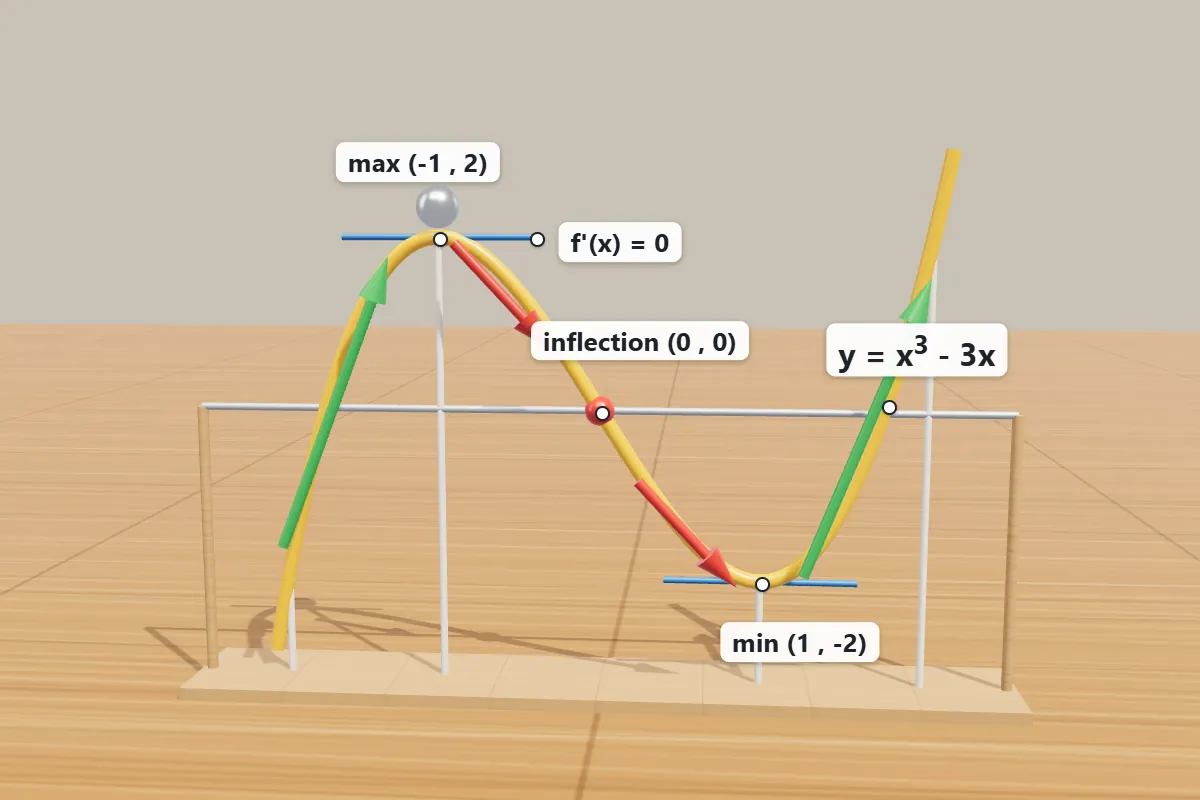
Increasing, Decreasing Functions and Maximum→a wire curve y = x3 – 3x like a hill and valley shows curve behaviour and maximum and minimum values: max (-1, 2) and min (1, -2).: 2-2 (b) Local maximum and minimum values
Increasing, Decreasing Functions and Maximum and Minimum Values · 5 / 9
2-2 (c) First-derivative test for local extrema
2-2 (c) First-derivative test for local extrema
Rule
- Let be a critical point of the continuous function .
- If changes from positive to negative at , then is a local maximum.
- If changes from negative to positive at , then is a local minimum.
- If does not change sign at , there is no local extremum.
- Find the domain and .
- Find the critical points (where or does not exist, inside the domain).
- Make a table of signs of around each critical point.
- Decide maximum, minimum or neither, and calculate .
✍️ Worked examples
- Example 6 Find the local extrema of .
- Solution:
- .
- Critical points at and .
- Signs of f′ positive for x<−3, negative for −3<x<1, positive for x>1.
- At x=−3 the sign goes +→− local maximum f(−3)=−27+27+27−7=20.
- At x=1 the sign goes −→+ local minimum f(1)=1+3−9−7=−12.
- Example 7 Find the local extrema of .
- Solution:
- , defined and continuous on .
- .
- does not exist and , so the critical points are and .
- For x<0 x−1<0 and x1/3<0, so f′>0. For 0<x<1: f′<0. For x>1: f′>0.
- At x=0 the sign goes +→− local maximum f(0)=0 (at a sharp point where the derivative does not exist).
- At x=1 the sign goes −→+ local minimum f(1)=−3.
- Example 8 Find the local extrema of .
- Solution:
- The domain is .
- .
- Critical points x=±2 (the value x=0 is not in the domain).
- Signs positive for x<−2, negative on ]−2,0[ and on ]0,2[, positive for x>2.
- Local maximum and local minimum .
- Notice that the local maximum is less than the local minimum .
- Example 9 Show that has no local extrema.
- Solution:
- for every .
- There is no critical point and is always increasing, so no local maximum or minimum exists.
- Example 10 Find the local extrema of .
- Solution:
- .
- The factor is always positive, so only at .
- for and for , so is a local maximum.
Increasing, Decreasing Functions and Maximum and Minimum Values · 6 / 9
2-2 (d) Absolute maximum and minimum on a closed interval
2-2 (d) Absolute maximum and minimum on a closed interval
Definition
- Let be defined on and .
- is the absolute minimum if for all .
- is the absolute maximum if for all .
- Together they are the absolute extrema (extreme values). They may occur at an inner point or at an end point.
- If is continuous on , it always has both an absolute maximum and an absolute minimum there.
- For an open or unbounded interval, or a discontinuous function, they may not exist.
- Find and .
- Find the critical points in and the value of at each.
- Compare all these values the largest is the absolute maximum and the smallest is the absolute minimum.
✍️ Worked examples
- Example 11 Find the absolute extrema of on .
- Solution:
- and .
- , so the critical points are , both inside the interval.
- and .
- Compare 21,3,−4,28 absolute maximum =28 at x=−2, absolute minimum =−4 at x=2.
- Example 12 Find the absolute extrema of on .
- Solution:
- , critical point .
- , , .
- Absolute maximum at ; absolute minimum at the end point .
- Example 13 Find the absolute extrema of on .
- Solution:
- gives , so or .
- and .
- End points f(0)=f(2π)=1.
- Absolute maximum and absolute minimum .
- Example 14 Find the absolute extrema of on .
- Solution:
- , so there is no critical point and is increasing.
- The extrema are at the end points minimum f(2)=1 and maximum f(5)=2.
Remarks
- On a closed interval the end points must always be tested, because an extreme value can sit there with a non-zero derivative.
- A function may have several local extrema but only one absolute maximum value (it can be attained at more than one point).
- A local extremum is only "local"; the absolute extremum of an interval can coincide with a local extremum.
Increasing, Decreasing Functions and Maximum and Minimum Values · 7 / 9
2-2 (e) Finding unknown constants from extrema
2-2 (e) Finding unknown constants from extrema
Idea
- Use the facts "the point lies on the curve" and " at the extremum" to build equations.
✍️ Worked examples
| Comparison aspect | Main idea | Keywords |
|---|---|---|
| Example 15 | The curve has a local maximum at . Find and . | curvelocalmaximumFind |
| • | Solution | Solution |
| The point lies on the curve | a+b=4 | |
| Critical point |
| 3ax2 |
| • | From the first equation ; then , so and . | firstequationthen |
| Check |
| 24x2positivejustbefore |
Increasing, Decreasing Functions and Maximum and Minimum Values · 8 / 9
2-2 (f) Summary
2-2 (f) Summary
| Point of comparison | Monotony test | Local extremum test | Absolute extremum on |
|---|---|---|---|
| Uses | Sign of on intervals | Sign change of at a critical point | Values of at critical points and end points |
| Result | Increasing / decreasing intervals | Local maximum / minimum value | Greatest and least value on the interval |
| Key condition | differentiable on the interval | continuous at | continuous on |
- .egp-ex{margin:18px 0;border:1px solid rgba(79,63,224,.2);border-radius:16px;overflow:hidden;background:#fff}.egp-ex-h{padding:10px 16px;font-weight:800;background:linear-gradient(90deg,#4f3fe0,#22c1c3);color:#fff}.egp-ex-tabs{display:flex;flex-wrap:wrap;gap:6px;padding:10px 12px;background:#f7f6ff}.egp-ex-b{border:1px solid rgba(79,63,224,.3);background:#fff;border-radius:20px;padding:5px 14px;font-weight:700;cursor:pointer}.egp-ex-b.on{background:#4f3fe0;color:#fff}.egp-ex-p{padding:12px 16px}
Increasing, Decreasing Functions and Maximum and Minimum Values · 9 / 9
Well done! You finished this lesson
What would you like to do next?