Curriculum
Mathematics
Unit 1
0/12
1.1Key terms1.2Laws and key relationships1.3Rigorous Derivation of Reciprocal Trigonometric Functions1.4Logarithmic and General Exponential Differentiation Techniques1.5Parametric and Implicit Second-Order Derivatives1.6Worked examples1.7Exam tips1.8Real-world applications1.9Key Scientific Tables & Anatomical Diagrams Extracted from Official Curricula1.10📌 Comprehensive Scientific Terminology Dictionary:1.11🔍 In-Depth Explanations, Deductions & Multi-Book Insights:1.12Lesson summary
Unit 2
0/141.1The counting principle1.2Permutations (nPr)1.3Combinations (nCr)1.4Worked examples on counting, permutations and combinations1.5Recall: counting principle, permutations and combinations1.61-1 (a) Pascal's triangle and the binomial expansion1.71-1 (b) The general term1.81-1 (c) The middle term1.91-2 The term containing xk and the term free of x1.101-3 (a) The ratio between two consecutive terms1.111-3 (b) The greatest term1.12Key Scientific Tables & Anatomical Diagrams Extracted from Official Curricula1.13Lesson 1 - Counting Principle, Permutations and Combinations and the Binomial Theorem1.14Lesson summary
Unit 3
0/131.1Key terms1.2Laws and key relationships1.3Geometry of 3D Vectors and Scalar/Cross Product Physics1.4Equations of Straight Lines in Three Dimensions1.5Equations of Planes and Perpendicular Distance Formulas1.6Worked examples1.7Exam tips1.8Real-world applications1.9Key Scientific Tables & Anatomical Diagrams Extracted from Official Curricula1.10📌 Comprehensive Scientific Terminology Dictionary:1.11⚖️ Governing Physical Laws & Mathematical Relations:1.12🔍 In-Depth Explanations, Deductions & Multi-Book Insights:1.13Lesson summary
Unit 4
0/81.11 Smooth and rough surfaces1.22 Properties of the static friction force1.33 Kinetic friction force1.44 The resultant reaction R′1.55 The angle of friction1.66 Equilibrium of a body on a rough horizontal plane1.77 Equilibrium of a body on a rough inclined plane1.88 Conditions of equilibrium and rigid bodies with friction
Unit 5
0/121.13-1 (a) Indefinite integrals of exponential functions1.23-1 (b) Indefinite integrals of logarithmic functions1.33-2 (a) The differential and the standard integrals1.43-2 (b) Integration by substitution1.53-2 (c) Integration by parts1.63-2 (d) Applications of the indefinite integral1.73-3 (a) The definite integral and the fundamental theorem of calculus1.83-3 (b) Properties of the definite integral1.93-3 (c) Definite integral by substitution, odd and even functions1.103-4 (a) Area of a plane region1.113-4 (b) Volumes of solids of revolution1.12Key Scientific Tables & Anatomical Diagrams Extracted from Official Curricula
Unit 6
0/81.12-1 (a) Polar coordinates and the Argand plane1.22-1 (b) Modulus, amplitude and principal amplitude1.32-1 (c) The trigonometric (polar) form of a complex number1.42-1 (d) Product and quotient in trigonometric form1.52-1 (e) The exponential (Euler) form1.62-2 (a) De Moivre's theorem for a positive integer power1.72-2 (b) De Moivre's theorem for a rational power and the roots of a complex number1.82-3 The cube roots of unity
Unit 7
0/101.11 Momentum and its change1.22 Newton's first law, inertia and force1.33 Newton's second law, the equation of motion and variable mass1.44 Newton's third law, lifts and scales1.55 Bodies connected by a string over a smooth pulley1.66 Impulse1.77 Work1.88 Kinetic energy and the work-energy principle1.99 Potential energy and conservation of energy1.1010 Power
Text lesson
Convexity, Inflection Points, Curve Sketching and Optimisation
Convexity, Inflection Points, Curve Sketching and Optimisation
Overview
Overview
- This lesson covers lessons 2-3 and 2-4 of the unit "Behaviour of the Function and Curve Sketching".
- After it you should be able to:
- use the second derivative for the direction of convexity, inflection points and the second-derivative test;
- sketch the curve of a polynomial up to degree three from its derivatives;
- model and solve maximum and minimum problems from geometry and daily life.
🌳 Concept tree
- Convexity
- Inflection Points
- Curve Sketching and Optimisation
├── 2-3 (a) Convexity of a curve
│ ├── Direction of convexity
│ └── The second-derivative test for convexity
├── 2-3 (b) Inflection points
│ ├── Definition
│ └── Finding inflection points
- ├── 2-3 (c) Second-derivative test for local extrema
│ └── Rule
├── 2-3 (d) Sketching a polynomial curve
│ ├── Plan
│ ├── Quadratic functions
│ ├── Sketching from given properties
│ └── Asymptotes (supplementary)
├── 2-4 (a) Mathematical modelling
│ ├── The modelling steps
- │ └── Why a critical point can give the absolute extremum
├── 2-4 (b) Geometric optimisation
- └── 2-4 (c) Cost
- shortest length and other applications
└── Checking the answer
Convexity, Inflection Points, Curve Sketching and Optimisation · 1 / 14
2-3 (a) Convexity of a curve
2-3 (a) Convexity of a curve
Direction of convexity
- A curve is convex downward on an interval when its tangent slope is increasing there, so . The curve lies above its tangents and has a cup shape (many books call this "concave up").
- A curve is convex upward on an interval when is decreasing, so . The curve lies below its tangents and has a cap shape (called "concave down").
- This lesson follows the book’s names convex downward means f′′>0 and convex upward means f′′<0.
- Let be twice differentiable on .
- If for all , the curve is convex downward on it.
- If for all , the curve is convex upward on it.
✍️ Worked examples
- Example 1 Find the intervals of convexity of .
- Solution:
- and .
- at .
- For x<−1 f′′>0, so the curve is convex downward on ]−∞,−1[.
- For x>−1 f′′<0, so the curve is convex upward on ]−1,∞[.
- Example 2 Find the intervals of convexity of .
- Solution:
- and .
- g′′>0 for x<0 and for x>2 convex downward on ]−∞,0[ and ]2,∞[.
- g′′<0 for 0<x<2 convex upward on ]0,2[.
Convexity, Inflection Points, Curve Sketching and Optimisation · 2 / 14
2-3 (b) Inflection points
2-3 (b) Inflection points
Definition
- A point is an inflection point if is continuous at , the curve has a tangent there, and the direction of convexity changes at .
- At an inflection point the tangent crosses the curve the curve lies under it on one side and above it on the other.
- Solve and find where does not exist.
- Test the sign of on both sides of each value; it must change.
- Make sure a tangent exists at the point.
- A zero of f′′ is not enough f(x)=x4 has f′′(0)=0 but f′′≥0 on both sides, so there is no inflection.
✍️ Worked examples
- Example 3 Find the inflection points of .
- Solution:
- From Example 2 the sign of changes at (from to ) and at (from to ).
- and .
- The inflection points are and .
- Example 4 Study the convexity and inflection of
f(x)={x2−4x<−2x3−3x+2x≥−2
- Solution:
- At both pieces give , so is continuous.
- Left derivative 2x=−4. Right derivative: 3x2−3=9. They differ, so f is not differentiable at x=−2 and there is no tangent there.
- for and for , which is zero at .
- Convex downward on (where ) and on ; convex upward on .
- is not an inflection point although the convexity changes, because no tangent exists.
- (0,2) is an inflection point the tangent exists, with slope f′(0)=−3, so its equation is y−2=−3x.
- Example 5 The point is an inflection point of . Find and .
- Solution:
- The point lies on the curve a+b=12.
- and , so and .
- Then , so and .
- Example 6 The point is an inflection point of . Find and .
- Solution:
- and , so .
- , so .
Convexity, Inflection Points, Curve Sketching and Optimisation · 3 / 14
2-3 (c) Second-derivative test for local extrema
2-3 (c) Second-derivative test for local extrema
Rule
- Let be twice differentiable near and .
- If , then is a local maximum (the curve is a cap at ).
- If , then is a local minimum (the curve is a cup at ).
- If the test fails; use the first-derivative test.
✍️ Worked examples
- Example 7 Use the second-derivative test on .
- Solution:
- , so the critical points are and .
- .
- f′′(0)=−16<0 local maximum f(0)=10.
- f′′(±2)=32>0 local minimum f(±2)=16−32+10=−6 at both points.
- Example 8 Find the extrema of .
- Solution:
- ; critical points and .
- .
- f′′(3)=12>0 local minimum f(3)=27−27−27=−27.
- f′′(−1)=−12<0 local maximum f(−1)=−1−3+9=5.
Convexity, Inflection Points, Curve Sketching and Optimisation · 4 / 14
2-3 (d) Sketching a polynomial curve
2-3 (d) Sketching a polynomial curve
Plan
| Comparison aspect | Main idea | Keywords |
|---|---|---|
| Domain and symmetry |
| evenfunctionsymmetricaxis |
| Find f′ and solve f′=0 |
| criticalpointsintervalsincrease |
| Find f′′ and solve f′′=0 | intervals of convexity and inflection points | intervalsconvexityinflectionpoints |
| Collect everything in one table |
| signbehaviourconvexity |
| Find intercepts |
| equationsolvable |
| • |
| extrapointsneededplot |
✍️ Worked examples
- Sketch .
- Solution:
- Domain ; the function is neither even nor odd.
- gives critical points and .
- gives .
- Table:
| to | to | to | to | ||||
|---|---|---|---|---|---|---|---|
| Behaviour | rising, convex upward | local max | falling, convex upward | inflection | falling, convex downward | local min | rising, convex downward |
| Comparison aspect | Main idea | Keywords |
|---|---|---|
| Intercepts |
| Sincecurvetouchesaxis |
| Extra point | f(3)=27−27+4=4 | |
| • | The curve comes up from the lower left through , peaks at , falls through the inflection to touch the axis at , then rises through . | curvecomeslowerleft |
✍️ Worked examples
- Example 10 Sketch .
- Solution:
- is odd (), so the curve is symmetric about the origin.
- , so the critical points are .
- , zero at .
- for , on , for .
- Local minimum and local maximum .
- for (convex downward) and for (convex upward); inflection at the origin .
- x-intercepts x(12−x2)=0, so x=0 and x=±23≈±3.46.
- Sketch falls to the minimum (−2,−16), climbs through the origin to the maximum (2,16), then falls through (23,0).
Quadratic functions
- For a parabola f(x)=ax2+bx+c f′′(x)=2a is constant, so there is one turning point at x=−b2a and no inflection.
- It is a cup if and a cap if .
Sketching from given properties
✍️ Worked examples
- Example 11 Sketch a continuous on with , , , for , for and throughout.
- Solution:
- Plot and ; the tangent is horizontal at .
- rises on and falls on , so is a local (and absolute) maximum.
- everywhere means the whole curve is convex upward (a cap), with no inflection point.
- Some curves, such as , level off. Since , the line is a horizontal asymptote that the two ends approach.
- A graphing program is the best help for such functions, to confirm extrema, convexity and asymptotes.
Convexity, Inflection Points, Curve Sketching and Optimisation · 5 / 14
2-4 (a) Mathematical modelling
2-4 (a) Mathematical modelling
The modelling steps
- Define the problem and its aim (largest area, least cost, shortest length, greatest profit).
- Draw a figure and name the variables (the unknowns).
- Write the quantity to optimise as a function (the model).
- Use the constraints (given volume, perimeter, similar triangles) to reduce it to one variable, and state its domain.
- Differentiate, find the critical points, and decide using the first- or second-derivative test (or the end points on a closed interval).
- Interpret the result in the language of the problem and give all the required quantities with units.
- If a continuous function has only one critical point in an interval and it is a local maximum (or minimum), then it is the absolute maximum (or minimum) on that interval.
- If keeps the same sign on the whole interval, the unique critical point is the absolute extremum.
Convexity, Inflection Points, Curve Sketching and Optimisation · 6 / 14
2-4 (b) Geometric optimisation
2-4 (b) Geometric optimisation
- Example 14 A closed cylinder must hold a fixed volume . Find the shape of least surface area.
- Solution:
- , so .
- Surface .
- gives .
- , so this is a minimum.
- Since V=2πr3, h=2πr3πr2=2r the height equals the diameter.
- Example 15 A sector has area 16 cm. Find the radius that makes its perimeter least, and the angle then.
- Solution:
- Let the arc be . Area , so .
- Perimeter .
- gives ; .
- So cm, cm, the angle is rad, and the least perimeter is cm.
- Example 16 A sector has perimeter 12 cm. Find its angle when its area is greatest.
- Solution:
- , so .
- , so and ; .
- and rad; the greatest area is 9 cm.
✍️ Worked examples
- Example 12:
- A rectangle is inscribed in a triangle of base 16 cm and height 12 cm, with one side on the base and the two upper vertices on the other sides.
- Find the dimensions of the rectangle of greatest area.
- Solution:
- Let the rectangle have height and length . Similar triangles give , so .
- Area with .
- gives ; .
- Then .
- The best rectangle is 6 cm by 8 cm, with area 48 cm.
- Example 13:
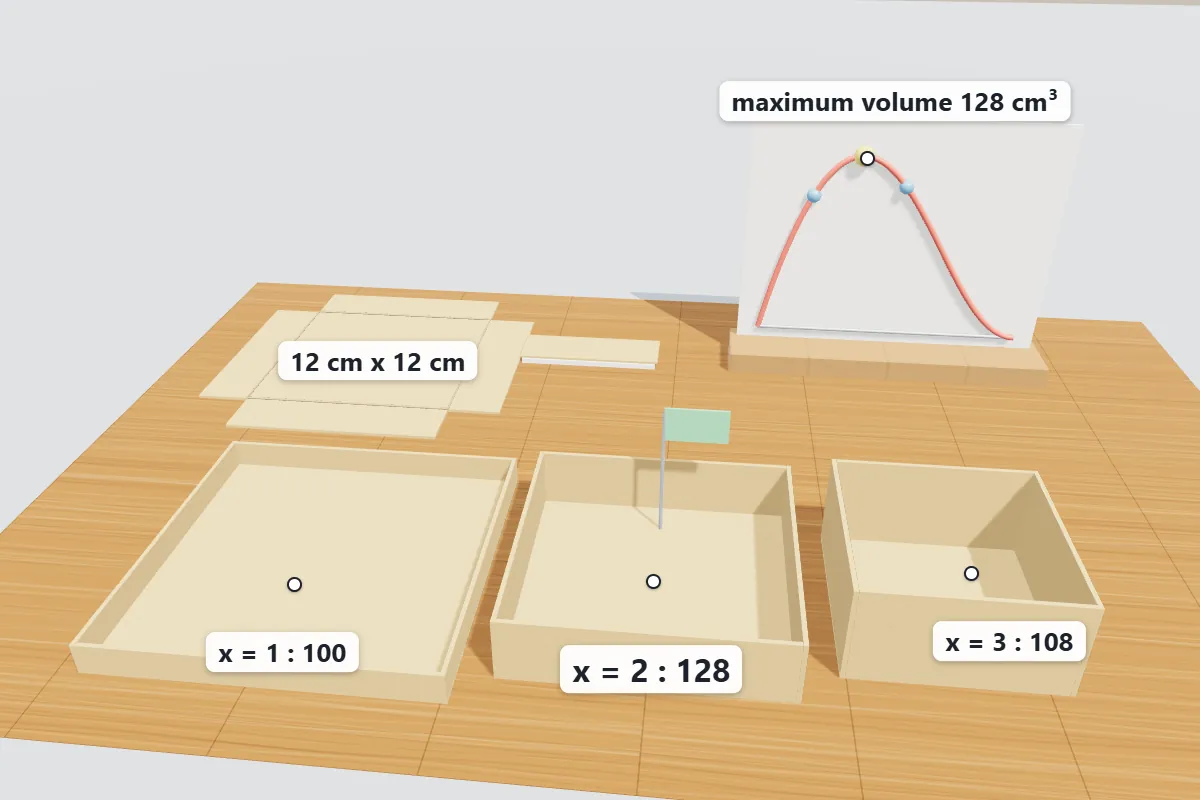
- A square sheet of side 24 cm has equal squares cut from its corners and the sides are folded up to make an open box.
- Find the cut that gives the largest volume.
- Solution:
- Let the cut square have side ; the box has base side and height , so , with .
- .
- gives (the value is rejected).
- for and for , so gives the maximum.
- cm.
Convexity, Inflection Points, Curve Sketching and Optimisation · 7 / 14
2-4 (c) Cost, shortest length and other applications
2-4 (c) Cost, shortest length and other applications
✍️ Worked examples
- Example 17:
- A silo is a vertical cylinder topped by a hemisphere.
- Its cylindrical part holds m of grain.
- A unit area of the top costs twice a unit area of the wall.
- Find the radius and height that minimise the cost.
- Solution:
- Let the wall cost per m and the roof cost .
- Volume of the cylinder πr2h=108π, so h=108r2.
- Wall area ; hemisphere area .
- Cost .
- gives , so .
- , so this is a minimum.
- Then h=1089=12 radius 3 m, cylinder height 12 m.
- Example 18:
- A 2 m high fence stands 2 m from a wall.
- Find the shortest ladder that rests on the ground, touches the top of the fence and leans on the wall.
- Solution:
- Let the foot of the ladder be m from the fence and the top be m up the wall. Similar triangles: , so .
- Length squared L2=(x+2)2+y2=(x+2)2(1+4x2).
- Differentiate L2 d(L2)dx=2(x+2)(1+4x2)+(x+2)2(−8x3)=2(x+2)(x3−8)x3.
- It is zero at (since ) and changes from negative to positive there, a minimum.
- , so m.
- Example 19 A line through meets the axes at and . Show that the least area of triangle is 12 square units.
- Solution:
- Let and . The line passes through : , so with .
- Area .
- .
- at , changing from negative to positive, so is least there.
- Then and square units.
- Example 20 The sum of two positive numbers is 20. Find them if the sum of their squares is least.
- Solution:
- Let the numbers be and ; .
- gives ; .
- Both numbers are 10 and the least sum of squares is 200.
Convexity, Inflection Points, Curve Sketching and Optimisation · 8 / 14
Checking the answer
Checking the answer
- Test the end points or the second derivative to be sure you found the required type of extremum.
- Check that the value lies in the physical domain (lengths positive, angles in range).
- Answer every part of the question the optimum value and the dimensions that produce it.
Convexity, Inflection Points, Curve Sketching and Optimisation · 9 / 14
📌 Comprehensive Scientific Terminology & Definitions:
📌 Comprehensive Scientific Terminology & Definitions:
| Comparison aspect | Main idea | Keywords |
|---|---|---|
| Concavity / Convexity (التحدب لأعلى ولأسفل) |
| curveconcaveupwarddownward |
| Inflection Point (نقطة الانقلاب) |
| continuouscurveconcavitychanges |
| Vertical and Horizontal Asymptotes (خطوط التقارب) |
|
| Comparison aspect | Main idea | Keywords |
|---|---|---|
| Applied Optimization (تطبيقات القيم العظمى والصغرى) |
| Mathematicalmodelingmaximizeprofit |
| Steps for Applied Optimization |
| Definevariablesdrawdiagram |
Convexity, Inflection Points, Curve Sketching and Optimisation · 10 / 14
⚖️ Governing Scientific Laws, Principles & Mathematical Formulas:
⚖️ Governing Scientific Laws, Principles & Mathematical Formulas:
| Comparison aspect | Main idea | Keywords |
|---|---|---|
| (“Inflection Condition | f”(c) = 0 (or undefined) AND f”(c – ε) · f”(c + ε) < 0 (must strictly change sign)." | undefinedmuststrictlychange |
| (“Cost-Distance Optimization (Snell’s Law Analogy) | Total Time T = (d₁ / v₁) + (d₂ / v₂) → dT/dx = 0 leads to sin θ₁ / v₁ = sin θ₂ / v₂.” | TotalTimeleads |
| (‘Box Volume Maximization | For a square sheet of side L with cut corner squares of side x: V(x) = x(L – 2x)2 → dV/dx = (L – 2x)(L – 6x) = 0 → x = L/6 yields maximum volume Vmax = 2L3/27.’ | squaresheetsidecorner |
Convexity, Inflection Points, Curve Sketching and Optimisation · 11 / 14
🔍 In-Depth Explanations, Deductions & Core Concepts:
🔍 In-Depth Explanations, Deductions & Core Concepts:
- Why f”(c) = 0 does not automatically guarantee an inflection point: For f(x) = x4, f”(x) = 12x2 so f”(0) = 0. However, 12x2 ≥ 0 for all x ≠ 0 (no sign change, remaining concave up everywhere), so (0, 0) is a local minimum, not an inflection point.
- Optimum dimensions of a cylinder of fixed volume V to minimize total surface area: Area A = 2π r2 + 2π r h. Since V = π r2 h → h = V / (π r2), substituting gives A(r) = 2π r2 + 2V/r. Setting dA/dr = 4π r – 2V/r2 = 0 yields r3 = V / (2π), leading to h = 2r (height equals diameter).
- Systematic 7-step guide to curve sketching 1. Domain; 2. Intercepts (x and y); 3. Symmetry (even/odd/periodic); 4. Asymptotes; 5. Intervals of increase/decrease (f’); 6. Local extrema; 7. Concavity and inflection points (f”).
Convexity, Inflection Points, Curve Sketching and Optimisation · 12 / 14
📊 Classic Applied Optimization Problems and Their Golden Ratios:
📊 Classic Applied Optimization Problems and Their Golden Ratios:
| Optimization Objective | Constraint Condition | Optimal Geometric Ratio / Dimension | Proven Mathematical Result |
|---|---|---|---|
| Maximum Rectangular Area with Fixed Perimeter P | 2x + 2y = P | Square: x = y = P / 4 | Area_max = P2 / 16 |
| Minimum Surface Area of Closed Cylinder with Fixed Volume V | V = π r2 h | Height equals diameter: h = 2r | Amin = 6π r2 |
| Maximum Open Box Volume from Square Sheet of Side L | V = x(L – 2x)2 | Cut square corners: x = L / 6 | Vmax = 2L3 / 27 |
| Maximum Inscribed Cylinder in Cone of Radius R and Height H | Similar Triangles r/R + h/H = 1 | r = (2/3)R, h = (1/3)H | Vmax = (4/27) Vcone |
Convexity, Inflection Points, Curve Sketching and Optimisation · 13 / 14
💡 High-Yield Exam Traps & Key Takeaways:
💡 High-Yield Exam Traps & Key Takeaways:
| Comparison aspect | Main idea | Keywords |
|---|---|---|
| Exam Secret |
| rectangularfencingproblemsagainst |
| Inflection Tangent Tip | The tangent line drawn at an inflection point crosses/cuts through the curve (inflectional tangent) | linedrawnpointcrosses |
Convexity, Inflection Points, Curve Sketching and Optimisation · 14 / 14
Well done! You finished this lesson
What would you like to do next?