Curriculum
Mathematics
Unit 1
0/12
1.1Key terms1.2Laws and key relationships1.3Rigorous Derivation of Reciprocal Trigonometric Functions1.4Logarithmic and General Exponential Differentiation Techniques1.5Parametric and Implicit Second-Order Derivatives1.6Worked examples1.7Exam tips1.8Real-world applications1.9Key Scientific Tables & Anatomical Diagrams Extracted from Official Curricula1.10📌 Comprehensive Scientific Terminology Dictionary:1.11🔍 In-Depth Explanations, Deductions & Multi-Book Insights:1.12Lesson summary
Unit 2
0/141.1The counting principle1.2Permutations (nPr)1.3Combinations (nCr)1.4Worked examples on counting, permutations and combinations1.5Recall: counting principle, permutations and combinations1.61-1 (a) Pascal's triangle and the binomial expansion1.71-1 (b) The general term1.81-1 (c) The middle term1.91-2 The term containing xk and the term free of x1.101-3 (a) The ratio between two consecutive terms1.111-3 (b) The greatest term1.12Key Scientific Tables & Anatomical Diagrams Extracted from Official Curricula1.13Lesson 1 - Counting Principle, Permutations and Combinations and the Binomial Theorem1.14Lesson summary
Unit 3
0/131.1Key terms1.2Laws and key relationships1.3Geometry of 3D Vectors and Scalar/Cross Product Physics1.4Equations of Straight Lines in Three Dimensions1.5Equations of Planes and Perpendicular Distance Formulas1.6Worked examples1.7Exam tips1.8Real-world applications1.9Key Scientific Tables & Anatomical Diagrams Extracted from Official Curricula1.10📌 Comprehensive Scientific Terminology Dictionary:1.11⚖️ Governing Physical Laws & Mathematical Relations:1.12🔍 In-Depth Explanations, Deductions & Multi-Book Insights:1.13Lesson summary
Unit 4
0/81.11 Smooth and rough surfaces1.22 Properties of the static friction force1.33 Kinetic friction force1.44 The resultant reaction R′1.55 The angle of friction1.66 Equilibrium of a body on a rough horizontal plane1.77 Equilibrium of a body on a rough inclined plane1.88 Conditions of equilibrium and rigid bodies with friction
Unit 5
0/121.13-1 (a) Indefinite integrals of exponential functions1.23-1 (b) Indefinite integrals of logarithmic functions1.33-2 (a) The differential and the standard integrals1.43-2 (b) Integration by substitution1.53-2 (c) Integration by parts1.63-2 (d) Applications of the indefinite integral1.73-3 (a) The definite integral and the fundamental theorem of calculus1.83-3 (b) Properties of the definite integral1.93-3 (c) Definite integral by substitution, odd and even functions1.103-4 (a) Area of a plane region1.113-4 (b) Volumes of solids of revolution1.12Key Scientific Tables & Anatomical Diagrams Extracted from Official Curricula
Unit 6
0/81.12-1 (a) Polar coordinates and the Argand plane1.22-1 (b) Modulus, amplitude and principal amplitude1.32-1 (c) The trigonometric (polar) form of a complex number1.42-1 (d) Product and quotient in trigonometric form1.52-1 (e) The exponential (Euler) form1.62-2 (a) De Moivre's theorem for a positive integer power1.72-2 (b) De Moivre's theorem for a rational power and the roots of a complex number1.82-3 The cube roots of unity
Unit 7
0/101.11 Momentum and its change1.22 Newton's first law, inertia and force1.33 Newton's second law, the equation of motion and variable mass1.44 Newton's third law, lifts and scales1.55 Bodies connected by a string over a smooth pulley1.66 Impulse1.77 Work1.88 Kinetic energy and the work-energy principle1.99 Potential energy and conservation of energy1.1010 Power
Text lesson
The 3D Coordinate System and Vectors in Space
The 3D Coordinate System and Vectors in Space
Overview
Overview
- This lesson covers lessons 3-1 and 3-2 of the unit "Geometry and Measurement in Two and Three Dimensions".
- After it you should be able to:
- locate a point in space and find the distance between two points and the midpoint of a segment;
- represent a vector by three components and carry out addition, scalar multiplication and equality in space;
- find the norm, the unit vector, the direction angles and direction cosines of a vector.
🌳 Concept tree
The 3D Coordinate System and Vectors in Space
- ├── 3-1 (a) The three-dimensional orthogonal coordinate system
│ ├── Why three axes
│ ├── The right-hand rule
│ ├── The coordinate planes
│ ├── Plotting a point
│ └── Distances to planes and axes
├── 3-1 (b) Distance between two points
│ └── Rule
├── 3-1 (c) The midpoint of a segment
│ └── Rule
├── 3-2 (a) Position vectors and components
│ └── Definitions
├── 3-2 (b) Operations on vectors
│ ├── Addition
│ ├── Multiplication by a real number
│ └── Equality of vectors
- ├── 3-2 (c) Unit vectors and the basis , ,
│ ├── The fundamental unit vectors
│ └── Unit vector
├── 3-2 (d) The vector between two points
│ └── Rule
- └── 3-2 (e) Direction angles and direction cosines
├── Definitions
└── Useful facts
The 3D Coordinate System and Vectors in Space · 1 / 15
3-1 (a) The three-dimensional orthogonal coordinate system
3-1 (a) The three-dimensional orthogonal coordinate system
Why three axes
- On a line, a body’s position is one number its distance from the origin O.
- In a plane, two perpendicular axes give the pair by projecting the point onto each axis.
- In space we need three mutually perpendicular axes , and meeting at the origin .
- A point is given by the ordered triple , the projections of on the three axes. The set of all such triples is .
- Curl the fingers of the right hand from the positive -axis towards the positive -axis; the thumb then points along the positive -axis.
- Every system in this course follows this rule (a right-handed system).
- All points lie in the -plane, whose equation is .
- All points lie in the -plane, whose equation is .
- All points lie in the -plane, whose equation is .
- The three planes divide space into eight regions called octants.
Plotting a point
✍️ Worked examples
| Comparison aspect | Main idea | Keywords |
|---|---|---|
| Example 1 | Locate and . | Locate |
| • | Solution | Solution |
| For A |
| plotplanethenmove |
| For C |
| coordinateliesplaneTake |
- Distance from to the -plane is ; to the -plane it is ; to the -plane it is .
- Distance to the -axis is ; to the -axis it is ; to the -axis it is .
- For example, the distance from to the -axis is .
- A point on the -axis has the form ; on the -axis ; on the -axis .
The 3D Coordinate System and Vectors in Space · 2 / 15
3-1 (b) Distance between two points
3-1 (b) Distance between two points
Rule
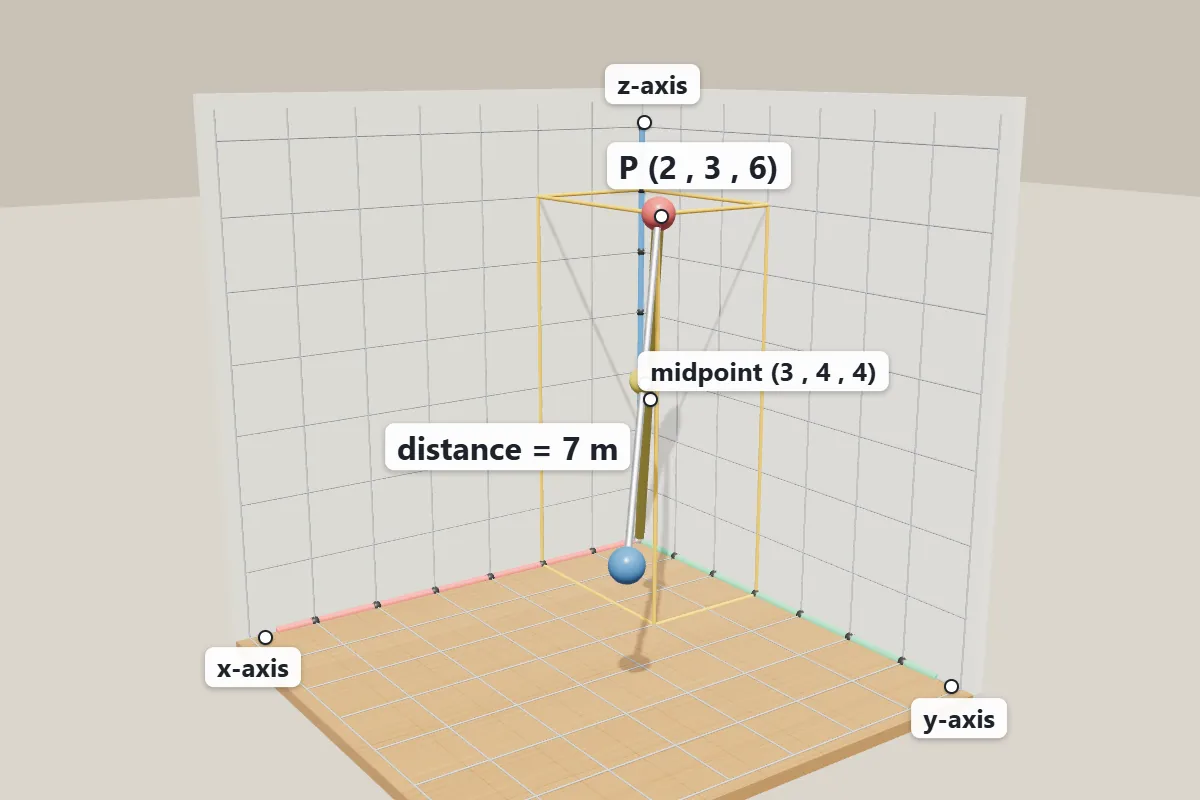
For A(x1,y1,z1) and B(x2,y2,z2)AB=(x2−x1)2+(y2−y1)2+(z2−z1)2
It comes from applying Pythagoras’ theorem twicefirst in the horizontal plane, then with the vertical difference.
✍️ Worked examples
- Example 2 Show that the triangle , , is right-angled at .
- Solution:
- .
- .
- .
- , so the angle at is .
- Example 3 Show that , , form an equilateral triangle and find its area.
- Solution:
- , , .
- All sides are equal, so it is equilateral.
- Area square units.
- Example 4 Find if the triangle with vertices , , is equilateral.
- Solution:
- Let the points be , , . .
- and , so for every (the triangle is always isosceles).
- Equilateral requires , so and .
The 3D Coordinate System and Vectors in Space · 3 / 15
3-1 (c) The midpoint of a segment
3-1 (c) The midpoint of a segment
Rule
The midpoint of AB is M=(x1+x22, y1+y22, z1+z22)
✍️ Worked examples
- Example 5 Find the midpoint of for and .
- Solution:
- .
- Example 6 is the midpoint of and . Find .
- Solution:
- , , .
- So , , and .
- Shortcut the end point is B=2C−A.
- Example 7 is the midpoint of with . Find .
- Solution:
- .
- A common error is to take or to halve instead of doubling.
The 3D Coordinate System and Vectors in Space · 4 / 15
3-2 (a) Position vectors and components
3-2 (a) Position vectors and components
Definitions
- The position vector of is the directed segment from the origin to , written .
- , , are the components of the vector along the three axes.
- The norm (magnitude) of A⃗ is its length ∥A⃗∥=Ax2+Ay2+Az2
- Example for A⃗=(2,3,1) the norm is 14 and for B⃗=(0,4,−3) it is 5.
- A vector with one zero component lies in a coordinate plane; for example above lies in the -plane.
The 3D Coordinate System and Vectors in Space · 5 / 15
3-2 (b) Operations on vectors
3-2 (b) Operations on vectors
Addition
For A⃗=(Ax,Ay,Az) and B⃗=(Bx,By,Bz)A⃗+B⃗=(Ax+Bx, Ay+By, Az+Bz)
Propertiesclosure, commutative (A⃗+B⃗=B⃗+A⃗), associative, the zero vector 0⃗=(0,0,0) is the identity, and −A⃗=(−Ax,−Ay,−Az) is the additive inverse.
- .
- If the direction is unchanged; if it is reversed; the norm is multiplied by .
- Properties (k+l)A⃗=kA⃗+lA⃗, k(A⃗+B⃗)=kA⃗+kB⃗, k(lA⃗)=(kl)A⃗.
✍️ Worked examples
- Example 8 For and find and the vector with .
- Solution:
- .
- .
- .
- if and only if , and .
✍️ Worked examples
- Example 9 Find , , if .
- Solution:
- gives .
- gives .
- gives .
- Example 10 Find and if .
- Solution:
- gives .
- gives .
The 3D Coordinate System and Vectors in Space · 6 / 15
3-2 (c) Unit vectors and the basis i^, j^, k^
3-2 (c) Unit vectors and the basis i^, j^, k^
The fundamental unit vectors
- , and have norm 1 along the positive , and axes.
Every vector can be written A⃗=Axi+Ayj+Azk^
- For example and .
✍️ Worked examples
- Example 11 For and find , then compare with .
- Solution:
- and , so .
- , with norm .
- .
- So . In general , with equality only when the vectors point the same way.
- A unit vector has norm 1.
- The unit vector in the direction of is
- For A⃗=(−2,2,1) ∥A⃗∥=3, so uA=(−23,23,13).
- A vector of norm in the direction of is ; the opposite direction uses .
The 3D Coordinate System and Vectors in Space · 7 / 15
3-2 (d) The vector between two points
3-2 (d) The vector between two points
Rule
- , because .
- Always "end minus start"; also .
- equals the distance .
✍️ Worked examples
- Example 12 For and find and .
- Solution:
- .
- .
- Example 13 If and , find .
- Solution:
- .
- Example 14 Find the unit vector in the direction of for and .
- Solution:
- , with norm .
- .
The 3D Coordinate System and Vectors in Space · 8 / 15
Definitions
Definitions
- Let , , be the angles a vector makes with the positive , , axes.
- They are the direction angles; , , are the direction cosines, often written , , .
- The components are , , .
- So the unit vector is , and therefore
- Each direction angle lies between and .
✍️ Worked examples
- Example 15 Find the direction cosines and angles of .
- Solution:
- .
- Direction cosines 13, 23, 23 (their squares add to 1+4+49=1).
- Angles cos−113≈70.5∘, and cos−123≈48.2∘ twice.
- Example 16 A force of 10 N makes angles of with and with and an acute angle with . Write it in component form.
- Solution:
- gives , so and .
- N.
- Example 17 A vector of norm 5 makes equal angles with the three positive axes. Write it in component form.
- Solution:
- Equal angles give , so and .
- .
- Example 18 Resolve a vector of norm 10 making with , whose projection on the -plane makes with .
- Solution:
- and the projection on the -plane has length .
- and .
- .
- Direction angles cos−12.2010≈77.3∘, cos−16.0410≈52.8∘, 40∘.
The 3D Coordinate System and Vectors in Space · 9 / 15
Useful facts
Useful facts
- A vector parallel to the -plane has .
- A vector along the -axis has the form and norm .
- For A⃗=(k,0,0) ∥A⃗∥=∣k∣.
- If the norm is known, e.g. with , then , so .
The 3D Coordinate System and Vectors in Space · 10 / 15
📌 Comprehensive Scientific Terminology & Definitions:
📌 Comprehensive Scientific Terminology & Definitions:
- 3D Cartesian Coordinate Frame (نظام الإحداثيات المتعامد ثلاثي الأبعاد): Defined by three mutually perpendicular axes (X, Y, Z) intersecting at origin O(0,0,0), satisfying the Right-Hand Rule, partitioning space into eight octants.
- Coordinate Planes and Projections (المستويات الإحداثية) XY-plane (z = 0); YZ-plane (x = 0); XZ-plane (y = 0). Distance from point P(x, y, z) to XY-plane is |z|; distance to z-axis is √(x2 + y2).
- Position Vector & Direction Cosines (متجه الموضع وجيوب تمام الاتجاه): Vector A = (Ax, Ay, Az) with magnitude |A| = √(Ax2 + Ay2 + Az2).
- Direction angles (α, β, γ) made with positive X, Y, Z axes yield direction cosines: cos α = Ax/|A|, cos β = Ay/|A|, cos γ = Az/|A|.
| Comparison aspect | Main idea | Keywords |
|---|---|---|
| Unit Vector (متجه الوحدة) | A vector of magnitude 1: uA = A / |A| = (cos α, cos β, cos γ), satisfying cos2 α + cos2 β + cos2 γ = 1. | magnitudesatisfyingcos2 |
| Standard Equation of a Sphere (معادلة الكرة في الفراغ) |
| centeredradiusGeneralform |
The 3D Coordinate System and Vectors in Space · 11 / 15
⚖️ Governing Scientific Laws, Principles & Mathematical Formulas:
⚖️ Governing Scientific Laws, Principles & Mathematical Formulas:
(‘Fundamental Direction Cosines Identitycos2 α + cos2 β + cos2 γ = 1; Consequently, sin2 α + sin2 β + sin2 γ = 2.’,)
(‘Distance Between Two Points in 3DAB = √[(x₂ – x₁)2 + (y₂ – y₁)2 + (z₂ – z₁)2].’,)
(‘Internal Division of a Line SegmentPoint P dividing AB in ratio m₁ : m₂ has coordinates x = (m₁x₂ + m₂x₁) / (m₁ + m₂), similarly for y and z.’,)
(‘Condition for Real SphereL2 + M2 + N2 – D > 0 (if = 0 it represents a point; if < 0 it represents an imaginary set).',)
The 3D Coordinate System and Vectors in Space · 12 / 15
🔍 In-Depth Explanations, Deductions & Core Concepts:
🔍 In-Depth Explanations, Deductions & Core Concepts:
| Comparison aspect | Main idea | Keywords |
|---|---|---|
| Why cos2 α + cos2 β + cos2 γ = 1 |
| Becauseunitvectormagnitude |
| Distance from P(x, y, z) to the coordinate axes |
| axisderivedPythagoreantheorem |
| Sphere tangent to the coordinate planes |
| touchesthreepositivecenter |
The 3D Coordinate System and Vectors in Space · 13 / 15
📊 Distances and Equations Associated with Point P(a, b, c) in Space:
📊 Distances and Equations Associated with Point P(a, b, c) in Space:
| Target Geometric Entity | Geometric Formula / Equation | Significance in Secondary 3 Exam |
|---|---|---|
| Distance to XY-Plane | d = |c| | Depends solely on the absolute z-coordinate |
| Distance to YZ-Plane | d = |a| | Depends solely on the absolute x-coordinate |
| Distance to XZ-Plane | d = |b| | Depends solely on the absolute y-coordinate |
| Distance to X-Axis | d = √(b2 + c2) | Pythagorean norm of y and z components |
| Distance to Y-Axis | d = √(a2 + c2) | Pythagorean norm of x and z components |
| Distance to Z-Axis | d = √(a2 + b2) | Pythagorean norm of x and y components |
The 3D Coordinate System and Vectors in Space · 14 / 15
💡 High-Yield Exam Traps & Key Takeaways:
💡 High-Yield Exam Traps & Key Takeaways:
| Comparison aspect | Main idea | Keywords |
|---|---|---|
| Exam Trap |
| confusedirectionratioscosines |
| Quick Identity | sin2 α + sin2 β + sin2 γ = (1 – cos2 α) + (1 – cos2 β) + (1 – cos2 γ) = 3 – 1 = 2 | sin2cos2 |
The 3D Coordinate System and Vectors in Space · 15 / 15
Well done! You finished this lesson
What would you like to do next?