Curriculum
Mathematics
Unit 1
0/12
1.1Key terms1.2Laws and key relationships1.3Rigorous Derivation of Reciprocal Trigonometric Functions1.4Logarithmic and General Exponential Differentiation Techniques1.5Parametric and Implicit Second-Order Derivatives1.6Worked examples1.7Exam tips1.8Real-world applications1.9Key Scientific Tables & Anatomical Diagrams Extracted from Official Curricula1.10📌 Comprehensive Scientific Terminology Dictionary:1.11🔍 In-Depth Explanations, Deductions & Multi-Book Insights:1.12Lesson summary
Unit 2
0/141.1The counting principle1.2Permutations (nPr)1.3Combinations (nCr)1.4Worked examples on counting, permutations and combinations1.5Recall: counting principle, permutations and combinations1.61-1 (a) Pascal's triangle and the binomial expansion1.71-1 (b) The general term1.81-1 (c) The middle term1.91-2 The term containing xk and the term free of x1.101-3 (a) The ratio between two consecutive terms1.111-3 (b) The greatest term1.12Key Scientific Tables & Anatomical Diagrams Extracted from Official Curricula1.13Lesson 1 - Counting Principle, Permutations and Combinations and the Binomial Theorem1.14Lesson summary
Unit 3
0/131.1Key terms1.2Laws and key relationships1.3Geometry of 3D Vectors and Scalar/Cross Product Physics1.4Equations of Straight Lines in Three Dimensions1.5Equations of Planes and Perpendicular Distance Formulas1.6Worked examples1.7Exam tips1.8Real-world applications1.9Key Scientific Tables & Anatomical Diagrams Extracted from Official Curricula1.10📌 Comprehensive Scientific Terminology Dictionary:1.11⚖️ Governing Physical Laws & Mathematical Relations:1.12🔍 In-Depth Explanations, Deductions & Multi-Book Insights:1.13Lesson summary
Unit 4
0/81.11 Smooth and rough surfaces1.22 Properties of the static friction force1.33 Kinetic friction force1.44 The resultant reaction R′1.55 The angle of friction1.66 Equilibrium of a body on a rough horizontal plane1.77 Equilibrium of a body on a rough inclined plane1.88 Conditions of equilibrium and rigid bodies with friction
Unit 5
0/121.13-1 (a) Indefinite integrals of exponential functions1.23-1 (b) Indefinite integrals of logarithmic functions1.33-2 (a) The differential and the standard integrals1.43-2 (b) Integration by substitution1.53-2 (c) Integration by parts1.63-2 (d) Applications of the indefinite integral1.73-3 (a) The definite integral and the fundamental theorem of calculus1.83-3 (b) Properties of the definite integral1.93-3 (c) Definite integral by substitution, odd and even functions1.103-4 (a) Area of a plane region1.113-4 (b) Volumes of solids of revolution1.12Key Scientific Tables & Anatomical Diagrams Extracted from Official Curricula
Unit 6
0/81.12-1 (a) Polar coordinates and the Argand plane1.22-1 (b) Modulus, amplitude and principal amplitude1.32-1 (c) The trigonometric (polar) form of a complex number1.42-1 (d) Product and quotient in trigonometric form1.52-1 (e) The exponential (Euler) form1.62-2 (a) De Moivre's theorem for a positive integer power1.72-2 (b) De Moivre's theorem for a rational power and the roots of a complex number1.82-3 The cube roots of unity
Unit 7
0/101.11 Momentum and its change1.22 Newton's first law, inertia and force1.33 Newton's second law, the equation of motion and variable mass1.44 Newton's third law, lifts and scales1.55 Bodies connected by a string over a smooth pulley1.66 Impulse1.77 Work1.88 Kinetic energy and the work-energy principle1.99 Potential energy and conservation of energy1.1010 Power
Text lesson
The Vector (Cross) Product and the Scalar Triple Product
The Vector (Cross) Product and the Scalar Triple Product
Overview
Overview
- This lesson covers the second part of lesson 3-3, "Vector multiplication". After it you should be able to:
- define and calculate the cross product and apply the right-hand rule;
- use it for parallelism, perpendicular vectors, and areas of parallelograms and triangles;
- calculate the scalar triple product and use it for volumes and coplanarity.
🌳 Concept tree
- The Vector (Cross) Product and the Scalar Triple Product
├── 3-3 (g) Definition of the vector product
│ ├── Definition
│ ├── Direction→the right-hand rule
│ ├── The unit vectors
│ └── Norm of the product
├── 3-3 (h) The cross product in components
│ └── Determinant form
├── 3-3 (i) Properties of the vector product
│ └── List
├── 3-3 (j) Parallel vectors
│ └── Condition
├── 3-3 (k) Geometric meaning→areas
│ ├── Parallelogram and triangle
│ └── Link with mechanics
├── 3-3 (l) The scalar triple product
│ ├── Definition
│ ├── Determinant form
│ └── Properties
└── 3-3 (m) Geometric meaning→volume
├── Parallelepiped and tetrahedron
└── Summary
The Vector (Cross) Product and the Scalar Triple Product · 1 / 14
3-3 (g) Definition of the vector product
3-3 (g) Definition of the vector product
Definition
- Let and be two vectors in space with angle between them ().
- Their vector product (cross product) is
- is the unit vector perpendicular to the plane containing and .
- The result is a vector, in contrast with the scalar product which is a number.
Direction: the right-hand rule
- Curl the fingers of the right hand from the first vector towards the second vector through the smaller angle.
- The thumb points along , the direction of .
- Swapping the order reverses the direction B⃗×A⃗=−(A⃗×B⃗).
The unit vectors
| Comparison aspect | Main idea | Keywords |
|---|---|---|
| For a right-handed system |
| |
| In the reverse order the sign changes |
| |
| • | . |
Norm of the product
- .
- It is zero when the vectors are parallel ( or ) and largest when they are perpendicular.
✍️ Worked examples
- Example 1 Two vectors in a plane have norms and and the angle between them is . Find .
- Solution:
- .
- Example 2 If , and , find the angle between them.
- Solution:
- The norm of the product is , so .
- , so or .
- The minus sign only says that points the other way; it does not affect the angle.
The Vector (Cross) Product and the Scalar Triple Product · 2 / 14
3-3 (h) The cross product in components
3-3 (h) The cross product in components
Determinant form
| Comparison aspect | Main idea | Keywords |
|---|---|---|
| For A⃗=(Ax,Ay,Az) and B⃗=(Bx,By,Bz) | A⃗×B⃗=∣ijk^AxAyAzBxByBz∣ =(AyBz−AzBy) i^−(AxBz−AzBx) j^+(AxBy−AyBx) k^ | AxAyAzBxByBzAyBzAzByAxBz |
| • | The middle term has a minus sign from expanding along the first row | middletermminussign |
| In the xy-plane (Az=Bz=0) only the last term survives | A⃗×B⃗=(AxBy−AyBx) k^ | AxByAyBx |
✍️ Worked examples
- Example 3 Find for and , and a unit vector perpendicular to both.
- Solution:
- i^ coefficient 3×4−1×2=10.
- j^ coefficient −[(−2)(4)−(1)(1)]=−(−9)=9.
- k^ coefficient (−2)(2)−(3)(1)=−7.
- , with norm .
- Unit vector perpendicular to the plane 1230(10,9,−7) (the opposite vector also works).
- Example 4 Find a unit vector perpendicular to the plane of and .
- Solution:
- i^ (−3)(−3)−(1)(2)=7.
- j^ −[(2)(−3)−(1)(−1)]=−(−5)=5.
- k^ (2)(2)−(−3)(−1)=1.
- and its norm is .
- Unit vector 153(7,5,1).
- Check (7,5,1)⋅A⃗=14−15+1=0 and (7,5,1)⋅B⃗=−7+10−3=0.
- Example 5 For and in the plane, find .
- Solution:
- (3)(4)−(2)(1)=10, so A⃗×B⃗=10 k^ the product points along the positive z-axis, since B⃗ is anticlockwise from A⃗.
- Example 6:
- is a square of side 12 cm, labelled anticlockwise, and is the unit vector perpendicular to its plane (out of the page).
- Find and .
- Solution:
- The angle between and is and .
- .
- AB→⊥BC→ AB→×BC→=12×12×1 e^=144 e^.
The Vector (Cross) Product and the Scalar Triple Product · 3 / 14
3-3 (i) Properties of the vector product
3-3 (i) Properties of the vector product
List
| Comparison aspect | Main idea | Keywords |
|---|---|---|
| Anti-commutative | (so it is not commutative). | |
| Distributive | . | |
| Scalars | . | |
| Self product | . | |
| Perpendicular to both | is perpendicular to and to , so . | |
| Zero product | means , or one of them is the zero vector. | meansthemvector |
| The cross product is not associative in general | (A⃗×B⃗)×C⃗≠A⃗×(B⃗×C⃗) |
The Vector (Cross) Product and the Scalar Triple Product · 4 / 14
3-3 (j) Parallel vectors
3-3 (j) Parallel vectors
Condition
- Two non-zero vectors are parallel if and only if , that is
- Equivalent form A⃗=kB⃗. If k>0 they have the same direction; if k<0 they are opposite.
- If a component of is zero, the matching component of must also be zero.
✍️ Worked examples
- Example 7 Find and if is parallel to .
- Solution:
- .
- gives .
- gives .
- The vectors are in the same direction since the ratio is positive.
- Example 8 A vector is parallel to and . Find .
- Solution:
- and , so .
- or .
- Example 9 Decide whether and are parallel, perpendicular, or neither.
- Solution:
- Ratios −2−8=14, 1−4=−14: not equal, so not parallel.
- Dot product 16−4+16=28≠0, so not perpendicular.
- They are neither.
The Vector (Cross) Product and the Scalar Triple Product · 5 / 14
3-3 (k) Geometric meaning: areas
3-3 (k) Geometric meaning: areas
Parallelogram and triangle
- Let and be adjacent sides of a parallelogram. Its height is above the base .
- Hence
- For a triangle ABC area =12∥AB→×AC→∥.
✍️ Worked examples
| Comparison aspect | Main idea | Keywords |
|---|---|---|
| Example 10 | Find the area of the parallelogram with adjacent sides and . | Findareaparallelogramadjacent |
| • | Solution | Solution |
| i^ | (1)(−1)−(2)(4)=−9 | |
| j^ | −[(−3)(−1)−(2)(3)]=−(3−6)=3 | |
| k^ | (−3)(4)−(1)(3)=−15 | |
| • | and the norm is . | norm |
| • | Area square units. | Areasquareunits |
| Example 11 | Find the area of the triangle whose two sides are and . | Findareatrianglewhose |
| • | Solution | Solution |
| i^ | (2)(−1)−(−4)(5)=18 | |
| j^ | −[(1)(−1)−(−4)(0)]=1 | |
| k^ | (1)(5)−(2)(0)=5 | |
| Norm | 324+1+25=350=514 | |
| • | Area square units. | Area5142squareunits |
| Example 12 | Find the area of triangle with , , . | Findareatriangle |
| • | Solution | Solution |
| • | and . | |
| AB→×AC→ |
| |
| Norm | 36+4+36=76=219 | |
| • | Area square units. | Areasquareunits |
Link with mechanics
- The moment of a force about a point is , where points from the point to the line of action.
- Its magnitude is the force times the perpendicular distance.
The Vector (Cross) Product and the Scalar Triple Product · 6 / 14
3-3 (l) The scalar triple product
3-3 (l) The scalar triple product
Definition
- For three vectors , , the scalar triple product is
- The brackets are essential in the sense that is calculated first (the other order, , is meaningless since is a number).
- The result is a number.
- If , , , then
- Cyclic permutation keeps the value A⃗⋅(B⃗×C⃗)=B⃗⋅(C⃗×A⃗)=C⃗⋅(A⃗×B⃗).
- Interchanging two vectors changes the sign (two rows of the determinant swap).
- , so the dot and the cross may be exchanged.
- If two of the vectors are equal or parallel, the product is zero.
- If the three vectors lie in one plane (coplanar), the product is zero, and conversely.
✍️ Worked examples
- Example 13 Calculate for , , .
- Solution:
- Determinant 2[3(−2)−2(1)]−1[(−1)(−2)−2(1)]+3[(−1)(1)−3(1)].
- .
- Example 14 Show that , , are coplanar.
- Solution:
- Note that .
- Determinant 1[1×7−4×3]−2[0×7−4×1]+3[0×3−1×1]=−5+8−3=0.
- The triple product is zero, so the vectors are coplanar.
The Vector (Cross) Product and the Scalar Triple Product · 7 / 14
Parallelepiped and tetrahedron
Parallelepiped and tetrahedron
- If , , are three non-coplanar edges meeting at a vertex of a parallelepiped, then
- Reason ∥B⃗×C⃗∥ is the area of the base and the component of A⃗ perpendicular to the base is the height.
- A tetrahedron on the same three edges has volume .
- The absolute value matters the sign only shows whether the three vectors form a right-handed or left-handed set.
✍️ Worked examples
- Example 15 Find the volume of the parallelepiped with edges , , .
- Solution:
- The triple product is (Example 13).
- cubic units.
- Example 16 Find the volume of the parallelepiped with edges , , .
- Solution:
- Determinant 3[2×2−3×2]−4[0×2−3×3]+1[0×2−2×3].
- .
- Volume cubic units.
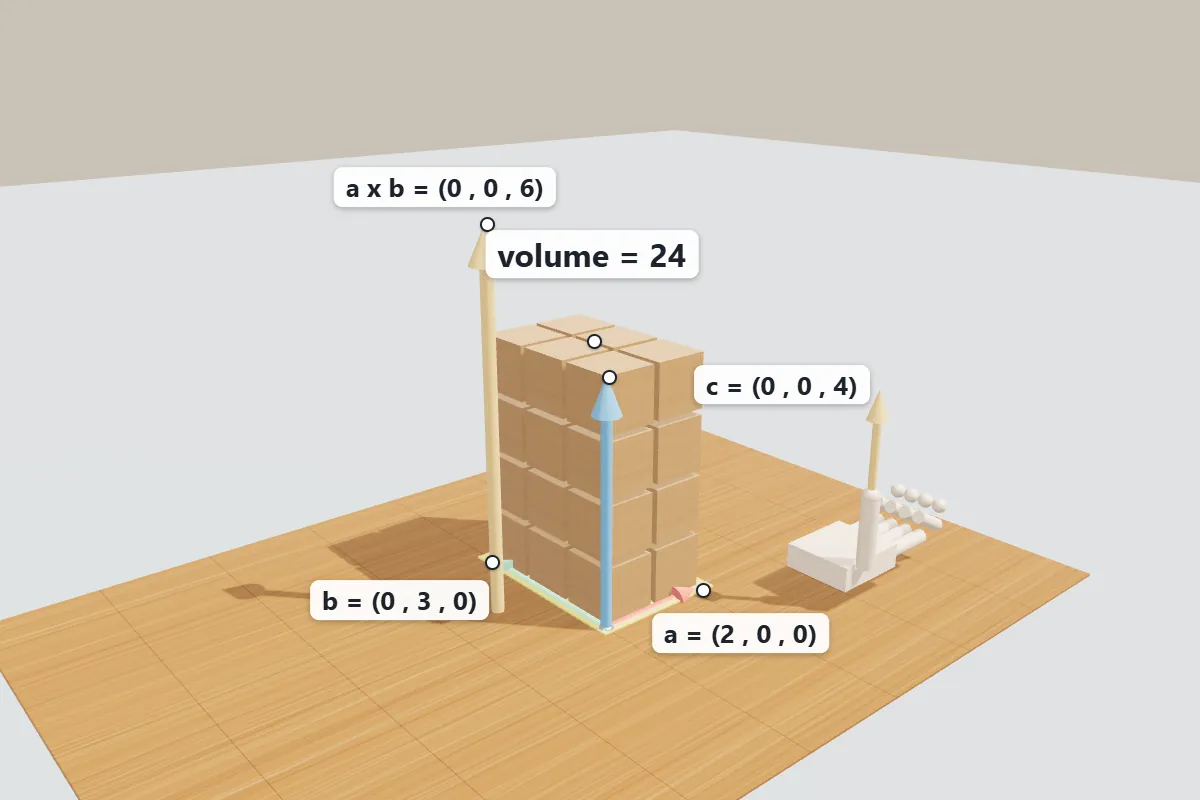
- Example 17 Find the volume of the tetrahedron with vertices , , , .
- Solution:
- Edges from O (2,0,0), (0,3,0), (0,0,4); the determinant is 2×3×4=24.
- Volume cubic units.
- Example 18 Find such that the points , , , are in one plane.
- Solution:
- Vectors from A AB→=(−1,1,0), AC→=(−1,0,1), AD→=(k−1,k,k).
- Triple product −1[0⋅k−1⋅k]−1[(−1)k−1(k−1)]+0=k−(−2k+1)⋅1=3k−1. Setting it to zero gives k=13.
- The four points are coplanar for (the point then lies on the plane ).
The Vector (Cross) Product and the Scalar Triple Product · 8 / 14
Summary
Summary
| Point of comparison | Scalar product | Vector product | Scalar triple product |
|---|---|---|---|
| Result | number | vector | number |
| Formula | |||
| Order | commutative | anti-commutative | sign changes if two swap |
| Zero when | vectors perpendicular | vectors parallel | vectors coplanar |
| Gives | angle, component, work | area, perpendicular vector, moment | volume of a parallelepiped |
The Vector (Cross) Product and the Scalar Triple Product · 9 / 14
📌 Comprehensive Scientific Terminology & Definitions:
📌 Comprehensive Scientific Terminology & Definitions:
| Comparison aspect | Main idea | Keywords |
|---|---|---|
| Vector / Cross Product (الضرب الاتجاهي) |
| operationtakingvectorsspace |
| Determinant Expansion Form | A × B = | i j k; Ax Ay Az ; Bx By Bz | = (Ay Bz – Az By) i – (Ax Bz – Az Bx) j + (Ax By – Ay Bx) k. | |
| Condition for Parallelism (التوازي) | Two non-zero vectors A and B are parallel (A ∥ B) if and only if A × B = 0 (since sin 0° = sin 180° = 0), or equivalently their components are proportional: Ax/Bx = Ay/By = Az/Bz = k. | zerovectorssinceequivalently |
| Geometric Area Interpretations |
| Magnitudeequalsparallelogramformed |
Scalar Triple Product (الضرب الثلاثي القياسي)→A · (B × C) represented by 3×3 determinant: | Ax Ay Az ; Bx By Bz ; Cx Cy Cz |, whose absolute value equals the volume of the parallelepiped formed by coterminous edges A, B, and C.
The Vector (Cross) Product and the Scalar Triple Product · 10 / 14
⚖️ Governing Scientific Laws, Principles & Mathematical Formulas:
⚖️ Governing Scientific Laws, Principles & Mathematical Formulas:
| Comparison aspect | Main idea | Keywords |
|---|---|---|
| (‘Anti-Commutative Property | A × B = – (B × A).’ | |
| (‘Parallelogram Area |
| Triangle |
| (‘Parallelepiped Volume |
| Tetrahedron |
| (‘Coplanar Vectors Condition | and C lie in the same geometric plane if and only if A · (B × C) = 0.’ | samegeometricplane |
| (“Lagrange’s Identity | |A × B|2 + (A · B)2 = |A|2 |B|2.” |
The Vector (Cross) Product and the Scalar Triple Product · 11 / 14
🔍 In-Depth Explanations, Deductions & Core Concepts:
🔍 In-Depth Explanations, Deductions & Core Concepts:
| Comparison aspect | Main idea | Keywords |
|---|---|---|
| Why the cross product is anti-commutative |
| Swappingvectorsreversesdirection |
| Right-hand cyclical rules for standard unit vectors |
| reversingcycleyieldsnegative |
| Physical application to Moment of a Force (عزم القوة) |
| vectorpointpositionline |
The Vector (Cross) Product and the Scalar Triple Product · 12 / 14
📊 Comparison Between Dot Product and Cross Product in 3D Space:
📊 Comparison Between Dot Product and Cross Product in 3D Space:
| Property / Metric | Scalar (Dot) Product: A · B | Vector (Cross) Product: A × B |
|---|---|---|
| Result Type | Scalar (real number) | Vector (perpendicular to A and B) |
| Trigonometric Kernel | |A| |B| cos θ | |A| |B| sin θ n (Right-Hand Rule) |
| Commutativity | Commutative: A · B = B · A | Anti-commutative: A × B = -(B × A) |
| Zero Test Condition | A ⊥ B ⟺ A · B = 0 | A ∥ B ⟺ A × B = 0 |
| Physical Application | Mechanical Work: W = F · s | Moment / Torque: M = r × F |
The Vector (Cross) Product and the Scalar Triple Product · 13 / 14
💡 High-Yield Exam Traps & Key Takeaways:
💡 High-Yield Exam Traps & Key Takeaways:
| Comparison aspect | Main idea | Keywords |
|---|---|---|
| Lagrange Identity Trick |
| givenfindimmediatelyusing |
| Coplanar vectors trap |
| fourpointsgiventest |
The Vector (Cross) Product and the Scalar Triple Product · 14 / 14
Well done! You finished this lesson
What would you like to do next?