Curriculum
Mathematics
Unit 1
0/12
1.1Key terms1.2Laws and key relationships1.3Rigorous Derivation of Reciprocal Trigonometric Functions1.4Logarithmic and General Exponential Differentiation Techniques1.5Parametric and Implicit Second-Order Derivatives1.6Worked examples1.7Exam tips1.8Real-world applications1.9Key Scientific Tables & Anatomical Diagrams Extracted from Official Curricula1.10📌 Comprehensive Scientific Terminology Dictionary:1.11🔍 In-Depth Explanations, Deductions & Multi-Book Insights:1.12Lesson summary
Unit 2
0/141.1The counting principle1.2Permutations (nPr)1.3Combinations (nCr)1.4Worked examples on counting, permutations and combinations1.5Recall: counting principle, permutations and combinations1.61-1 (a) Pascal's triangle and the binomial expansion1.71-1 (b) The general term1.81-1 (c) The middle term1.91-2 The term containing xk and the term free of x1.101-3 (a) The ratio between two consecutive terms1.111-3 (b) The greatest term1.12Key Scientific Tables & Anatomical Diagrams Extracted from Official Curricula1.13Lesson 1 - Counting Principle, Permutations and Combinations and the Binomial Theorem1.14Lesson summary
Unit 3
0/131.1Key terms1.2Laws and key relationships1.3Geometry of 3D Vectors and Scalar/Cross Product Physics1.4Equations of Straight Lines in Three Dimensions1.5Equations of Planes and Perpendicular Distance Formulas1.6Worked examples1.7Exam tips1.8Real-world applications1.9Key Scientific Tables & Anatomical Diagrams Extracted from Official Curricula1.10📌 Comprehensive Scientific Terminology Dictionary:1.11⚖️ Governing Physical Laws & Mathematical Relations:1.12🔍 In-Depth Explanations, Deductions & Multi-Book Insights:1.13Lesson summary
Unit 4
0/81.11 Smooth and rough surfaces1.22 Properties of the static friction force1.33 Kinetic friction force1.44 The resultant reaction R′1.55 The angle of friction1.66 Equilibrium of a body on a rough horizontal plane1.77 Equilibrium of a body on a rough inclined plane1.88 Conditions of equilibrium and rigid bodies with friction
Unit 5
0/121.13-1 (a) Indefinite integrals of exponential functions1.23-1 (b) Indefinite integrals of logarithmic functions1.33-2 (a) The differential and the standard integrals1.43-2 (b) Integration by substitution1.53-2 (c) Integration by parts1.63-2 (d) Applications of the indefinite integral1.73-3 (a) The definite integral and the fundamental theorem of calculus1.83-3 (b) Properties of the definite integral1.93-3 (c) Definite integral by substitution, odd and even functions1.103-4 (a) Area of a plane region1.113-4 (b) Volumes of solids of revolution1.12Key Scientific Tables & Anatomical Diagrams Extracted from Official Curricula
Unit 6
0/81.12-1 (a) Polar coordinates and the Argand plane1.22-1 (b) Modulus, amplitude and principal amplitude1.32-1 (c) The trigonometric (polar) form of a complex number1.42-1 (d) Product and quotient in trigonometric form1.52-1 (e) The exponential (Euler) form1.62-2 (a) De Moivre's theorem for a positive integer power1.72-2 (b) De Moivre's theorem for a rational power and the roots of a complex number1.82-3 The cube roots of unity
Unit 7
0/101.11 Momentum and its change1.22 Newton's first law, inertia and force1.33 Newton's second law, the equation of motion and variable mass1.44 Newton's third law, lifts and scales1.55 Bodies connected by a string over a smooth pulley1.66 Impulse1.77 Work1.88 Kinetic energy and the work-energy principle1.99 Potential energy and conservation of energy1.1010 Power
Text lesson
Connected Bodies: Pulleys, Tables, Inclined Planes and Pulley Reaction
Connected Bodies: Pulleys, Tables, Inclined Planes and Pulley Reaction
Overview
Overview
- This lesson develops lesson 2-2 of the dynamics unit "Applications on Newton’s Laws of Motion".
- It goes beyond the vertical two-mass pulley and treats rough and inclined cases and the force on the pulley.
- After it you should be able to:
- write one equation of motion for each body and solve for the common acceleration and the tension;
- handle a string that is cut, a mass that is added or removed, and a body that hits the ground;
- find the force on the pulley and solve problems with friction and inclined planes.
🌳 Concept tree
Connected Bodies→Pulleys, Tables, Inclined Planes and Pulley Reaction
├── 2-2 (a) General method for connected bodies
│ ├── Assumptions
│ └── Steps
- ├── 2-2 (b) Two masses hanging over a smooth pulley
│ ├── Results
│ └── The pulley reaction
├── 2-2 (c) Adding, removing and cutting
│ ├── Extra mass on one side
│ ├── When the extra mass is removed
│ └── When the string is cut
- ├── 2-2 (d) A body on a smooth table joined to a hanging body
│ ├── Set-up
│ ├── Pulley reaction at a corner
│ └── With friction on the table
├── 2-2 (e) Inclined planes
- │ ├── Body on an incline joined to a hanging body
│ └── Equilibrium conditions
├── 2-2 (f) The force on an inclined pulley
│ └── Rule
- ├── 2-2 (g) Lifts and apparent weight (connected systems)
│ └── Forces in a lift
└── 2-2 (h) Summary
├── Comparison
└── Check list
Connected Bodies: Pulleys, Tables, Inclined Planes and Pulley Reaction · 1 / 15
2-2 (a) General method for connected bodies
2-2 (a) General method for connected bodies
Assumptions
- The string is light (negligible mass) and inextensible, so connected bodies move with the same speed and the same magnitude of acceleration.
- The pulley is small and smooth, so the tension is the same on both sides of it.
- The pulley itself is fixed, light, and frictionless unless stated otherwise.
- Draw a separate diagram for each body with all the forces on it (weight, tension, normal reaction, friction).
- Choose for each body the positive direction as the direction of its motion.
- Write the equation for each body; the unknowns are usually and .
- Solve the equations together (adding them eliminates ).
- Use the constant-acceleration formulas , , for the questions about time, distance and speed.
- If the string is cut, or a mass is removed, start a new stage of motion with the velocity reached as the initial velocity.
Connected Bodies: Pulleys, Tables, Inclined Planes and Pulley Reaction · 2 / 15
2-2 (b) Two masses hanging over a smooth pulley
2-2 (b) Two masses hanging over a smooth pulley
Results
- Let hang at the ends of the string. Equations: and .
- If the masses start level, after time each has moved in opposite directions, so they are apart vertically.
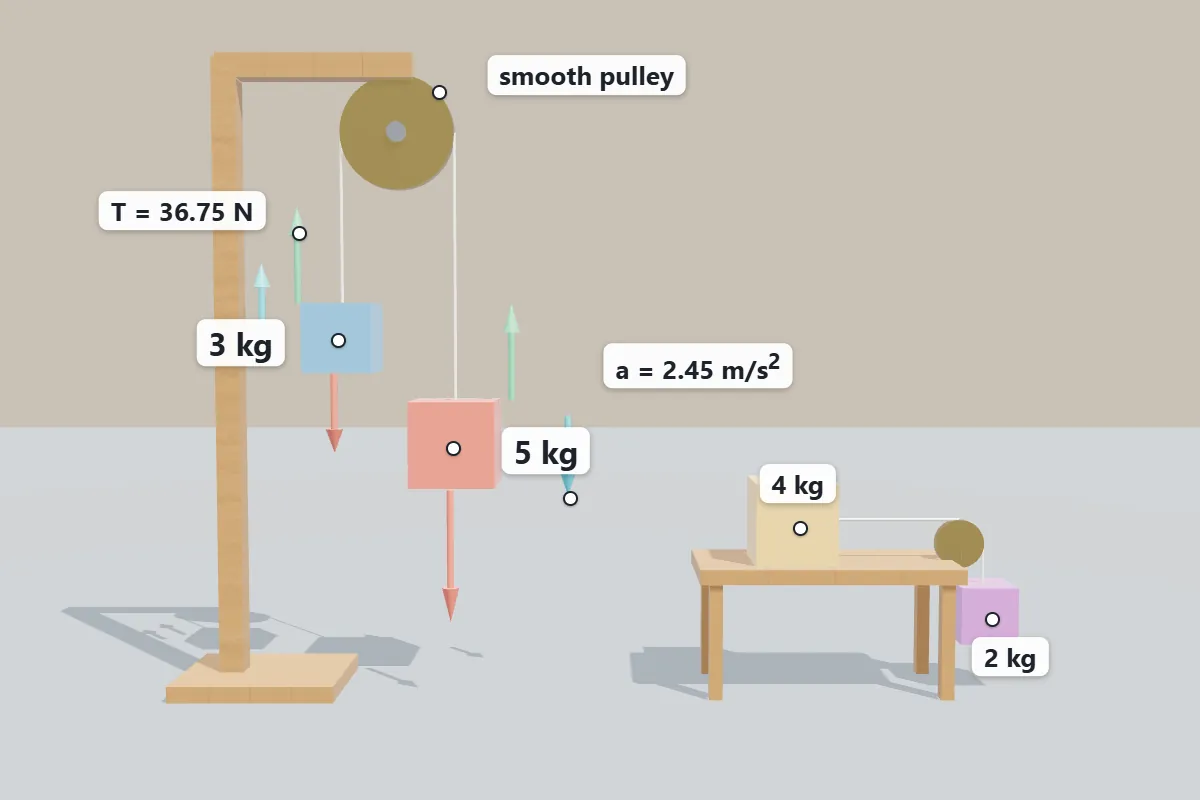
The pulley reaction
- The string pulls the pulley with on each side, both downward, so the force on the pulley’s axle is
- This is the pressure the pulley exerts on its support (the support’s reaction is equal and opposite).
- A light pulley’s own weight is ignored.
✍️ Worked examples
- Example 1:
- Masses 105 g and 70 g hang over a smooth pulley, level and at rest.
- Find the acceleration.
- If the heavier body hits the ground after falling 50 cm, find the total time until the lighter body first comes to rest instantaneously.
- Solution:
- cm/s.
- When the heavier mass lands v2=0+2(196)(50)=19 600, so v=140 cm/s, after t1=140196=57 s.
- The lighter mass then rises freely with initial speed 140 cm/s and deceleration : it stops after s.
- Total time s.
- Example 2:
- A 90 g mass and a 70 g mass hang from a string over a smooth pulley.
- The 90 g mass starts from rest 245 cm above the ground.
- Find (a) the time for it to reach the ground and (b) the time until the string becomes taut again.
- Solution:
- cm/s.
- (a) , so and s. Its speed on landing is cm/s.
- (b) The 70 g mass is then 245 cm above its start, moving up at 245 cm/s. The string goes slack and the mass moves freely under gravity.
- The string becomes taut when the 70 g mass has returned to the height of 245 cm, i.e. after s.
- That is 2.5 s from the beginning of the motion.
- Example 3 A 5 kg and a 3 kg mass hang level over a smooth pulley. Find , and the force on the pulley.
- Solution:
- m/s.
- N.
- Force on the pulley P=2T=73.5 N.
- Example 4 Two masses start level. After 1 s the vertical distance between them is 20 cm. Find .
- Solution:
- Each has moved 10 cm 10=12a(1)2, so a=20 cm/s2.
- , so .
- m2=48m1, so m1 m2=25:24.
Connected Bodies: Pulleys, Tables, Inclined Planes and Pulley Reaction · 3 / 15
2-2 (c) Adding, removing and cutting
2-2 (c) Adding, removing and cutting
Extra mass on one side
- If a mass m3 rests on m1 and m1+m3>m2 (m1+m3)a=(m1+m3)g−T and m2a=T−m2g.
- The tension in a string joining to (if tied rather than resting) is found from the equation of alone: .
- When equal masses hang on both sides and a small mass is added to one, .
- After removal the velocity is the velocity at that moment; the acceleration changes to the new value and may be negative (a deceleration).
- The system stops instantaneously if the new acceleration is a deceleration, then reverses.
- If the remaining masses are equal, the system continues at a constant velocity.
Each body then moves under gravity only→a=g downward, whatever its direction of motion.
✍️ Worked examples
- Example 5:
- A 30 g mass hangs on one side of a smooth pulley; two 20 g masses hang tied together on the other side.
- After 2 s one of the 20 g masses is removed.
- Find the total distance travelled by the 30 g mass until it first comes to rest.
- Solution:
- Stage 1 a=40−3070×980=140 cm/s2 (the 40 g side goes down).
- After 2 s v=280 cm/s and s1=12(140)(4)=280 cm.
- Stage 2 masses 30 g and 20 g with 30 g now heavier: a′=20−3050×980=−196 cm/s2.
- It comes to rest after cm.
- The 30 g mass rises cm before coming to rest, then reverses.
- Example 6:
- Masses 5 kg and 3 kg start level at 2.45 m above the ground and the string is cut after 1 s.
- Find the speed with which each strikes the ground.
- Solution:
- m/s; at the cut m/s and each has moved m.
- The 5 kg mass is m above the ground: , so m/s.
- The 3 kg mass is m above the ground and moving upward: take downward positive, , : , so m/s.
Connected Bodies: Pulleys, Tables, Inclined Planes and Pulley Reaction · 4 / 15
2-2 (d) A body on a smooth table joined to a hanging body
2-2 (d) A body on a smooth table joined to a hanging body
Set-up
- A mass on a smooth horizontal table is joined by a string over a pulley at the edge to a hanging mass .
- Equations T=m1a and m2g−T=m2a. a=m2m1+m2 g,T=m1m2m1+m2 g
- The table does not change the result because the normal reaction cancels the weight .
- At the table edge one part of the string is horizontal and one vertical, both with tension , so the resultant force on the pulley has magnitude
directed at below the horizontal (towards the line between the strings). - In general, if the two parts of the string make an angle with each other, .
✍️ Worked examples
- Example 7 A 3 kg mass on a smooth table is joined over a pulley to a hanging 2 kg mass. Find , and the force on the pulley.
- Solution:
- m/s.
- N.
- N.
- Friction on the table body is , opposing motion. The equations become and .
- The system moves only if (the hanging weight exceeds limiting friction).
✍️ Worked examples
- Example 8:
- A 4 kg block on a rough table () is joined to a hanging 3 kg mass.
- Find and .
- After the hanging mass has fallen 1 m, how far does the block slide further if the 3 kg mass lands and the table is long enough?
- Solution:
- m/s.
- N. Check on the block: .
- After 1 m v2=2(3.08)(1)=6.16.
- The string goes slack when the hanging mass lands; the block then decelerates with m/s.
- Further distance m.
Connected Bodies: Pulleys, Tables, Inclined Planes and Pulley Reaction · 5 / 15
2-2 (e) Inclined planes
2-2 (e) Inclined planes
Body on an incline joined to a hanging body
| Comparison aspect | Main idea | Keywords |
|---|---|---|
| • | A mass on a smooth incline of angle is connected by a string over a pulley at the top to a hanging mass . | masssmoothinclineangle |
| Component of weight along the plane |
| m1gsinnormalreactionm1gcos |
| If m2 moves down | m2g−T=m2a and T−m1gsinθ=m1a. a=m2−m1sinθm1+m2 g | m1gsinm1sin |
| With friction |
| timesnormalreactionopposes |
✍️ Worked examples
- Example 9 A 6 kg block on a smooth incline is joined over a pulley to a 4 kg hanging mass. Find and .
- Solution:
- m/s.
- N.
- Check on the block 35.28−6(9.8)(0.5)=35.28−29.4=5.88=6(0.98).
- Example 10 A 5 kg block on a rough incline with , and is joined over a pulley to a hanging 5 kg mass. Find and .
- Solution:
- Normal reaction 5g×45=4g; friction: 14×4g=g.
- Weight component along the plane 5g×35=3g.
- Net driving force 5g−3g−g=g, total mass 10 kg, so a=g10=0.98 m/s2.
- N.
- Check on the block T−3g−g=44.1−39.2=4.9=5(0.98).
- Example 11:
- Two masses on two smooth inclined planes meeting at a top edge carry a string over a pulley: a 10 kg mass on a plane with and a 5 kg mass on a plane with .
- Find and .
- Solution:
- Driving components 10g(0.6)=6g down the first plane and 5g(0.8)=4g down the second plane.
- The first body goes down a=6g−4g15=2g15=1.307 m/s2.
- N.
- Check on the first body 6g−T=58.8−45.73=13.07=10(1.307).
Equilibrium conditions
- A body on a rough incline is in limiting equilibrium with a hanging mass when (about to move up) or (about to move down).
Connected Bodies: Pulleys, Tables, Inclined Planes and Pulley Reaction · 6 / 15
2-2 (f) The force on an inclined pulley
2-2 (f) The force on an inclined pulley
Rule
- For a pulley at the top of an incline with one part of the string along the incline and the other vertical, the angle between the two parts is (measured on the side where they pull).
- Then .
- For θ=30∘ P=2Tcos30∘=3 T; with T=35.28 N from Example 9, P≈61.1 N.
- Check by components along the plane T and vertical T; the horizontal component of the pulley load is Tcos30∘ and the vertical component is T+Tsin30∘=1.5T, giving (0.866T)2+(1.5T)2=3 T.
Connected Bodies: Pulleys, Tables, Inclined Planes and Pulley Reaction · 7 / 15
2-2 (g) Lifts and apparent weight (connected systems)
2-2 (g) Lifts and apparent weight (connected systems)
Forces in a lift
| Comparison aspect | Main idea | Keywords |
|---|---|---|
| • | A person of mass in a lift pressing on the floor with force : | personmassliftpressing |
| lift accelerating upward with a |
| |
| lift accelerating downward with a |
| |
| constant velocity or at rest | N=mg | |
| For the lift plus person as one system with total mass M | the wire tension is T=M(g+a) going up (and M(g−a) going down) | wiretensiongoingdown |
| • | The tension in the wire is the sum of the weight-type forces, so it is also where is the lift’s own mass. | tensionwireweighttype |
✍️ Worked examples
- Example 12:
- A man of 70 kg is in a lift of mass 420 kg that accelerates upward at 0.7 m/s.
- Find the tension in the cable and the man’s pressure on the floor, in kg·wt.
- Solution:
- Man N=70(9.8+0.7)=735 N =75 kg·wt.
- Whole system T=490(9.8+0.7)=5145 N =525 kg·wt.
- Check with the lift alone T−420g−N=420(0.7) gives T=4116+735+294=5145 N.
- Example 13:
- A body is hung from a spring scale fixed to the roof of a lift.
- The scale reads 8 kg·wt when the lift rises with acceleration , and 5 kg·wt when the lift descends with acceleration .
- Find the mass and .
- Solution:
- Rising T−mg=ma, so 8g−mg=ma . . . (1).
- Descending mg−T=m(2a), so mg−5g=2ma . . . (2).
- Divide (2) by (1) m−58−m=2, so m−5=16−2m and m=7 kg.
- From (1) 7a=(8−7)g, so a=g7=1.4 m/s2.
Connected Bodies: Pulleys, Tables, Inclined Planes and Pulley Reaction · 8 / 15
Comparison
Comparison
| Point of comparison | Vertical pulley | Table and hanging body | Incline and hanging body |
|---|---|---|---|
| Acceleration | |||
| Tension | |||
| Force on pulley | |||
| With friction | not applicable | subtract in the numerator | subtract in the numerator |
Connected Bodies: Pulleys, Tables, Inclined Planes and Pulley Reaction · 9 / 15
Check list
Check list
- One equation per body, signs consistent with the direction of motion.
- The tension is the same throughout a light string over a smooth pulley, and the accelerations are equal in magnitude.
- When the string is cut or goes slack, change to (or on a rough table).
- Convert units before substituting (g with cm/s when masses are in grams and distances in cm).
Connected Bodies: Pulleys, Tables, Inclined Planes and Pulley Reaction · 10 / 15
📌 Comprehensive Scientific Terminology & Definitions:
📌 Comprehensive Scientific Terminology & Definitions:
| Comparison aspect | Main idea | Keywords |
|---|---|---|
| Atwood Machine / Vertical Pulley System (البكرات الملساء الرأسية) | Two masses m₁ and m₂ (m₁ > m₂) connected by a light inextensible string passing over a smooth fixed pulley: both move with common acceleration a = [(m₁ – m₂)g] / (m₁ + m₂) | massesconnectedlightinextensible |
| Smooth Horizontal Table System (حركة جسم على نضد أفقي أملس) |
| Massconnectedstringover |
| Rough Horizontal Table System (حركة جسم على نضد خشن) | Friction force fk = μ_k · N = μ_k · m₁ g opposes motion: a = [(m₂ – μ_k m₁)g] / (m₁ + m₂). | Frictionforceopposesmotion |
| Inclined Plane Pulley System (حركة على مستوى مائل) | Mass m₁ on inclined plane of angle α connected to hanging mass m₂: equation depends on comparing m₂ g with component of weight m₁ g sin α | Massangleconnectedhanging |
Pressure / Reaction on Pulley Axle (الضغط على محور البكرة)→Resultant force R exerted by string on the pulley: 1. Two vertical strings: R = 2T; 2. Horizontal and vertical strings: R = T√2; 3. Angle θ between strings: R = 2T cos(θ/2).
Connected Bodies: Pulleys, Tables, Inclined Planes and Pulley Reaction · 11 / 15
⚖️ Governing Scientific Laws, Principles & Mathematical Formulas:
⚖️ Governing Scientific Laws, Principles & Mathematical Formulas:
(‘Vertical Pulley Systema = [(m₁ – m₂) / (m₁ + m₂)] · g; T = [2 m₁ m₂ / (m₁ + m₂)] · g; Pressure on Pulley R = 2T.’,)
(‘Smooth Table Pulley Systema = [m₂ / (m₁ + m₂)] · g; T = [m₁ m₂ / (m₁ + m₂)] · g; Pressure on Pulley R = T√2.’,)
(‘Inclined Plane (Angle α) with Vertical Hanging Mass m₂a = [(m₂ – m₁ sin α) / (m₁ + m₂)] · g (for smooth plane).’,)
(‘General Pulley Pressure FormulaR = 2T cos(θ / 2), where θ is the angle between the two taut string segments.’,)
Connected Bodies: Pulleys, Tables, Inclined Planes and Pulley Reaction · 12 / 15
🔍 In-Depth Explanations, Deductions & Core Concepts:
🔍 In-Depth Explanations, Deductions & Core Concepts:
| Comparison aspect | Main idea | Keywords |
|---|---|---|
| Why acceleration is identical for both bodies |
| Becausestringinextensiblelength |
| What happens when the string is cut after time t (قطع الخيط) |
| bodiescontinuemovingacquired |
| • |
| Distancebetweenmassesvertical |
Connected Bodies: Pulleys, Tables, Inclined Planes and Pulley Reaction · 13 / 15
📊 Summary of Pulley Systems: Equations of Motion and Pressure on Axle:
📊 Summary of Pulley Systems: Equations of Motion and Pressure on Axle:
| System Configuration | Equation of Common Acceleration (a) | String Tension (T) | Resultant Pressure on Pulley (R) |
|---|---|---|---|
| Two Vertical Hanging Masses (m₁ > m₂) | a = (m₁ – m₂)g / (m₁ + m₂) | T = (2 m₁ m₂ g) / (m₁ + m₂) | R = 2T |
| Smooth Horizontal Table + Hanging m₂ | a = m₂ g / (m₁ + m₂) | T = (m₁ m₂ g) / (m₁ + m₂) | R = T √2 (acts at 45°) |
| Rough Horizontal Table (μ_k) + Hanging m₂ | a = (m₂ – μ_k m₁)g / (m₁ + m₂) | T = m₁ m₂ g (1 + μ_k) / (m₁ + m₂) | R = T √2 |
| Smooth Plane Inclined at α + Hanging m₂ | a = (m₂ – m₁ sin α)g / (m₁ + m₂) | T = [m₁ m₂ (1 + sin α)g] / (m₁ + m₂) | R = T √(2 + 2 sin α) = 2T cos(45° – α/2) |
Connected Bodies: Pulleys, Tables, Inclined Planes and Pulley Reaction · 14 / 15
💡 High-Yield Exam Traps & Key Takeaways:
💡 High-Yield Exam Traps & Key Takeaways:
| Comparison aspect | Main idea | Keywords |
|---|---|---|
| Exam Trap |
| findingverticalseparationbetween |
| String Cut Question |
| momentseveredtensionvanishes |
Connected Bodies: Pulleys, Tables, Inclined Planes and Pulley Reaction · 15 / 15
Well done! You finished this lesson
What would you like to do next?