Curriculum
Mathematics
Unit 1
0/12
1.1Key terms1.2Laws and key relationships1.3Rigorous Derivation of Reciprocal Trigonometric Functions1.4Logarithmic and General Exponential Differentiation Techniques1.5Parametric and Implicit Second-Order Derivatives1.6Worked examples1.7Exam tips1.8Real-world applications1.9Key Scientific Tables & Anatomical Diagrams Extracted from Official Curricula1.10📌 Comprehensive Scientific Terminology Dictionary:1.11🔍 In-Depth Explanations, Deductions & Multi-Book Insights:1.12Lesson summary
Unit 2
0/141.1The counting principle1.2Permutations (nPr)1.3Combinations (nCr)1.4Worked examples on counting, permutations and combinations1.5Recall: counting principle, permutations and combinations1.61-1 (a) Pascal's triangle and the binomial expansion1.71-1 (b) The general term1.81-1 (c) The middle term1.91-2 The term containing xk and the term free of x1.101-3 (a) The ratio between two consecutive terms1.111-3 (b) The greatest term1.12Key Scientific Tables & Anatomical Diagrams Extracted from Official Curricula1.13Lesson 1 - Counting Principle, Permutations and Combinations and the Binomial Theorem1.14Lesson summary
Unit 3
0/131.1Key terms1.2Laws and key relationships1.3Geometry of 3D Vectors and Scalar/Cross Product Physics1.4Equations of Straight Lines in Three Dimensions1.5Equations of Planes and Perpendicular Distance Formulas1.6Worked examples1.7Exam tips1.8Real-world applications1.9Key Scientific Tables & Anatomical Diagrams Extracted from Official Curricula1.10📌 Comprehensive Scientific Terminology Dictionary:1.11⚖️ Governing Physical Laws & Mathematical Relations:1.12🔍 In-Depth Explanations, Deductions & Multi-Book Insights:1.13Lesson summary
Unit 4
0/81.11 Smooth and rough surfaces1.22 Properties of the static friction force1.33 Kinetic friction force1.44 The resultant reaction R′1.55 The angle of friction1.66 Equilibrium of a body on a rough horizontal plane1.77 Equilibrium of a body on a rough inclined plane1.88 Conditions of equilibrium and rigid bodies with friction
Unit 5
0/121.13-1 (a) Indefinite integrals of exponential functions1.23-1 (b) Indefinite integrals of logarithmic functions1.33-2 (a) The differential and the standard integrals1.43-2 (b) Integration by substitution1.53-2 (c) Integration by parts1.63-2 (d) Applications of the indefinite integral1.73-3 (a) The definite integral and the fundamental theorem of calculus1.83-3 (b) Properties of the definite integral1.93-3 (c) Definite integral by substitution, odd and even functions1.103-4 (a) Area of a plane region1.113-4 (b) Volumes of solids of revolution1.12Key Scientific Tables & Anatomical Diagrams Extracted from Official Curricula
Unit 6
0/81.12-1 (a) Polar coordinates and the Argand plane1.22-1 (b) Modulus, amplitude and principal amplitude1.32-1 (c) The trigonometric (polar) form of a complex number1.42-1 (d) Product and quotient in trigonometric form1.52-1 (e) The exponential (Euler) form1.62-2 (a) De Moivre's theorem for a positive integer power1.72-2 (b) De Moivre's theorem for a rational power and the roots of a complex number1.82-3 The cube roots of unity
Unit 7
0/101.11 Momentum and its change1.22 Newton's first law, inertia and force1.33 Newton's second law, the equation of motion and variable mass1.44 Newton's third law, lifts and scales1.55 Bodies connected by a string over a smooth pulley1.66 Impulse1.77 Work1.88 Kinetic energy and the work-energy principle1.99 Potential energy and conservation of energy1.1010 Power
Text lesson
Curve Behaviour: Maxima, Minima and Points of Inflection
Curve Behaviour: Maxima, Minima and Points of Inflection
Overview
Overview
- Determine the intervals on which a function is increasing or decreasing from the sign of its first derivative.
- Find stationary points and classify them as maximum, minimum or point of inflection.
- Use the second derivative to test concavity and locate points of inflection.
- Sketch a curve completely and solve maximum/minimum word problems.
🌳 Concept tree
Behaviour of a Function
├── First derivative
│ ├── f'(x) > 0 → increasing
- │ ├── f'(x) < 0 → decreasing │ └── f'(x) = 0 → stationary point ├── Classifying stationary points │ ├── First-derivative (sign) test │ └── Second-derivative test: f″<0 max, f″>0 min, f″=0 inconclusive
├── Concavity
│ ├── f″ > 0 concave up (∪)
│ ├── f″ < 0 concave down (∩) │ └── Point of inflection→f″ = 0 with a change of sign ├── Curve sketching │ └── intercepts · asymptotes · stationary points · end behaviour └── Applications: maximum area, minimum cost, greatest volume
Curve Behaviour: Maxima, Minima and Points of Inflection · 1 / 9
Increasing and decreasing functions
Increasing and decreasing functions
- A function f is increasing (ascending) on an interval when f′(x) > 0 at every point of it, and decreasing (descending) when f′(x) < 0.
- Procedure compute f′(x), solve f′(x) = 0 for the critical numbers, then test the sign of f′ in each interval bounded by them (substitute a convenient value, or use the factor-sign chart).
- f is never increasing at a point where f′ does not exist (e.g. a cusp) — always state the domain first.
Worked example
- f(x) = x3 − 6x2 + 9x + 2 ⟹ f′(x) = 3x2 − 12x + 9 = 3(x − 1)(x − 3). f′ = 0 at x = 1
- 3.
- x < 1 f′ > 0 (increasing) · 1 < x < 3: f′ < 0 (decreasing) · x > 3: f′ > 0 (increasing).
- So f increases on (−∞, 1) ∪ (3, ∞) and decreases on (1, 3).
The strictly-increasing condition
- If f(x) = x3 + 3x2 + kx is increasing on ℝ, then f′(x) = 3x2 + 6x + k ≥ 0 for all x, so its discriminant ≤ 0: 36 − 12k ≤ 0 ⟹ k ≥ 3.
Curve Behaviour: Maxima, Minima and Points of Inflection · 2 / 9
Stationary points and the first-derivative test
Stationary points and the first-derivative test
| Comparison aspect | Main idea | Example | Keywords |
|---|---|---|---|
| • |
| — | stationarypointcurvetangent |
| Local maximum | f′ changes from positive to negative as x increases through the point (the curve rises then falls) | — | changespositivenegativeincreases |
| Local minimum | f′ changes from negative to positive | — | changesnegativepositive |
| Point of inflection (stationary) | f′ does not change sign — it keeps the same sign on both sides | f(x) = x3 at x = 0 | doeschangesignkeeps |
| Curve Behaviour |
| — | wirelikehillvalley |
Worked example
- f(x) = x3 − 6x2 + 9x + 2, stationary at x = 1 and x = 3.
- At x = 1 the sign goes + → −, so maximum at (1, f(1)) = (1, 6).
- At x = 3 the sign goes − → +, so minimum at (3, 2).
- Note that a maximum value is local the local maximum 6 is smaller than the value at x = 5, which is 27.
Curve Behaviour: Maxima, Minima and Points of Inflection · 3 / 9
The second-derivative test
The second-derivative test
- Compute f″(x) and substitute the x-coordinate of each stationary point:
f″(a) < 0⟹ f has a local maximum at x = a.
f″(a) > 0⟹ f has a local minimum at x = a.
f″(a) = 0⟹ the test fails; go back to the sign of f′ (it may be a maximum, a minimum or a point of inflection).
Worked example
- f(x) = 2x3 − 9x2 + 12x − 3 ⟹ f′ = 6x2 − 18x + 12 = 6(x − 1)(x − 2) ⟹ stationary at x = 1
- 2. f″ = 12x − 18.
- f″(1) = −6 < 0 ⟹ maximum at (1, 2).
- f″(2) = 6 > 0 ⟹ minimum at (2, 1).
Finding constants from a given extremum
- If f(x) = ax3 + bx2 has a maximum at (1, 3), then f(1) = 3 ⟹ a + b = 3, and f′(1) = 3a + 2b = 0 ⟹ solving, a = −6, b = 9.
Curve Behaviour: Maxima, Minima and Points of Inflection · 4 / 9
Concavity and points of inflection
Concavity and points of inflection
- The curve is concave up (∪, “holds water”) where f″(x) > 0 and concave down (∩) where f″(x) < 0.
- A point of inflection is where the concavity changes solve f″(x) = 0 and check that the sign of f″ really changes across the root.
- At a point of inflection the tangent crosses the curve, and the value of f′ there is a maximum or a minimum (the slope is extreme).
- For a cubic, the point of inflection is the midpoint of the segment joining the maximum and the minimum; its x-coordinate is the average of the two critical numbers.
Worked example
- f(x) = x3 − 6x2 + 9x + 2 ⟹ f″ = 6x − 12 = 0 ⟹ x = 2, f(2) = 4.
- Sign of f″: negative before 2, positive after ⟹ point of inflection (2, 4) — indeed the midpoint of (1, 6) and (3, 2).
When there is no inflection point
- f(x) = x4 has f″ = 12x2, which is zero at x = 0 but positive on both sides, so x = 0 is a minimum, not an inflection point.
- Zero second derivative alone is never enough.
Curve Behaviour: Maxima, Minima and Points of Inflection · 5 / 9
Complete curve sketching
Complete curve sketching
- Draw y = f(x) by collecting the information in this order:
| Comparison aspect | Main idea | Keywords |
|---|---|---|
| Domain |
| valuesexcludeddenominatorseven |
| Intercepts | set x = 0 for the y-intercept and solve f(x) = 0 for the x-intercepts | solve |
| Symmetry |
| evenfunctionsymmetricaxis |
| Asymptotes |
| verticaldenominatorvanisheshorizontal |
| Stationary points |
| nature |
| Points of inflection | and the concavity on each side | concavityside |
| End behaviour |
| signleadingtermthen |
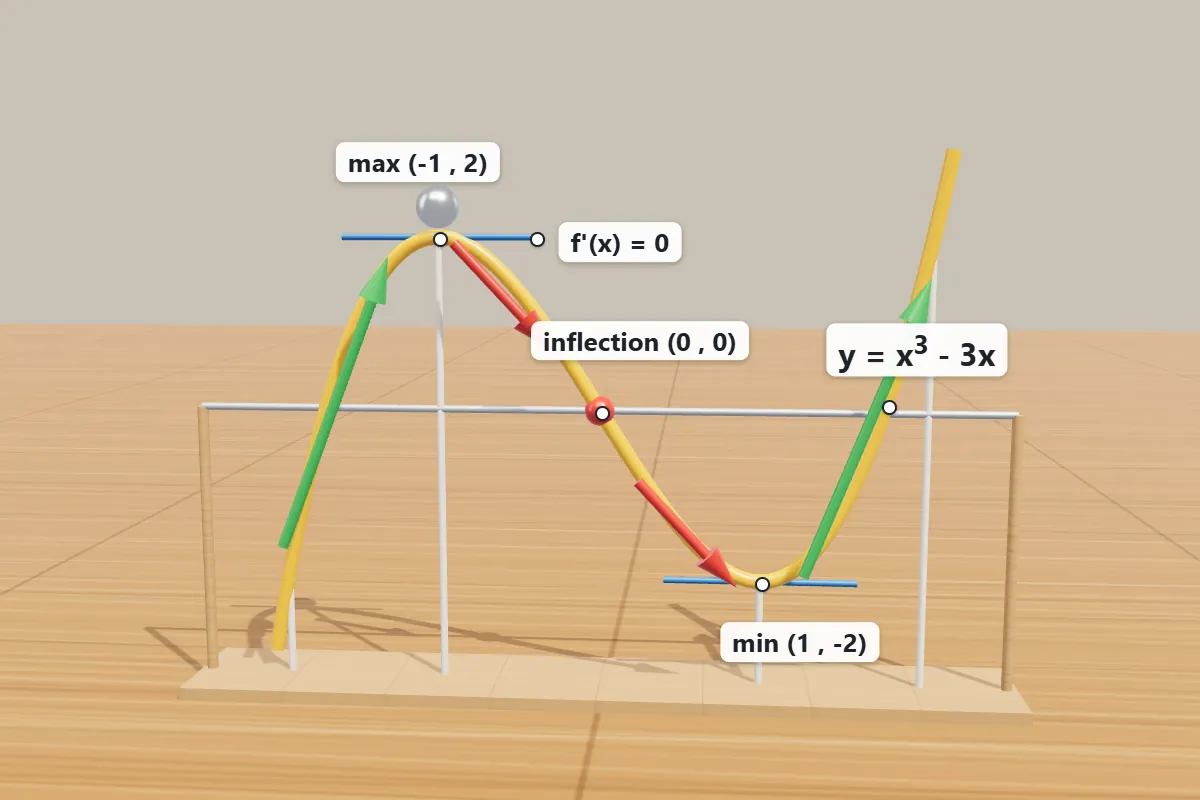
Example→y = x3 − 3x. Odd function; intercepts at x = 0, ±√3; y′ = 3x2 − 3 ⟹ max (−1, 2), min (1, −2); y″ = 6x ⟹ inflection (0, 0); as x → ∞, y → ∞.
Curve Behaviour: Maxima, Minima and Points of Inflection · 6 / 9
Maximum and minimum applications
Maximum and minimum applications
Method→write the quantity to be optimised as a function of one variable using the constraint, state the admissible interval, differentiate, set f′ = 0, justify the nature, then answer the question in words with units.
| Comparison aspect | Main idea | Keywords |
|---|---|---|
| Fencing |
| rectangularfieldareafenced |
| Open box |
| squaresquaressidefold |
| Closest point |
| nearestminimisepointsdistance |
| Revenue |
| 100xunitsprice |
Curve Behaviour: Maxima, Minima and Points of Inflection · 7 / 9
Practice with answers
Practice with answers
- Find the intervals of increase and decrease of f(x) = 2x3 − 3x2 − 12x + 5. — f′ = 6(x − 2)(x + 1): increasing on (−∞, −1) ∪ (2, ∞), decreasing on (−1, 2).
- Locate and classify the stationary points of f(x) = x4 − 4x3. — f′ = 4x2(x − 3) ⟹ minimum (3, −27); x = 0 is a stationary point of inflection.
- The curve y = ax2 + bx passes through (1, 4) and has a minimum at x = 2. Find a, b. — a + b = 4 and 2a(2) + b = 0 ⟹ a = 4, b = −8.
- Find the point of inflection of y = x3 − 3x2 + 4. — y″ = 6x − 6 ⟹ (1, 2).
- A farmer has 240 m of fencing for a rectangular plot against a river (no fence on the river side). Greatest area? — A = x(240 − 2x), A′ = 240 − 4x ⟹ x = 60, other side 120, area 7,200 m2.
- Find the maximum value of f(x) = x e−x. — f′ = e−x(1 − x) = 0 ⟹ x = 1, f″(1) = −e−1 < 0 ⟹ maximum 1/e ≈ 0.368.
- For what k does x3 + kx have no stationary points? — f′ = 3x2 + k ≥ 0 always ⟹ k ≥ 0.
Curve Behaviour: Maxima, Minima and Points of Inflection · 8 / 9
Exam traps
Exam traps
| Comparison aspect | Main idea | Keywords |
|---|---|---|
| f′ = 0 is necessary, not sufficient. |
| Everystationarypointmaximum |
| f″ = 0 is not an inflection point. | It must be accompanied by a change of concavity (x4 is the standard counter-example) | mustaccompaniedchangeconcavity |
| Endpoints of a closed interval. |
| absolutegreatestleastvalue |
| Maximum value versus point. |
| questionabscissaAnswerexactly |
| Constant of integration when reconstructing f. |
| Givenpointfindbefore |
| Units and “in words”. |
| Optimisationanswerslosemarks |
Curve Behaviour: Maxima, Minima and Points of Inflection · 9 / 9
Well done! You finished this lesson
What would you like to do next?