6.1Chapter 6: Forces, Motion and Pressure
Speed — Alhussan Physics - Stage 8 Revision Notes & Topical Questions
5 min read 8 parts Lesson 1 of 19 2 quizzes
Physics 6.1 Speed — Calculating Speed, Distance and Time (v = d / t) — Alhussan International Academy — Physics (Stages 7–9) notes: Calculate speed and distinguish average speed from instantaneous speed.Speed = a measure of how fast something is moving, the distance moved per uni…
- Speed equation
- Rearranged forms
- Why speed varies
- m/s to km/h
- km/h to m/s
- Comparing speeds
Section 1 of 8What speed is
- Speed is measured in metres per second (m/s) or kilometres per hour (km/h).
- In the UK and USA speeds are usually given in miles per hour (mph).
- A person walks at about 5 km/h or 1 m/s; a fast car drives at over 300 km/h or about 80 m/s.
Section 2 of 8Calculating speed
- Speed = distance ÷ time (v = d ÷ t).
- To find the speed of a moving object, measure the time it takes to travel a known distance.
- Distance = speed × time (d = v × t) and time = distance ÷ speed (t = d ÷ v).
- Writing the units of distance and time into the equation gives the correct unit for speed, such as 100 m ÷ 20 s = 5 m/s.
- Write the equation, substitute the values with their units, calculate, and state the answer with its unit.
Section 3 of 8Average speed
- It is found over a whole journey and includes stops and changes of speed.
- It makes it easier to compare how fast different people, boats or cars travel.
- A sailing boat goes faster in strong wind and slower when there is very little wind.
Section 4 of 8Instantaneous speed
- Instantaneous speed = the speed at one moment in time.
- The reading on a car's speedometer is an instantaneous speed.
- It is worked out from the size of the wheels and how fast they are turning, not from the whole journey.
Section 5 of 8Typical speeds and unit conversion
| Object | Typical speed |
|---|---|
| Walking | 1.5 m/s |
| Cycling | 5 m/s |
| Car on a motorway | 30 m/s (about 108 km/h) |
| Hurricane wind | over 33 m/s |
| Plane cruising | 250 m/s |
| Sound in air | 330 m/s |
- Multiply by 3.6 .
- (1 m/s = 3.6 km/h)
- Divide by 3.6.
- Convert both to the same unit first, because a smaller number in a larger unit can be the faster speed.
Section 6 of 8Measuring speed in an experiment
Section 7 of 8Key terms
| Term | Meaning |
|---|---|
| Speed | The distance moved per unit of time. |
| Average speed | Total distance divided by total time. |
| Instantaneous speed | The speed at a particular moment in time. |
| Metre per second (m/s) | The SI unit of speed. |
| Speedometer | A device showing the instantaneous speed of a vehicle. |
Section 8 of 8Exam technique
Marked practiceQuizzes for this lesson
?What do you want to solve now?
✓Checkpoint Quiz
1 multiple-choice + 1 written questions from real exam papers on this lesson.
Question 1 of 1 1:30

Answer key
1 D
Written question 1 of 1 · part (a) (1 / 3) 3:00
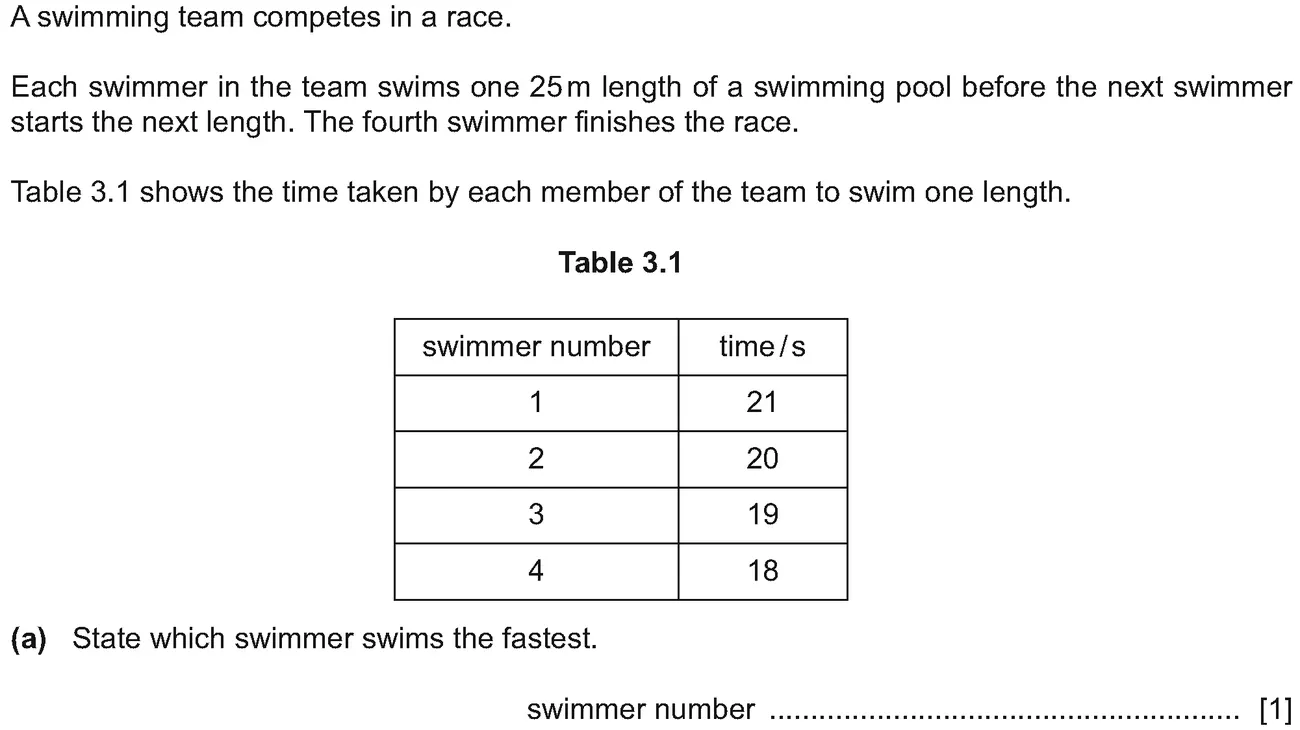
Show the answer

Written question 1 of 1 · part (b)(i) (2 / 3) 3:00

Show the answer

Written question 1 of 1 · part (b)(ii) (3 / 3) 3:00

Show the answer

Each part of a written question is on its own screen. Write your answer first, then open "Show the answer" to check it against the mark scheme.
Last updated: