8.1Chapter 8: Magnetism and Electromagnets
The properties of magnets — Alhussan Physics - Stage 8 Revision Notes & Topical Questions
5 min read 8 parts Lesson 1 of 6 2 quizzes
Lesson summary
Physics 8.1 The properties of magnets — Magnetic Poles, Attraction, Repulsion and Magnetic Materials — Alhussan International Academy — Physics (Stages 7–9) notes: Describe the properties of magnets, know which materials are magnetic and use domains to explain magnetic behaviour.…
- Non-contact force
- North-seeking pole
- Magnetic elements
- Compounds and alloys
- Steel and lodestone
- Non-magnetic
Section 1 of 8Magnets and magnetic forces
Lodestone
- The Ancient Greeks found that this naturally magnetic, iron-containing rock attracted small pieces of iron.
- It was first found in Magnesia in Greece.
Non-contact force
- A magnetic force acts even when objects are not touching.
Poles
- Every magnet has a north pole and a south pole, and the forces are strongest at the poles.
Section 2 of 8Attraction and repulsion
| Poles brought together | Force |
|---|---|
| North and south (unlike) | Attract |
| North and north (like) | Repel |
| South and south (like) | Repel |
Compass
- A freely suspended magnet turns to point north-south because the Earth behaves like a giant bar magnet.
North-seeking pole
- The end that points north.
Section 3 of 8Magnetic materials
Magnetic materials
Magnetic materials materials that are attracted to magnets.
Magnetic elements
- Iron, cobalt and nickel are magnetic elements.
Compounds and alloys
- Some of their alloys and oxides are also magnetic.
Steel and lodestone
- Steel is magnetic because it is mainly iron, and lodestone (magnetite) contains iron oxide.
Non-magnetic
- Copper, aluminium, brass, plastic, wood, glass and cotton are not magnetic.
Attraction only
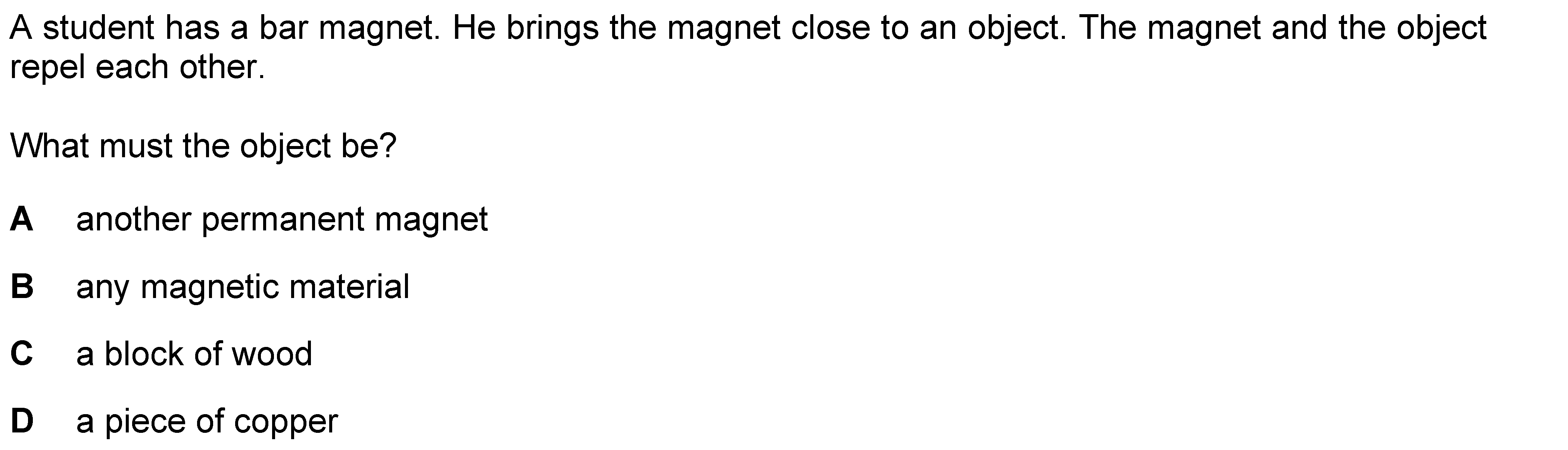
- A magnetic material is attracted to a magnet but is never repelled by it.
- Magnetic materials do not attract or repel each other.
- Only two magnets can repel each other, so repulsion is the test for a magnet.
Section 4 of 8Domains
Domains
Domains very small regions in a magnetic material, each behaving like a tiny bar magnet.
Unmagnetised
- The domains point in many different directions and their effects cancel.
Magnetised
- The domains line up when the material is put near a magnet or stroked with it.
Breaking a magnet
- Each piece is a magnet with its own north and south pole because the domains remain.
Section 5 of 8Magnetising and demagnetising
Iron
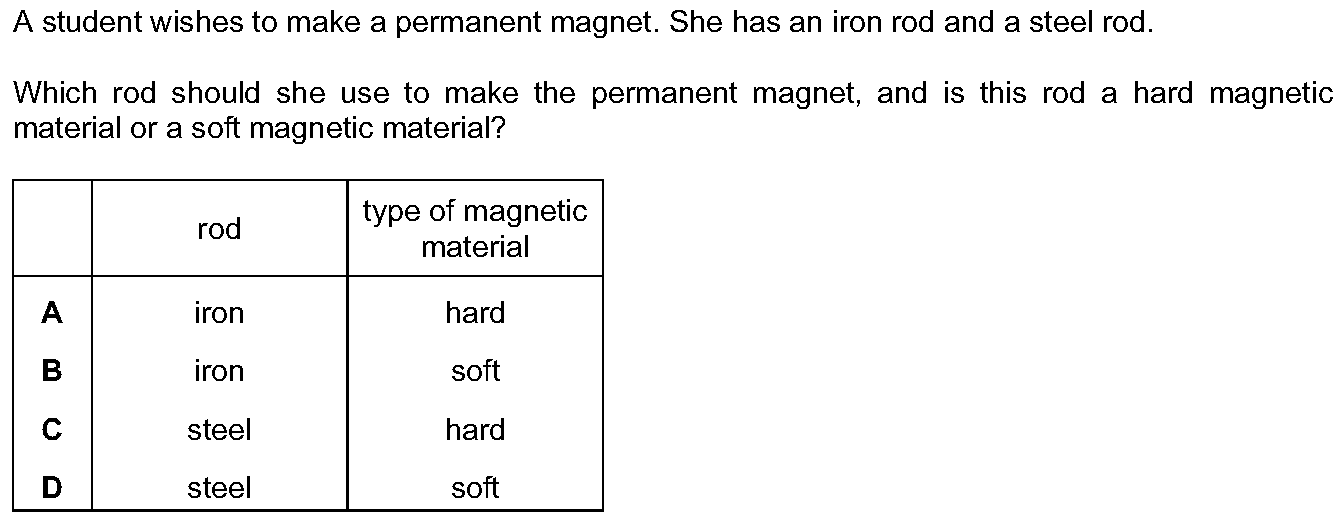
- It is easy to magnetise but loses its magnetism when the magnet is removed.
Steel
- It is harder to magnetise than iron but stays magnetised, making a permanent magnet.
Stroking
- Stroking a steel needle repeatedly in the same direction with a magnet makes a stronger magnet.
Demagnetising
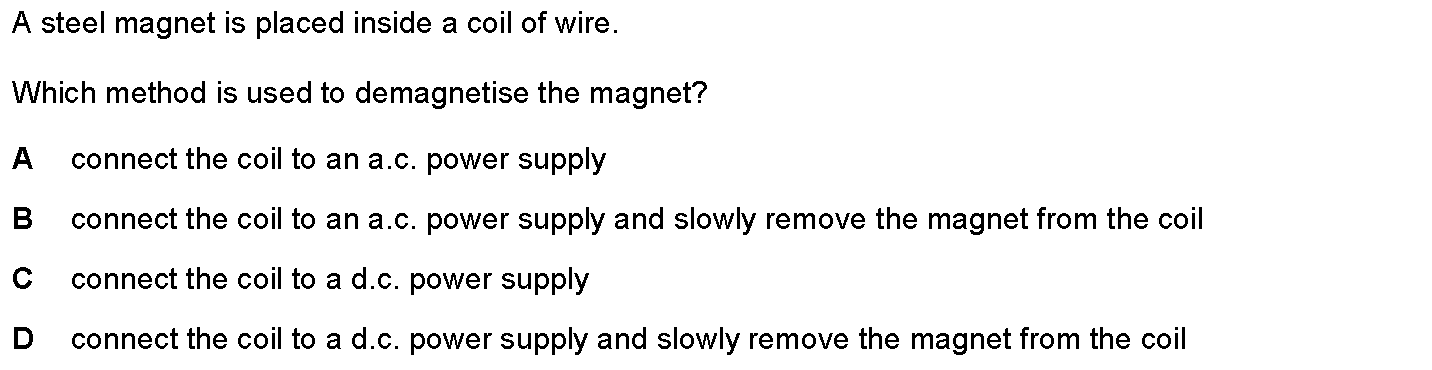
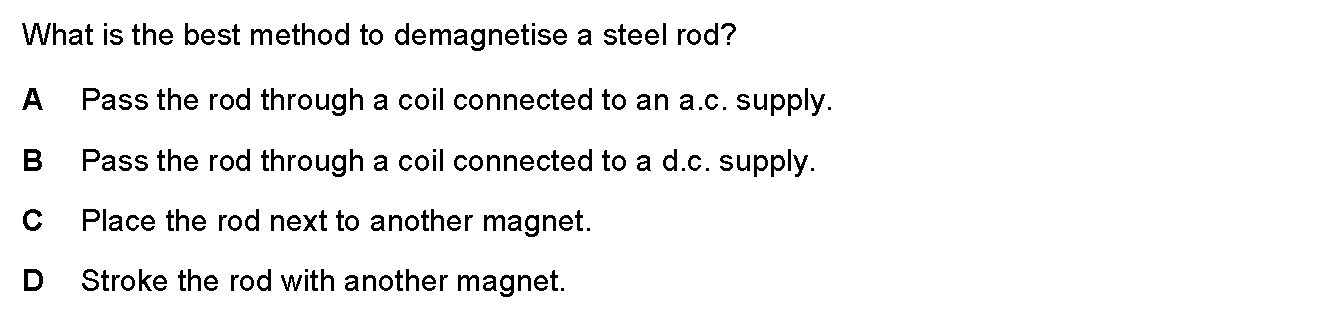
- A permanent magnet cannot be turned off but can be demagnetised.
- Heating it to a high temperature jolts the domains into random directions.
- Hitting it with a hammer or dropping it does the same.
Section 6 of 8Everyday uses
Credit card strip
- A plastic containing tiny iron pieces that behave like magnets stores information.
Other uses
- Fridge door seals, compasses, loudspeakers, motors and magnetic catches.
Magnetic levitation
- This happens when like poles repel.
| Test | Result for a magnet | Result for unmagnetised iron |
|---|---|---|
| Near one pole of a known magnet | Attracts or repels | Attracts only |
Section 7 of 8Key terms
| Term | Meaning |
|---|---|
| Magnetic field | The region around a magnet where magnetic materials experience a force. |
| Pole | The end of a magnet where the magnetic force is strongest. |
| Domain | A tiny region in a magnetic material that acts like a small magnet. |
| Magnetic material | A material attracted by a magnet, such as iron, cobalt or nickel. |
| Permanent magnet | A magnet that stays magnetised. |
| Demagnetise | To remove the magnetism of a magnet. |
Section 8 of 8Exam technique
1
Thinking a magnet attracts all metals — only iron, cobalt, nickel and their alloys.
2
Thinking attraction proves an object is a magnet — only repulsion does.
3
Thinking a broken magnet has only one pole — each piece has a north and a south pole.
4
Thinking iron and steel behave the same — steel stays magnetised and iron does not.
Marked practiceQuizzes for this lesson
?What do you want to solve now?
✓Checkpoint Quiz
10 multiple-choice questions from real exam papers on this lesson.
Question 1 of 10 1:30
Question 2 of 10 1:30
Question 3 of 10 1:30

Question 4 of 10 1:30
Question 5 of 10 1:30
Question 6 of 10 1:30

Question 7 of 10 1:30

Question 8 of 10 1:30

Question 9 of 10 1:30

Question 10 of 10 1:30

Score: 0 / 10
Answer key
1 A2 C3 B4 B5 A6 A7 C8 C9 B10 B
Last updated: