6.9Chapter 6: Forces, Motion and Pressure
Tension and upthrust — Alhussan Physics - Stage 8 Revision Notes & Topical Questions
5 min read 7 parts Lesson 9 of 19 1 quiz
Physics 6.9 Tension and upthrust — Elastic Extension and Floating — Alhussan International Academy — Physics (Stages 7–9) notes: Describe stretching of springs, elastic limit, and explain floating using upthrust.Stretching — Ropes, cords and springs all stretch when you pull them…
- Bungee cord
- Hooke's law
- Newtonmeter
- Apparent weight
- Archimedes' principle
- Tension = the force in a rope or spring that is being stretched.It balances the climber's weight
Part 1 of 5Tension
- Ropes, cords and springs all stretch when you pull them.
- Climbing ropes are designed to stretch a certain amount in case the climber falls, so the climber is not injured.
- It balances the climber's weight.
- As you pull, the particles inside move apart and the force of attraction pulls them back together.
Part 2 of 5Elastic and plastic materials
- An elastic material returns to its original length when the force is removed.
- A material that does not go back to its original length after stretching.
- It is made of many elastic cords bound together so that it stretches a very long way.
Part 3 of 5Stretching a spring
- Springs are used in spring balances, trampolines and car suspension, so the right spring must be chosen for each job.
- Within a limit the extension of a spring is proportional to the force applied.
- A bigger force produces a bigger extension.
- Doubling the force doubles the extension.
- It contains a spring and can measure forces because the extension is proportional to the force.
- Beyond this load the spring does not return to its original length when the force is removed.
- The spring is then permanently extended.
- Elastic materials break if the force is too big.
Part 4 of 5Upthrust and floating
- Water particles collide with the bottom of the boat and push it up.
- A large area produces a big force that can balance a big weight.
- An object floats when the upthrust equals its weight, so the forces are balanced.
- If the weight is greater than the upthrust the object sinks.
Part 5 of 5Apparent weight and displaced water
- An object weighed underwater seems to weigh less because of upthrust.
- It is easier to pull yourself out of a swimming pool than to pull yourself up when not in water.
- The upthrust equals the weight of the water displaced.
- A weight of 10 N with an upthrust of 4 N has an apparent weight of 6 N.
| Situation | Weight compared with upthrust | Result |
|---|---|---|
| Floating | Equal | Stays at the surface |
| Sinking | Weight greater | Goes down |
| Rising | Upthrust greater | Goes up |
Key terms
| Term | Meaning |
|---|---|
| Tension | The force in a rope or spring that is being stretched. |
| Extension | The increase in length of a stretched object. |
| Elastic limit | The point beyond which an object does not return to its original length. |
| Hooke's law | Extension is proportional to the force, up to the elastic limit. |
| Upthrust | The upward force of a fluid on an object in it. |
| Archimedes' principle | Upthrust equals the weight of the fluid displaced. |
Avoid these mistakes
Topic quiz · 161 questionsQuiz for this lesson
?What do you want to solve now?
✓Checkpoint Quiz
2 written questions from real exam papers on this lesson.
Written question 1 of 2 · part (a) (1 / 3) 3:00

Show the answer

Written question 1 of 2 · part (b)(i) (2 / 3) 3:00

Show the answer

Written question 1 of 2 · part (b)(ii) (3 / 3) 3:00
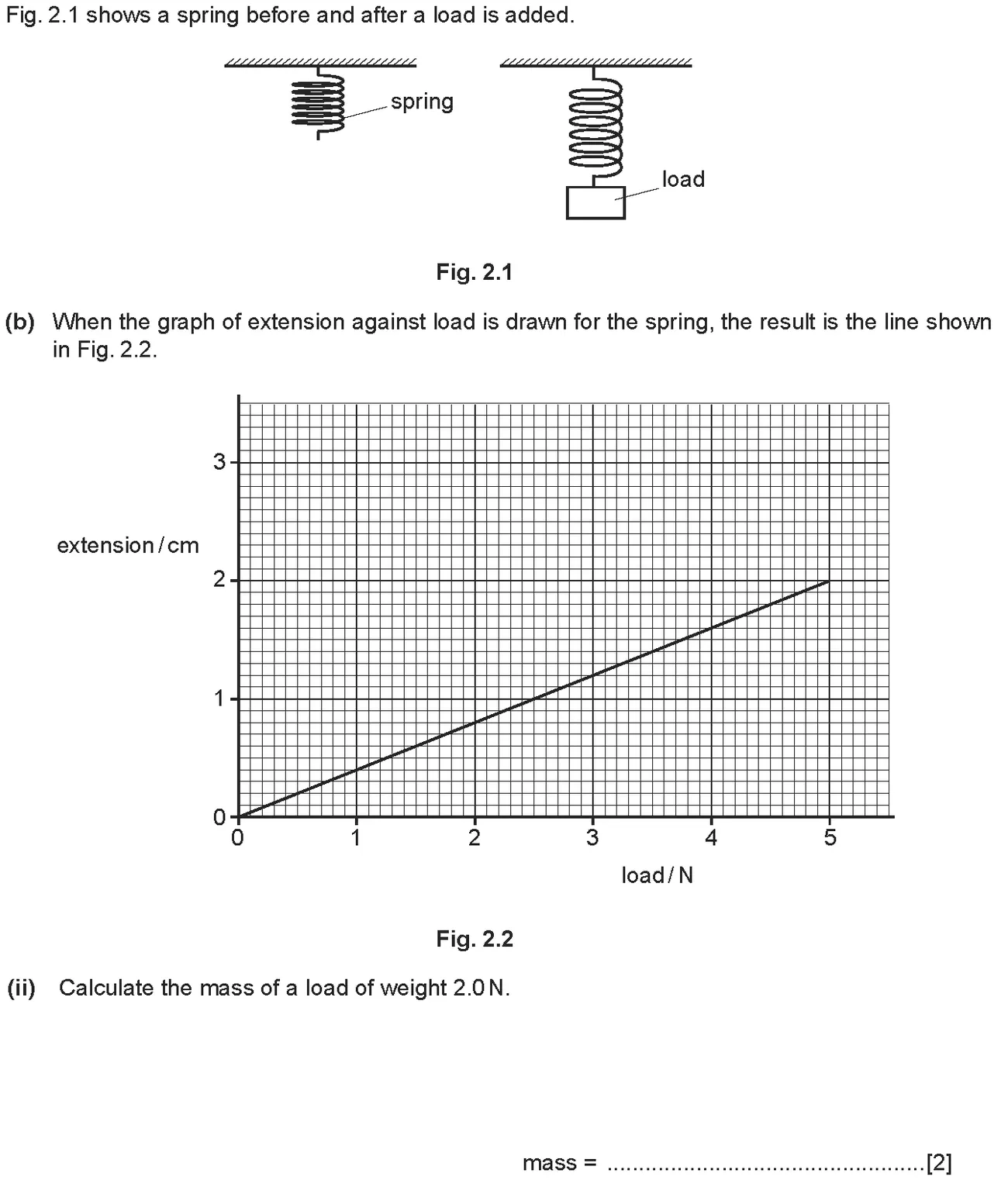
Show the answer
Written question 2 of 2 · part (a) (1 / 3) 3:00
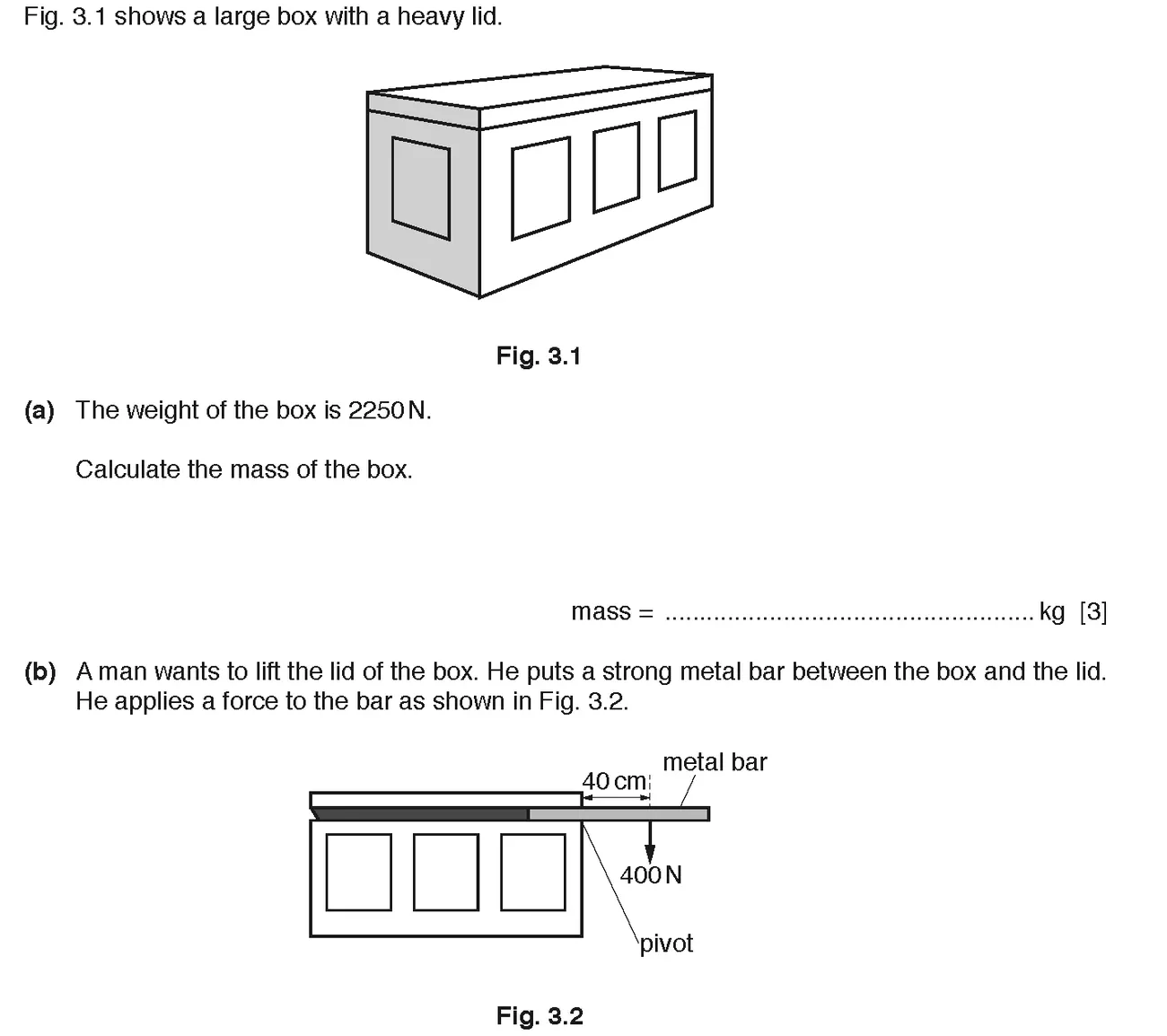
Show the answer

Written question 2 of 2 · part (b)(i) (2 / 3) 3:00

Show the answer
Written question 2 of 2 · part (b)(ii) (3 / 3) 3:00

Show the answer
Each part of a written question is on its own screen. Write your answer first, then open "Show the answer" to check it against the mark scheme.
Last updated: