6.11Chapter 6: Forces, Motion and Pressure
Levers — Alhussan Physics - Stage 8 Revision Notes & Topical Questions
5 min read 7 parts Lesson 11 of 19 1 quiz
Physics 6.11 Levers — Pivots, Effort, Load and Force Multipliers — Alhussan International Academy — Physics (Stages 7–9) notes: Describe what a lever is and how levers act as force or distance multipliers.Turning effect — Forces can make objects turn as well as change their motio…
- Levers in history
- Pivot (fulcrum)
- Turning force
- Wheelbarrow
- Balance of moments
- Mechanical advantage
Section 1 of 7Turning forces
- Forces can make objects turn as well as change their motion.
- Closing a door, using a wheelbarrow and sitting on a see-saw all apply turning forces.
- The ancient Egyptians used levers to lift huge blocks of stone onto rollers when building the pyramids.
Section 2 of 7Parts of a lever
Section 3 of 7How a lever works
- Pushing down on one end produces a turning force that makes the other end move up.
- The distance from the effort to the pivot is bigger than the distance from the load to the pivot.
- A small effort can balance or move a much bigger load.
- The effort moves through a greater distance than the load.
- A lever does not give free energy: ignoring friction, the work done by the effort equals the work done on the load.
Section 4 of 7Force multipliers and distance multipliers
| Type | Effort compared with load | Distance moved by effort | Examples |
|---|---|---|---|
| Force multiplier | Smaller than load | Greater than load | Crowbar, wheelbarrow, spanner, hammer removing a nail |
| Distance multiplier | Larger than load | Smaller than load | Tongs, tweezers, fishing rod |
- The load is between the effort and the pivot (the wheel), so a small lift force supports a large weight.
- A small movement of the fingers moves the ends of the tongs much further, but with a smaller force.
Section 5 of 7Calculating with levers
- Effort × effort distance = load × load distance, both measured from the pivot.
- Levers are not always straight bars.
Section 6 of 7Key terms
| Term | Meaning |
|---|---|
| Lever | A bar that turns about a pivot when a force is applied. |
| Effort | The force applied to a lever. |
| Load | The weight or force the lever moves or overcomes. |
| Pivot (fulcrum) | The fixed point about which a lever turns. |
| Force multiplier | A lever that gives a bigger force on the load than the effort. |
| Distance multiplier | A lever that moves the load further than the effort moves. |
Section 7 of 7Exam technique
Marked practiceQuizzes for this lesson
?What do you want to solve now?
✓Checkpoint Quiz
2 written questions from real exam papers on this lesson.
Written question 1 of 2 · part (a) (1 / 4) 3:00

Show the answer

Written question 1 of 2 · part (b) (2 / 4) 3:00

Show the answer
Written question 1 of 2 · part (c) (3 / 4) 3:00

Show the answer
Written question 1 of 2 · part (d) (4 / 4) 3:00
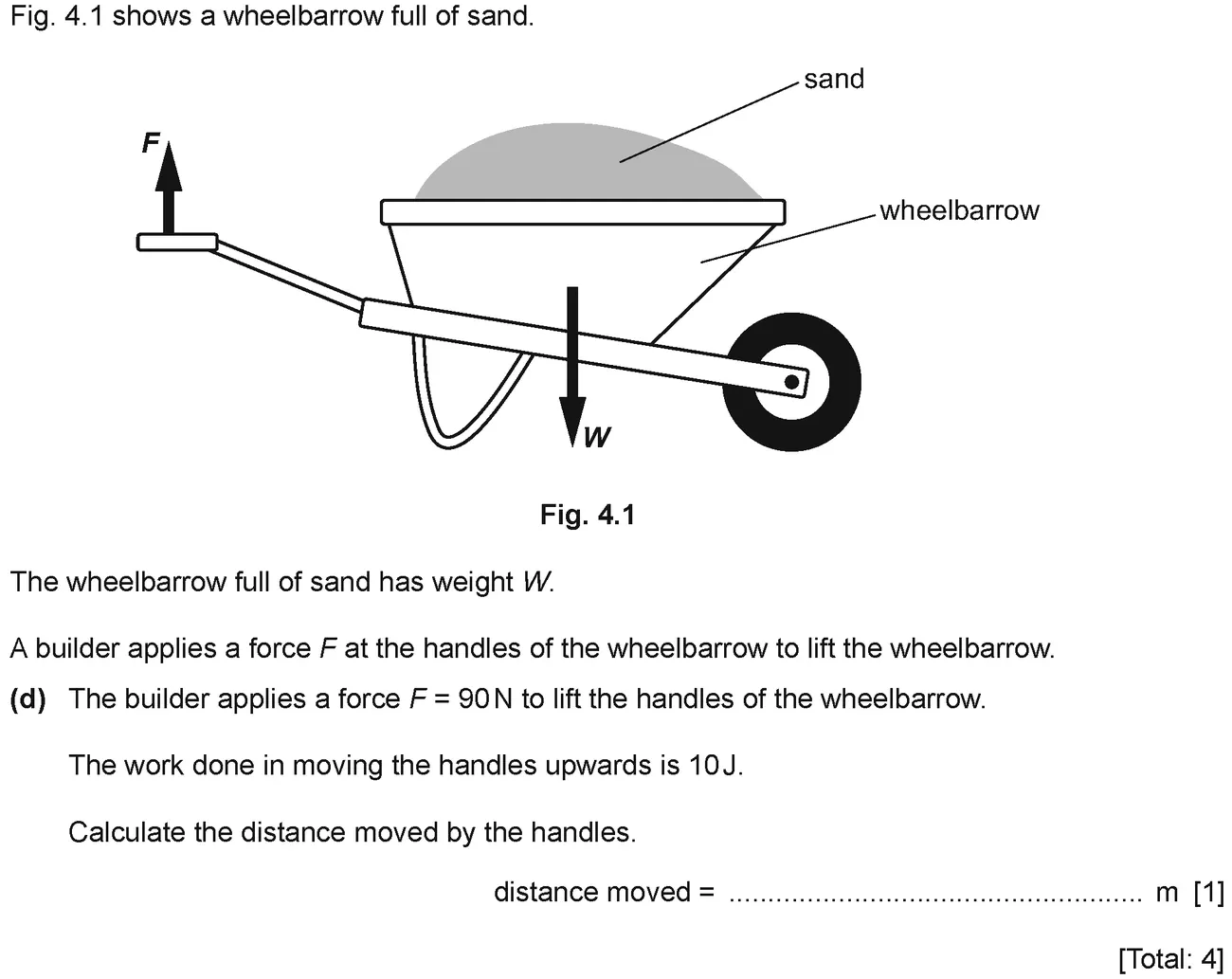
Show the answer
Written question 2 of 2 · part (a) (1 / 3) 3:00

Show the answer

Written question 2 of 2 · part (b)(i) (2 / 3) 3:00

Show the answer

Written question 2 of 2 · part (b)(ii) (3 / 3) 3:00
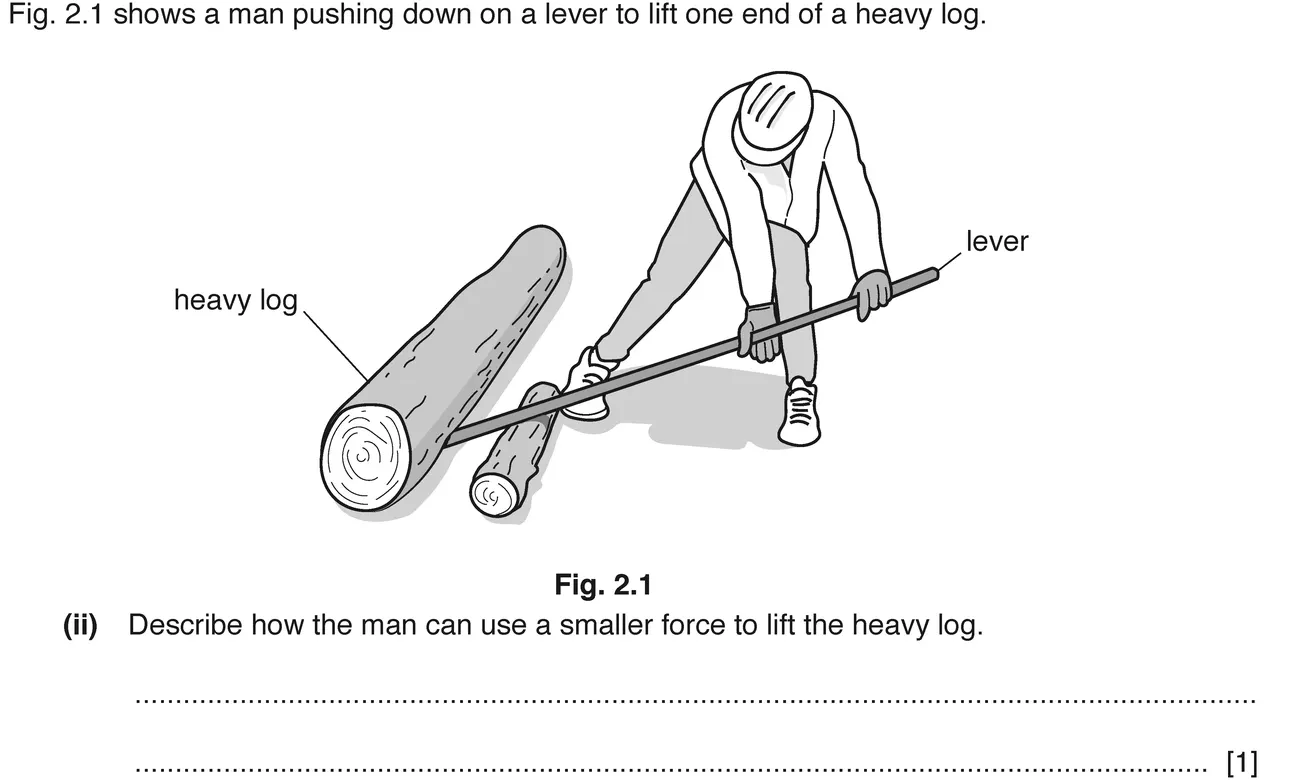
Show the answer

Each part of a written question is on its own screen. Write your answer first, then open "Show the answer" to check it against the mark scheme.
Last updated: