12.3Chapter 12: Energy Transfer
Energy transfer: conduction — Alhussan Physics - Stage 9 Revision Notes & Topical Questions
5 min read 8 parts Lesson 3 of 7 2 quizzes
Lesson summary
Physics 12.3 Energy transfer: conduction — Lattice Vibrations and Delocalised Electrons — Alhussan International Academy — Physics (Stages 7–9) notes: Name conductors and insulators, explain conduction using particles and explain why some materials feel warmer than others.Conduct…
- Contact needed
- Warm feeling
- Thermal conductors
- All solids
- Skin detects energy transfer
- Metal handlebar
Section 1 of 8What conduction is
Conduction
Conduction the transfer of energy through a solid.
Contact needed
- It needs particles in contact, so it cannot happen through a vacuum.
Direction
- Energy moves from the hot end to the cold end of an object.
Warm feeling
- If you touch something hotter than your skin, energy moves from the object to your hand, so it feels warm.
Example
- A burning splint can be held at the cool end because energy is not transferred easily along the wood.
Section 2 of 8Conductors and insulators
Thermal conductors
- Solids that transfer energy well, such as metals.
- Cooking pans are often made of copper because it quickly conducts energy to the food.
Insulators
- Many non-metals, such as paper, cloth, wood and plastic, transfer energy very slowly.
- Insulators still conduct, but very slowly.
- You stir hot food with wooden spoons so you do not burn yourself.
| Material | Conductivity | Use |
|---|---|---|
| Copper, aluminium | Good conductor | Saucepans, radiators |
| Wood, plastic | Insulator | Pan handles, spoons |
| Trapped air | Very poor conductor | Duvets, jackets, double glazing |
Section 3 of 8Conduction in terms of particles
Conduction in terms of particles
All solids
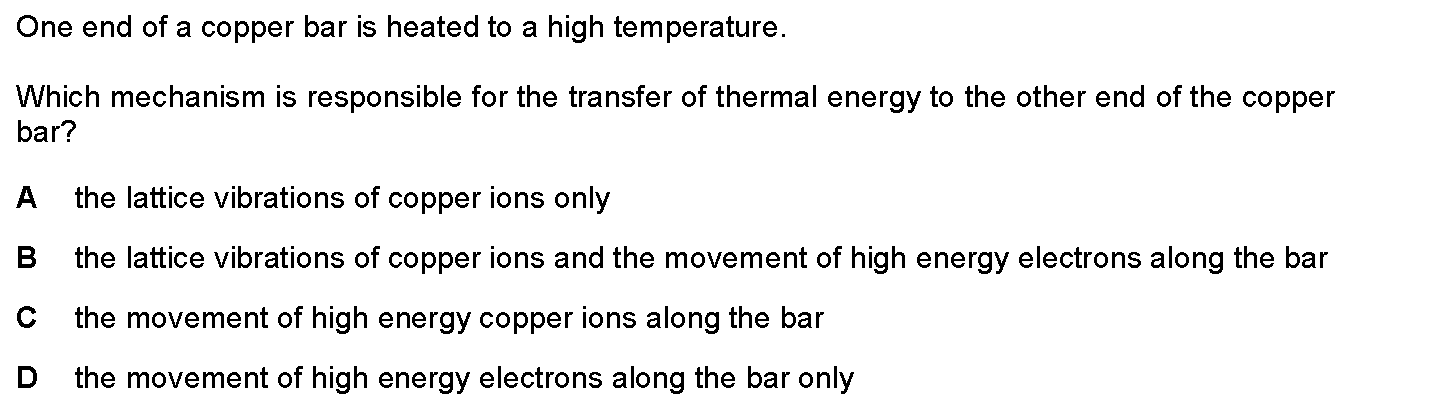
- Particles at the hot end vibrate with more kinetic energy.
- They bump into neighbours and pass the energy along the lattice from particle to particle.
Metals
- Free (delocalised) electrons also carry energy.
- They gain energy at the hot end and move quickly through the lattice.
- They collide with atoms further along, passing energy on much faster.
- This is why metals are good conductors.
Section 4 of 8Why some objects feel cold
1Skin detects energy transfer
- Skin detects the rate of energy transfer, not the temperature itself.
2Metal handlebar
- Energy is quickly transferred from the hand to the metal, so it feels cold.
3Plastic grip
- Energy is not transferred quickly away from the hand, so it feels warm.
4Same temperature
- The metal and plastic are at the same temperature.
Section 5 of 8Liquids and gases
Liquids
- Liquids such as water are poor conductors compared with metals.
- An ice cube held down by a weight at the bottom of a test tube does not melt even when the water at the top is boiling.
Gases
- Gases such as air transfer energy poorly because their particles are far apart.
Trapped fluids
- Liquids and gases that cannot move around are poor conductors, so they act as insulators.
Section 6 of 8Using insulators to keep warm
Wetsuit
- A thin layer of water between the skin and the suit is not free to flow away, so the diver loses energy slowly.
Drysuit
- Clothing underneath traps a layer of air, a very poor conductor, so energy leaves the body slowly.
Clothing and bedding
- Padded jackets and bedding trap air, and trapped air must be prevented from moving.
Double glazing
- Two panes of glass with a near vacuum between them insulate houses and reduce fuel bills, since a vacuum is an even better insulator.
Section 7 of 8Key terms
| Term | Meaning |
|---|---|
| Conduction | The transfer of energy through a material by particles passing on vibrations or electrons. |
| Conductor | A material that transfers energy well. |
| Insulator | A material that transfers energy poorly. |
| Delocalised electrons | Free electrons in a metal that carry energy and charge. |
| Lattice | The regular arrangement of particles in a solid. |
| Vacuum | A space with no particles. |
Section 8 of 8Exam technique
1
Thinking insulators trap heat — they slow the transfer of energy.
2
Thinking metals are colder than plastic in a room — they only feel colder because they conduct energy from your hand faster.
3
Thinking conduction can occur through a vacuum — it needs particles.
4
Thinking insulators do not conduct at all — they conduct very slowly.
Marked practiceQuizzes for this lesson
?What do you want to solve now?
✓Checkpoint Quiz
2 multiple-choice questions from real exam papers on this lesson.

Last updated: