12.6Chapter 12: Energy Transfer
Cooling by evaporation — Alhussan Physics - Stage 9 Revision Notes & Topical Questions
5 min read 8 parts Lesson 6 of 7 2 quizzes
Lesson summary
Physics 12.6 Cooling by evaporation — Particle Kinetic Energy Distribution and Latent Cooling — Alhussan International Academy — Physics (Stages 7–9) notes: Explain why liquids cool when they evaporate and describe uses of cooling by evaporation.Evaporation = a liquid changing to…
- Everyday example
- Different from boiling
- Particles in a liquid
- Range of speeds
- Continued evaporation
- Average height model
Part 1 of 6Evaporation
Evaporation
Evaporation a liquid changing to a vapour at its surface at any temperature.
Everyday example
- A dish of water left out dries up.
Different from boiling
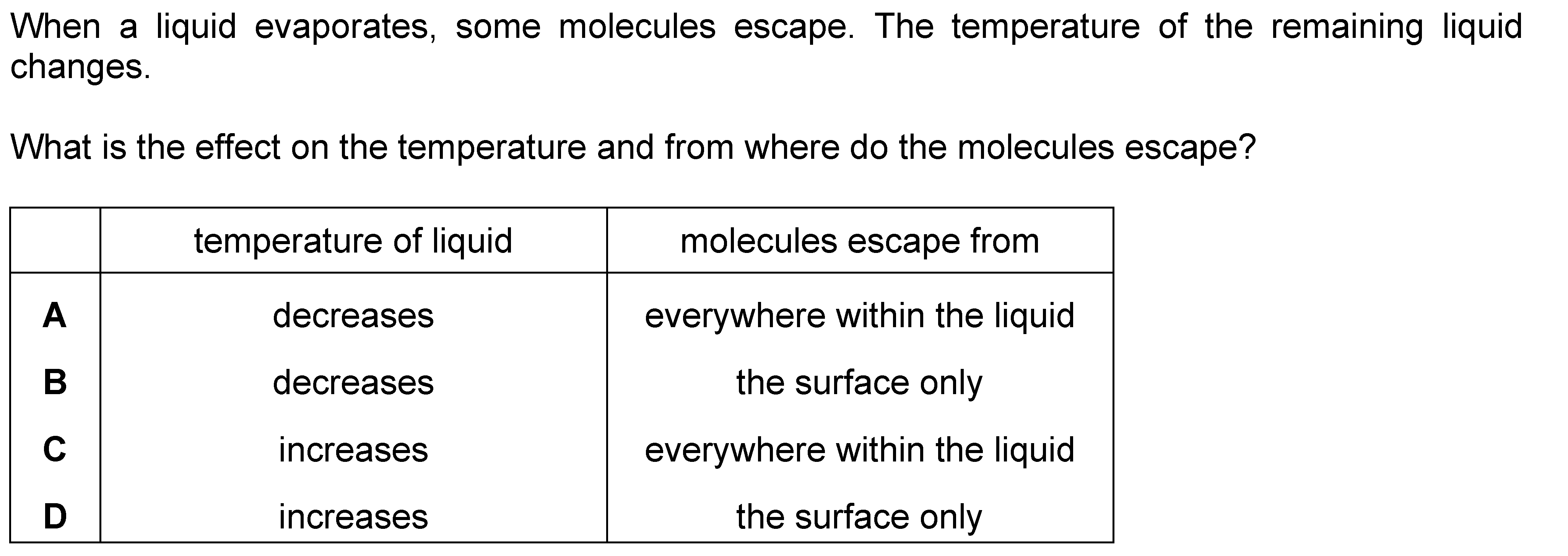
- It happens only at the surface and at any temperature.
Part 2 of 6Particle explanation of cooling
Particle explanation of cooling
Particles in a liquid
- They are close together, move over each other and attract their neighbours.
Range of speeds
- Particles move in all directions at different speeds, and the average speed depends on the temperature.
- At a higher temperature the average speed is higher.
- Energy is transferred between particles in collisions.
Escape
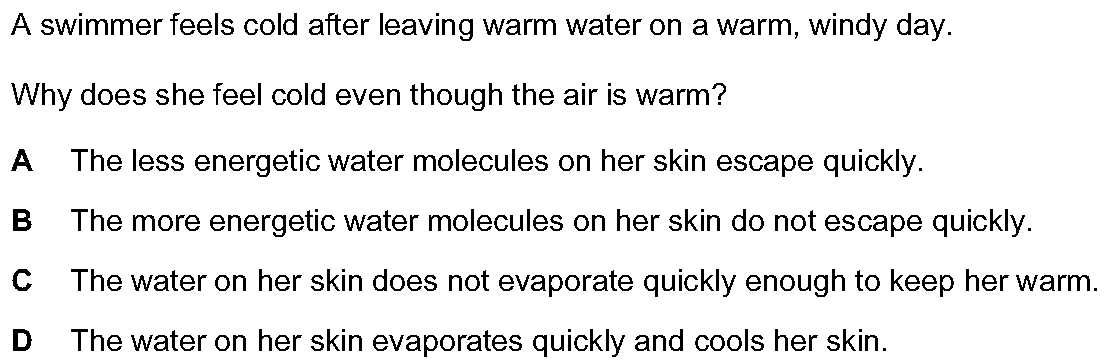
- A few fast particles at the surface have enough kinetic energy to overcome the attraction of neighbours and escape into the air.
Cooling
- The slower particles left behind lower the average speed, so the liquid is cooler.
Continued evaporation
- The cooler liquid absorbs energy from the air or skin around it, so more particles escape and the air around cools.
Part 3 of 6A model for evaporative cooling
A model for evaporative cooling
Average height model
- The average height of a group falls when the tallest children leave.
Particles
- When the fastest particles leave a liquid, the average speed of the remaining particles falls.
Part 4 of 6What makes evaporation faster
Warmer liquid or air
- More particles have enough energy to escape.
Larger surface area
- More particles are at the surface.
Moving air
- It carries vapour away.
Dry air
- Vapour can enter the air easily.
Part 5 of 6Cooling animals and people
Sweating
- Droplets of sweat on the skin evaporate as energy is transferred from the skin to the water, so you feel cooler.
Wet hands
- The same cooling effect happens as water dries from them.
Dogs
- They pant so that water evaporates from their tongues.
Elephants
- They use water on their skin to cool down.
Part 6 of 6Coolers and refrigerators
1Evaporative cooler
- A fan draws warm air over water, energy is transferred to the water, which evaporates, and the cooled air circulates around the house.
- It needs electricity for the fan and pump.
- In ancient Egypt, wet mats were hung over doorways and fans cooled the air.
2Refrigerator
- A refrigerant liquid is pumped around tubes at the back.
3Cooling inside
- Energy from inside the refrigerator evaporates the refrigerant, which cools the inside.
4Cycle
- The vapour is compressed and cooled outside, where it condenses and releases energy.
Key terms
| Term | Meaning |
|---|---|
| Evaporation | A liquid changing to a vapour at its surface. |
| Average speed | The mean speed of the particles, related to temperature. |
| Refrigerant | A special liquid that evaporates to cool the inside of a refrigerator. |
| Evaporative cooler | A device that cools air by evaporating water. |
| Vapour | A gas formed from a liquid. |
Avoid these mistakes
1
Thinking all particles in a liquid move at the same speed — there is a range of speeds.
2
Thinking the slowest particles evaporate — the fastest particles escape.
3
Thinking evaporation happens only at the boiling point — it occurs at any temperature.
4
Thinking evaporation warms the liquid — it cools the liquid left behind.
Marked practiceQuizzes for this lesson
?What do you want to solve now?
✓Checkpoint Quiz
3 multiple-choice questions from real exam papers on this lesson.

Last updated: