12.4Chapter 12: Energy Transfer
Energy transfer: convection — Alhussan Physics - Stage 9 Revision Notes & Topical Questions
5 min read 7 parts Lesson 4 of 7 2 quizzes
Lesson summary
Physics 12.4 Energy transfer: convection — Fluid Density Changes and Convection Currents — Alhussan International Academy — Physics (Stages 7–9) notes: Describe how energy is transferred by convection and how convection currents form in everyday situations.Convection = the transf…
- Fluids only
- Conduction first
- Cooling at the top
- Fire in a house
- Freezer compartment
- Rising air
Section 1 of 7What convection is
1Convection
Convection the transfer of energy by the movement of a heated liquid or gas.
2Fluids only
- It occurs only in liquids and gases that are free to move, where particles can move from place to place.
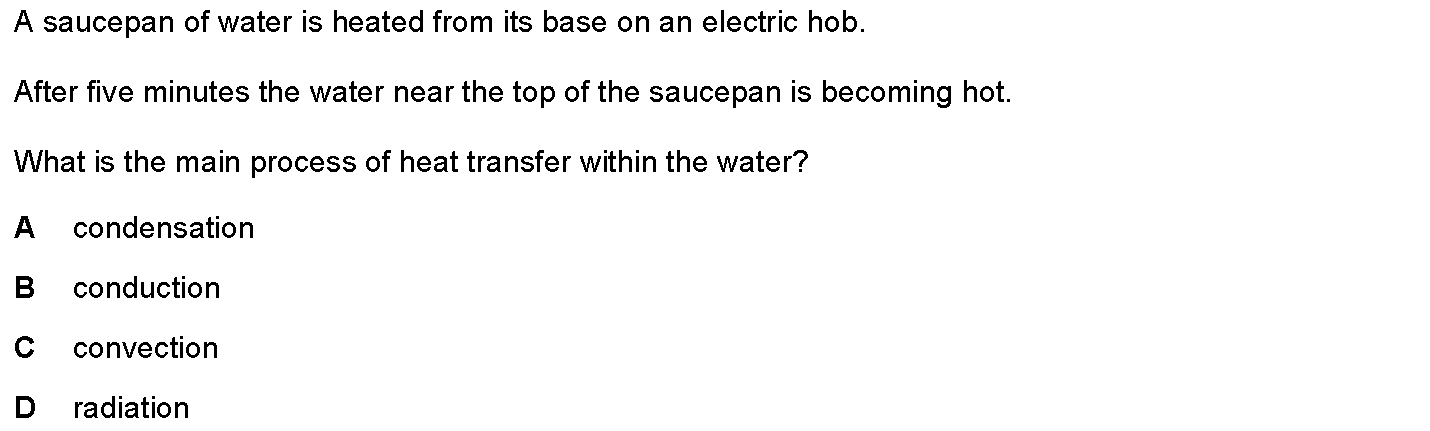
3Saucepan
- Heating the bottom warms all the water, not just the bottom part.
4Conduction first
- Energy passes through the solid bottom of the pan to the water by conduction.
Section 2 of 7How a convection current forms
1
The water in contact with the pan is warmed.
2
Its molecules move faster and further apart.
3
The warmer water becomes less dense.
4
The warmer water rises (floats up).
5
Cooler, denser water moves down to take its place.
6
Eventually all the water circulates up and down, forming a convection current.
- Cooling at the top
- Fluid that reaches the top cools, becomes denser and sinks.
Section 3 of 7Everyday examples
Everyday examples
Fire in a house
- Hot smoky air expands and rises, so firefighters crawl along the floor where the air is cleanest.
Radiators
- They are placed low in rooms so that warm air rises and cooler air flows down to be heated.
Freezer compartment
- It is at the top of a fridge so that cold, dense air sinks and cools the food.
Thermals
- Convection currents in the air caused by the Sun heating the ground are used by birds to climb high.
Section 4 of 7Sea breezes
Daytime
- The land heats faster than the sea, so the air above the ground gets hot.
- The hot air expands and rises like hot water in a pan.
- Cooler air from above the sea replaces it, so the breeze comes off the sea.
Night
- The ground cools more quickly than the sea.
- Air above the sea is now warmer and rises.
- Cooler air from above the land replaces it, so the breeze comes off the land.
Section 5 of 7Convection in the atmosphere
Equator
- The Sun heats the Earth more at the equator than near the poles.
Rising air
- Air near the equator rises and is replaced by cooler air.
Weather
- This moves the air in the atmosphere and affects weather patterns across the world.
Key idea
- When a gas or liquid is heated it expands and becomes less dense, and the less dense fluid rises.
Section 6 of 7Key terms
| Term | Meaning |
|---|---|
| Convection | Energy transfer by the movement of a heated liquid or gas. |
| Convection current | The circulation of a fluid as warm fluid rises and cool fluid sinks. |
| Density | Mass per unit volume. |
| Thermal | A convection current in the air. |
| Fluid | A liquid or a gas. |
Section 7 of 7Exam technique
1
Thinking hot air rises because heat rises — warmer, less dense fluid is pushed up by denser cooler fluid.
2
Thinking convection happens in solids — it needs fluids that can flow.
3
Thinking convection and conduction are the same — convection involves moving fluid.
4
Thinking the sea breeze blows the same way at night — it reverses.
Marked practiceQuizzes for this lesson
?What do you want to solve now?
✓Checkpoint Quiz
5 multiple-choice + 1 written questions from real exam papers on this lesson.
Question 1 of 5 1:30

Question 2 of 5 1:30

Question 3 of 5 1:30
Question 4 of 5 1:30

Question 5 of 5 1:30

Score: 0 / 5
⇩ Answer key (PDF) 

Answers to written questions are not published. Write your answer, then send the question number on WhatsApp to get the model answer.
Last updated: