16.0Reflection and Refraction
Overview: Reflection and Refraction: Mirrors, Refraction of Light and Lenses — American System Physics Revision Notes & Topical Questions
5 min read 7 parts Lesson 2 of 5 Unit quiz
Lesson summary
Apply the law of reflection.Light bends toward the normal entering a denser medium.Critical anglesinθc = n2/n1.Optical fibres use total internal reflection.Rainbows result from dispersion and internal reflection in droplets.Nearsightedness is corrected with diverging lenses; fars…
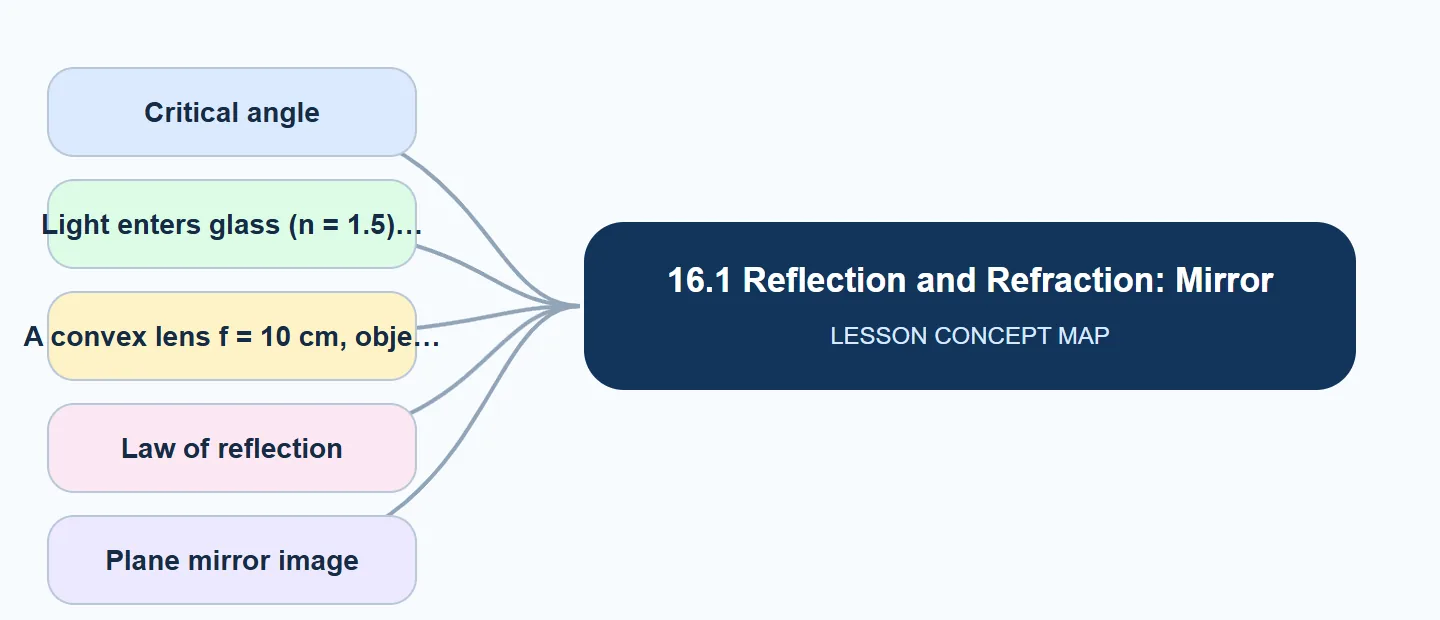
- Light enters glass (n = 1.5) from air at 30°. Refraction angle?
- A convex lens f = 10 cm, object 30 cm. Image distance?
- Plane mirror image
- Concave mirror
- Convex mirror
- Mirror/lens equation
Section 1 of 7Overview: Reflection and Refraction: Mirrors, Refraction of Light and Lenses
1
2
Negative di means a virtual image.
3
Negative m means inverted.
4
Chromatic aberration occurs in lenses due to dispersion.
5
Microscopes and telescopes combine lenses.
6
Mirages are caused by refraction in air layers.
Section 2 of 7Process & sequence
1
Draw principal rays (parallel, focal, centre).
2
Locate the image where rays meet.
3
Apply 1/f = 1/do + 1/di.
4
Calculate magnification.
5
Classify the image: real/virtual, upright/inverted, size.
Image by a convex lenswrite these steps in this order; each step is a marking point.
- Ray parallel → through F
- Ray through centre
- Rays meet
- Image located
- Describe image
Section 3 of 7Compare
| Device | Type | Images formed |
|---|---|---|
| Plane mirror | — | Virtual, upright, same size |
| Concave mirror | Converging | Real inverted (object beyond f) or virtual upright (inside f) |
| Convex mirror | Diverging | Virtual, upright, smaller |
| Convex lens | Converging | Real inverted or virtual magnified |
| Concave lens | Diverging | Virtual, upright, smaller |
| Medium | n |
|---|---|
| Vacuum/air | 1.00 |
| Water | 1.33 |
| Glass | 1.52 |
| Diamond | 2.42 |
Section 4 of 7Worked examples
Light enters glass (n
1.5) from air at 30°. Refraction angle?
- sinθ = 0.5/1.5 = 0.333, θ = 19.5°.
A convex lens f
10 cm, object 30 cm. Image distance?
- 1/di = 1/10 − 1/30, di = 15 cm (real, inverted, smaller).
Section 5 of 7Key terms
Section 6 of 7Command terms
Command terms
Identify / Describe (FRQ)
A short, specific statement; describing requires relevant characteristics, not a single word.
Explain / Justify (FRQ)
Give the cause-and-effect reasoning or evidence; a restated fact does not score.
Calculate
Show setup, substitution and the answer with units.
Predict
State the expected outcome; add a reason only if asked to justify.
MCQ technique
Read every option; eliminate distractors that are true statements but do not answer the question; watch for NOT/EXCEPT.
Section 7 of 7Exam technique
Keywords the mark scheme looks for in this lesson
Keywords the mark scheme looks for in this lesson
Law of reflection · Plane mirror image · Concave mirror · Convex mirror · Mirror/lens equation · Magnification · Index of refraction · Snell's law · Total internal reflection · Dispersion
Learn each definition in the Key words tab exactly; a missing keyword in a definition usually loses the mark.
How to get full marks (examiner guidance)
1
Answer exactly what is asked; extra correct material does not earn credit, and contradictory statements can cancel credit (AP FRQ).
2
Use precise vocabulary (e.g. “active site”, “concentration gradient”, “allele”), never “it/stuff/things”.
3
Show units and working in calculations.
4
In MCQs, predict the answer before reading the options, then eliminate.
Instant feedbackCheck yourself
Q1. Plane mirror images are
- A. real
- B. virtual
- C. inverted
- D. magnified
Show answer
B. Behind the mirror.
Q2. Light entering water from air bends
- A. away from normal
- B. toward normal
- C. not at all
- D. backward
Show answer
B. Slower medium.
Q3. Optical fibres work by
1
A. refraction only
2
B. total internal reflection
3
C. diffraction
4
D. polarisation
Show answer
B. TIR.
Q4. A concave lens forms images that are
- A. real and inverted
- B. virtual and smaller
- C. magnified real
- D. none
Show answer
B. Diverging.
Last updated: