21.0Electromagnetic Induction and Electromagnetism
Overview: Electromagnetism: Induction, Generators, Transformers and Electromagnetic Waves — American System Physics Revision Notes & Topical Questions
5 min read 7 parts Lesson 2 of 5 Unit quiz
Lesson summary
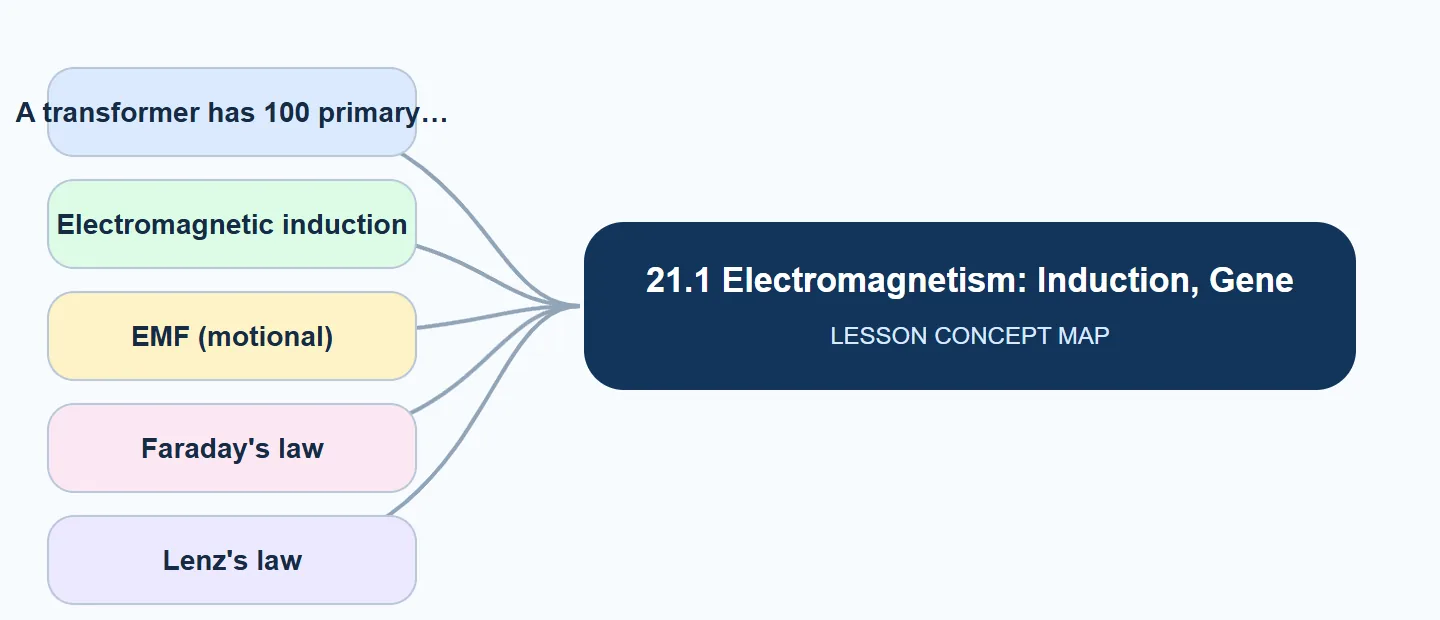
Explain electromagnetic induction.Transformers work only with alternating current.Power lines use high voltage to reduce I²R losses.All EM waves travel at c in vacuum.Eddy currents cause magnetic braking.Accelerating charges produce EM waves (antennas).Explain electromagnetic ind…
- A transformer has 100 primary and 2000 secondary turns; 120 V in. Output?
- EMF (motional)
- Faraday's law
- Lenz's law
- Electromagnetic wave
- Mass spectrometer
Section 1 of 7Overview: Electromagnetism: Induction, Generators, Transformers and Electromagnetic Waves
1
2
AC generators produce sinusoidal voltage.
3
Effective (rms) voltage = Vmax/√2.
4
Self-inductance opposes changes in current.
5
Induction cooktops use eddy currents.
6
Radio waves have the longest wavelengths.
Section 2 of 7Process & sequence
1
Identify a changing magnetic flux.
2
Calculate EMF (BLv or Faraday's law).
3
Use Lenz's law for direction.
4
For transformers, apply the turns ratio.
5What the symbols mean:
Power in ≈ power out: VpIp = VsIs.
What the symbols mean: V = voltage (V) · N = number of turns · I = current (A) · p = primary coil · s = secondary coil
Generator principlewrite these steps in this order; each step is a marking point.
- Coil rotates
- Flux changes
- EMF induced
- Current flows
- AC output
Section 3 of 7Compare
| Type | Turns | Voltage | Current |
|---|---|---|---|
| Step-up | Ns > Np | Increases | Decreases |
| Step-down | Ns < Np | Decreases | Increases |
| Region | Use |
|---|---|
| Radio | Broadcasting |
| Microwave | Cooking, radar |
| Infrared | Heat imaging |
| Visible | Sight |
| Ultraviolet | Sterilisation |
| X-ray | Medical imaging |
| Gamma | Cancer treatment |
Section 4 of 7Worked examples
A transformer has 100 primary and 2000 secondary turns; 120 V in. Output?
- Vs = 120 × 20 = 2400 V (step-up).
Section 5 of 7Key terms
Section 6 of 7Command terms
Command terms
Identify / Describe (FRQ)
A short, specific statement; describing requires relevant characteristics, not a single word.
Explain / Justify (FRQ)
Give the cause-and-effect reasoning or evidence; a restated fact does not score.
Calculate
Show setup, substitution and the answer with units.
Predict
State the expected outcome; add a reason only if asked to justify.
MCQ technique
Read every option; eliminate distractors that are true statements but do not answer the question; watch for NOT/EXCEPT.
Section 7 of 7Exam technique
Keywords the mark scheme looks for in this lesson
Keywords the mark scheme looks for in this lesson
Electromagnetic induction · EMF (motional) · Faraday's law · Lenz's law · Generator · Transformer · Electromagnetic wave · Mass spectrometer
Learn each definition in the Key words tab exactly; a missing keyword in a definition usually loses the mark.
How to get full marks (examiner guidance)
1
Answer exactly what is asked; extra correct material does not earn credit, and contradictory statements can cancel credit (AP FRQ).
2
Use precise vocabulary (e.g. “active site”, “concentration gradient”, “allele”), never “it/stuff/things”.
3
Show units and working in calculations.
4
In MCQs, predict the answer before reading the options, then eliminate.
Instant feedbackCheck yourself
Q1. Transformers need
- A. DC
- B. AC
- C. batteries
- D. magnets only
Show answer
B. Changing flux.
Q2. Lenz's law is a consequence of conservation of
- A. charge
- B. energy
- C. momentum
- D. mass
Show answer
B. Opposes change.
Q3. Step-down transformer: secondary voltage
- A. higher
- B. lower
- C. same
- D. zero
Show answer
B. Fewer turns.
Q4. Which EM wave has the highest frequency?
- A. radio
- B. visible
- C. X-ray
- D. gamma
Show answer
D. Shortest λ.
Last updated: