3.1Accelerated Motion
Acceleration — American System Physics Revision Notes & Topical Questions
10 min read 7 parts Lesson 3 of 5 1 quiz
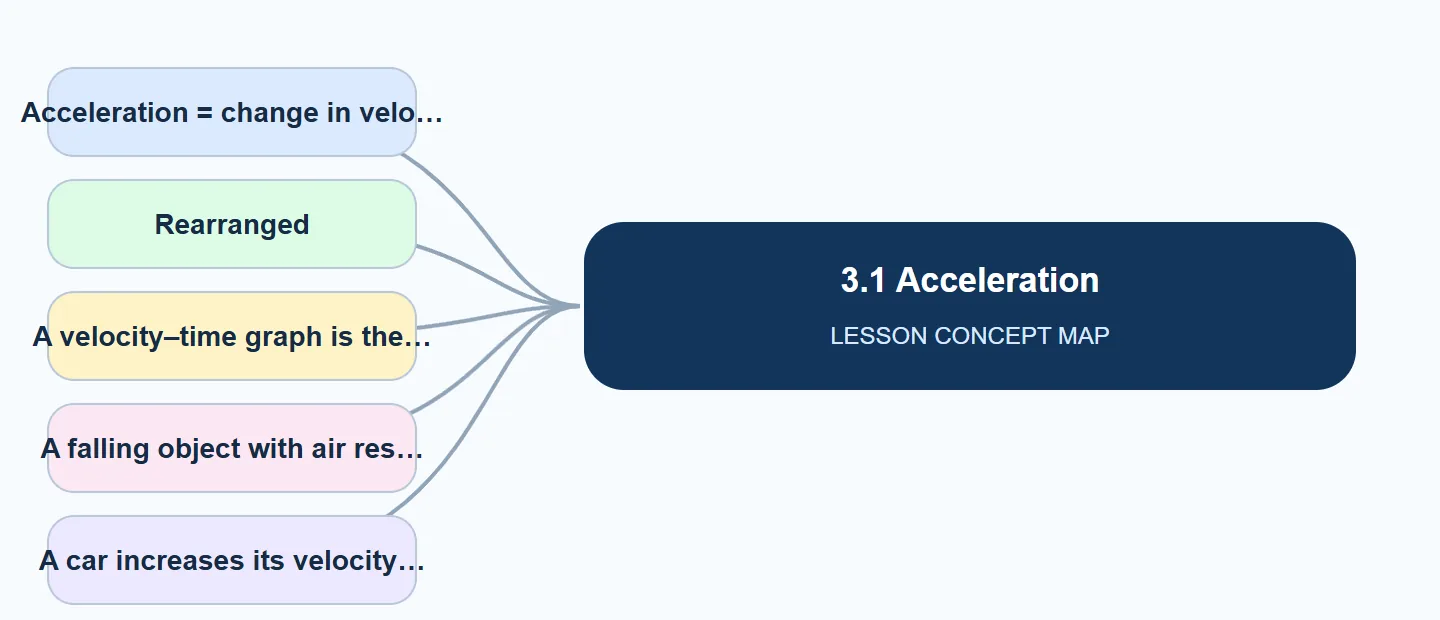
Define acceleration and calculate average acceleration.Acceleration = change in velocity ÷ time takena = Δv/Δt = (vf − vi)/Δt (m/s2).Rearrangedvf = vi + aΔt; Δt = (vf − vi)/a.Acceleration = gradient of velocity–time graph.Displacement = area under velocity–time graph (triangle = …
- A velocity–time graph is the key tool
- A falling object with air resistance
- A car increases its velocity from 8.0 m/s to 26 m/s in 6.0 s. Find its acceleration
- Instantaneous acceleration
- Constant (uniform) acceleration
- Deceleration
Section 1 of 7Acceleration
Section 2 of 7Process & sequence
Analysing a velocity–time graphwrite these steps in this order; each step is a marking point.
Section 3 of 7Compare
| v | a | Motion |
|---|---|---|
| + | + | Moving right, speeding up |
| + | − | Moving right, slowing down |
| − | − | Moving left, speeding up |
| − | + | Moving left, slowing down |
| any | 0 | Constant velocity |
| Feature | Meaning |
|---|---|
| Horizontal line | Constant velocity (a = 0) |
| Straight line sloping up | Constant positive acceleration |
| Straight line sloping down | Constant negative acceleration |
| Curve | Changing acceleration |
| Line on time axis | At rest |
| Area under graph | Displacement |
Section 4 of 7Worked examples
A car increases its velocity from 8.0 m/s to 26 m/s in 6.0 s. Find its acceleration.
- a = (vf − vi)/Δt = (26 − 8.0)/6.0 = 18/6.0 = 3.0 m/s2.
- a = (0 − 12)/4.0 = −3.0 m/s2 (deceleration 3.0 m/s2).
- Distance = area of triangle under v–t graph = ½ × 4.0 × 12 = 24 m.
- Triangle
- ½ × 40 × 20 = 400 m.
- Rectangle: 60 × 20 = 1200 m.
- Total = 1600 m (1.6 × 10³ m).
Section 5 of 7Key terms
Section 6 of 7Command terms
Section 7 of 7Exam technique
Keywords the mark scheme looks for in this lesson
How to get full marks (examiner guidance)
Words to avoid
Instant feedbackCheck yourself
Q1. The unit of acceleration is
- A. m/s
- B. m/s2
- C. m s
- D. m2/s
Show answer
B. Change in velocity (m/s) per second.
Q2. A bike goes from 2 m/s to 10 m/s in 4 s. Its acceleration is
- A. 0.5 m/s2
- B. 2 m/s2
- C. 3 m/s2
- D. 32 m/s2
Show answer
B. (10 − 2)/4 = 2 m/s2.
Q3. The gradient of a velocity–time graph represents
- A. displacement
- B. speed
- C. acceleration
- D. time
Show answer
C. Δv/Δt is acceleration.
Q4. An object with v = −5 m/s and a = −2 m/s2 is
- A. slowing down
- B. speeding up
- C. at rest
- D. moving at constant velocity
Show answer
B. v and a have the same sign, so it speeds up.
Q5. A v–t graph is a straight line from 0 to 6 m/s over 3 s. The displacement is
- A. 2 m
- B. 9 m
- C. 18 m
- D. 6 m
Show answer
B. ½ × 3 × 6 = 9 m.
Q6. A car goes round a roundabout at a steady 10 m/s. It is
Show answer
B. Changing direction changes velocity, so it accelerates.
Marked practiceQuizzes for this lesson
Last updated: