Skip to content
Dabour HubLEARN · PRACTICE · EXPLORESign inStudent

5.2Displacement and Force in Two Dimensions

Friction — American System Physics Revision Notes & Topical Questions

10 min read 7 parts Lesson 4 of 5 1 quiz

🩺
100% Curriculum Specification Match Lesson Doctor Verified
The only platform with 100% curriculum specification match and verified interactive question banks.
0%read
Lesson summary

Describe friction as a contact force opposing relative motion and explain its effects.Kinetic frictionFk = μkFN (N).Static friction0 ≤ Fs ≤ μsFN (N).On a level surface with only vertical forces weight and normal: FN = mg, so Fk = μkmg.Coefficients have no unitμ = Ff/FN (N/N).Push…

  • Pushed at constant velocity
  • Static friction is a 'responsive' force
  • Friction is essential
  • Friction is also a nuisance
  • A 10 kg box is pulled horizontally by 60 N. μk = 0.40. Find its acceleration
  • A car moving at 20 m/s skids to a stop. μk = 0.70. Find the stopping distance

Part 1 of 7Key ideas

1Kinetic friction
Fk = μkFN (N).
2Static friction
0 ≤ Fs ≤ μsFN (N).
3
On a level surface with only vertical forces weight and normal: FN = mg, so Fk = μkmg.
4Coefficients have no unit
μ = Ff/FN (N/N).
5Pushed at constant velocity
Pushed at constant velocity applied force = kinetic friction.
6
Sliding to a stop on a level surface with only friction: deceleration a = μkg (m/s2).
7
Usually μk < μs: it is easier to keep something sliding than to start it.
8
Friction is (to a good approximation) independent of contact area and of sliding speed.

Part 2 of 7Learning objectives

1
Describe friction as a contact force opposing relative motion and explain its effects.
2
Distinguish static and kinetic friction.
3
Use Ff = μFN to solve problems, including with Newton's second law.
4
Describe an experiment to measure coefficients of friction.

Part 3 of 7Essential knowledge

Essential knowledge
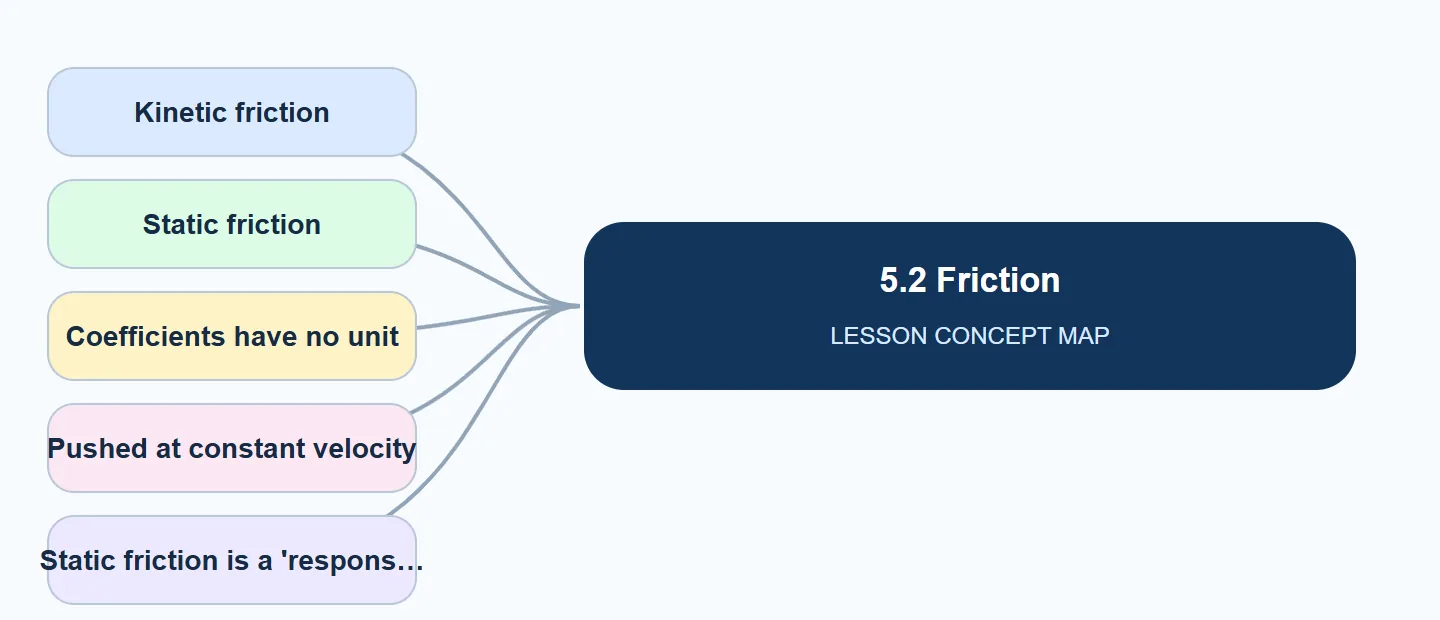
5.2 Friction concept map: Kinetic friction, Static friction, Coefficients have no unit, Pushed at constant velocity, Static friction is a &#x27;respons
Visual guide to the key ideas explained in this lesson.
Friction arises because real surfaces are rough on a microscopic scale; tiny bumps interlock and form temporary bonds. It always acts parallel to the surfaces and opposite to the relative motion or the tendency to move.
Static friction is a 'responsive' force
Static friction is a 'responsive' force if you push a heavy box gently with 50 N and it does not move, static friction is exactly 50 N. Push harder and static friction increases, until it reaches its maximum μsFN; any greater push starts the box sliding.
Once sliding, kinetic friction takes over. It is roughly constant, equal to μkFN, and usually smaller than maximum static friction, which is why a box 'jerks' into motion.
Friction depends on the normal force (how hard the surfaces are pressed together) and the nature of the surfaces (μ), but to a good approximation not on the area of contact or the sliding speed.
Friction is essential
Friction is essential it lets us walk, lets tyres grip the road, and lets brakes stop vehicles. Tread on tyres removes water to keep friction high in the wet; anti-lock brakes keep tyres rolling (static friction) rather than skidding (lower kinetic friction).
Friction is also a nuisance
Friction is also a nuisance it wastes energy by heating moving parts and causes wear. It is reduced with lubricants (oil, grease), ball bearings, smooth surfaces, or air cushions.
When a force moves an object against friction, work is done and energy is transferred from the kinetic store to the internal (thermal) store — the surfaces warm up (e.g. rubbing hands, hot brake discs).
In F = ma problems, friction is just another force on the free-body diagram: net force = applied force − friction. At constant velocity the applied force equals friction.
If a force is applied at an angle, the normal force is not equal to mg: pulling upward at an angle reduces FN (and friction); pushing downward at an angle increases it.
Drag in fluids is similar to friction but grows with speed; this is why cars have maximum speeds and falling objects reach terminal velocity.

Part 4 of 7Process & sequence

1
Place a wooden block on a level board and attach a newton meter horizontally.
2
Measure the weight of the block with the newton meter; on a level surface FN = weight.
3
Pull slowly and increase the force; record the largest reading just before the block moves (maximum static friction).
4
Pull so the block slides at constant velocity; record the steady reading (kinetic friction, since net force = 0).
5
Add masses on top to change FN and repeat for several values.
6
Plot friction against normal force: the gradients give μs and μk.

Pushing a heavy boxwrite these steps in this order; each step is a marking point.

1
Small push: static friction equals the push, no motion
2
Push increases: static friction increases
3
Push reaches μsFN: box about to slide
4
Box slides: kinetic friction μkFN acts
5
Push = kinetic friction: constant velocity
6
Push > kinetic friction: box accelerates

Part 5 of 7Worked examples

Worked examples
74 N
A 25 kg crate is pushed across a level floor at constant velocity. μk = 0.30. Find the pushing force (g = 9.8 N/kg).
  • FN = mg = 25 × 9.8 = 245 N.
    Fk = μkFN = 0.30 × 245 = 73.5 N.
    Constant velocity ⇒ push = friction = 74 N (2 s.f.).
A 10 kg box is pulled horizontally by 60 N. μk
0.40. Find its acceleration.
  • Fk = 0.40 × 10 × 9.8 = 39.2 N.
    Fnet = 60 − 39.2 = 20.8 N.
    a = 20.8/10 = 2.1 m/s2.
A car moving at 20 m/s skids to a stop. μk
0.70. Find the stopping distance.
  • a = −μkg = −0.70 × 9.8 = −6.86 m/s2.
    v2 = u2 + 2as ⇒ 0 = 400 + 2(−6.86)s.
    s = 400/13.72 = 29 m.
    What the symbols mean: v = final velocity · u = initial velocity (m s−1) · a = acceleration (m s−2) · s = displacement (m)

Part 6 of 7Summary

1
Friction opposes relative motion and acts parallel to the surfaces.
2
Static friction adjusts up to a maximum of μsFN.
3
Kinetic friction is Fk = μkFN.
4
μ has no unit and is usually smaller for sliding.
5
Friction transfers energy to the thermal store, heating the surfaces.

Part 7 of 7Compare: Compare

Static vs kinetic friction
FeatureStatic frictionKinetic friction
SurfacesNot slidingSliding
SizeVariable, 0 up to μsFNFixed: μkFN
EquationFs ≤ μsFNFk = μkFN
Typical coefficientLargerSmaller
ExampleBox that won't budge; tyres gripping roadBox sliding across floor; skidding car
Typical coefficients (approximate)
Surfacesμsμk
Rubber on dry concrete0.800.65
Wood on wood0.500.20
Steel on steel (dry)0.740.57
Steel on ice0.100.06

Values vary with surface condition; always use the data given in a question.

Key terms

Command terms

Command terms
Identify / Describe (FRQ)
A short, specific statement; describing requires relevant characteristics, not a single word.
Explain / Justify (FRQ)
Give the cause-and-effect reasoning or evidence; a restated fact does not score.
Calculate
Show setup, substitution and the answer with units.
Predict
State the expected outcome; add a reason only if asked to justify.
MCQ technique
Read every option; eliminate distractors that are true statements but do not answer the question; watch for NOT/EXCEPT.

Exam technique

Keywords the mark scheme looks for in this lesson

Keywords the mark scheme looks for in this lesson
Friction · Static friction · Kinetic friction · Coefficient of static friction · Coefficient of kinetic friction · Normal force · Limiting friction · Rolling friction · Lubricant · Resistive force · Heating by friction
Learn each definition in the Key words tab exactly; a missing keyword in a definition usually loses the mark.

How to get full marks (examiner guidance)

1
Answer exactly what is asked; extra correct material does not earn credit, and contradictory statements can cancel credit (AP FRQ).
2
Use precise vocabulary, never “it/stuff/things”.
3
Show units and working in calculations.
4
In MCQs, predict the answer before reading the options, then eliminate.

Words to avoid

1
friction always acts backwardfriction acts opposite to the relative motion (or tendency to move) of the surfaces
2
static friction is always μsFNstatic friction can be any value up to μsFN
3
friction makes heatwork done against friction transfers energy to the thermal store of the surfaces
4
μ is measured in newtonsμ is a ratio of two forces and has no unit
5
FN = mg alwaysFN = mg only on a level surface with no other vertical forces or vertical acceleration

Last updated:

\n