Skip to content
Dabour HubLEARN · PRACTICE · EXPLORESign inStudent

5.3Displacement and Force in Two Dimensions

Forces in Two Dimensions — American System Physics Revision Notes & Topical Questions

10 min read 7 parts Lesson 5 of 5 1 quiz

🩺
100% Curriculum Specification Match Lesson Doctor Verified
The only platform with 100% curriculum specification match and verified interactive question banks.
0%read
Lesson summary

Find the equilibrant of a set of forces and state the conditions for equilibrium.EquilibriumΣFx = 0 and ΣFy = 0 (N).Equilibrant = −(resultant)same size, opposite direction.Component of weight down a slopeFg∥ = mg sin θ (N).Component of weight into a slopeFg⊥ = mg cos θ (N).Fricti…

  • Frictionless slope
  • Sliding down with friction
  • Just about to slide
  • A load hung from two ropes
  • Closed vector triangle
  • Inclined plane

Section 1 of 7Forces in Two Dimensions
Essential knowledge
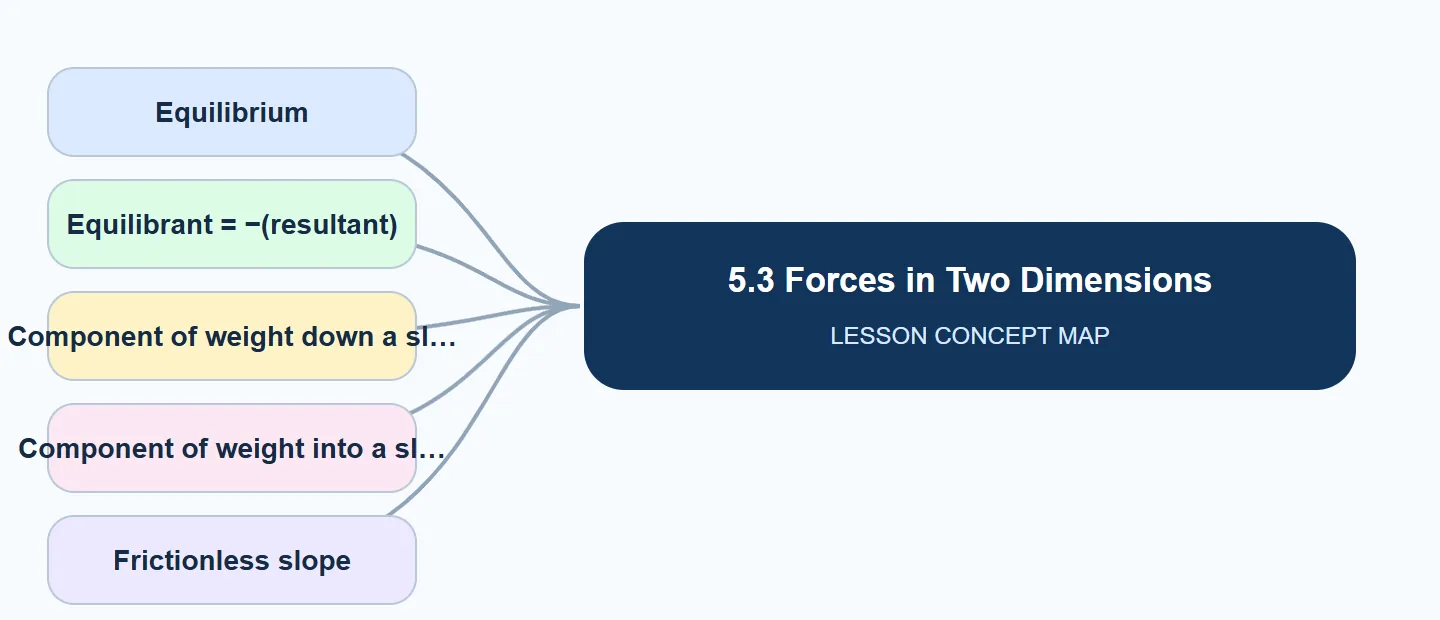
5.3 Forces in Two Dimensions concept map: Equilibrium, Equilibrant = −(resultant), Component of weight down a sl, Component of weight into a sl, Frictionless slope
Visual guide to the key ideas explained in this lesson.
When forces act in two dimensions, resolve them into perpendicular components and apply Newton's laws separately along each axis: ΣFx = max and ΣFy = may.
An object is in equilibrium when the resultant force is zero. For three forces in equilibrium, drawing them tip-to-tail gives a closed triangle; a scale drawing of this triangle can find an unknown force.
The equilibrant is the force needed to balance all other forces: find their resultant, then reverse its direction.
On an inclined plane, the weight still acts vertically downward, but it is useful to split it into mg sin θ down the slope and mg cos θ into the slope. Check: at θ = 0 there is no down-slope component; at 90° the whole weight acts along the 'slope'.
The normal force on an incline balances the perpendicular component of weight, so FN = mg cos θ — smaller than mg. Friction on a slope is therefore μmg cos θ.
If friction is negligible, the only force along the slope is mg sin θ, giving a = g sin θ, independent of mass.
A block rests on a slope when static friction balances mg sin θ. As θ increases, mg sin θ increases and FN decreases, so eventually the block slides; the critical angle satisfies tan θ = μs.
For an object moving up a slope, friction and mg sin θ both act down the slope; moving down, friction acts up the slope.
A load hung from two ropes
A load hung from two ropes the vertical components of the tensions add to the weight. The more nearly horizontal the ropes, the larger the tension needed — a washing line can never be pulled perfectly straight.
Applying a force at an angle θ above the horizontal gives a useful forward component F cos θ and an upward component F sin θ that reduces the normal force.

Section 2 of 7Process & sequence

1
Draw a free-body diagram showing weight, normal force, friction and any applied force.
2
Choose axes: for slopes take x along the slope and y perpendicular to it.
3
Resolve every force not on an axis into components (weight → mg sin θ and mg cos θ).
4
Apply ΣFy = 0 (no acceleration perpendicular) to find the normal force.
5
Use Ff = μFN and apply ΣFx = ma (or = 0 for equilibrium).
6
Solve for the unknown and check the direction and units.

Solving an inclined-plane problemwrite these steps in this order; each step is a marking point.

1
Draw weight, normal force and friction
2
Tilt axes along and perpendicular to slope
3
Resolve weight: mg sin θ and mg cos θ
4
Perpendicular: FN = mg cos θ
5
Parallel: mg sin θ − Ff = ma
6
Solve for a or the unknown force

Section 3 of 7Compare

Forces on a block on a slope (angle θ)
ForceParallel to slopePerpendicular to slope
Weight mgmg sin θ (down the slope)mg cos θ (into the slope)
Normal force0FN (out of slope)
FrictionOpposes sliding, up to μFN0
Result (no other forces)Fnet = mg sin θ − FfFN = mg cos θ
Checking extremes
θsin θcos θMeaning
0° (flat)01No force down the slope; FN = mg
30°0.500.87Half the weight acts down slope
90° (vertical)10Free fall; no normal force

Section 4 of 7Worked examples

42 N
A 5.0 kg block slides down a frictionless 30° slope. Find the acceleration and the normal force (g = 9.8 m/s2).
  • a = g sin θ = 9.8 × sin 30° = 4.9 m/s2 down the slope.
    FN = mg cos θ = 5.0 × 9.8 × 0.866 = 42 N.
The same block on a 30° slope with μk = 0.20. Find its acceleration down the slope.
  • Down slope: mg sin θ = 24.5 N.
    • Friction = 0.20 × 42.4 = 8.49 N up slope.
      Fnet = 24.5 − 8.49 = 16.0 N.
      a = 16.0/5.0 = 3.2 m/s2.
12 N
A 20 N sign hangs from two cables, each at 30° to the vertical. Find the tension in each cable.
  • Vertical2T cos 30° = 20 N.
    T = 20/(2 × 0.866) = 12 N (11.5 N).

Section 5 of 7Key terms

Section 6 of 7Command terms

Command terms
Identify / Describe (FRQ)
A short, specific statement; describing requires relevant characteristics, not a single word.
Explain / Justify (FRQ)
Give the cause-and-effect reasoning or evidence; a restated fact does not score.
Calculate
Show setup, substitution and the answer with units.
Predict
State the expected outcome; add a reason only if asked to justify.
MCQ technique
Read every option; eliminate distractors that are true statements but do not answer the question; watch for NOT/EXCEPT.

Section 7 of 7Exam technique

Keywords the mark scheme looks for in this lesson

Keywords the mark scheme looks for in this lesson
Equilibrium · Equilibrant · Closed vector triangle · Inclined plane · Parallel component of weight · Perpendicular component of weight · Normal force on an incline · Tilted coordinate system · Resultant force · Angle of repose · Components of a force
Learn each definition in the Key words tab exactly; a missing keyword in a definition usually loses the mark.

How to get full marks (examiner guidance)

1
Answer exactly what is asked; extra correct material does not earn credit, and contradictory statements can cancel credit (AP FRQ).
2
Use precise vocabulary, never “it/stuff/things”.
3
Show units and working in calculations.
4
In MCQs, predict the answer before reading the options, then eliminate.

Words to avoid

1
the normal force on a slope equals mgon a slope FN = mg cos θ
2
weight acts perpendicular to the slopeweight acts vertically downward; its component mg cos θ is perpendicular to the slope
3
the equilibrant is the resultantthe equilibrant is equal in size but opposite in direction to the resultant
4
in equilibrium there are no forcesin equilibrium the resultant force is zero
5
the down-slope force is mg cos θthe down-slope component of weight is mg sin θ

Last updated: