Skip to content
Dabour HubLEARN · PRACTICE · EXPLORESign inStudent

8.2Rotational Motion

Rotational Dynamics: Torque and Moment of Inertia — American System Physics Revision Notes & Topical Questions

10 min read 7 parts Lesson 4 of 5 1 quiz

🩺
100% Curriculum Specification Match Lesson Doctor Verified
The only platform with 100% curriculum specification match and verified interactive question banks.
0%read
Lesson summary

Define torque and calculate it for forces at any angle.Torque = force × lever armτ = Fr sin θ (τ in N·m, F in N, r in m).For a force at 90° to the leverτ = Fr, i.e.

  • Principle of moments (equilibrium)
  • Torques are given signs
  • Newton's second law for rotation
  • A 25 N force is applied to a 0.30 m wrench at 60° to the handle. Find the torque
  • Torque (τ) / moment of a force
  • Lever arm (moment arm)

Part 1 of 7Key ideas

1Torque
Torque force × lever arm
τ = Fr sin θ (τ in N·m, F in N, r in m).
2For a force at 90° to the lever
τ = Fr, i.e. moment = force × perpendicular distance from the pivot.
3
Moment of inertia of a point mass = mass × (distance from axis)2: I = mr2 (kg·m2).
4
Net torque = moment of inertia × angular acceleration: τnet = Iα.
5
Angular acceleration = net torque ÷ moment of inertia: α = τnet/I (rad/s2).
6Principle of moments (equilibrium)
Σ clockwise moments = Σ counterclockwise moments.
7
Rotational kinetic energy = ½ × moment of inertia × (angular velocity)2: KE = ½Iω2 (J).
8
A force whose line of action passes through the pivot produces zero torque.

Part 2 of 7Learning objectives

1
Define torque and calculate it for forces at any angle.
2
Describe how moment of inertia depends on mass and its distribution.
3
Apply Newton's second law for rotation, α = τnet/I.
4
Use the principle of moments to solve balance problems.

Part 3 of 7Essential knowledge

Essential knowledge
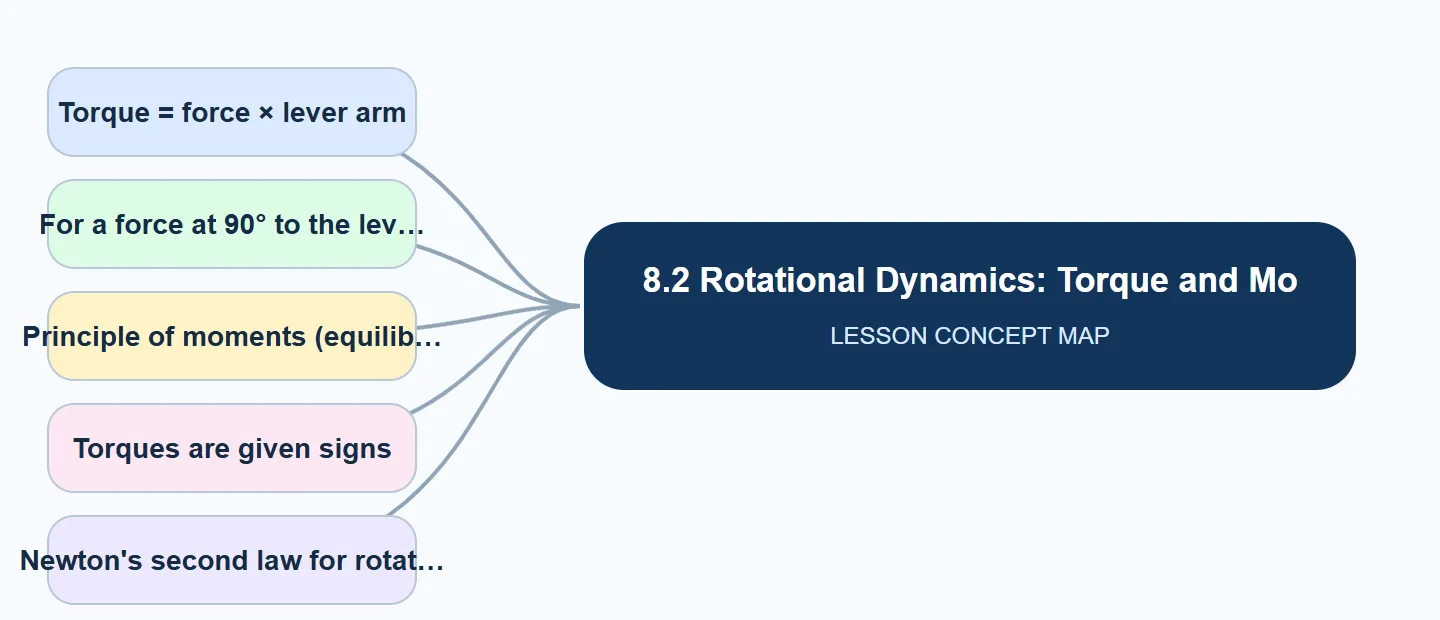
8.2 Rotational Dynamics: Torque and Momen… concept map: Torque = force × lever arm, For a force at 90° to the lev, Principle of moments (equilib, Torques are given signs, Newton's second law for rotat
Visual guide to the key ideas explained in this lesson.
The turning effect of a force depends on its size, its distance from the pivot and its direction. A door is easiest to open by pushing at the handle, far from the hinges, at right angles to the door.
Torque τ = Fr sin θ; r sin θ is the lever arm (the perpendicular distance from pivot to line of action). Pushing along the door towards the hinge (θ = 0) produces no turning.
Torques are given signs
Torques are given signs counterclockwise positive, clockwise negative. The net torque decides whether rotation speeds up, slows down or stays steady.
Moment of inertia plays the role that mass plays in linear motion. It is larger when mass is farther from the axis: a hoop has I = mr2, a solid disc of the same mass and radius has only ½mr2.
The same object can have different I about different axes, e.g. a rod is harder to spin about its end ((1/3)ml2) than about its centre ((1/12)ml2).
Newton's second law for rotation
α = τnet/I. Doubling the net torque doubles α; doubling I halves α.
Tightrope walkers carry long poles to increase their moment of inertia, so a small unbalanced torque gives only a small angular acceleration, giving them time to correct.
In a balance (seesaw) problem take moments about the pivot: for balance the total clockwise moment equals the total counterclockwise moment (principle of moments).
A couple (two equal, opposite, parallel forces not in line, like hands on a steering wheel) gives a torque but no resultant force, so it causes rotation without linear acceleration. Torque of a couple = one force × perpendicular distance between the lines.
Rolling objects share their kinetic energy between translation and rotation; objects with smaller I/(mr2) (e.g. a solid sphere) roll down a slope faster than hoops.

Part 4 of 7Process & sequence

1
Choose the axis (pivot) and label all forces on the object.
2
For each force, find the perpendicular distance from the axis to its line of action (r sin θ).
3
Calculate each torque τ = Fr sin θ and give it a sign (counterclockwise +, clockwise −).
4
Add the torques to find the net torque.
5
Find the moment of inertia I (from a table or I = Σmr2).
6
Use α = τnet/I to find the angular acceleration, with units rad/s2.

Solving a seesaw (moments) problemwrite these steps in this order; each step is a marking point.

1
Mark the pivot and every force with its distance from the pivot.
2
Classify each moment as clockwise or counterclockwise.
3
Calculate each moment = force × perpendicular distance.
4
Set total clockwise moment = total counterclockwise moment.
5
Solve for the unknown force or distance and add units.

Part 5 of 7Worked examples

6.5 N·m

A 25 N force is applied to a 0.30 m wrench at 60° to the handle. Find the torque.

  • τ = Fr sin θ = 25 × 0.30 × sin 60° = 25 × 0.30 × 0.866 = 6.5 N·m.
A solid disc of mass 2.0 kg and radius 0.20 m is acted on by a net torque of 0.80 N·m. Find its angular acceleration.
  • I = ½mr2 = ½ × 2.0 × 0.202 = 0.040 kg·m2
    α = τ/I = 0.80/0.040 = 20 rad/s2.
1.0 m
A 300 N child sits 1.5 m from a seesaw pivot. Where must a 450 N adult sit on the other side to balance?
  • Principle of moments300 × 1.5 = 450 × d → d = 450/450 = 1.0 m from the pivot.

Part 6 of 7Summary

1
Torque is the turning effect of a force: τ = Fr sin θ.
2
Only the perpendicular distance to the line of action counts.
3
Moment of inertia is rotational inertia; it depends on mass distribution.
4
Newton's second law for rotation: α = τnet/I.
5
In balance, clockwise moments = counterclockwise moments.

Part 7 of 7Compare: Compare

Moments of inertia of common shapes (mass m, radius r, length l)
ObjectAxisI
Point mass / thin hoopThrough centre (hoop) or at distance rmr2
Solid cylinder or discThrough centre½mr2
Solid sphereThrough centre(2/5)mr2
Thin rodThrough centre, perpendicular(1/12)ml2
Thin rodThrough one end, perpendicular(1/3)ml2

The farther the mass from the axis, the larger I.

How to increase torque
MethodWhy it works
Push harder (larger F)τ ∝ F
Push farther from pivot (larger r)τ ∝ r
Push at 90° to the leversin θ is maximum (=1)

Key terms

Command terms

Command terms
Identify / Describe (FRQ)
A short, specific statement; describing requires relevant characteristics, not a single word.
Explain / Justify (FRQ)
Give the cause-and-effect reasoning or evidence; a restated fact does not score.
Calculate
Show setup, substitution and the answer with units.
Predict
State the expected outcome; add a reason only if asked to justify.
MCQ technique
Read every option; eliminate distractors that are true statements but do not answer the question; watch for NOT/EXCEPT.

Exam technique

Keywords the mark scheme looks for in this lesson

Keywords the mark scheme looks for in this lesson
Torque (τ) / moment of a force · Lever arm (moment arm) · Pivot (fulcrum) · Line of action · Net torque · Moment of inertia (I) · Newton's second law for rotation · Principle of moments · Couple · Angle θ (in τ = Fr sin θ) · Rotational kinetic energy
Learn each definition in the Key words tab exactly; a missing keyword in a definition usually loses the mark.

How to get full marks (examiner guidance)

1
Answer exactly what is asked; extra correct material does not earn credit, and contradictory statements can cancel credit (AP FRQ).
2
Use precise vocabulary, never “it/stuff/things”.
3
Show units and working in calculations.
4
In MCQs, predict the answer before reading the options, then eliminate.

Words to avoid

1
torque = force × distancetorque = force × perpendicular distance from the pivot to the line of action
2
moment of inertia is the same as massmoment of inertia depends on mass and on how far the mass is from the axis
3
the unit of torque is Jthe unit of torque is N·m (not the joule, which is for energy)
4
the object is balanced because the forces are equalit is in rotational equilibrium because clockwise moments equal counterclockwise moments about the pivot
5
a force through the pivot makes it turna force whose line of action passes through the pivot has zero moment

Last updated: