8.3Rotational Motion
Equilibrium and Centre of Mass — American System Physics Revision Notes & Topical Questions
10 min read 7 parts Lesson 5 of 5 1 quiz
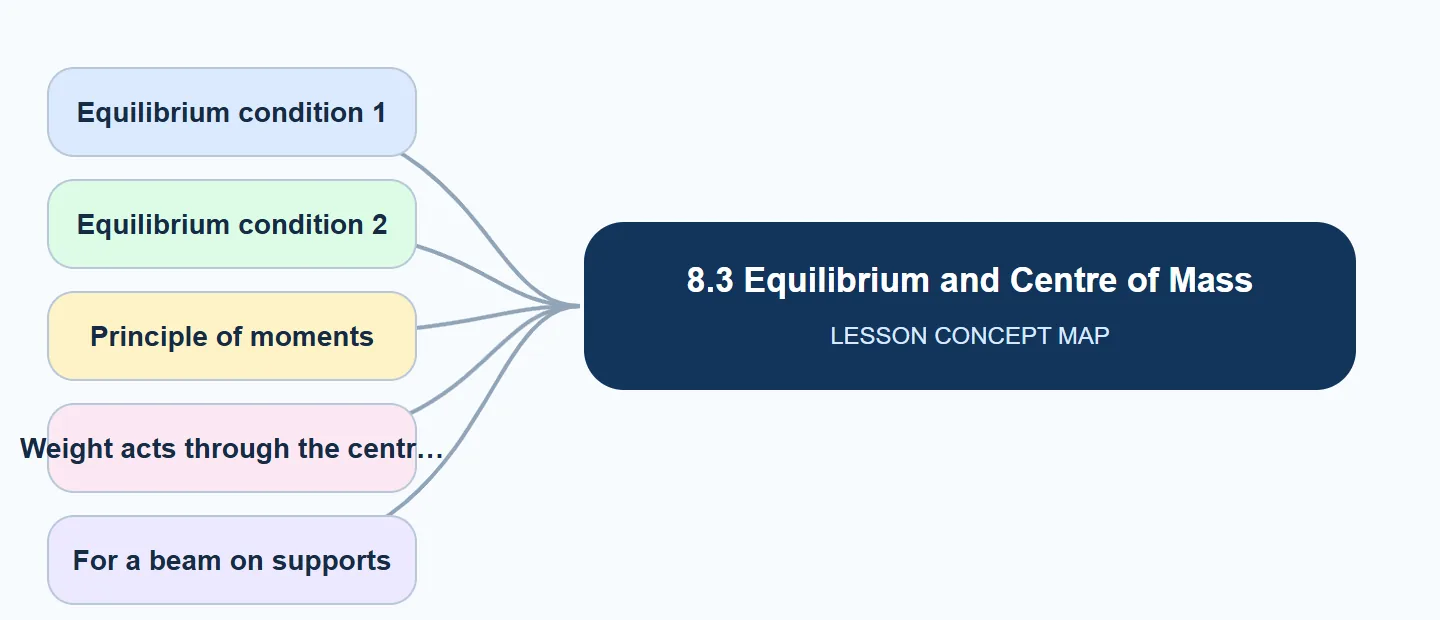
Describe how to find the centre of mass of a flat irregular object experimentally.Equilibrium condition 1resultant force = 0: ΣF = 0 (N).Equilibrium condition 2resultant torque about any axis = 0: Στ = 0 (N·m).Principle of momentssum of clockwise moments = sum of anticlockwise mo…
- Weight acts through the centre of mass
- For a beam on supports
- Centre of gravity
- Translational equilibrium
- Rotational equilibrium
- Static equilibrium
Section 1 of 7Equilibrium and Centre of Mass
Section 2 of 7Process & sequence
Why a tilted object toppleswrite these steps in this order; each step is a marking point.
Section 3 of 7Compare
| Type | Small push makes the centre of mass... | Result | Example |
|---|---|---|---|
| Stable | rise | Returns to original position | Cone on its base; pendulum at rest |
| Unstable | fall | Topples further | Cone balanced on its tip |
| Neutral | stay at same height | Stays in new position | Ball on flat floor; cone on its side |
| Condition | Equation | Meaning |
|---|---|---|
| First condition | ΣF = 0 | No linear acceleration |
| Second condition | Στ = 0 about ANY point | No angular acceleration |
Both must hold for full equilibrium.
Section 4 of 7Worked examples
- Moments about left support (clockwise = counterclockwise):
600 × 1.0 + 200 × 2.0 = FR × 4.0 → 1000 = 4.0FR → FR = 250 N
ΣF = 0: FL + 250 = 800 → FL = 550 N.
- Distance of 3.0 N from pivot = 30 cm.
- Moment = 3.0 × 0.30 = 0.90 N·m.
2.0 × d = 0.90 → d = 0.45 m, so hang it at the 95 cm mark.
- Moment = 3.0 × 0.30 = 0.90 N·m.
Section 5 of 7Key terms
Section 6 of 7Command terms
Section 7 of 7Exam technique
Keywords the mark scheme looks for in this lesson
How to get full marks (examiner guidance)
Words to avoid
Instant feedbackCheck yourself
Q1. For an object to be in equilibrium:
Show answer
C. Both conditions are needed; it can move at constant velocity.
Q2. Which change makes a lamp more stable?
Show answer
C. Lowers the centre of mass.
Q3. The centre of mass of a lamina hung from a pin lies:
Show answer
B. The weight's line of action passes through the pivot when at rest.
Q4. A cone balanced on its tip is in:
Show answer
C. A small push lowers its centre of mass and it falls.
Q5. A uniform 2.0 m beam weighs 100 N. Its weight acts at:
- A. 0.5 m from one end
- B. 1.0 m from either end
- C. the end
- D. anywhere
Show answer
B. Midpoint for a uniform beam.
Q6. The outward push felt by passengers as a car turns is best explained by:
- A. a real outward force
- B. inertia – they tend to keep moving in a straight line
- C. air resistance
- D. gravity
Show answer
B. It is an apparent force in the rotating frame.
Marked practiceQuizzes for this lesson
Last updated:
Kc
- : Kc! (ΔH < 0) Kc. (ΔH > 0) Kc.
- : ( ).
- : Kc .