9.1Momentum and Its Conservation
Impulse and Momentum — American System Physics Revision Notes & Topical Questions
10 min read 7 parts Lesson 3 of 5 1 quiz
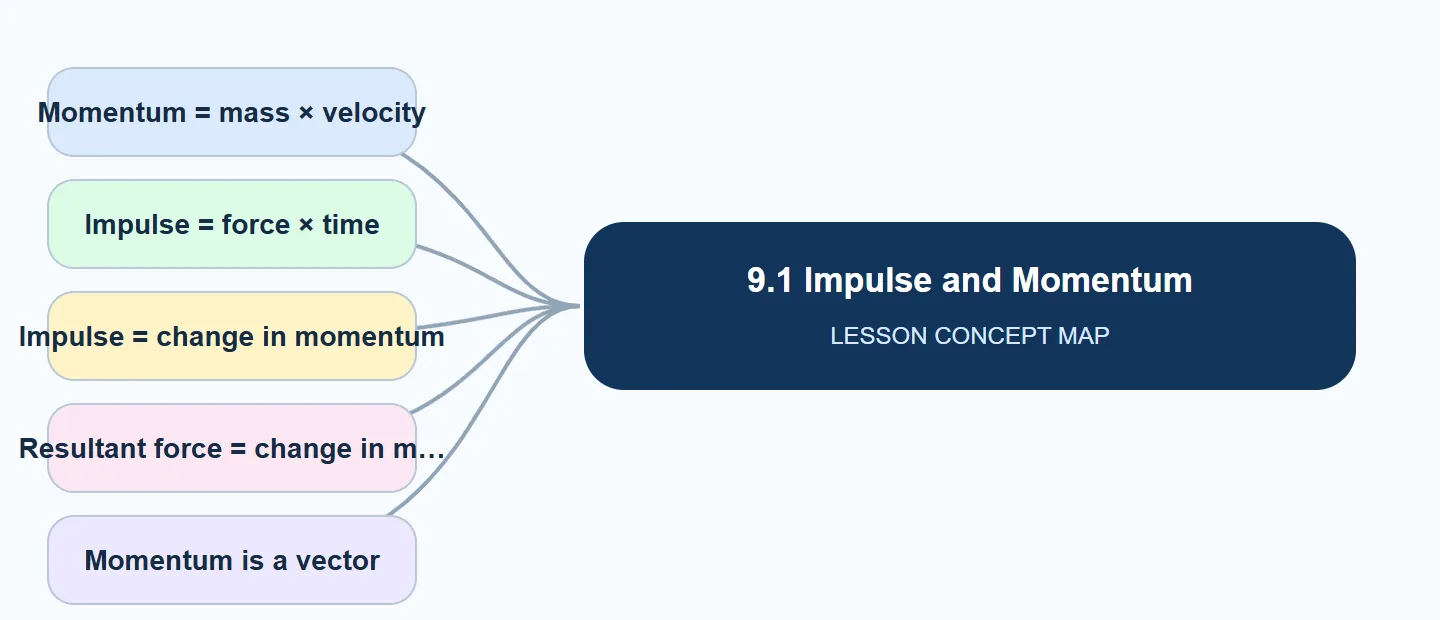
Define momentum and impulse and state their units.Momentum = mass × velocityp = mv (kg·m/s).Impulse = force × timeFΔt (N·s).Impulse = change in momentumFΔt = Δp = mvf − mvi.Resultant force = change in momentum ÷ time takenF = Δp/Δt (N).1 N·s = 1 kg·m/s.Area under a force–time gra…
- Momentum is a vector
- Newton's second law can be written F = Δp/Δt
- Rearranging gives FΔt = Δp
- Momentum and kinetic energy are different
- Momentum (p)
- Impulse–momentum theorem
Section 1 of 7Impulse and Momentum
Section 2 of 7Process & sequence
How an airbag reduces injurywrite these steps in this order; each step is a marking point.
Section 3 of 7Compare
| Feature | What it changes | Effect on force |
|---|---|---|
| Airbag | Increases stopping time of head | Smaller average force |
| Seat belt (stretches slightly) | Increases stopping time; spreads force | Smaller force and pressure |
| Crumple zone | Increases collision time | Smaller force on occupants |
| Bending knees on landing | Increases time to stop | Smaller force on legs |
| Helmet foam | Increases time head takes to stop | Smaller force on skull |
In each case Δp is fixed by the situation; only Δt can be changed.
| Property | Momentum | Kinetic energy |
|---|---|---|
| Formula | p = mv | KE = ½mv2 |
| Unit | kg·m/s | J |
| Scalar/vector | Vector | Scalar |
| Conserved in all collisions (closed, isolated)? | Yes | Only in elastic collisions |
Section 4 of 7Worked examples
- Take the ball's initial direction as +.
Δp = m(vf − vi) = 0.15 × (0 − 20) = −3.0 N·s (3.0 N·s opposite to the motion)
F = Δp/Δt = −3.0/0.050 = −60 N, i.e. 60 N opposite to the ball's motion.
- Take the leaving direction as +vi = −25 m/s, vf = +30 m/s.
Δp = 0.060 × (30 − (−25)) = 0.060 × 55 = 3.3 N·s
F = 3.3/0.0040 = 825 N ≈ 830 N in the direction the ball leaves.
- Δp = 1200 × (25 − 10) = 1.8 × 10⁴ N·s
F = 1.8 × 10⁴/6.0 = 3.0 × 10³ N forwards.
Section 5 of 7Key terms
Section 6 of 7Command terms
Section 7 of 7Exam technique
Keywords the mark scheme looks for in this lesson
How to get full marks (examiner guidance)
Words to avoid
Instant feedbackCheck yourself
Q1. The unit of momentum is:
- A. N
- B. kg·m/s
- C. kg·m/s2
- D. J
Show answer
B. p = mv: kg × m/s.
Q2. Impulse is equal to:
Show answer
B. FΔt = Δp.
Q3. The area under a force–time graph gives:
- A. work done
- B. power
- C. impulse
- D. acceleration
Show answer
C. Area = F × t = impulse.
Q4. A crumple zone reduces the force on passengers by:
Show answer
B. Same Δp over a longer Δt gives smaller F.
Q5. A 2.0 kg ball at 3.0 m/s hits a wall and rebounds at 3.0 m/s. The magnitude of its change in momentum is:
- A. 0
- B. 6.0 kg·m/s
- C. 12 kg·m/s
- D. 3.0 kg·m/s
Show answer
C. Δp = 2.0 × (3.0 − (−3.0)) = 12 kg·m/s.
Q6. A net force of 50 N acts for 0.20 s. The change in momentum is:
- A. 10 N·s
- B. 250 N·s
- C. 0.004 N·s
- D. 50 N·s
Show answer
A. FΔt = 50 × 0.20 = 10 N·s.
Marked practiceQuizzes for this lesson
Last updated: