9.1Momentum and Its Conservation
Impulse and Momentum — American System Physics Revision Notes & Topical Questions
10 min read 7 parts Lesson 3 of 5 1 quiz
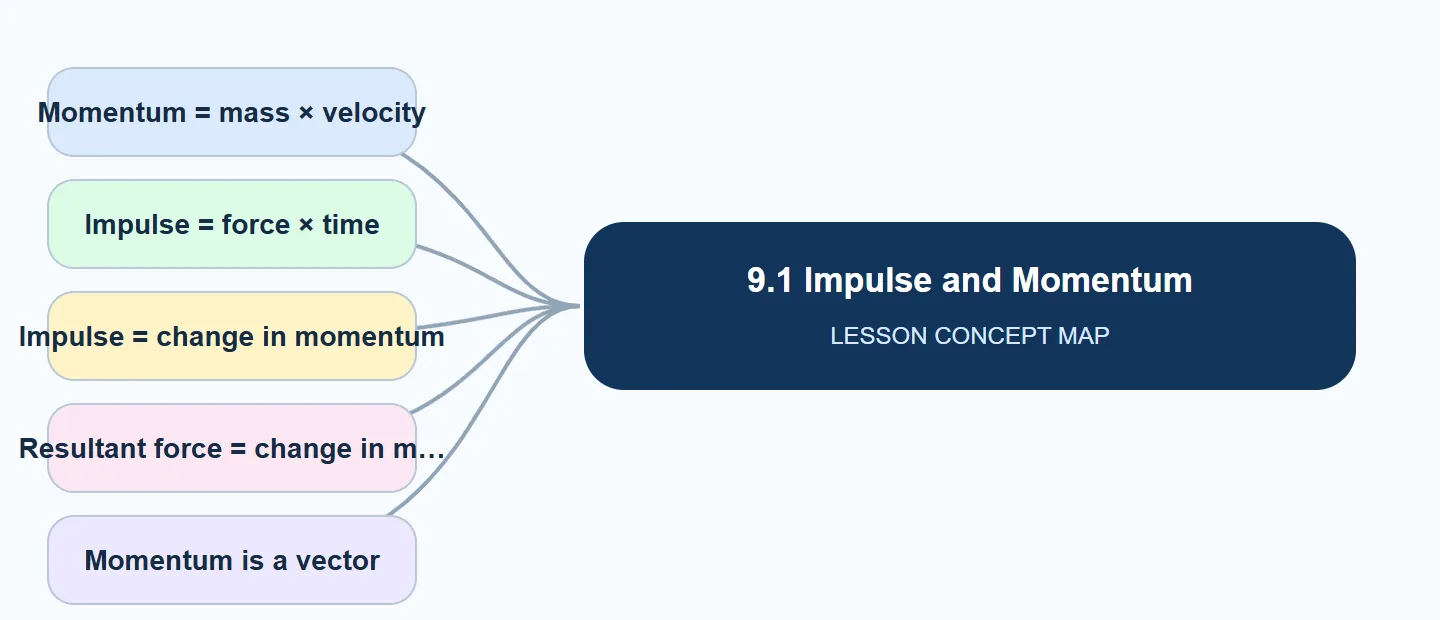
Define momentum and impulse and state their units.Momentum = mass × velocityp = mv (kg·m/s).Impulse = force × timeFΔt (N·s).Impulse = change in momentumFΔt = Δp = mvf − mvi.Resultant force = change in momentum ÷ time takenF = Δp/Δt (N).1 N·s = 1 kg·m/s.Area under a force–time gra…
- Momentum is a vector
- Newton's second law can be written F = Δp/Δt
- Rearranging gives FΔt = Δp
- Momentum and kinetic energy are different
- Momentum (p)
- Impulse–momentum theorem
Part 1 of 7Key ideas
Part 2 of 7Learning objectives
Part 3 of 7Essential knowledge
Part 4 of 7Process & sequence
How an airbag reduces injurywrite these steps in this order; each step is a marking point.
Part 5 of 7Worked examples
- Take the ball's initial direction as +.
Δp = m(vf − vi) = 0.15 × (0 − 20) = −3.0 N·s (3.0 N·s opposite to the motion)
F = Δp/Δt = −3.0/0.050 = −60 N, i.e. 60 N opposite to the ball's motion.
- Take the leaving direction as +vi = −25 m/s, vf = +30 m/s.
Δp = 0.060 × (30 − (−25)) = 0.060 × 55 = 3.3 N·s
F = 3.3/0.0040 = 825 N ≈ 830 N in the direction the ball leaves.
- Δp = 1200 × (25 − 10) = 1.8 × 10⁴ N·s
F = 1.8 × 10⁴/6.0 = 3.0 × 10³ N forwards.
Part 6 of 7Summary
Part 7 of 7Compare: Compare
| Feature | What it changes | Effect on force |
|---|---|---|
| Airbag | Increases stopping time of head | Smaller average force |
| Seat belt (stretches slightly) | Increases stopping time; spreads force | Smaller force and pressure |
| Crumple zone | Increases collision time | Smaller force on occupants |
| Bending knees on landing | Increases time to stop | Smaller force on legs |
| Helmet foam | Increases time head takes to stop | Smaller force on skull |
In each case Δp is fixed by the situation; only Δt can be changed.
| Property | Momentum | Kinetic energy |
|---|---|---|
| Formula | p = mv | KE = ½mv2 |
| Unit | kg·m/s | J |
| Scalar/vector | Vector | Scalar |
| Conserved in all collisions (closed, isolated)? | Yes | Only in elastic collisions |
Key terms
Command terms
Exam technique
Keywords the mark scheme looks for in this lesson
How to get full marks (examiner guidance)
Words to avoid
Instant feedbackCheck yourself
Q1. The unit of momentum is:
- A. N
- B. kg·m/s
- C. kg·m/s2
- D. J
Show answer
B. p = mv: kg × m/s.
Q2. Impulse is equal to:
Show answer
B. FΔt = Δp.
Q3. The area under a force–time graph gives:
- A. work done
- B. power
- C. impulse
- D. acceleration
Show answer
C. Area = F × t = impulse.
Q4. A crumple zone reduces the force on passengers by:
Show answer
B. Same Δp over a longer Δt gives smaller F.
Q5. A 2.0 kg ball at 3.0 m/s hits a wall and rebounds at 3.0 m/s. The magnitude of its change in momentum is:
- A. 0
- B. 6.0 kg·m/s
- C. 12 kg·m/s
- D. 3.0 kg·m/s
Show answer
C. Δp = 2.0 × (3.0 − (−3.0)) = 12 kg·m/s.
Q6. A net force of 50 N acts for 0.20 s. The change in momentum is:
- A. 10 N·s
- B. 250 N·s
- C. 0.004 N·s
- D. 50 N·s
Show answer
A. FΔt = 50 × 0.20 = 10 N·s.
Marked practiceQuizzes for this lesson
Last updated: